
Knowing how to find cheap flights to London genuinely makes a difference to the price you pay. The same route on the same airline can vary by hundreds of dollars depending on when you search, when you book, which airport you fly into and how you structure the itinerary. There is no magic single trick that always works. But there are nine things that experienced London travellers do consistently – and each one can save money independently. Combined, they can cut a significant amount off your total flight cost.

London is one of the most connected cities in the world. It has six airports, dozens of airlines flying from over 25 US cities and hundreds of routes from European, Middle Eastern and Asian hubs. That competition is your friend – it means there are usually multiple options to reach the city, and the price difference between the obvious route and a slightly less obvious one can be substantial.
These nine tricks are drawn from data across Skyscanner, Google Flights, Hopper and the Going flight deals service. They are not theories – they are patterns in how London flight prices actually behave, and they are all actionable today.
Cheap Flights to London – Key Facts at a Glance
Cheapest Round-Trip Seen In 2025: $243 from Washington DC (Skyscanner data)
Cheapest Months: January ($380) and February (~$395) from New York
Most Expensive Months: July ($695) and August (~$678) – peak summer demand
Best Booking Window: 2–6 months ahead for transatlantic flights (Goldilocks Window)
Best Days To Fly: Tuesday, Wednesday, Saturday – cheapest departure days
Best Day To Book: Sunday – Expedia data shows 8% average saving vs Friday booking
London Airports: Six options – LHR, LGW, STN, LTN, LCY, SEN – each with different prices
Tip That Surprises Most People: Stansted and Luton fares often beat Heathrow by $80–$150
When to Book and When to Fly – The Data Behind the Timing
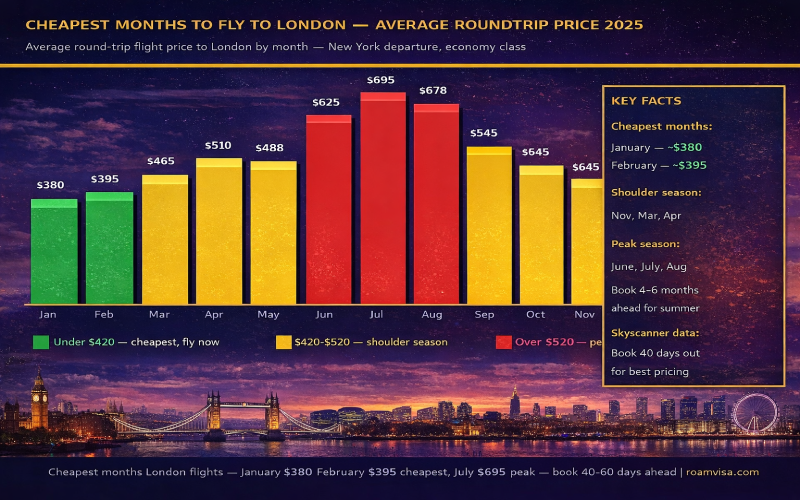
Flight pricing for London is more predictable than most travellers realise. There is a clear seasonal pattern that repeats every year, and understanding it allows you to either plan around it or work with it strategically.
The Cheapest and Most Expensive Months to Fly to London
January and February are the cheapest months to fly to London from almost any origin city. The combination of post-Christmas demand drop, cold weather deterring leisure travellers and school terms resuming creates a pricing valley that is consistently the lowest of the year. From New York, January round-trip fares regularly sit at $350–$420. From other US cities, proportionally similar savings apply.
The most expensive months are July and August, followed closely by Christmas week and the school spring break period in late March to mid-April. If your dates are fixed in these periods, the tricks in this guide still help – but the absolute price ceiling is higher and harder to get below.
The shoulder seasons – March through early May, and September through November – are the sweet spot for travellers who want decent weather alongside cheaper fares. September and October in particular are excellent: post-summer crowds have gone, the city is in full operation and flight prices are noticeably below peak. Going.com data shows their members find the most deals with travel dates in February, with July having the fewest deals available.
The Goldilocks Booking Window – Not Too Early, Not Too Late
For transatlantic flights to London, the best booking window – what Going calls the Goldilocks Window – is approximately two to six months before departure. Skyscanner’s data suggests the cheapest prices are found around 40 days before departure for Heathrow specifically. Cheapflights recommends at least 82 days ahead. The consensus from all the major flight search engines is: book somewhere between six weeks and six months out. Earlier than six months and prices have not yet reached their floor. Later than three weeks and they begin climbing rapidly as seats fill.
The week before departure is consistently the most expensive time to buy a transatlantic fare to London. The occasional genuine last-minute deal exists – and fare alert apps like Hopper and Going can capture them – but waiting for one as a strategy is unreliable. If you know you are going to London, book inside the Goldilocks Window.
The 9 Tricks – How Each One Actually Works
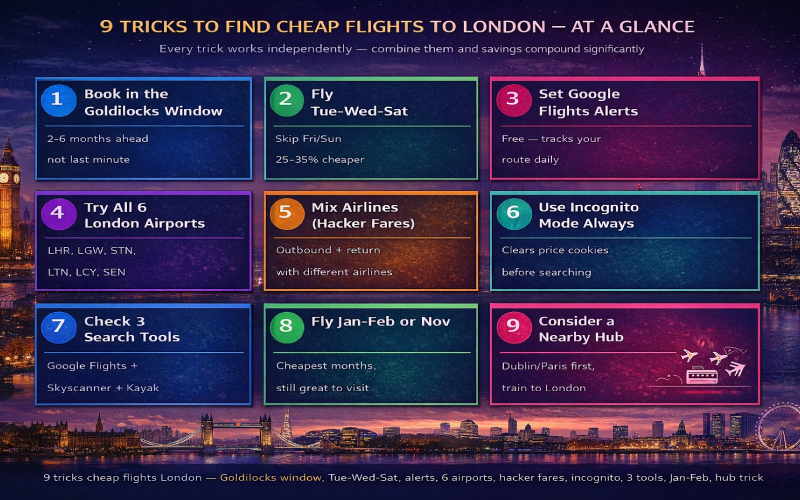
Trick 1 – Book in the Goldilocks Window (2–6 Months Out)
This is the single most impactful thing on this list. Transatlantic flight prices to London follow a predictable curve: they start relatively high when seats go on sale, drop gradually as the airline tries to fill the plane, then rise steeply in the final three to four weeks when remaining seats become scarce and last-minute travellers are willing to pay more.
The sweet spot is two to six months ahead. You have enough time for prices to have settled from their initial release, enough time for airlines to have run promotions or seat sales and enough seats still available that competition between routes keeps prices competitive. For summer travel to London, this means booking in January through March. For Christmas trips, book in June or July.
How to Use This
- Set a calendar reminder for two months before your intended travel date – this is when you should start actively searching.
- Use Google Flights’ price tracking feature to see the price graph for your route. It shows whether the current price is typical, higher or lower than usual.
- Do not wait for a deal that does not materialise. If you are inside the window and the price looks reasonable against the historical average, book it.
Trick 2 – Fly on Tuesday, Wednesday or Saturday
Friday and Sunday are consistently the most expensive days to depart for London from most US cities. Business travellers fly Monday and Thursday. Leisure travellers cluster on Friday and Sunday for weekend trips. Tuesday, Wednesday and Saturday are the lightest demand days and prices reflect this. Hopper data shows Tuesday is the cheapest day to fly to London, with savings of up to $26 per ticket compared to Friday – not dramatic on a single booking, but meaningful when multiplied across a family.
The Day to Book – Not Just the Day to Fly
Expedia’s analysis shows that booking on Sunday saves an average of 8% compared to booking on Friday. This is separate from the day-of-travel effect – you can save money both by choosing a cheaper departure day and by booking on a cheaper day of the week. Combined, these two adjustments can shave $30–$60 off a transatlantic round-trip.
Trick 3 – Set Google Flights Price Alerts
Google Flights has a free price alert feature that monitors your specific route and sends an email when the price drops. You set up the route, your approximate travel dates and your current benchmark price – Google watches it for you. There is no charge, no sign-up required beyond a Google account and it works reliably.
The key to using price alerts effectively is to set them early – ideally when you are still outside the Goldilocks Window. This way, you are tracking from the higher initial price and will be notified when the first meaningful drops occur. Setting an alert two weeks before you want to fly is not useful – by that point, prices are rising, not falling.
Other Alert Tools Worth Using
- Going (formerly Scott’s Cheap Flights): a service that specifically hunts mistake fares and flash sales. Free tier shows some deals; paid membership shows everything. Members reportedly save 36–90% on flights compared to standard prices.
- Hopper: tracks prices and sends push notifications when your route hits a deal. Also provides a ‘buy now or wait’ recommendation based on historical price trends.
- Skyscanner ‘Price Alerts’: similar to Google Flights but sometimes catches different deals from different carriers.
Trick 4 – Check All Six London Airports
Most people search for flights to ‘London’ and accept whatever Heathrow options come up first. This is one of the most consistent ways to overpay. London has six airports – Heathrow (LHR), Gatwick (LGW), Stansted (STN), Luton (LTN), London City (LCY) and Southend (SEN) – and the price differences between them can be $80–$200 on a round-trip.
Stansted and Luton are the budget airline hubs – Ryanair, easyJet and Wizz Air use them heavily. From European origins especially, prices at Stansted can be dramatically lower than Heathrow. From US origins, Norse Atlantic Airways, Fly Play and similar transatlantic low-cost carriers often serve Gatwick or Stansted rather than Heathrow.
One Important Calculation to Make
The lower fare to Stansted is only genuinely cheaper if you account for the transport cost and time to central London. The Stansted Express to Liverpool Street costs £20–£28 and takes about 50 minutes. The Heathrow Express costs £25 and takes 15 minutes. A taxi or Uber from Stansted can run £80–£120. Run the full numbers before declaring Stansted the winner.
Trick 5 – Use Hacker Fares (Mix Your Airlines)
A hacker fare is when you book your outbound and return flights with different airlines, treating them as two separate one-way tickets rather than a round-trip. This works because the cheapest available seat from New York to London might be on American Airlines, but the cheapest seat back from London to New York that week might be on Norwegian or British Airways. Combining the two often beats any round-trip fare on a single carrier.
Kayak’s Hacker Fares feature does this automatically – it searches for the cheapest outbound with one carrier and the cheapest return with another and shows the combined price. Google Flights also lets you do this manually by searching one-way fares and comparing totals. The downside is that if one flight is cancelled or delayed, the airline is not responsible for your second booking – you are operating two independent tickets. Travel insurance is particularly important with hacker fares.
When Hacker Fares Make Most Sense
- When you are flexible on return date – you can optimise each leg independently
- When transatlantic low-cost carriers are running one-direction promotions (Norse, Play, Level)
- When one direction has a flash sale – book that leg immediately and find the other independently
Trick 6 – Always Search in Incognito Mode
Airlines and flight search engines use cookies to track how many times you have searched for a specific route. When they detect repeat searches, some algorithms increase the displayed price to create urgency – the logic being that if you have searched five times, you clearly want to go and may be willing to pay more. Whether this happens consistently is debated, but the cost of opening an incognito or private browsing window is zero. The potential saving is real. There is no reason not to do it every time you search.
Related: Clear Your Cookies Before Booking
If you have been searching for London flights repeatedly in a standard browser, clear your cookies before doing your final price check and booking. Some travellers also use a VPN to appear to be searching from a different country, as some fare engines show different prices to different geographic markets. US prices for US-origin flights are typically standard, but for flights originating from other countries, VPN comparison can sometimes surface lower fares.
Trick 7 – Use Three Search Tools, Not One
No single flight search engine indexes every available fare. Google Flights is the most comprehensive and its interface is the most useful for date-flexible searches and price tracking. Skyscanner often catches fares on smaller regional airlines and charter operators that Google misses. Momondo searches hundreds of smaller online travel agencies and can unearth lower prices than both Google and Skyscanner. Kayak is particularly strong for Hacker Fares (see Trick 5).
The Three-Tool Workflow
- Start with Google Flights: use the flexible dates calendar to identify the cheapest travel window within your acceptable range.
- Check Skyscanner: enter the same dates and compare. Look specifically at airlines you do not recognise from the Google results – these are often regional or charter carriers with lower prices.
- Check Momondo before booking: it aggregates smaller OTAs and occasionally shows prices 5–15% below what the major platforms show. Always verify the final total on the airline’s own website before completing a purchase through a third-party OTA.
Trick 8 – Travel in January, February or November
The cheapest and most underrated time to visit London is January through early March. The Christmas and New Year crowds have left, prices across flights and hotels drop, the city’s museums and attractions are all open and operating normally, and you have Westminster, the South Bank and the rest of central London without fighting through summer tourist congestion. London in winter is cold and overcast, but it is also genuinely beautiful – particularly around the parks and historic areas.
November is the other underrated month. Post-half-term school holidays but pre-Christmas, fares drop meaningfully from the summer and autumn peaks. The city has its Christmas lights up by mid-November, the markets begin in late November and temperatures are cold but manageable. Going.com data supports this – November and February are consistently among the months with the most available deals to London.
If You Must Travel in Summer
- Book four to six months ahead – for a July London trip, start looking in January or February
- Fly Tuesday, Wednesday or Saturday and avoid the Friday and Sunday price spikes
- Consider Stansted or Gatwick over Heathrow – summer sees the biggest inter-airport price differences
Trick 9 – Try the Nearby Hub Trick
The Nearby Hub Trick works like this: if direct fares to London are expensive from your departure city, search for flights to other European hubs – Dublin, Paris, Amsterdam, Frankfurt, Lisbon – and then check the cost of a cheap connecting flight or Eurostar train from there to London. Sometimes flying New York to Paris and then taking a two-hour Eurostar to London is cheaper than flying New York to London directly, and you get a Paris connection thrown in.
This works particularly well when low-cost transatlantic carriers like Norse Atlantic Airways, Fly Play or Level are running promotional fares to specific European cities that are not London. If Norse is running a sale from Baltimore to Berlin for $299 and the fare to London from Baltimore is $620, the question becomes: how much does Berlin to London cost? A Ryanair or easyJet fare from Berlin to London Stansted is often £25–£60. Your total flight cost might end up significantly below the direct London price, with a potential city addition as a bonus.
How to Research the Hub Trick Effectively
- Use Google Flights’ Explore feature: enter your departure airport and select ‘Explore destinations’ – it shows a map of the cheapest fares to every destination. Look for European cities significantly cheaper than London.
- Check the budget airline connections from that city to London. Ryanair, easyJet and Wizz Air all fly multiple daily routes to Stansted, Gatwick and Luton from most European capitals.
- Calculate total: connecting fare + budget airline + train from London’s secondary airport to the centre. Compare to direct London fare. The hub trick works – but only when the maths genuinely shows a saving.
Related Articles: Best Time to Fly to Canada- Cheapest Months and Airlines
London’s Six Airports – What You Need to Know
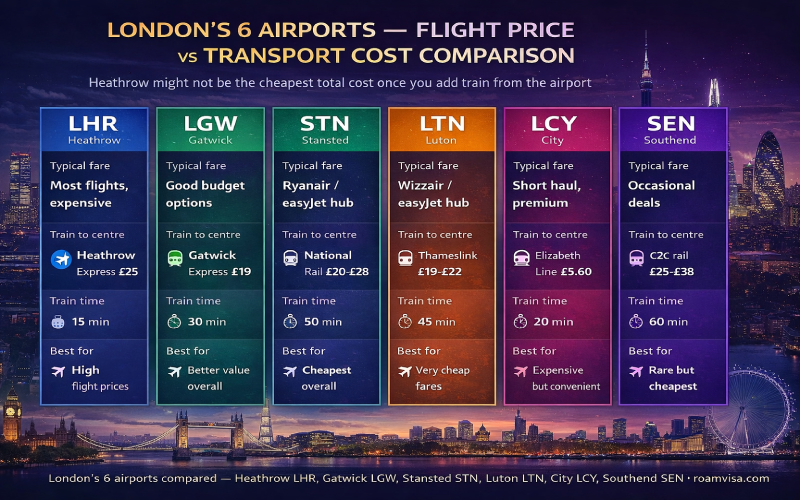
Understanding what you are actually comparing when you see flight prices to London is essential. The listed fare is only part of the cost – the transport from airport to central London adds £5 to £30 depending on which airport you land at.
| Airport | Code | Transport to Centre | Journey Time | Flight Price Level | Best For |
|---|---|---|---|---|---|
| Heathrow | LHR | Elizabeth Line £5.60 / Heathrow Express £25 | 15–30 min | Higher – most services | All airlines, all routes – default choice |
| Gatwick | LGW | Gatwick Express £19 / Thameslink £13 | 30–45 min | Mid-range | Budget transatlantic – Norse, Level, Norwegian |
| Stansted | STN | National Rail £20–£28 / Stansted Express | 55 min | Lowest – Ryanair hub | European routes, some transatlantic budget |
| Luton | LTN | Thameslink £18–£22 + shuttle bus | 50–65 min | Low – Wizz, easyJet | Eastern European routes, some short-haul UK |
| London City | LCY | Elizabeth Line £5.60 | 20 min | High – business routes | Short-haul Europe, business travellers |
| Southend | SEN | c2c rail £25–£38 | 55–70 min | Occasional very low | Only if the saving is significant enough |
The Airport Calculation You Should Always Run
If a Stansted fare is £80 cheaper than a Heathrow fare, the train from Stansted costs £24 vs the Elizabeth Line from Heathrow at £5.60. Your real saving is £80 − (£24 − £5.60) = approximately £61.60. That is still a meaningful saving. But if the Stansted fare is only £25 cheaper, the transport difference nearly wipes out the saving. Always run the total cost calculation before declaring one airport the winner.
Flight Search Tools Compared – Which One to Use for London
| Tool | Best For | What It Catches Others Miss | Alerts Available? | Our Verdict |
|---|---|---|---|---|
| Google Flights | Flexible date search, price graphs, tracking | Comprehensive airline coverage, visual calendar | Yes – free, reliable | Start here for every London search |
| Skyscanner | Charter airlines, regional carriers | Smaller airlines not on Google, sometimes lower OTA prices | Yes – email alerts | Second check after Google |
| Kayak | Hacker Fares, price forecast | Hacker Fares auto-search, OTA price comparison | Yes – price drop alerts | Best for hacker fares and OTA comparison |
| Momondo | OTA comparison, best total price | Aggregates 200+ booking sites, often finds lower totals | No built-in alerts | Final check before booking |
| Going (paid) | Flash sales, mistake fares | Error fares, airline seat sales, deals 36–90% off | Yes – instant email | Worth £25–£45/year if you fly 2+ times |
| Hopper | Price forecast, buy/wait advice | Predicts if price will rise or fall in next 7–14 days | Yes – push notifications | Useful for uncertain timing decisions |
Frequently Asked Questions
What is the cheapest month to fly to London?
January and February are consistently the cheapest months to fly to London from most US and international origins. From New York, January round-trip fares regularly come in at $350–$420. February is similar. These months have low leisure demand, no major holidays driving prices up and ample seat availability.
How far in advance should I book a flight to London?
For transatlantic flights to London, the Goldilocks Window is two to six months ahead of your departure date. Skyscanner data specifically suggests around 40 days before departure as the optimum for Heathrow. Cheapflights recommends at least 82 days. The practical takeaway: book somewhere between six weeks and five months out for the best combination of price and availability.
Is Heathrow or Gatwick cheaper to fly into?
It depends on your origin and airline. From US gateways, Heathrow typically has more full-service airline competition (British Airways, Virgin Atlantic, United, American, Delta) which keeps prices relatively competitive despite the premium.
Does searching in incognito mode actually save money on flights?
The evidence is mixed but the cost of doing it is zero, so there is no reason not to. Some flight search engines and airline websites are known to raise prices when they detect repeat searches from the same cookie profile. Opening a fresh incognito window eliminates any cookies from previous searches.
What is a hacker fare for London flights?
A hacker fare is a combination of two one-way tickets from different airlines rather than a single round-trip fare. Kayak’s Hacker Fares feature automatically searches for the cheapest outbound and return on different carriers and shows the combined price. It works because the cheapest New York–London seat might be on British Airways while the cheapest London–New York seat that week is on Norwegian or Norse.
Do flight prices go down on specific days of the week?
For booking day: Expedia data shows Sunday is typically 8% cheaper than Friday to book. For departure day: Tuesday, Wednesday and Saturday are consistently the cheapest days to depart for London – leisure travellers cluster on Fridays and Sundays, pushing prices up on those days.
Our Recommendation
The single most effective combination of tricks on this list is Tricks 1, 3 and 8 together: book inside the Goldilocks Window (two to six months out), set a Google Flights alert to track the price from the moment you decide you are going, and travel in January, February or November if your dates allow it. This combination alone can save $200–$400 on a New York–London round-trip compared to booking late in July.
If your dates are fixed in peak season, Tricks 2, 4, 5 and 7 become your primary tools. Fly Tuesday or Wednesday, search all six London airports and run the total-cost calculation including the train from each, try hacker fares on Kayak, and check Momondo before booking to make sure you are paying the lowest available total. These will not turn a July fare into a January fare, but they will ensure you pay the least available price for the dates you have chosen.
Trick 9 – the Nearby Hub Trick – is worth checking whenever you are booking, particularly if you are flying from a smaller US airport with limited direct services to London. A flight to Dublin with Aer Lingus plus a budget carrier to London, or a transatlantic fare to Paris with the Eurostar connection, can occasionally beat the direct London price significantly while also giving you a couple of days in an additional city.
One practical note: when you find a good price, book it. Flight prices can move significantly in a day and deals do not wait. If you are within the Goldilocks Window and the price looks right against the Google Flights historical average, do not wait for it to drop further. The 24-hour US Department of Transportation rule allows you to cancel any US airline booking within 24 hours of purchase at no charge, so you have a brief window to reconsider – but the price you found may not be there the next morning.