
The Canadian budget airline landscape has changed dramatically in the past two years. When travellers compared Flair, Lynx, and Porter in 2022 and 2023, all three were operating as distinct low-cost options with different positioning. Today the picture is very different – Lynx Air ceased operations on 26 February 2024, taking with it the second-cheapest major carrier in Canada. Swoop, WestJet’s budget subsidiary, was folded into WestJet’s main operation in late 2023. What remains is a reduced and polarised market: Flair Airlines as the only true ultra-low-cost carrier, Porter Airlines positioned as a hybrid low-cost-plus-amenities option, and WestJet’s new UltraBasic fare class directly competing with Flair on core routes. This article honestly assesses the remaining options and explains where Lynx fit into the picture before its collapse.

This guide compares Flair, Porter, and the current Canadian budget landscape including what Lynx used to offer, breaks down the honest total costs including baggage, reviews customer satisfaction data from the Canadian Transportation Agency, and provides a decision framework for Indian travellers arriving in Canada who need to get from their international gateway (Toronto or Vancouver) to a second Canadian city. We also cover which domestic Canadian budget airlines Indian travellers can realistically book, what happened to Lynx and why (to help you avoid articles that still recommend it), and how Porter’s rapid 2024-2025 expansion changes the calculation versus older reviews that treated Porter as a small regional carrier.
Quick Facts – Canadian Budget Airline Landscape in 2025
✓ Important update: Lynx Air ceased operations on 26 February 2024 – no longer exists as an operating airline
✓ Current Canadian budget options: Flair Airlines (ultra-low-cost), Porter Airlines (hybrid), WestJet UltraBasic (low-cost)
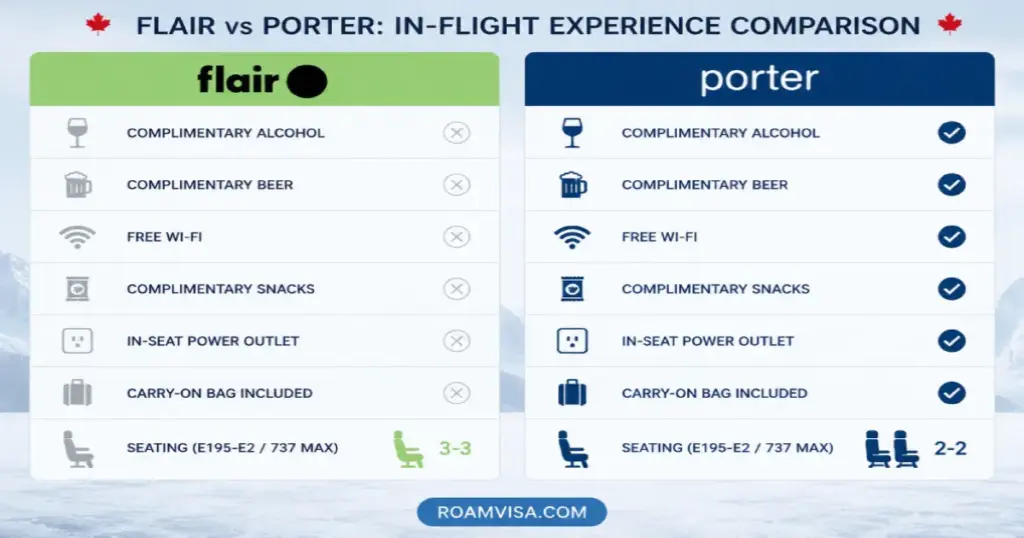
✓ Flair Airlines: Cheapest base fares, widest domestic route network, notorious for baggage fees and delays
✓ Porter Airlines: Higher base fares but includes free beer wine snacks WiFi, best customer satisfaction rating
✓ Flair received highest customer complaints per 100 flights of any Canadian airline (17.9 per 100) per Canadian Transportation Agency
✓ Porter has expanded aggressively in 2024-2025 with new jets serving cross-country routes beyond Billy Bishop
✓ Best value pick for most travellers: Porter on routes it serves; Flair only when Porter is not an option and you travel cabin-bag-only
What Happened to Lynx Air – The Honest Story
Lynx Air launched in April 2022 as Canada’s newest ultra-low-cost carrier, flying a fleet of Boeing 737 MAX aircraft on routes between major Canadian cities plus select US and Mexican destinations. Its pricing was competitive with Flair and its customer service reputation was slightly better in its early days. Within 22 months of launch, Lynx filed for creditor protection in February 2024 and ceased operations on 26 February 2024. Canadian ultra-low-cost aviation is structurally difficult because operating costs are high (fuel, airport fees, labour unions) and pricing power is low (Canadians are small population, competitor capacity is already high, and US carriers like WestJet and Porter compete aggressively).
Lynx was acquired by Air Canada in parts during its wind-down, and some of its routes have been absorbed by WestJet and Air Canada. The practical impact on Indian travellers is that any article published before 2024 recommending Lynx as a budget option should be treated as outdated – Lynx no longer exists. The remaining budget options for Canadian domestic travel are Flair Airlines (ultra-low-cost), Porter Airlines (hybrid), WestJet UltraBasic (low-cost competitor to Flair), and to a lesser extent Air Canada’s basic economy fares.
Flair Airlines – The Current Ultra-Low-Cost Option
Flair Airlines is now the only true ultra-low-cost carrier operating in Canada at scale. Based in Edmonton, Alberta, Flair operates a fleet of around 20 Boeing 737 MAX 8 aircraft serving 30+ Canadian destinations plus select US, Mexico, and Caribbean routes. Its business model is the classic ULCC formula – lowest possible base fare, aggressive unbundling of all services, ancillary revenue through bag fees, seat selection fees, and on-board sales.
Flair Base Fares – Genuinely Low
Flair’s base fares on major Canadian routes (Toronto-Vancouver, Toronto-Calgary, Vancouver-Edmonton) routinely drop to CAD 39 to 79 one-way on flash sales, with standard fares in the CAD 99 to 149 range. This is 40 to 60 percent below typical Air Canada or WestJet full-fare economy on the same route. For a solo traveller flying light between Canadian cities, Flair is the cheapest option available in 2025.
Flair Baggage Fees – The Big Catch
Flair’s personal item (under-seat bag) is free. Everything else costs. Carry-on bag: CAD 29 to 74 per direction depending on route. First checked bag: CAD 49 to 84 per direction. Second checked bag: progressively higher. Airport-counter fees are 2 to 3 times the online pre-booking fee. Bundle options combine baggage and seat selection for a small saving over buying separately. A typical family of four travelling with carry-ons and one checked bag each on a Toronto-Vancouver round-trip can easily add CAD 800 to 1,200 in baggage fees – which erases much of the base fare advantage.
Flair Customer Experience – Honest Rating
Flair received the highest customer complaint rate of any Canadian airline in 2024 – 17.9 complaints per 100 flights per Canadian Transportation Agency data, dramatically higher than Sunwing (9.5) or WestJet (5.3). Common issues include unexplained delays, last-minute cancellations, aggressive baggage fee enforcement, and limited rebooking options when flights disrupt. Flair operates few spare aircraft, so when one plane has an issue, a cascade of cancellations follows. For time-sensitive travel, this is a real concern.
Porter Airlines – The Hybrid Canadian Option
Porter Airlines started in 2006 as a regional Ontario and Quebec carrier operating turboprop aircraft from Toronto’s Billy Bishop downtown airport. From 2023 onwards, Porter transformed aggressively – adding Embraer E195-E2 jets, expanding to cross-country routes from Toronto Pearson (YYZ) rather than just Billy Bishop, and positioning itself as a hybrid low-cost carrier that competes directly with Air Canada on price while offering meaningfully better amenities.
Porter Fares – Mid-Range but Value-Packed
Porter’s base fares sit between Flair and Air Canada – typically CAD 120 to 220 one-way on major routes like Toronto-Vancouver or Toronto-Halifax. This is 30 to 50 percent higher than Flair’s base but 15 to 30 percent lower than Air Canada’s main economy fare on equivalent routes. Porter’s new Economy Basic fare is directly competitive with Flair for solo travellers, while its main Economy fare includes more amenities as standard.
Porter Amenities – The Differentiator
Porter includes free beer, wine, and cocktails on every flight regardless of fare class. Free soft drinks and snacks. Free inflight WiFi (rolling out across the E195-E2 fleet in 2024-2025). Free carry-on bag. Free in-seat power outlets. No middle seats on Porter Embraer jets (2-2 configuration). Fresh meal service available for purchase on flights over 2.5 hours. Compared to Flair’s paid-for-everything model or Air Canada’s basic economy strip-down, Porter’s included package is genuinely superior for a small price premium.
Porter Route Network – Expanding Rapidly
In early 2023 Porter had around 20 aircraft and served primarily Central and Eastern Canada. By late 2025 Porter operates 35+ E195-E2 jets with 40 more on order, serving major transcontinental routes including Toronto-Vancouver, Toronto-Calgary, Toronto-Edmonton, Toronto-Miami, and Eastern Canada plus US destinations. The airline operates from Toronto Pearson (YYZ), Toronto Billy Bishop (YTZ), Vancouver (YVR), Calgary (YYC), Montreal (YUL), Halifax (YHZ), and Ottawa (YOW). For an Indian traveller arriving in Toronto or Vancouver and needing to reach other Canadian cities, Porter’s network is genuinely usable.
Related Articles: Cheapest Flights to Canada – Save Big on Tickets
Real Total Cost Comparison – Flair vs Porter
The table below shows realistic total costs on a Toronto to Vancouver one-way flight comparing Flair’s base fare plus typical add-ons against Porter’s fare with most amenities included. Prices are in Canadian dollars for a typical shoulder-season midweek fare.
| Item | Flair (CAD) | Porter (CAD) |
| Base fare | 79 | 165 |
| Carry-on bag | +49 | 0 (included) |
| Checked bag 20 kg | +65 | +30 |
| Seat selection | +18 | 0 (included main) |
| Beer or wine on board | +8 (no longer served as of 2024) | 0 (included) |
| WiFi | +8 | 0 (included) |
| Snacks | +6 | 0 (included) |
| TOTAL with all extras | 233 | 195 |
| Cabin bag only total | 97 (base + personal item only) | 165 (all inclusive) |
The math is striking. For a traveller who wants a standard full-service experience (carry-on plus checked bag plus seat selection plus onboard amenities), Porter at CAD 195 total beats Flair at CAD 233 total by CAD 38 – and delivers superior service in the process. Flair only wins the total-cost comparison if you can travel with just a personal item (no carry-on, no checked bag, no seat selection, no onboard purchases). In that narrow scenario, Flair at CAD 79 beats Porter at CAD 165 by CAD 86. For everyone else, Porter is genuinely the better value.
When to Choose Flair Anyway
Despite the total-cost comparison favouring Porter in most scenarios, Flair remains the correct choice in specific situations.
1. Porter Does Not Fly Your Route
Porter’s network is expanding but still does not cover every Canadian domestic route. Flights to Saskatoon, Regina, Charlottetown, St. John’s Newfoundland, Yellowknife, Whitehorse, and many smaller cities are not served by Porter. If Flair flies your route and Porter does not, Flair versus Air Canada basic economy is the real comparison, and Flair usually wins.
2. You Are a True Cabin-Bag-Only Solo Traveller
If you can fit everything into a personal item (40 x 30 x 18 cm roughly), do not want or need onboard drinks or WiFi, and are not fussy about your seat, Flair’s CAD 79 fare is genuinely unbeatable. Backpackers, short-trip business travellers with a laptop bag only, and flexible solo travellers fit this profile.
3. You Have Robust Flexibility for Schedule Issues
Flair’s 17.9 complaints per 100 flights reflects real operational issues. If your trip is time-sensitive (connecting to an international flight, attending a wedding, starting a new job), Flair’s reliability risk is too high. If your trip is flexible and you can accept a potential 2 to 6 hour delay or even a cancellation without serious consequence, Flair’s pricing becomes acceptable.
WestJet UltraBasic – The New Third Option
WestJet introduced its UltraBasic fare class in 2024 as a direct response to Flair’s pricing competition. UltraBasic fares are similarly priced to Flair (CAD 79 to 139 on major routes) but operate through WestJet’s mainline network and aircraft. For Indian travellers, UltraBasic may be a better option than Flair for specific routes because WestJet’s operational reliability is much better than Flair’s, and the fleet spare aircraft capacity means fewer cascade delays.
UltraBasic Limitations
Like Flair, UltraBasic charges separately for carry-on, checked bags, seat selection, and changes. Unlike Flair, UltraBasic includes WestJet’s standard onboard snack service (water and pretzels) and accesses WestJet’s broader network for rebooking if your specific flight disrupts. In the first week of launch, WestJet sold over 100,000 UltraBasic tickets, showing strong market response to the option.
Route-by-Route Recommendation Guide
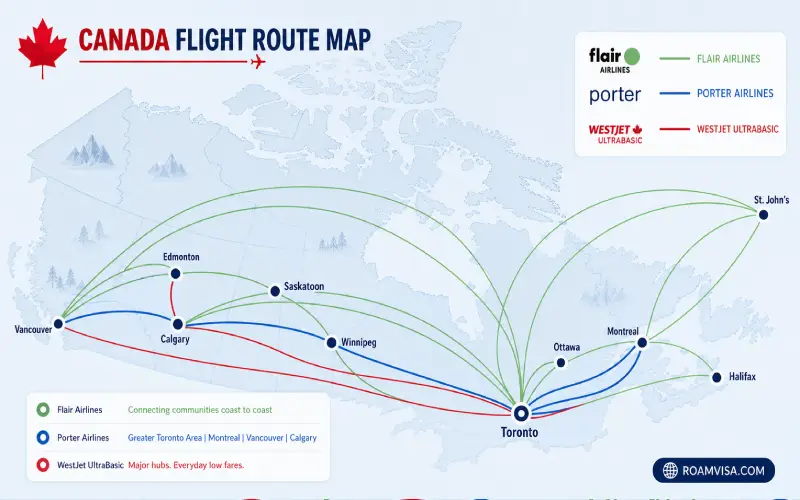
Toronto to Vancouver
All three airlines fly this route. Best pick: Porter for most travellers (Porter at CAD 165 with amenities included beats Flair at CAD 79 base that becomes CAD 200+ with extras). Flair only if you are cabin-bag-only solo. WestJet UltraBasic is a solid middle ground if Porter’s fare is above CAD 220 for your specific date.
Toronto to Calgary or Edmonton
Porter serves Toronto-Calgary but not yet Toronto-Edmonton directly as of mid-2025. For Calgary, Porter wins. For Edmonton, Flair or WestJet UltraBasic are your options – Flair is cheaper, WestJet is more reliable. Flight time Toronto-Calgary is 4 hours, so amenities matter.
Toronto to Halifax or Montreal
Porter’s home territory – fly Porter on these routes without hesitation. Porter’s Billy Bishop downtown Toronto departure is particularly convenient for Toronto-based travellers. Flight time is 1.5 to 2 hours so amenity differences matter less, but Porter’s fare is usually within CAD 30 to 60 of Flair.
Toronto to Ottawa, Quebec City, or Regional Ontario
Porter is the default choice on these short routes. Flair does not serve most small Ontario destinations. WestJet has limited direct service. Porter’s CAD 120 to 180 fare with all amenities is the practical option.
Vancouver to Calgary, Edmonton, or Winnipeg
Flair or WestJet UltraBasic on these Western Canada routes. Porter does not yet fly extensively within Western Canada. Flair typically cheapest for solo cabin-bag travellers. WestJet more reliable for most other profiles.
Six Mistakes Indian Travellers Make Booking Canadian Domestic Budget
- Booking Lynx Air based on outdated 2022-2023 articles – the airline ceased operations 26 February 2024 and no longer exists.
- Booking Flair without totaling baggage costs – the CAD 79 fare can become CAD 233 with standard extras, which is more than Porter.
- Picking Air Canada basic economy by default – Air Canada basic economy has fewer amenities than Porter’s Economy Basic at a similar price.
- Not checking whether Porter serves your route – Porter’s expansion in 2024-2025 means they now cover many routes where travellers still assume Porter is a regional-only airline.
- Booking Flair for time-sensitive connections – Flair’s 17.9 complaints per 100 flights rate means a meaningful chance of delay or disruption that can cascade.
- Paying airport-counter baggage fees on Flair – airport fees are 2 to 3 times higher than pre-booked online fees, turning cheap fares expensive at the gate.
Before You Book – Time Your Canada Trip Well
The best budget airline choice only matters if you are flying to Canada at a sensible time in the first place. Our companion guide on cheapest months to fly to Canada with real seasonal fare data shows that November, January, and February save 30 to 40 percent versus peak months like March and July on the international leg from India. Pair that with the right domestic budget airline choice and you save meaningfully on both legs of your trip.
If you are a Canadian Indian community member travelling home to India or hosting family visiting you, the same seasonal patterns apply in reverse. The cheapest months to fly to London with month-by-month fare data covers similar seasonal analysis for the UK, which many Indian-Canadian families also visit – and the February and November sweet spots align closely with what works for direct India-Canada travel.
Final Thoughts
The Canadian budget airline landscape of 2022 and 2023 no longer exists. Lynx Air shut down in February 2024, Swoop was folded into WestJet mainline in 2023, and what remains is a polarised market of Flair (true ultra-low-cost, operationally troubled, lowest-base-fare) and Porter (hybrid, amenity-rich, expanding fast, best customer satisfaction among budget-ish Canadian carriers). For most Indian travellers arriving at Toronto or Vancouver and needing onward domestic travel, Porter is the correct default choice – its base fare is 30 to 50 percent higher than Flair, but its included amenities (free wine, beer, snacks, WiFi, carry-on) make the total cost lower once you add the equivalent extras on Flair.
Flair is the correct choice only in three specific scenarios:
(1) you are a genuine cabin-bag-only solo traveller with no need for onboard services,
(2) Porter does not serve your specific route and Flair does, or
(3) your schedule is flexible enough to absorb a potential delay or cancellation. For everyone else – families, couples, anyone with standard luggage, anyone with a time-sensitive schedule – Porter is the better value.
WestJet UltraBasic is a solid third option directly competing with Flair on price with much better operational reliability. Ignore any article that still recommends Lynx; ignore any article that still treats Porter as a small regional carrier. The 2025 picture is clearer than older comparisons suggest – Porter is the grown-up budget choice, Flair is the high-risk lowest-fare option, and Lynx is gone.
Frequently Asked Questions
Is Lynx Air still operating in 2025?
No. Lynx Air ceased all operations on 26 February 2024 after filing for creditor protection. The airline no longer exists and cannot be booked. Articles that recommend Lynx are outdated and should be ignored. The current Canadian budget options are Flair Airlines, Porter Airlines, and WestJet UltraBasic.
Is Flair really cheaper than Porter or does the baggage fee catch everyone out?
Flair’s base fare is genuinely cheaper at around CAD 79 versus Porter’s CAD 165 on major routes. But once you add a carry-on (CAD 49), checked bag (CAD 65), and seat selection (CAD 18) on Flair, your total reaches CAD 211 – more than Porter’s all-inclusive CAD 165. Flair only beats Porter on total cost if you travel with a personal item only and buy nothing extra.
Does Porter really give free beer and wine on every flight?
Yes, on every flight regardless of fare class or route. Porter serves complimentary beer, wine, and cocktails on all its flights, along with snacks, soft drinks, and in-seat power. Free WiFi is rolling out across the fleet in 2024-2025 – check the specific aircraft type for your route to confirm
Which Canadian budget airline has the best on-time performance?
Porter has the best on-time performance and customer satisfaction of the three. Flair received 17.9 complaints per 100 flights per Canadian Transportation Agency 2024 data – the highest of any Canadian airline. Porter’s figures are significantly lower. WestJet UltraBasic uses WestJet’s main operations so benefits from WestJet’s broader reliability.
Can I fly Porter to all major Canadian cities now?
Porter’s network has expanded dramatically since 2023. Porter now flies Toronto-Vancouver, Toronto-Calgary, Toronto-Edmonton, Toronto-Halifax, Toronto-Miami plus its original Eastern Canada short-haul routes. However it does not yet serve Saskatoon, Regina, St. John’s, Yellowknife, or most small regional cities. Check Porter’s route map before assuming they fly your specific route.
Is WestJet UltraBasic the same as flying Flair?
Priced similarly but operationally superior. WestJet UltraBasic fares are in the CAD 79 to 139 range on major routes, matching Flair. The fare class has the same stripped-down baggage and seat structure as Flair. However WestJet’s mainline operations include more spare aircraft, broader rebooking options when flights disrupt, and better customer service response.