
Scottish Highlands Road Trip – Best Route, Stops and Tips

Scottish Highlands road trip few journeys in Europe can match it for raw drama. Ancient lochs stretching beyond the horizon, three-thousand-foot mountains rising straight from the valley floor, stone castles rising from rocky islands, and single-track roads that reward patience with views that stop you in your tracks. The Scottish Highlands is one of the last genuinely wild places in Western Europe, and the best way to experience it is behind the wheel at your own pace.

This guide covers the best road trip route through the Scottish Highlands from Glasgow north through Glen Coe, Fort William and Eilean Donan Castle, across to Loch Ness and Inverness with the essential stops, practical driving tips, and everything you need to plan the trip.
Scottish Highlands Road Trip Key Facts
Best route: Glasgow → Loch Lomond → Glen Coe → Fort William → Eilean Donan → Loch Ness → Inverness
Total distance: Approx 200 miles one way (Glasgow to Inverness via the west)
Minimum time: 3 days (rushed) 5–7 days recommended
Best months: May, June, September good weather, fewer midges, lower accommodation costs
Car hire tip: Book well in advance in summer Highland depots sell out quickly
Road type: Mix of A-roads and single-track roads with passing places✔ Budget: £80–150/night accommodation, £40–60/day fuel and food
The Best Scottish Highlands Road Trip Route
The classic Highlands road trip runs from Glasgow north through the western Highlands via Loch Lomond, Glen Coe and Fort William before looping east through Glen Shiel and Eilean Donan Castle, then north to Loch Ness and Inverness. This route takes in the most dramatic Highland scenery in a logical, driveable sequence.
| Day | Route | Distance | Key Stops | Drive Time |
|---|---|---|---|---|
| Day 1 | Glasgow → Loch Lomond → Glen Coe | 95 miles | Loch Lomond, Rest and Be Thankful, Glen Coe | 2.5–3 hrs driving |
| Day 2 | Glen Coe → Fort William → Glenfinnan | 45 miles | Glen Coe Visitor Centre, Ben Nevis, Glenfinnan Viaduct | 1.5–2 hrs driving |
| Day 3 | Glenfinnan → Kyle of Lochalsh → Eilean Donan | 80 miles | Road to Isles, Kyle of Lochalsh, Eilean Donan Castle | 2.5 hrs driving |
| Day 4 | Eilean Donan → Inverness → Loch Ness | 95 miles | Beauly, Inverness city, Loch Ness, Urquhart Castle | 2.5 hrs driving |
| Day 5 | Loch Ness → Cairngorms → Return South | 120 miles | Aviemore, Cairngorms National Park, Blair Atholl | 3 hrs driving |
Stop 1: Glen Coe: Scotland’s Most Dramatic Glen

Glen Coe is the centrepiece of any Highland road trip a glacially carved valley of extraordinary scale, flanked on the south by the Three Sisters and on the north by the Aonach Eagach ridge, the most challenging scramble on the Scottish mainland. The A82 runs straight through the valley floor, and the views from the road alone are worth the journey.
The glen has history as dark as its weather. In February 1692, soldiers under government command massacred 38 members of the MacDonald clan who had offered them hospitality for twelve days. The Massacre of Glencoe is one of the most infamous episodes in Scottish history, and the landscape still carries that sense of brooding weight.
What to do at Glen Coe:
- Glen Coe Visitor Centre (National Trust for Scotland) excellent exhibition on the geology, wildlife and history of the glen, including the massacre. Allow 1 hour.
- The Lost Valley (Coire Gabhail) a hidden valley between two of the Three Sisters. A 3-mile return walk with some scrambling, taking 2–3 hours. One of the finest short walks in Scotland.
- Glencoe village a small village at the western end of the glen with a good local museum, café and the starting point for several walks.
- Buachaille Etive Mòr the iconic pyramid-shaped mountain at the entrance to the glen, visible for miles. Experienced hillwalkers can reach the summit; the lower slopes are accessible to most.
- Stop at the Three Sisters viewpoint a purpose-built layby on the A82 with the single best view of the glen. Allow time to simply stand and look.
Glen Coe Driving Tip Drive the A82 through Glen Coe from east to west (from Rannoch Moor towards Glencoe village) for the most dramatic unfolding view of the Three Sisters. The sun in the afternoon lights the south-facing slopes perfectly.
Stop 2: Eilean Donan Castle: Scotland’s Most Photographed Castle
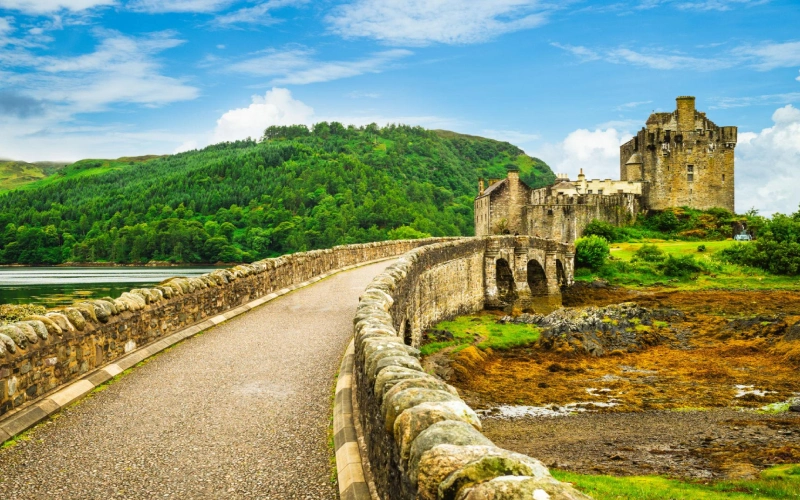
Eilean Donan is arguably the most photographed castle in Scotland and the reality lives up to every photograph. The 13th-century castle sits on a small island where three sea lochs meet: Loch Duich, Loch Long and Loch Alsh. A stone causeway connects it to the shore near the village of Dornie, 8 miles from Kyle of Lochalsh.
The castle was largely destroyed in 1719 during a Jacobite uprising and lay as a ruin for nearly 200 years before Lieutenant Colonel John MacRae-Gilstrap undertook a complete restoration between 1919 and 1932. Today it is one of the most visited historic attractions in Scotland, with excellent guided tours of the restored interior.
What to do at Eilean Donan:
- Castle tour guided tours cover the Billeting Room, the Banqueting Hall, the Military Room and the bedroom. Allow 45–60 minutes. Tickets from around £12 adults.
- Photography from the causeway the view from the A87 layby looking south-west across Loch Duich with the castle framed by mountains is the classic shot. Best light is morning or late afternoon.
- Dornie village the small village across the road from the castle has a good café and a useful petrol station fill up here before heading into more remote Highland territory.
- Drive to Kyle of Lochalsh 8 miles west, with views across to the Isle of Skye. The Skye Bridge is worth crossing for a short detour to Kyleakin even if you are not doing the full Skye circuit.
Stop 3: Loch Ness and Urquhart Castle

Loch Ness is 23 miles long, up to 755 feet deep and holds more fresh water than all the lakes in England and Wales combined. It is famous worldwide for the legend of the Loch Ness Monster a story that has generated global fascination since a reported sighting in 1933. Whether or not you believe in Nessie, the loch itself is genuinely spectacular.
The ruins of Urquhart Castle stand on a promontory above the loch approximately midway along the western shore. The castle was one of the largest in medieval Scotland and has a complex history of siege and ownership stretching back to the 6th century. Its ruined towers and walls make for extraordinary photography against the backdrop of the loch.
What to do at Loch Ness:
- Urquhart Castle explore the ruins of this medieval fortress with an audio guide and visit the visitor centre. The views from the Grant Tower across the loch are outstanding. Tickets from £15 adults, Historic Scotland managed.
- Loch Ness Centre, Drumnadrochit a serious exhibition covering the history of Nessie sightings, original sonar equipment used in monster hunts, and the scientific evidence. Well presented and genuinely interesting.
- Drive the B852 on the eastern shore far quieter than the A82 on the west, with stunning views across the loch. Pass through the villages of Foyers and Inverfarigaig.
- Foyers Waterfall a short walk from the B852 near Foyers leads to one of Scotland’s most impressive waterfalls, dropping 90 feet into a forested gorge. Free, 20 minutes return walk.
- Inverness 16 miles north of Loch Ness, the capital of the Highlands is a pleasant overnight stop with good restaurants, a Victorian castle and easy access to the Culloden Battlefield (8 miles east).
Related Articles: Best Hostels in Europe for Solo Travelers- Complete Guide
More Essential Stops on the Scottish Highlands Road Trip
| Stop | Location | Why Visit | Time Needed |
|---|---|---|---|
| Loch Lomond | 30 miles north of Glasgow | Largest lake in Great Britain, stunning southern gateway to Highlands | Half day |
| Rest and Be Thankful | A83, Argyll | Highland pass with panoramic views one of Scotland’s great viewpoints | 30 minutes |
| Ben Nevis | Fort William | Britain’s highest mountain viewpoint and visitor centre at the base | 1–4 hours |
| Glenfinnan Viaduct | Glenfinnan, Lochaber | Harry Potter steam train viaduct, spectacular Highland backdrop | 1–2 hours |
| Glencoe village & museum | Glen Coe | Massacre of Glencoe history, local museum, excellent starting walks | 1–2 hours |
| Fort Augustus | Southern end Loch Ness | Caledonian Canal locks, abbey ruins, pleasant village for lunch stop | 1 hour |
| Culloden Battlefield | 8 miles east of Inverness | Site of 1746 Jacobite defeat moving battlefield and visitor centre | 2 hours |
| Cairngorms National Park | Aviemore, on return south | UK’s largest national park red squirrels, ospreys, Highland wildlife | Half–full day |
Essential Driving Tips for the Scottish Highlands
The Scottish Highlands require a different approach to driving than most of Europe or North America. Understanding the road types and unwritten rules makes the experience enormously more enjoyable.
Single-track roads the most important thing to know
Much of the Highlands is served by single-track roads one lane wide, with passing places marked by white diamond signs or small laybys every 100–200 metres. The rule is simple: if a vehicle approaches from the opposite direction, one driver pulls into the nearest passing place to let the other pass. If the passing place is on your right, pull up opposite it rather than driving into it this allows the oncoming vehicle to use it.
Never treat passing places as picnic spots or parking areas. Local residents and farm vehicles use these roads daily and blocking a passing place can cause serious delays. Always pull over promptly to let faster vehicles behind you overtake lorries, vans and local drivers will want to pass, and the courteous response is to let them.
Highland Driving Tips Practical Checklist
- Fuel up at every opportunity petrol stations can be 40–60 miles apart in remote areas
- Allow twice the time you would expect single-track roads mean 40 mph averages at best
- Download offline maps (Maps.me or Google Maps offline) mobile signal is patchy
- Book accommodation well in advance Highland villages have limited options
- Pack midges repellent May to September, especially near lochs at dawn and dusk
- Carry a physical map as backup OS Landranger 1:50,000 covers the Highlands
- Check the weather forecast daily conditions change rapidly at higher elevations
- Sheep on the road they will not move. Slow down and wait patiently.
Best Time to Do the Scottish Highlands Road Trip
| Month | Weather | Midges | Crowds | Recommendation |
|---|---|---|---|---|
| January–March | Cold, snow on passes | None | Very quiet | Experienced drivers only dramatic but challenging |
| April | Cool, unpredictable | Starting | Low | Good for solitude waterfalls at peak after winter rains |
| May | Warming, longer days | Low | Moderate | Excellent bluebells, lambs, clear skies common |
| June | Best weather | Moderate | Busy | Very good longest daylight, warmest reliable month |
| July–August | Warmest | High | Peak crowds | Good weather but most expensive and crowded |
| September | Still warm, turning | Dropping | Quieter | Excellent autumn colours begin, much quieter than summer |
| October | Cool, dramatic skies | Gone | Quiet | Beautiful colours book flexible accommodation |
| November–December | Cold, short days | None | Very quiet | Atmospheric but limited daylight hours |
Frequently Asked Questions
How long does the Scottish Highlands road trip take?
The minimum is 3 days (Glasgow to Inverness via the west coast), but 5–7 days allows you to stop properly at Glen Coe, Eilean Donan, Loch Ness, the Cairngorms and Glenfinnan Viaduct without rushing. The North Coast 500 the full Highland circular route takes 7–10 days to do justice.
What is the North Coast 500?
The North Coast 500 (NC500) is a 516-mile circular route starting and ending in Inverness, running clockwise around the northern tip of Scotland. It is one of the most acclaimed road trips in the world covering remote sea lochs, dramatic cliff coastlines, white sand beaches and ancient castles. Allow 7–10 days minimum.
Do I need a special car for the Highlands?
No a standard hire car is perfectly adequate. High clearance or 4WD is not necessary on normal routes. In winter, snow chains or winter tyres are advisable for mountain passes. A smaller car is easier on single-track roads than a large SUV.
What should I watch out for on Highland roads?
Sheep and deer on the road especially at night and early morning. Always drive slowly through glens and passes after dark. Single-track passing places require patience. Fuel stations are sparse never pass a petrol station in a remote area without checking your gauge.
Final Thoughts
The Scottish Highlands road trip is genuinely one of the great journeys of the British Isles and it rewards exactly the kind of travel that road trips are best for: slow progress, spontaneous stops, and the freedom to linger wherever the landscape demands it. Glen Coe alone justifies the drive north from Glasgow. Eilean Donan, Loch Ness and the Glenfinnan Viaduct are among the most dramatic landmarks in Europe.
Plan for at least five days, fuel up whenever you can, pack waterproofs and midges repellent, and give yourself permission to stop whenever a view demands it because on this road trip, the views demand it constantly.


