
There is a straightforward answer to which are the Cheapest days to fly to the USA – Tuesday and Wednesday – and a less straightforward truth sitting right behind it: the day you fly matters, but the month you fly, the window in which you book and the tools you use to search can each save you more money individually than picking the right departure day. This guide covers all of it, in plain terms, without padding.

The data behind this comes from multiple sources: Expedia’s 2026 Air Travel Hacks Report, Google’s 2025 flight pricing analysis, NerdWallet’s day-by-day fare research, Kayak’s booking behaviour study and the Going flight deals service. These are not the same source recycled under different names – each dataset has nuances and occasionally disagrees on the specifics. Where they agree, the consensus is reliable. Where they diverge, this guide notes it and explains why.
One thing to say upfront: there is no single magic move that makes every flight to the USA cheap. But there are several moves that consistently reduce what you pay, and most people only know one or two of them. This guide covers the ones that actually work in 2025.
Cheapest Days to Fly to the USA – Key Facts
Cheapest Day To Fly: Tuesday – approximately 14% cheaper than Sunday (NerdWallet + Expedia data)
Second Cheapest: Wednesday – about 13% cheaper than Sunday (Google 2025 report)
Midweek Savings: Monday–Wednesday up to 13% cheaper than weekends – can save nearly $100 per ticket
Cheapest To Book: Sunday (Expedia 2026 data) – saves 8% vs booking on Friday
Most Expensive Day To Fly: Sunday – highest combined leisure + last-minute business demand
Cheapest Months: January and February – fares drop sharply after the holiday season
Best Booking Window (international): 2–6 months ahead – 49 days average for best fare (Google data)
Connecting Flights Save 25%: Google Flights data – stops cost on average 25% less than nonstop
Peak Season Trap: July and August to the USA are the most expensive months – book 4–6 months ahead
The Cheapest Days to Fly to the USA – All 7 Days Ranked
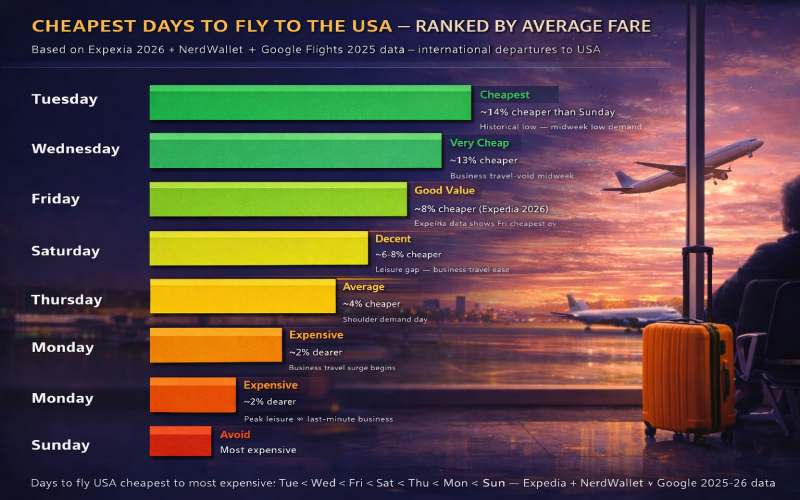
Not every data source agrees on the exact ranking, but the directional pattern is consistent across all of them. Midweek is cheaper than weekend. Tuesday and Wednesday lead the cheap end. Sunday leads the expensive end. Here is how the week plays out.
Tuesday – The Historically Cheapest Day to Fly
NerdWallet’s analysis puts Tuesday as the cheapest day to fly in terms of raw average cost – roughly 14% less than Sunday departures.
The reason is structural: business travellers dominate Monday and Thursday routes (outbound and return for the typical corporate week), leisure travellers cluster on Fridays and Sundays and that leaves Tuesday with comparatively low demand. Airlines respond with lower prices on seats that would otherwise go unsold.
A 2025 Google Flights analysis reinforced this: midweek departures including Tuesday run about 13–14% below weekend prices. In dollar terms, that translates to savings of roughly $100 per ticket on domestic US routes and potentially $200–$400 on international long-haul fares. For a family of four, a Tuesday versus Sunday departure can mean the difference of $400–$1,600 on flights alone.
Wednesday – Close Behind, Often Overlooked
Wednesday is Tuesday’s near-equal in most pricing studies. Google’s 2025 report found that Monday through Wednesday flights are consistently about 13% cheaper than flying over the weekend. Kayak’s analysis agrees. The Points Guy noted that travellers who fly on Wednesday specifically can save an average of $56 per ticket on domestic US fares throughout the year – and that midweek savings spike above $60 during spring break and summer vacation months, when the gap between midweek and weekend pricing widens.
Friday – A Surprising Value Day (Expedia 2026 Data)
Here is where the data gets slightly contradictory and worth paying attention to. Expedia’s 2026 Air Travel Hacks Report ranks Friday as the cheapest day to fly overall, above Tuesday. NerdWallet uses the same Expedia data and notes that Friday averages the overall cheapest flights by most metrics in that dataset, though Tuesday wins on raw average cost in other analyses. The likely explanation is timing: Friday morning and afternoon flights are cheaper than you might expect because business travellers who fly Friday mostly go in the early morning, leaving afternoon slots underpriced.
The Practical Takeaway on Day of Departure
Tuesday, Wednesday and Friday are your target days for the cheapest USA fares. If you have flexibility, check all three before settling on dates. The specific cheapest day for your particular route may vary – the general pattern holds but individual routes sometimes diverge from the average. Always use Google Flights’ calendar view to see actual prices on every day around your target dates rather than relying on the day-of-week pattern alone.
Saturday – Decent, But Not Midweek
Saturday often has lower prices than Sunday because leisure travellers who depart Friday or Saturday for a week-long trip leave a pricing gap on the return-day side of Saturday. It is typically 6–8% cheaper than Sunday but does not match the Tuesday-Wednesday-Friday discount range. FareCompare lists Saturday as one of the consistently cheaper options alongside Tuesday and Wednesday in their analysis of nearly 300 million airfares.
Sunday and Monday – Most Expensive Days to Fly
Sunday is the most expensive departure day by almost every metric. It is the dominant return day for week-long leisure trips and also popular for business travellers who want to arrive Monday morning. This dual demand from two entirely different traveller types creates the highest average fares of the week. Monday is expensive for similar reasons – outbound business travel surges and any leisure travellers who extended a weekend trip are catching late Sunday or Monday morning flights.
If Sunday is your only option, the best mitigation is to book early (the Goldilocks Window), use Google Flights’ date flexibility to check the Saturday and Monday either side, and consider whether a one-day shift saves enough to justify the rearrangement.
The Best Day to Book – It Is Not Tuesday
There is a widespread myth that Tuesday is the best day to book a flight as well as to fly. This used to be partially true when airlines uploaded their fare schedules to the internet once a week on Tuesdays. That system has not existed for decades. Modern airline pricing algorithms reprice seats in real time, constantly, based on demand signals, remaining inventory and competitive factors. There is no weekly fare upload that creates a Tuesday booking discount.
What the Data Actually Shows on Booking Day
Expedia’s 2026 Air Travel Hacks Report found that Sunday is the cheapest day to book flights – saving an average of 8% compared to booking on Friday. National Geographic’s 2025 travel article cited multiple industry experts who specifically told travellers to stop focusing on Tuesday bookings and start focusing on demand patterns instead. Kayak’s own analysis busted the Tuesday booking myth explicitly, finding that observing demand trends over time was far more predictive of low prices than booking on a specific day of the week.
The Real Rule on Booking Day
Book when you find a price that is at or below the typical range for your route and dates. Google Flights shows you whether the current price is low, typical, or high based on historical data for that route. When it says low, book it. When it says high, set a price alert and wait. The specific day of the week you are booking on matters far less than where the price sits relative to its historical range.
Cheapest Months to Fly to the USA – The Seasonal Pattern
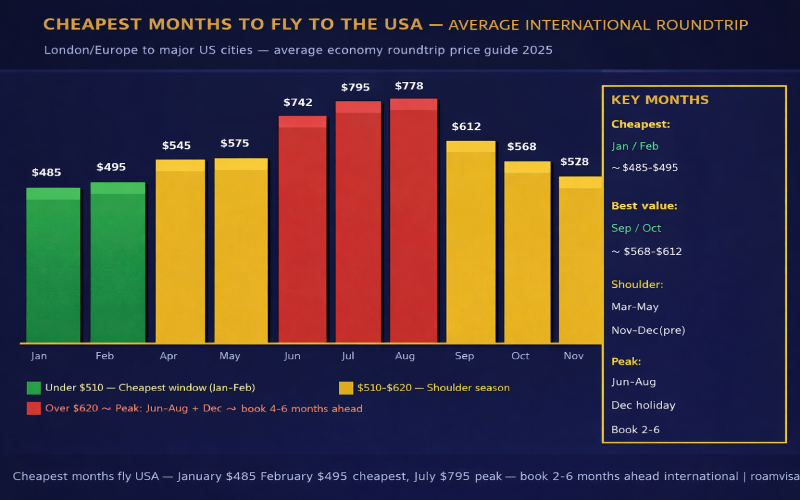
The day of the week you fly matters. The month you fly matters more. The difference between a January fare and a July fare on the same transatlantic route can be $300–$600. Understanding the seasonal pattern for USA flights means you can either plan your trip around cheaper windows or book far enough ahead in peak season to still pay a reasonable price.
January and February – the Cheapest Window of the Year
The post-holiday demand crash in early January creates the most consistent pricing low of the year for flights to the USA. From UK and European origins, January and February are reliably the cheapest months to fly. After the Christmas and New Year holiday crowds clear, airlines are left with aircraft that need to be filled and few leisure travellers are booking. The result is a price floor that rarely appears at any other time of year.
NerdWallet identifies January and September as particularly strong value months. Dollar Flight Club data confirms January and February as the cheapest months for international fares, noting that international flights in February run approximately 15% below holiday rates. Skyscanner’s analysis from the UK shows September as the cheapest month for USA flights from British origins – the summer rush has ended, schools are back and demand drops sharply.
September and October – The Underrated Sweet Spot
September is the month that experienced travellers quietly compete for. Summer is over, schools are back in session across most markets, and the September price drop from August peak is significant – sometimes 20–30% off August rates on the same routes. The weather in most of the USA in September and October is excellent by any standard – warm, mostly dry, and without the oppressive humidity that makes July and August in New York, Washington DC and other east coast cities genuinely uncomfortable.
October continues the value pattern. Expedia’s late August recommendation reinforces this – their Summer Travel Outlook specifically identifies late August as the moment when peak summer crowds drop but weather remains good, and October extends that logic further into autumn. For travellers with flexible dates, September through mid-November is the single best window for combining value with good travel conditions in the USA.
June, July and August – Peak Season Reality
Summer is expensive. There is no trick that makes a July fare to New York cost the same as a February fare. What you can do is mitigate the peak premium with early booking. For summer USA travel, booking four to six months ahead is the standard recommendation from every major flight data source in this guide. That means if you are planning a July trip, start searching and booking in January or February – the same period when off-season fares are at their lowest, which adds a useful alignment to the calendar.
Within peak summer, flying on Tuesday or Wednesday still applies and saves money relative to the same week’s Sunday or Monday fare. The absolute price is higher, but the relative saving from choosing the right departure day is actually larger in percentage terms during busy periods – The Points Guy noted that midweek savings spike above $60 per ticket during spring break and summer vacation months specifically.
December – The Holiday Premium
December is an interesting month because it splits into two very different pricing periods. Early December – particularly the first two weeks – can be relatively affordable, as travellers who are not going home for Christmas have no particular reason to fly. Then Christmas week prices spike sharply. A fare that costs $550 on December 10 may cost $850 or more on December 20. If you can travel on the holiday itself – Christmas Day, New Year’s Day – prices often drop back because demand falls as most people have already arrived at their destinations.
The Goldilocks Booking Window and 4 Myths Busted

The Goldilocks Window – How Far Ahead to Book USA Flights
The Goldilocks Window is the booking period that is neither too early nor too late – where prices are typically at or near their lowest while seat availability is still reasonable. For international flights to the USA, this window sits between two and six months before departure. Google’s 2025 flight pricing data found that average prices are lowest 49 days before departure for international flights broadly. Going.com (formerly Scott’s Cheap Flights) defines the international Goldilocks Window as two to eight months out.
For peak summer travel (June–August) and the Christmas holiday period, shift the window earlier. Booking four to six months ahead for July and August is appropriate. For Christmas and New Year, The Points Guy recommends locking in bookings by late October at the latest – with the lowest prices typically found around 52 days before Thanksgiving and similar windows for Christmas.
Booking Windows by Route Type:
- Domestic USA flights: 1–3 months ahead for regular travel, 3–5 months for peak holiday and summer periods
- Transatlantic (Europe/UK to USA): 2–6 months ahead for standard travel, 4–8 months for July/August and December
- USA to/from Asia-Pacific: 3–6 months ahead, 5–8 months for peak season
- USA to/from Latin America and Caribbean: 6–10 weeks for off-peak, 3–4 months for school holiday periods
4 Flight Price Myths That Cost Travellers Real Money
Myth 1 – You Should Book on Tuesday for the Cheapest Price
This myth dates from the early days of online booking when airlines loaded their weekly fare schedules on Tuesday mornings. That practice ended when airlines moved to real-time dynamic pricing. Today, algorithms price seats based on current demand, remaining inventory and competitor fares – continuously, every hour. As National Geographic’s 2025 travel piece put it directly: ‘Twenty-plus years ago, airlines used to load their schedules onto the internet once a week so that Tuesday myth might have been true then, but these days, algorithms are so much more sophisticated.’ The best day to book is when you find a genuinely good price – not a specific day of the week.
Myth 2 – Last-Minute Deals Save Money on USA Flights
Last-minute deals exist – but they are rare, unpredictable and most common in premium cabins rather than economy. For long-haul economy fares to the USA, waiting until the final two to three weeks before departure is one of the most reliable ways to pay more rather than less. Flight prices typically spike sharply in the final 21 days as the airline protects remaining inventory for business travellers who book close to departure and are less price-sensitive. Thrifty Traveler specifically warns that the worst move is waiting too long to book. Last-minute strategy works for award travel in business class. It does not work for economy on transatlantic routes.
Related Articles: Best Time to Fly to Canada- Cheapest Months and Airlines
Myth 3 – Early Morning or Late Night Flights Are Always Cheaper
Departure time pricing depends entirely on demand for that specific flight, not time of day as a rule. The example that Experian and multiple other sources cite from 2025 data: a 4:25pm Delta flight from LAX to JFK costs $139, while the 9:15pm and 10:15pm flights on the same day cost $389. Late night is often cheaper – but not always. Early morning is often cheaper for short domestic routes, but again, not reliably. The only reliable approach is to use Google Flights’ calendar view and look at actual prices across every departure time on your chosen day.
Myth 4 – Searching Repeatedly Makes Prices Go Up
Flight prices do change after repeated searches, but not because the airline is tracking your interest and raising prices specifically against you. Prices change because other travellers are searching and booking the same seats simultaneously, reducing inventory and triggering algorithmic price increases. Opening an incognito window eliminates cookie-based tracking, which is worth doing. But it does not stop price changes driven by genuine demand from other travellers. If a price has gone up since you last checked, it is much more likely to be because other people booked those seats than because your search history was used against you.
Complete Day, Month and Booking Window Reference – USA Flights
| Day / Period | Cheapness Rank | Saving vs Peak | Best For | Source |
|---|---|---|---|---|
| Tuesday departure | 1 Cheapest day | 14% vs Sunday | Any US route, especially east coast | NerdWallet + Expedia 2025–26 |
| Wednesday departure | 2 Cheapest day | 13% vs Sunday | Midweek flexibility travellers | Google 2025 + The Points Guy |
| Friday departure | 3 (Expedia 2026) | 8% vs Sunday | Afternoon departures especially | Expedia 2026 Air Hacks |
| Saturday departure | 4 | 6–8% vs Sunday | Short and medium haul | FareCompare 300m fare data |
| Thursday departure | 5 Average | 4% vs Sunday | Business-adjacent routes | Multiple sources |
| Monday departure | 6 Expensive | 2% above avg | Unavoidable early business | Expedia + Google |
| Sunday departure | Most expensive | Baseline (highest) | Avoid if possible | All major data sources |
| January / February | Cheapest months | 15–20% vs peak | Best for long-haul value | Dollar Flight Club + NerdWallet |
| September / October | Best shoulder | 10–15% vs peak | Value + good weather | Skyscanner + Expedia |
| November (early) | Good value | 8–12% vs peak | Pre-Christmas deals | Going.com + NatGeo |
| July / August | Peak – expensive | Baseline (highest) | Book 4–6 months ahead | All major data sources |
| December holiday wk | 2nd most expensive | 30–50% above avg | Book by October at latest | The Points Guy + Thrifty Traveler |
The Tools That Find the Actual Cheapest USA Fares
Knowing the cheapest days and months is useful. Having the right tools to act on that knowledge is what makes the saving real. These are the tools that experienced travellers actually use to find cheap USA fares.
Google Flights – Start Every Search Here
Google Flights has two features that no other tool matches for regular travellers. The first is the Date Grid – a calendar view that shows the price for every combination of departure and return date within your chosen window. You can see at a glance which week is cheaper, which day costs less and how much a one-day shift saves. The second is Price Tracking – a free alert that emails you when the price changes for your specific route and dates. These two features together are more valuable than any single booking day tip.
Google’s Price Insight Label
Google Flights shows whether a current fare is ‘low’, ‘typical’ or ‘high’ based on historical pricing for that route. It also shows when the cheapest booking window is for your specific route – sometimes displaying a message like ‘prices are typically lowest 60–100 days before departure.’ This is real data, not a generic recommendation, and it is worth checking before deciding whether to book now or wait.
Skyscanner – For Non-Obvious Routes and Carriers
Skyscanner indexes airlines and routes that Google sometimes misses, particularly smaller regional carriers, charter operators and budget airlines on transatlantic routes. If you are flying from a smaller origin airport to the USA, Skyscanner’s ‘Everywhere’ search lets you see the cheapest available fares to any US destination, which is useful for flexible travellers. The whole-month view shows the cheapest day within a given month – search for USA flights in January and you can see which specific Tuesday or Wednesday is cheapest at a glance.
Kayak and Its Hacker Fares
Kayak’s Hacker Fares feature searches for the cheapest outbound and return on two different airlines rather than a round-trip on a single carrier. This can produce a combined total price that beats anything available as a standard round-trip. Kayak also provides a price forecast showing whether current fares are expected to rise or fall in the next seven days – useful when you are uncertain whether to book now or wait a few days.
Going and Dollar Flight Club – For Deals You Would Never Find Yourself
Going (formerly Scott’s Cheap Flights) and Dollar Flight Club are services specifically built to find and alert you to exceptional USA and international flight deals – flash sales, error fares and airline promotions that do not appear in regular search results. Both have free tiers that show some deals and paid memberships that show everything. Going members reportedly save an average of 36% compared to standard fares on flights they book through the service. If you are planning to visit the USA in the next year and have even a small amount of date flexibility, both services are worth signing up for.
Frequently Asked Questions
What is the cheapest day of the week to fly to the USA?
Tuesday is the cheapest day to fly to the USA based on raw average cost across multiple datasets – roughly 14% less than Sunday departures according to NerdWallet. Wednesday is a close second at about 13% below Sunday. Google’s 2025 flight pricing analysis found Monday through Wednesday fares are consistently about 13% cheaper than weekend departures.
What is the cheapest month to fly to the USA?
January and February are the cheapest months for international flights to the USA from most origins. The post-holiday demand drop removes both leisure and business travel pressure, leaving airlines with seats to fill at reduced prices. From UK origins specifically, Skyscanner data identifies September as the cheapest month.
How far in advance should I book a flight to the USA?
For international flights to the USA, book between two and six months ahead of departure for the best combination of price and seat choice. Google’s 2025 data puts the optimal international booking point at approximately 49 days before departure for average lowest prices.
Is the Tuesday booking discount myth true?
No. The Tuesday booking myth dates from the early 2000s when airlines uploaded their weekly fare schedules on Tuesday mornings. Modern airline pricing uses real-time algorithms that reprice seats continuously based on demand, competitor fares and remaining inventory. There is no weekly upload cycle. Expedia data suggests Sunday is the cheapest booking day (saving about 8% versus Friday), but even this is a modest and inconsistent effect.
Do connecting flights to the USA cost less than nonstop?
On average, yes. Google Flights data shows that flights with stops cost around 25% less than nonstop flights on the same route. The trade-off is travel time, luggage risk and the possibility of missing a connection if the first leg is delayed. For travellers with tight schedules or important deadlines, the nonstop premium is often worth paying.
Are flights cheaper if booked at a specific time of day?
No consistent rule exists. Prices fluctuate throughout the day based on demand, booking volumes and competitor adjustments – not on a fixed schedule. Some travellers report finding deals in early morning when overnight algorithmic adjustments are freshest, but this is not reliable enough to plan around.
Our Recommendation
The most impactful combination available to any international traveller heading to the USA is: fly on Tuesday or Wednesday, travel in January, February, September or October, and book two to four months ahead. That combination can save $300–$600 on a single round-trip compared to flying on Sunday in July with a booking made two weeks before departure. None of these moves requires a special account, a credit card or an app subscription – they are purely about timing.
If your dates are not flexible, the tools become more important. Set a Google Flights price alert for your route as soon as you know your approximate travel window. When the alert says the price is ‘low’, book it. Expedia’s data suggests booking on Sunday saves a modest additional 8% versus Friday – worth doing as a habit even though it is not the primary saving. Check Skyscanner alongside Google for any routes where budget or regional airlines might offer lower prices not indexed by Google. One underused insight worth highlighting: the savings from flying midweek are larger during peak periods than off-peak. A Tuesday departure in July saves more in absolute dollar terms than a Tuesday departure in February – because the gap between midweek and weekend pricing widens when overall demand is high. If you cannot avoid summer travel to the USA, flying Tuesday or Wednesday is even more valuable than it is the rest of the year. The $100 midweek saving quoted in Google’s 2025 report applies to an average week – in July, that figure can be higher.
Finally: when you find a genuinely good price inside the Goldilocks Window and Google confirms it is ‘low’ for that route – book it. Flight prices do not always keep going down. The 24-hour rule in the USA (applicable to flights to or from the USA booked directly with the airline at least seven days before departure) gives you a cancellation window if you change your mind. Use it as a safety net, not as a reason to delay. Good fares disappear.