
Finding the cheapest flights to Europe is one of the most searched travel topics in the world – and for good reason. Europe is home to over 40 distinct countries, hundreds of culturally rich cities, and arguably the most competitive aviation market on the planet. Whether you are dreaming of sipping espresso on a Roman piazza, cycling through Amsterdam’s canal streets, or watching the Northern Lights from Tromsø, the cost of the flight itself should not be the reason you never go.

The good news is this: Europe has more budget airlines, more competing routes, and more fare-dropping opportunities than almost any other destination in the world. Ryanair alone operates over 2,400 routes. EasyJet, Wizz Air, Vueling, and a dozen other low-cost carriers pile on top of that. When you factor in the tactics that experienced travellers use – nearby airports, positioning flights, mid-week bookings, and strategic fare alerts – it becomes genuinely possible to fly to Europe for a fraction of what most people pay.
This guide covers everything: which routes are consistently cheapest, which airlines offer the best real-world value once you factor in extras, when to book, which months to target, and ten concrete tricks that will immediately change how you search for European flights. Let us get straight into it.
Quick Facts – Cheapest Flights to Europe
Cheapest Transatlantic: New York → London from ~€149 (Norwegian, Level, promo fares)
Cheapest Intra-Europe: From €9.99 base fare (Ryanair flash sales)
Best Booking Window: 4–8 weeks for budget routes; 10–12 weeks for long-haul
Cheapest Months: January, February, November (outside of school holidays)
Top Budget Airlines: Ryanair, EasyJet, Wizz Air, Vueling, Transavia, Norwegian
Key Budget Airports: London Stansted, Paris Beauvais, Brussels Charleroi, Bergamo, Kaunas
Best Fare Tools: Google Flights, Skyscanner, Kayak, Hopper, Kiwi.com
1. Why Europe Has the World’s Most Competitive Flight Market
Europe’s aviation market is uniquely competitive for several reasons that travellers should understand – because that competition is what creates cheap fares, and knowing its mechanics helps you exploit it.
First, the geography. Europe’s major cities are closely clustered, making short-haul flights viable and plentiful. The distance from London to Barcelona is less than 1,200 km – easily covered in under two hours. This makes intra-European travel ideal for low-cost carriers whose model thrives on quick turnarounds and high-frequency routes.
Second, European Union open skies agreements allow any EU-licensed carrier to operate on any route within the bloc. This opened the door for a wave of budget carriers in the 1990s and 2000s – Ryanair, EasyJet, and Wizz Air among them – which collectively collapsed fare levels and permanently changed how Europeans (and international visitors) travel.
Third, the sheer density of international airports. Europe has over 500 commercial airports, many of which are secondary or regional facilities with lower landing fees. Budget airlines park their fleets at these cheaper airports – London Stansted instead of Heathrow, Paris Beauvais instead of Charles de Gaulle, Milan Bergamo instead of Malpensa – and pass the savings on to passengers as dramatically lower base fares. Knowing this geography is, in itself, a money-saving trick.
2. Best Budget Airlines for Cheap Flights to Europe
Not all budget airlines are created equal. Some offer genuinely competitive all-in fares; others advertise rock-bottom base prices that balloon once you add baggage, seat selection, and airport fees. Here is a practical breakdown of the major players.
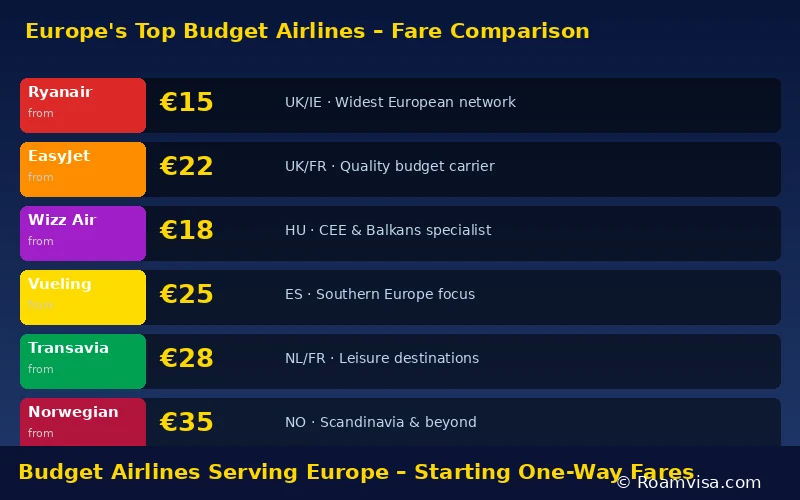
Europe’s leading budget airlines with starting one-way fares – Roamvisa.com
Ryanair – The Volume King
Ryanair is the world’s largest international airline by passenger numbers and the undisputed king of cheap European fares. Headquartered in Dublin with bases across 40+ countries, it operates over 2,400 routes. Base fares can drop to €4.99–€14.99 during flash sales, though more realistic booking prices start around €15–€40 for short hops.
The catch with Ryanair is its add-on structure. Hold baggage, priority boarding, and even a large carry-on bag (the second bag) all cost extra. If you travel light with only a personal item that fits under the seat, Ryanair is almost always the cheapest option in Europe. If you need a hold bag, re-calculate the all-in fare before assuming it beats the competition.
EasyJet – The Comfortable Budget Choice
EasyJet occupies the middle ground between Ryanair’s ultra-stripped model and full-service carriers. It includes one hand luggage bag (larger than Ryanair’s free allowance) and operates from more central airports – London Gatwick and Luton rather than Stansted. For travellers who want slightly better connectivity and slightly less of the ancillary fee game, EasyJet is the preferred budget carrier. Starting fares are typically €22–€50 for popular routes.
Wizz Air – Eastern and Central Europe Specialist
Wizz Air is the budget carrier of choice for Eastern Europe, the Balkans, and routes from the Middle East and Central Asia into Europe. Based in Budapest, it offers exceptional value on routes that other budget carriers ignore – Bucharest, Sofia, Tirana, Kutaisi, Pristina. If your European destination is off the beaten track, Wizz Air may be your best option by a wide margin. Its Wizz Air Discount Club membership (a paid subscription) reduces base fares further for frequent flyers.
Vueling – Southern Europe and Spain
Owned by IAG (the same group as British Airways and Iberia), Vueling offers a slightly more polished product while maintaining budget pricing. It is the dominant carrier at Barcelona El Prat and has an extensive network across Spain, France, Italy, and North Africa. If you are flying to Spain or the western Mediterranean, Vueling frequently offers the most competitive full-service fares with included baggage options.
Transavia and Norwegian
Transavia (operated jointly by Air France-KLM and TUI) covers leisure routes from France and the Netherlands, particularly to Mediterranean beach destinations. Norwegian pioneered low-cost transatlantic travel to Europe – its London Gatwick and Paris CDG routes from North America brought transatlantic fares down dramatically, though its network has contracted significantly post-pandemic. It remains a genuine option for budget transatlantic bookings on select routes.
| Airline | Best For | Baggage Policy | One-Way From | Key Airports |
|---|---|---|---|---|
| Ryanair | Short hops, flash sales | Extra fee | €9–€15 | STN, DUB, BGY, KUN |
| EasyJet | UK/France routes | 1 cabin bag free | €22–€40 | LGW, LTN, CDG T2 |
| Wizz Air | Eastern Europe, Balkans | Extra fee | €18–€35 | BUD, WAW, SOF, LTN |
| Vueling | Spain, Mediterranean | Options available | €25–€45 | BCN, VLC, FCO, CDG |
| Transavia | Leisure, beach routes | Extra fee | €28–€50 | AMS, ORY, EIN |
| Norwegian | Transatlantic to Europe | Extra fee | €35–€199 | LGW, CDG, HEL |
3. Cheapest International Routes to Europe
Where you are flying from has the biggest single impact on your European airfare. Below are the consistently cheapest route options from major global regions, along with the carriers most likely to offer competitive prices.
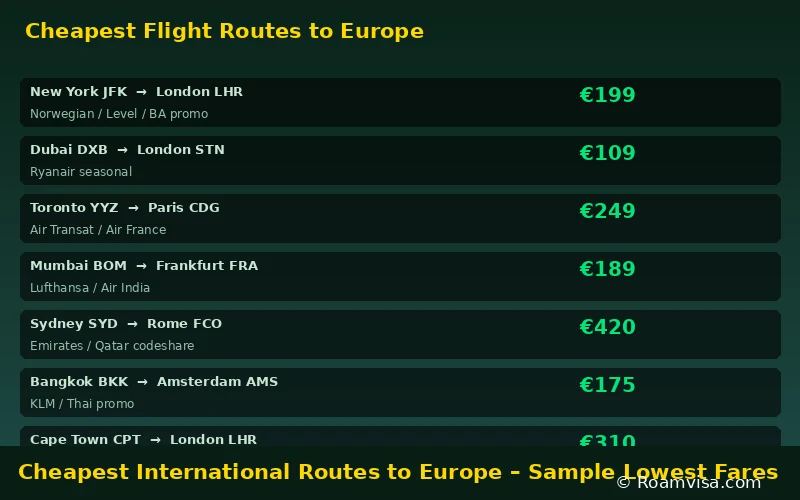
Cheapest international flight routes into Europe from major global origins – Roamvisa.com
From North America
The transatlantic market is the most competitive long-haul aviation corridor in the world. London remains the cheapest and most frequent entry point into Europe from North America. New York JFK to London Heathrow sees fares as low as €149–€199 one-way during promotional windows, with carriers like Norse Atlantic, Level, Iberia, and the three major US/UK carriers all competing. From the US East Coast, flying to London first and then connecting on a budget carrier to your actual European destination is frequently cheaper than a direct flight to cities like Milan, Amsterdam, or Lisbon.
From the US West Coast, fares to Europe are higher due to the greater distance – budget accordingly for $500–$700+ return from Los Angeles or San Francisco, though Icelandair’s Reykjavik stopover option can significantly reduce transatlantic costs if you book flexibly.
From South Asia and the Middle East
The Dubai, Mumbai, Delhi, and Doha corridors into Europe are extremely well-served, with Emirates, Qatar, Etihad, Air India, and IndiGo all competing. Promotional economy fares from Mumbai or Delhi to London can drop as low as €189–€280 return. The Middle East hub carriers – Emirates, Qatar, Etihad – are known for their quality, but their connections to secondary European cities (beyond London, Paris, Frankfurt) are often more competitive than people expect. If you are flying from South Asia, checking both direct and Middle East connecting fares side by side is essential.
Related Articles: Cheapest Month to Fly to Dubai – Complete Fare Comparison
From Southeast Asia and Australia
Bangkok, Singapore, Kuala Lumpur, and Jakarta are well-connected to European hubs. Thai Airways, Singapore Airlines, and Malaysia Airlines are the premium options, while AirAsia’s Kuala Lumpur hub offers budget connections (though these involve a transit). From Australia, the 20+ hour journey to Europe makes layover routing almost unavoidable – Emirates via Dubai, Singapore Airlines via Singapore, and Qatar via Doha are the most popular options and regularly offer competitive promotional fares, especially in January and February.
From Africa
South Africa, Kenya, Nigeria, and Morocco all have direct or well-connected services to Europe. Ethiopian Airlines has expanded aggressively as a hub carrier connecting sub-Saharan Africa to Europe via Addis Ababa, and frequently offers competitive fares. From North Africa, budget carrier routes – including Air Arabia Maroc and Transavia – bring Morocco to European cities for surprisingly low prices. Cape Town to London is typically €310–€450 economy return when booked on promotion.
4. Cheapest European Entry Points – Airport Strategy
One of the most underutilised strategies for finding cheap flights to Europe is choosing your entry airport strategically. Not all European airports are equal in terms of budget carrier access – and the difference in fare between flying into a major hub versus a secondary airport can be enormous.
| Target City | Main Airport (Expensive) | Budget Airport (Cheaper) | Budget Carrier | Transfer Time |
|---|---|---|---|---|
| London | Heathrow (LHR) | Stansted (STN) / Luton (LTN) | Ryanair, EasyJet | 50–75 min to centre |
| Paris | Charles de Gaulle | Beauvais (BVA) | Ryanair | 75–90 min to centre |
| Milan | Malpensa (MXP) | Bergamo (BGY) | Ryanair | 50 min to centre |
| Brussels | Zaventem (BRU) | Charleroi (CRL) | Ryanair, Wizz Air | 60 min to centre |
| Stockholm | Arlanda (ARN) | Skavsta (NYO) | Ryanair | 100 min to centre |
| Frankfurt | Main (FRA) | Hahn (HHN) | Ryanair | 90 min to centre |
| Barcelona | El Prat (BCN) | Girona (GRO) / Reus (REU) | Ryanair | 80 min to centre |
| Rome | Fiumicino (FCO) | Ciampino (CIA) | Ryanair, EasyJet | 40 min to centre |
| Vilnius | Vilnius (VNO) | Kaunas (KUN) | Wizz Air, Ryanair | 90 min to Vilnius |
The key rule: always check the budget airport option before assuming the main airport is cheaper. A Ryanair flight from New York to London Stansted that costs €180 with one hold bag is a better deal than a full-service carrier to Heathrow at €380, even after the slower train connection to central London. Do the maths including ground transport both ways, and you will almost always find the budget airport option wins on total cost.
5. Best Months for Cheap Flights to Europe
Understanding Europe’s seasonal demand pattern is the foundation of smart booking. Europe’s tourism calendar is tightly linked to school holidays and summer weather – which means the cheapest months to fly are almost always outside of these windows.
| Month | Season | Fare Level | Notes |
|---|---|---|---|
| January | Deep Off-Season | Cheapest | Post-Christmas lull, excellent deals |
| February | Off-Season | Very Cheap | Half-term spike mid-month (check dates) |
| March | Shoulder | Cheap–Moderate | Spring beginning, weather improving |
| April | Shoulder/Peak | Moderate–High | Easter holiday surge – avoid those weeks |
| May | Early Summer | Moderate | Good weather, before school holiday rush |
| June | Summer | High | School holidays begin in some countries |
| July | Peak Summer | Highest | School summer holidays – peak demand |
| August | Peak Summer | Highest | Full peak season across Europe |
| September | Shoulder | Moderate | Excellent value – warm, less crowded |
| October | Off-Season Start | Cheap–Moderate | Great weather in Mediterranean |
| November | Off-Season | Cheap | Quiet period – very good deals |
| December | Mixed | Variable | Early Dec cheap; Christmas week peaks sharply |
Best Value Windows to Fly to Europe
- January (after the 7th): Lowest fares of the year across most routes
- Early November: Before Christmas demand begins, weather still mild in south
- Last two weeks of September: Summer crowds gone, fares dropped, weather still warm
- Second half of February (outside of half-term dates): Very cheap mid-season window
- First two weeks of May: Spring at its best, fares before the summer surge
6. 10 Tricks to Get the Cheapest Flights to Europe
Beyond choosing the right month and the right airline, how you search and book makes an enormous difference. These are the ten tricks that consistently deliver the cheapest fares for European flights.
10 proven tricks for finding the cheapest flights to Europe – Roamvisa.com
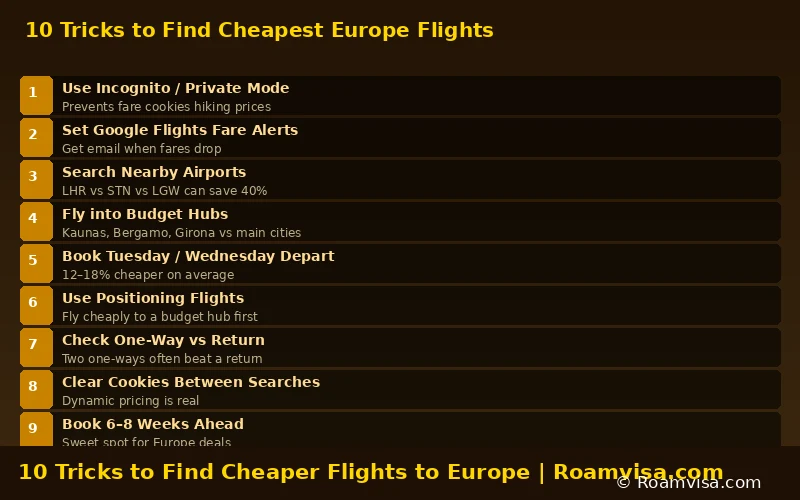
Trick 1 – Always Search in Incognito / Private Mode
Airlines and booking engines use cookies to track your searches. When they see you repeatedly searching the same route, some platforms use dynamic pricing to slightly inflate the fare – nudging you to book before the price goes higher. Always search in an incognito or private browser window to see the genuine published fare without this artificial inflation. This is the simplest trick and costs you nothing.
Trick 2 – Use Google Flights’ Calendar and Price Graph
Google Flights has a Price Graph and a flexible date calendar that shows you the cheapest available fare for every day of a given month on a single screen. Rather than searching a specific date and accepting whatever you are shown, open the calendar view and let the cheapest date find you. The difference between the most expensive and cheapest date in the same month can easily be €80–€150 on European routes.
Trick 3 – Set Up Fare Alerts and Wait
For trips that are 6–12 weeks away, set a fare alert on Google Flights, Skyscanner, or Kayak for your route and target price. Airlines release seats in batches, and fares can drop significantly at certain points – particularly on Tuesdays when carriers upload new promotional inventory. A fare alert means you capture this drop automatically rather than having to check manually every day.
Trick 4 – Check Nearby Departure and Arrival Airports
This works both ways. If you live near multiple airports, always check all of them – the difference between flying from your main city airport and a secondary one 60 minutes away can be €100–€200. On the European arrival side, flying into a secondary airport (Bergamo instead of Milan, Girona instead of Barcelona) and taking a cheap bus to your destination frequently saves far more than the extra ground transport costs.
Trick 5 – Compare One-Way vs Return Fares Separately
Booking a return ticket from the same airline is not always cheaper than booking two separate one-way tickets. With budget carriers especially, mixing airlines (Ryanair outbound, EasyJet return, for example) can yield a lower total than any single carrier’s return fare. Tools like Kiwi.com specialise in finding these mixed-carrier combinations and automatically calculate the cheapest multi-carrier itinerary.
Trick 6 – Use a Positioning Flight
If you are based in a city without a large budget carrier presence, consider a cheap positioning flight to a major budget hub before your main European journey. Flying from a regional city to London Stansted (at €25–€50) and then on to your European destination with Ryanair (at €20–€40) may be significantly cheaper than a direct flight from your origin city, even after accounting for the two flights and the layover time.
Trick 7 – Book 6–8 Weeks Ahead for European Routes
The optimal booking window for European flights is shorter than most people think. For intra-European budget routes, the sweet spot is 4–8 weeks before departure – this is when airlines have released the bulk of their discounted inventory but seats are not yet scarce. Booking 6 months in advance on a Ryanair or EasyJet route rarely yields the cheapest fare; these carriers open routes about 6–8 months out at moderate prices, then prices fluctuate down and eventually back up as the departure date approaches.
Trick 8 – Fly on Unpopular Travel Days
Tuesday, Wednesday, and Saturday are typically the cheapest days to fly in Europe. Friday evening and Sunday afternoon/evening are the most expensive, dominated by business travellers and weekend tourists respectively. If your schedule has any flexibility, shifting a departure from Sunday to Tuesday can save 15–20% on the fare – particularly relevant on longer, more expensive routes.
Trick 9 – Check the Airline’s Own Website Last
Start with meta-search tools (Google Flights, Skyscanner) to identify the cheapest fares and carriers. Then go directly to the airline’s own website to book. Direct booking sometimes – not always – offers a marginally lower price because it cuts out the booking platform’s margin, and you avoid third-party booking fees. It also simplifies changes and cancellations since you deal directly with the carrier. This is especially relevant for budget airlines like Ryanair that charge extra to make changes on bookings made through third parties.
Trick 10 – Target Flash Sales and Newsletter Deals
Every major European budget airline runs flash sales – typically 24–72 hour promotional windows where specific routes are offered at dramatically reduced prices. Ryanair’s €0.99 fare sales (plus taxes), EasyJet’s Big Orange Sale, and Wizz Air’s WIZZ Discount Club promotions are well-known examples. Sign up for airline newsletters and follow their social media channels to catch these sales as they launch. The best flash sale fares are often sold out within hours.
Common Mistakes That Cost You Money on European Flights
- Not factoring in baggage fees – the all-in fare is what matters, not the headline
- Assuming the main city airport is always the best option
- Booking too far in advance on budget carriers (6+ months rarely saves money)
- Ignoring nearby airports at your origin city
- Not comparing one-way vs return on budget carriers
- Searching from the same browser repeatedly (cookie price inflation)
- Overlooking connection options via Middle East or European hubs
7. All-In Cost Comparison – Budget vs Full-Service to Europe
The headline fare is only the starting point. Here is a realistic all-in comparison for a traveller flying from London to Rome on both a budget carrier and a full-service airline, including common extras.
| Cost Item | Ryanair (Budget) | British Airways (Full-Service) |
|---|---|---|
| Base Fare | €19 | €110 |
| Hand Luggage (cabin) | Included (small bag only) | Included (standard) |
| Hold Bag (23kg) | €28–€40 | Included |
| Seat Selection | €5–€18 | Included (most fares) |
| Meals | €10–€15 | Snack included, meal on longer routes |
| Airport (Ciampino vs Fiumicino) | Ciampino – €7 bus | Fiumicino – €15 train |
| TOTAL ESTIMATE | €69–€99 | €132–€155 |
The gap is real but smaller than the headline fare difference suggests. On short European routes where you travel with hand luggage only, Ryanair and EasyJet remain significantly cheaper. On longer routes or for travellers who need a hold bag, the premium carriers close the gap considerably. Always price the full journey, not just the fare displayed on the search results page.
8. Connecting Through European Hubs to Save Money
For international travellers flying into Europe from long-haul origins, routing through a secondary European hub can yield significant savings compared to flying directly to expensive city airports. The hub-and-spoke model is how budget-savvy international travellers have cracked European flight costs for years.
London is the most effective entry hub for budget onward travel in Europe. Stansted and Luton airports are home to some of the densest Ryanair and EasyJet route networks in the world. Flying transatlantic to London on a competitive fare and then connecting to virtually anywhere in Europe on a €20–€50 budget carrier ticket is a well-established strategy that frequently beats the all-in cost of a direct flight to your final European destination. Kaunas in Lithuania is an increasingly popular budget entry point for Eastern Europe – Wizz Air uses it as a hub with extensive Central and Eastern European connections at very low fares. Similarly, Budapest and Bucharest both serve as Wizz Air hubs with exceptional value connections to southeastern European destinations.
Conclusion
Europe’s aviation market rewards informed travellers more than almost any other destination in the world. The infrastructure for cheap travel is all there – hundreds of budget carriers, secondary airports with low fares, and a continent-wide network of connections that makes almost any city reachable for under €100 from within Europe. The challenge is not finding cheap flights to Europe; it is knowing how to look.
Start with the right month – January, November, early October, or late September. Choose the right airline for your luggage needs and route. Use secondary airports where the savings outweigh the transfer time. Book in incognito, set fare alerts, and buy in the 4–10 week window for the best prices. Do not book too far ahead on budget carriers and do not pay for flexibility you will not use. Apply these principles consistently and the cheapest flights to Europe will become a reliable feature of your travel planning – not a lucky accident.
Frequently Asked Questions
Q1. What is the single cheapest way to fly to Europe?
The cheapest way to fly to Europe depends on your origin, but the general strategy is: target January or November travel dates, fly into London Stansted or another budget hub, book 6–8 weeks in advance, travel with hand luggage only on a budget carrier like Ryanair or Wizz Air, and search in incognito mode.
Q2. Is Ryanair genuinely the cheapest airline in Europe?
On many routes, yes – but only when you factor in the all-in cost. Ryanair’s base fares are frequently the lowest available, but the airline charges extra for everything including checked bags, seat selection, and priority boarding. If you travel with only a small personal item that fits under the seat, Ryanair is almost certainly the cheapest option.
Q3. How far in advance should I book cheap European flights?
For intra-European budget carrier routes, the optimal booking window is 4–8 weeks before departure. For transatlantic or long-haul international flights into Europe, book 10–14 weeks ahead. Booking too early on budget carriers (6+ months ahead) often means paying mid-range fares before cheaper promotional inventory is released closer to departure.
Q4. Are secondary airports worth the inconvenience?
Almost always yes, provided the fare saving exceeds the additional transfer cost and time. If flying into London Stansted instead of Heathrow saves you €120 but adds €15 in train fare and 30 minutes of travel time, that trade-off is clearly worthwhile. The key is to calculate total cost and total travel time door-to-door, not just the fare and airport on the ticket.
Q5. Do European budget airlines offer refunds?
Budget airlines typically offer non-refundable tickets on their cheapest fares. EasyJet and some Ryanair fare types offer fee-based changes or flexibility at a higher price tier. If there is any chance your plans may change, either pay for the flexible fare option or purchase travel insurance that covers flight cancellation.
Q6. What is the cheapest European city to fly to overall?
London (Stansted), Budapest, Bucharest, Warsaw, and Kaunas are consistently the cheapest European cities to reach by air from both within Europe and internationally, due to their status as budget carrier hubs and their lower airport costs. From there, you can cheaply connect to anywhere else on the continent.