
Finding Cheapest Flights to Canada takes a bit more strategy than booking a budget hop within Europe or Asia – but the savings available to Travellers who know where to look are substantial. Canada’s vast geography, multiple international gateway airports, and a competitive mix of full-service and ultra-budget carriers mean that the difference between an informed booking and a casual one can easily run to $300–$500 on a single return ticket.

Canada is one of the most beautiful and diverse travel destinations on the planet. From the Rocky Mountains of British Columbia to the French-speaking charm of Montreal, the thundering spectacle of Niagara Falls to the polar bear watching season in Churchill, Manitoba – Canada offers something extraordinary for every type of traveller. The challenge, historically, has been the flight cost. Transatlantic fares to Canada have traditionally been higher than equivalent European routes, and domestic connections within Canada can add significant cost on top.
This guide cuts through all of that. We cover which months offer the lowest fares, which airlines to prioritise, which cities to fly into, how far in advance to book, and nine concrete strategies that will immediately change how you shop for Canada flights. Whether you are travelling from Europe, South Asia, the United Kingdom, Australia, or anywhere else, there is a proven approach to getting a significantly cheaper fare.
Quick Facts – Cheapest Flights to Canada
- Cheapest Months: January, February, November (return fares 30–40% lower than peak)
- Most Expensive: July and August (summer holiday peak)
- Budget Pick: Air Transat – consistently 20–30% cheaper than Air Canada on transatlantic
- Cheapest Entry Airport: Toronto Pearson (YYZ) – best connectivity, most competition
- Best Booking Window: 8–12 weeks ahead for transatlantic; 4–6 weeks for domestic add-on
- Fare Tools: Google Flights, Skyscanner, Momondo, Hopper, Kayak
- Key Trick: Open-jaw routing (fly into Toronto, out of Vancouver) often cheaper than return
1. Why Canada Flights Are Priced the Way They Are
To find cheap flights to Canada, it helps to first understand why fares behave the way they do. Canada is a large country served primarily by transatlantic and transpacific routes from international origins – unlike Europe, where a dense network of intra-continental budget carriers keeps prices highly competitive year-round. Canada’s aviation market is more oligopolistic, historically dominated by Air Canada and WestJet, which has kept average fare levels higher.
However, this picture has changed significantly in recent years. Air Transat – a leisure charter and scheduled airline – has expanded its scheduled transatlantic service aggressively, bringing competitive pricing on European and UK routes. Flair Airlines and Swoop have entered the ultra-low-cost domestic market. And global booking platforms now make it easy to compare every option in seconds, eroding the pricing power that the major carriers once relied on.
The result is that genuine bargains exist – but they require more deliberate searching than equivalent European routes. The traveller who books Canada flights with the same approach they would use for a London-Amsterdam hop is almost certainly paying too much.
2. Best Airlines for Cheap Flights to Canada
Your choice of airline is the single biggest variable in the cost of your Canada flight. Here is a practical rundown of every carrier worth considering, from ultra-budget to full-service, and where each one makes sense.
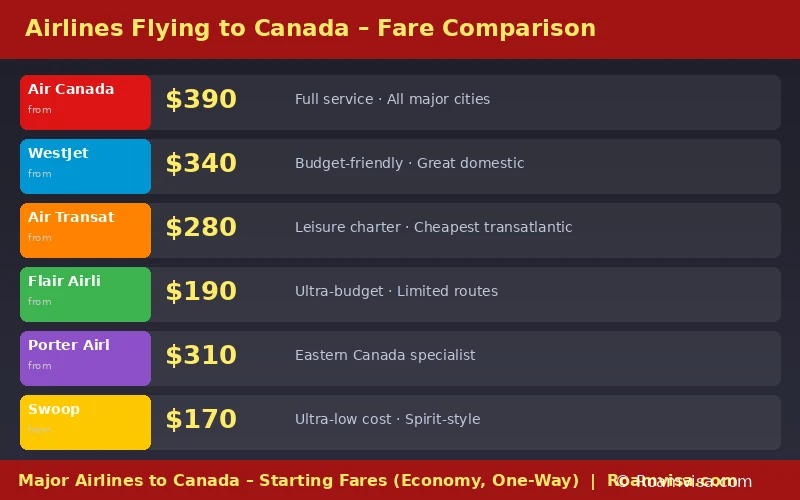
Air Canada – Full Service, Worth Watching for Sales
Air Canada is the country’s flag carrier and operates the widest international network, with direct routes from London Heathrow, Paris CDG, Frankfurt, Tokyo, Sydney, Delhi, and dozens of other cities. Its standard economy fares are not cheap, but Air Canada runs frequent promotional sales – particularly in January and November – where transatlantic economy fares drop to genuinely competitive levels. The airline’s Aeroplan loyalty programme also generates significant value for frequent flyers. If you need direct routing to a secondary Canadian city (not just Toronto or Vancouver), Air Canada is often your only realistic option.
WestJet – The Friendly Budget Alternative
WestJet operates transatlantic routes to London and a handful of European cities, plus an extensive domestic Canadian network. It positions itself as a more relaxed, value-oriented carrier than Air Canada and its base fares are typically 10–20% lower on comparable routes. WestJet Vacations packages (flight plus hotel) can also deliver outstanding value. For domestic travel within Canada – flying from Toronto to Calgary, or Vancouver to Halifax – WestJet and Air Canada compete directly and prices are reasonable when booked a few weeks ahead.
Air Transat – The Transatlantic Budget Champion
Air Transat is the most important airline to know about for budget transatlantic Canada travel. Originally a charter carrier, it now operates a scheduled service between major European cities (London Gatwick, Paris, Amsterdam, Brussels, Lyon, and more) and Canadian cities including Toronto, Montreal, Vancouver, and Calgary. Its economy fares on these routes are consistently 20–30% cheaper than Air Canada on the same route – and its Club Class product (premium economy) is also excellent value compared to full-service business class.
The trade-off with Air Transat is frequency – it does not operate daily on all routes, and its schedule is more oriented around leisure travel patterns. But if your dates are flexible, Air Transat is almost always the first airline to check for Europe-to-Canada routes.
Flair Airlines and Swoop – Ultra-Budget Domestic
Flair and Swoop are Canada’s ultra-low-cost carriers in the Spirit/Ryanair mould – very low base fares but fees for everything including carry-on bags beyond a personal item. They serve domestic Canadian routes (Toronto, Vancouver, Calgary, Edmonton, Winnipeg, Halifax) and some US border routes. For getting around within Canada cheaply once you have landed, checking Flair and Swoop alongside WestJet and Air Canada is essential – base fares can be as low as $39–$99 one-way on popular domestic routes.
Porter Airlines – Eastern Canada Specialist
Porter Airlines operates out of Toronto Billy Bishop City Airport (a short ferry ride from downtown) and focuses on Eastern Canada and US East Coast routes. Its product is notably more pleasant than Flair or Swoop – complimentary snacks, drinks, and a higher level of service are standard. For Eastern Canada destinations (Halifax, Quebec City, Ottawa, Montreal), Porter is worth checking as it frequently offers competitive fares with a significantly better on-board experience.
| Airline | Type | Routes | One-Way From | Baggage |
|---|---|---|---|---|
| Air Canada | Full Service | Global network | $290 | 23kg included on most fares |
| WestJet | Hybrid | Transatlantic + domestic | $240 | 1 bag included on Plus fares |
| Air Transat | Leisure/Budget | Europe↔Canada transatlantic | $180 | Extra fee on base fares |
| Flair Airlines | Ultra-Budget | Domestic Canada + US | $39 | All bags extra |
| Swoop | Ultra-Budget | Domestic Canada | $29 | All bags extra |
| Porter Airlines | Hybrid | Eastern Canada + US East | $89 | 1 carry-on included |
3. Cheapest Months to Fly to Canada
Canada’s airfare calendar is strongly influenced by its climate and tourism seasons. The country’s most popular visitor months – July and August – coincide with its most expensive flight prices. Conversely, the long Canadian winter (outside of the Christmas window) produces some of the lowest fares of the year. Understanding this cycle is the foundation of booking cheap Canada flights.
Average economy return fares to Canada by month – green indicates budget season | Roamvisa.com
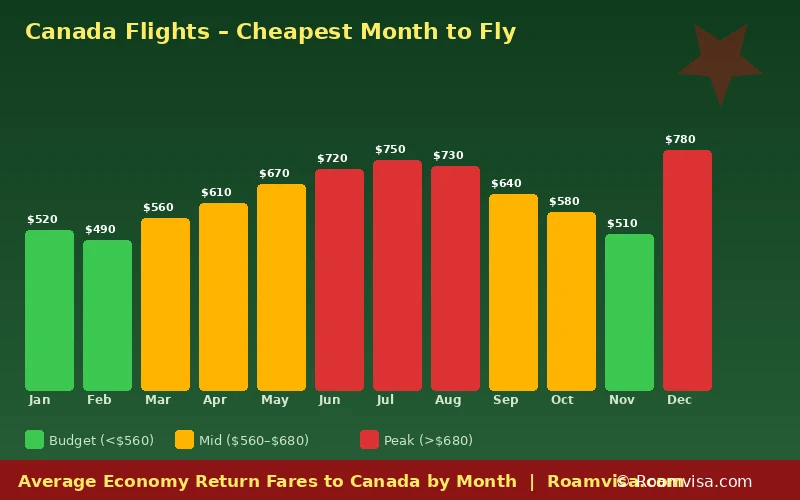
| Month | Fare Season | Avg Return (Economy) | What to Expect |
|---|---|---|---|
| January | Cheapest | $490–$560 | Post-Christmas low – excellent deals, cold weather |
| February | Budget | $470–$540 | Still very cheap, fewer tourists, winter conditions |
| March | Shoulder | $540–$620 | Spring approaching, fares creeping up |
| April | Shoulder | $580–$650 | Good weather emerging, demand rising |
| May | Rising | $630–$710 | Pre-summer bookings push fares higher |
| June | High | $680–$760 | Summer season begins, prices elevated |
| July | Peak | $720–$800+ | School holidays – most expensive month |
| August | Peak | $700–$790 | Still peak season, families travelling |
| September | Shoulder | $610–$680 | Kids back in school – fares ease quickly |
| October | Good Value | $550–$630 | Fall foliage season – popular but reasonable |
| November | Budget | $490–$560 | Very cheap fares, beautiful autumn lingering |
| December | Mixed | $520–$820+ | Early Dec cheap; Christmas week surges sharply |
Best Value Windows to Fly to Canada:
January (after the 7th): Lowest fares of the year on most routes
November (first 3 weeks): Excellent deals before Christmas demand builds
Late September – early October: Autumn foliage, cooler temperatures, fares easing
Mid-February (outside school half-term): Very cheap mid-winter window
Early May (before the 20th): Before summer fare surge, shoulder weather
4. Which Canadian City to Fly Into – Airport Strategy
Canada has five main international gateway airports and your choice of entry city significantly affects your fare. Here is what you need to know about each.
Toronto Pearson (YYZ) – The Cheapest Hub
Toronto Pearson is Canada’s busiest airport and, crucially, its most competitive. More airlines fly to Toronto than any other Canadian city, which drives fares down through competition. If you are flexible about your ultimate Canadian destination, flying into Toronto first and then connecting domestically is frequently the cheapest overall strategy – even if Toronto is not your final stop. WestJet, Flair, and Air Canada all operate extensive domestic networks from YYZ.
Montreal Trudeau (YUL) – Bilingual Budget Pick
Montreal is Canada’s most European-feeling city and has direct transatlantic connections with Air Transat, Air Canada, and some European carriers. For travellers from France specifically, Paris CDG to Montreal is often extremely competitive – the cultural and linguistic connection drives demand and therefore airline supply on this route. Montreal is also a natural base for exploring Quebec City, Ottawa, and the Eastern Canadian provinces.
Vancouver International (YVR) – West Coast Gateway
Vancouver is the entry point for Western Canada and is well-connected to Asia Pacific routes – making it the natural choice for travellers from Australia, Japan, South Korea, and Southeast Asia. From Europe and the Americas, Vancouver fares are typically $50–$100 higher than Toronto on comparable routes due to the greater distance, but it saves you a long domestic connection if British Columbia or the Canadian Rockies are your destination.
Calgary (YYC) and Edmonton (YEG) – Rocky Mountain Access
For the Canadian Rockies – Banff, Jasper, Lake Louise – Calgary is the closest international gateway. Direct transatlantic flights to Calgary are limited but Air Canada, WestJet, and occasional Air Transat services operate seasonally. Flying into Calgary directly can be cheaper overall than flying into Toronto and paying for an internal flight westward, particularly in summer when domestic fares spike alongside international ones.
| Airport | Code | Best For | International Direct Routes | Domestic Connections |
|---|---|---|---|---|
| Toronto Pearson | YYZ | Cheapest entry, most routes | Global – widest selection | Excellent – all Canada |
| Montreal Trudeau | YUL | Eastern Canada, French routes | Europe especially France | Good – Eastern focus |
| Vancouver Intl | YVR | West Coast, Asia Pacific | Asia, UK, US West Coast | Good – Western focus |
| Calgary Intl | YYC | Rocky Mountains access | Limited transatlantic | Good – western hub |
| Halifax Stanfield | YHZ | Atlantic Canada | UK / Ireland seasonal | Limited domestic |
Related Articles: Best Time to Fly to Canada- Cheapest Months and Airlines
5. Best Booking Strategies for Cheap Canada Flights
Beyond choosing the right month and airline, how you search and when you book makes a tangible difference on Canada fares. Here are the nine strategies that consistently deliver the cheapest tickets.
9 best booking strategies to find cheap flights to Canada – Roamvisa.com

Strategy 1 – Book 8–12 Weeks Before Departure
Transatlantic and long-haul flights to Canada respond best to bookings made 8–12 weeks ahead of departure. This is when airlines have released the bulk of their discounted economy inventory but seats have not yet become scarce. Booking further out – 6+ months – rarely yields the cheapest fares on Canada routes because airlines open with moderate pricing and release cheaper batches progressively as the departure date approaches. For domestic Canadian connections, 4–6 weeks ahead is the optimal window.
Strategy 2 – Make Air Transat Your First Search Stop
If you are flying between Europe and Canada, always start with Air Transat before checking other carriers. Its fares are consistently 20–30% below Air Canada on the same transatlantic routes, and it covers London, Paris, Amsterdam, Brussels, Lyon, Glasgow, Dublin, and several other European departure cities. The airline runs seasonal sales in January and February with particularly aggressive pricing. Do not overlook it simply because it is a less familiar name – it is a fully regulated scheduled carrier with a strong safety record.
Strategy 3 – Consider Open-Jaw Routing
Canada’s geography makes open-jaw routing – flying into one city and out of another – a genuinely useful strategy. Flying from London into Toronto, travelling across Canada by train, bus, or domestic flight, and then flying home from Vancouver is not only a richer travel experience; it frequently costs less than a return to either city alone. Booking platforms like Skyscanner and Google Flights allow you to search open-jaw itineraries directly. Always compare the open-jaw total against a simple return before assuming one is cheaper.
Strategy 4 – Use Toronto as Your Hub for Domestic Connections
If your ultimate destination is not Toronto itself, flying into Toronto and connecting domestically is often cheaper than buying a direct flight to your final Canadian city. Toronto’s status as the most competitive international gateway means the transatlantic portion of your journey is priced more aggressively. Domestic fares from Toronto to Calgary, Halifax, or Vancouver can be found for $99–$199 one-way on Flair, Swoop, or WestJet – often making the two-stage journey cheaper than a single direct flight from your European or global origin.
Strategy 5 – Target January and November Windows
Canada’s two deepest budget windows are January (after the 7th, once New Year travel subsides) and November (the first three weeks, before Christmas demand builds). Both periods see return fares from Europe drop to $490–$560 – a saving of $200–$300 compared to July. The weather is cold in most of Canada during these months, but indoor cultural attractions (museums, restaurants, galleries), winter sports, and the stunning beauty of a snow-covered Canadian landscape are all strong reasons to travel. Northern lights visibility is also at its best in January and November from high-latitude Canadian locations.
Strategy 6 – Compare YYZ vs YUL vs YVR on Every Search
Do not assume Toronto is always the cheapest entry point. Run a quick three-way comparison – Toronto, Montreal, and Vancouver – every time you search Canada flights. The cheapest city to fly into on a given date varies with supply, airline schedules, and seasonal demand patterns. On some dates, Montreal is $80 cheaper than Toronto; on others, Vancouver undercuts both. This 60-second check at the start of every search session is one of the easiest ways to find consistent savings.
Strategy 7 – Set Fare Alerts on Multiple Platforms
Canada is one of the best routes for fare alerts because prices fluctuate more than on well-regulated short-haul markets. Set alerts on Google Flights, Skyscanner, and Hopper simultaneously – each platform captures different sale events and airline promotional windows. Hopper’s AI prediction feature is particularly useful for Canada: it tells you whether current fares are likely to fall or rise, and recommends whether to buy now or wait. For travel 10–14 weeks out, waiting for a promotional window rather than buying immediately can save $150–$250.
Strategy 8 – Fly Mid-Week and Avoid Sunday Returns
Tuesday and Wednesday departures to Canada are typically 12–18% cheaper than Friday evening or Sunday flights. This pattern is consistent across Air Canada, WestJet, and Air Transat. Sunday returns – particularly Sunday evening – are the most expensive day for transatlantic fares due to demand from business travellers extending weekend leisure trips. If your schedule permits even a one-day shift, the savings on a transatlantic ticket are meaningful.
Strategy 9 – Check Package Deals and WestJet Vacations
For travellers planning to stay in hotels or resorts, package deals (flight plus accommodation) can deliver genuine savings over booking each element separately. WestJet Vacations is the best-known Canadian package operator and frequently runs promotions where the combined cost of a flight and hotel is lower than the flight alone from competing booking platforms. Air Transat similarly offers package holidays to sun destinations (Caribbean, Mexico) through Canada that can undercut component pricing significantly. Always price both the package and the individual elements before committing.
Expensive Mistakes to Avoid on Canada Flights:
- Booking in July or August without checking November/January alternatives
- Ignoring Air Transat on European-Canada routes – it is almost always cheaper
- Flying direct to your final Canadian city without checking the Toronto hub strategy
- Paying for flexibility on budget carriers you will not use
- Not comparing open-jaw vs return – Canada’s geography rewards one-way routing
- Booking domestic Canadian connections on the same ticket as international (forces same carrier)
- Assuming the most familiar airline name is the best value
6. Regional Guide – Cheapest Flights by Origin
From the United Kingdom
The UK-Canada corridor is one of the most competitive transatlantic routes. London Heathrow, Gatwick, and Manchester all have direct services to Toronto and Vancouver. Air Transat’s London Gatwick to Toronto route is the budget benchmark – fares frequently drop to £280–£380 return in January and November. Air Canada and WestJet compete with full-service alternatives. Flying from London Heathrow to Toronto is typically £30–£60 more expensive than the Gatwick equivalent due to higher airport costs.
From Europe (Continental)
Paris CDG to Montreal is the most culturally specific and competitively priced route from mainland Europe, driven by the shared French-speaking connection. Air Transat, Air Canada, and Air France all serve it and promotions are frequent. From Germany and the Netherlands, KLM and Lufthansa offer connections via their hubs (Amsterdam and Frankfurt) to all major Canadian cities. Direct German-Canada routes are more limited, making connection fares the standard option.
From South Asia and the Middle East
India, Pakistan, and the Gulf states are large source markets for Canada given significant diaspora communities. Air India operates direct Delhi to Toronto and Vancouver services, and competitive fares emerge regularly on this route. Gulf carriers (Emirates, Qatar, Etihad) offer excellent one-stop connections from South Asian cities to Toronto and Vancouver via their Dubai, Doha, and Abu Dhabi hubs – and frequently offer lower all-in fares than direct Air India services, particularly when booked on promotion.
From Australia and New Zealand
The routing options from Australia to Canada are via Asia (Singapore Airlines, Cathay Pacific, Air Canada via Hong Kong) or across the Pacific (Air Canada’s direct Sydney to Vancouver service, which runs seasonally). The Sydney to Vancouver direct is approximately 15–16 hours and offers genuine value when booked on promotion – checking Air Canada’s Pacific promotional sales in January and February is recommended. Return fares from Sydney to Vancouver start around AUD 1,400–1,800 in budget windows.
Conclusion
Cheap flights to Canada are more accessible than most people assume – the key is knowing where to look and when to book. Air Transat on the transatlantic leg, a Toronto entry hub strategy, January or November travel dates, and an open-jaw itinerary approach are the four pillars that consistently deliver the lowest fares. Layer on top of those the mid-week departure habit, a set of live fare alerts, and the discipline to compare all-in fares rather than headline prices, and you have a complete toolkit for booking Canada flights at a fraction of what unprepared travellers pay.
Canada rewards the traveller who shows up prepared. The country is spectacular in every season – and with the right booking strategy, the flight getting you there does not have to drain the budget you need for the experience itself.
Frequently Asked Questions
Q1. What is the cheapest month to fly to Canada?
January and November are consistently the cheapest months to fly to Canada. Post-Christmas demand subsides in early January and November sits outside both the summer peak and the Christmas holiday surge. Economy return fares from Europe drop to $490–$560 during these months – a saving of $200–$300 compared to peak summer fares.
Q2. Is Air Transat worth considering for Canada flights?
Yes, absolutely. Air Transat is a licensed, fully scheduled carrier operating transatlantic routes between Europe and Canada. Its fares are consistently 20–30% lower than Air Canada’s on comparable routes. The product is oriented towards leisure travellers – think more relaxed boarding, good in-flight entertainment, and optional meal packages – rather than the business-travel focus of the full-service carriers.
Q3. Is it cheaper to fly into Toronto or Vancouver?
Toronto (YYZ) is generally the cheapest Canadian entry point due to the volume of airline competition on the route. Vancouver is typically $50–$100 more expensive from European and UK origins. However, always run a side-by-side comparison on your specific travel dates – the cheapest city varies, and if your final destination is Western Canada, the saving on Vancouver’s transatlantic fare may be wiped out by a domestic connection from Toronto.
Q4. How far in advance should I book Canada flights?
For transatlantic flights to Canada, the optimal booking window is 8–12 weeks before departure. Booking 6+ months ahead on most transatlantic routes rarely captures the cheapest fares – airlines release discounted inventory progressively as departure approaches. For domestic Canadian connections, 4–6 weeks ahead is typically optimal. Set fare alerts to capture any promotional drops rather than committing at the first price you see.
Q5. Can I find cheap domestic flights within Canada once I arrive?
Yes. Flair Airlines and Swoop are Canada’s ultra-low-cost domestic carriers with base fares from $29–$99 one-way on popular routes. WestJet is also competitively priced and covers a wider network. Book domestic legs separately from your international ticket – buying them as part of a single international booking forces you onto the same carrier and removes the budget airline option. The domestic flight booking window is shorter: 4–6 weeks ahead typically delivers the best prices.
Q6. Are there any useful travel pass options for multiple Canadian cities?
Air Canada offers the North America Airpass for international visitors arriving in Canada – a pre-purchased block of domestic flight coupons at reduced per-coupon rates. It is best value if you plan to visit 4+ cities within Canada. WestJet also runs periodic promotional fares for multi-city Canadian itineraries. For a classic cross-country trip covering Toronto, Calgary, Vancouver, and potentially Halifax, comparing the Airpass against individual budget carrier bookings is worth doing before your international flight departs.