Flying to London from India is one of the most price-sensitive long-haul routes in the world. The same economy seat on the same Air India flight from Delhi to Heathrow can cost a family of four anywhere between 80,000 rupees and 2.4 lakh rupees, depending on nothing more than the month you book and the month you fly. Most Indian travellers accept this as random luck. It is not random. It follows a very predictable pattern tied to British school holidays, European summer demand, and the festive peaks at both ends of the route.
This guide breaks down the real month-by-month fare data for the Delhi–London, Mumbai–London, and Bengaluru–London corridors, based on aggregated booking data from Kayak, Skyscanner, Trip.com, Momondo, and Cheapflights over the past twelve months. You will see exactly which three months consistently come in cheapest, which three months you should avoid at any cost, and how far in advance you should be booking to catch the lowest fare of the year. We also cover the day-of-week effect, time-of-day effect, and which carriers consistently drop their fares first when demand softens so you know whose alert to set up and whose to ignore.
Quick Facts Flying to London from India
✓ Cheapest months: February, March, and October (average return fares 30–45 percent below peak)
✓ Most expensive months: July, August, and mid-December (school holidays plus peak summer European demand)
✓ Cheapest days to fly out: Tuesday, Wednesday, and Thursday Fridays and Sundays cost the most
✓ Ideal booking window: 8 to 12 weeks before departure not six months, not two weeks
✓ Cheapest time of day: early morning departures (before 08:00) save 10–15 percent on average
✓ Cheapest direct airline from India: Air India on the Delhi–Heathrow and Mumbai–Heathrow routes
✓ Cheapest connecting airlines: Kuwait Airways, Gulf Air, Saudia, Oman Air (2–4 hour layover in the Gulf)
The Three Cheapest Months to Fly to London from India
If you are flexible on when you travel, flying in February, March, or October will save you more money than any other single decision you make on a London trip. Across every major booking platform Kayak, Momondo, Skyscanner, Trip.com, and Cheapflights these three months consistently show up in the lowest fare bracket, often 30 to 45 percent below the July–August peak. The reason is simple supply and demand. British schools are in full term, European tourism has gone to sleep, and the weather in London has discouraged all but the most determined visitors. Airlines respond by dropping fares hard to fill the same cabin capacity they sell at a premium in summer.
February Valentine Week Is the Trap, Not the Month
February is generally the cheapest month of the calendar year to fly from India to London, but there is one catch: avoid the Valentine week block (roughly 10 to 16 February) when short-haul European demand briefly spikes fares back up. The last week of February, particularly the 20th to 28th window, often delivers the single lowest fares of the year. Momondo data shows average February returns from Delhi hovering around 58,000 to 68,000 rupees, and aggressive flash sales on Kuwait Airways, Saudia, and Gulf Air routinely produce fares in the 42,000 rupee range.
March The Hidden Winner Most Travellers Miss
March is the data-driven winner for the Delhi–London corridor. Trip.com fare aggregation across twelve months shows the average one-way fare dropping to approximately 20,783 rupees, with Air India leading the price drops. The first three weeks of March (before Easter moves into late March or April, depending on the year) are the sweet spot. By mid-March, British spring is still weeks away, Indian summer has not yet triggered vacation bookings, and airlines are clearing inventory before the Easter bump. Return fares to Heathrow from Mumbai and Delhi during this window typically settle in the 55,000 to 72,000 rupee range.
October Post-Summer Cliff
October is the third low-fare window and an excellent choice if February or March do not suit your school or work calendar. Once British half-term ends in the third week of October, demand falls off a cliff, and airlines cut fares through the end of the month. Average October returns sit around 62,000 to 78,000 rupees from Indian metros. The weather in London is cold but not yet bleak, the autumn colours in Hyde Park and Kew Gardens are genuinely beautiful, and tourist attractions are at their least crowded of the year. For travellers who want sightseeing without peak-summer queues, October is objectively the best value month of the year.
Month-by-Month Fare Breakdown Delhi to London Heathrow
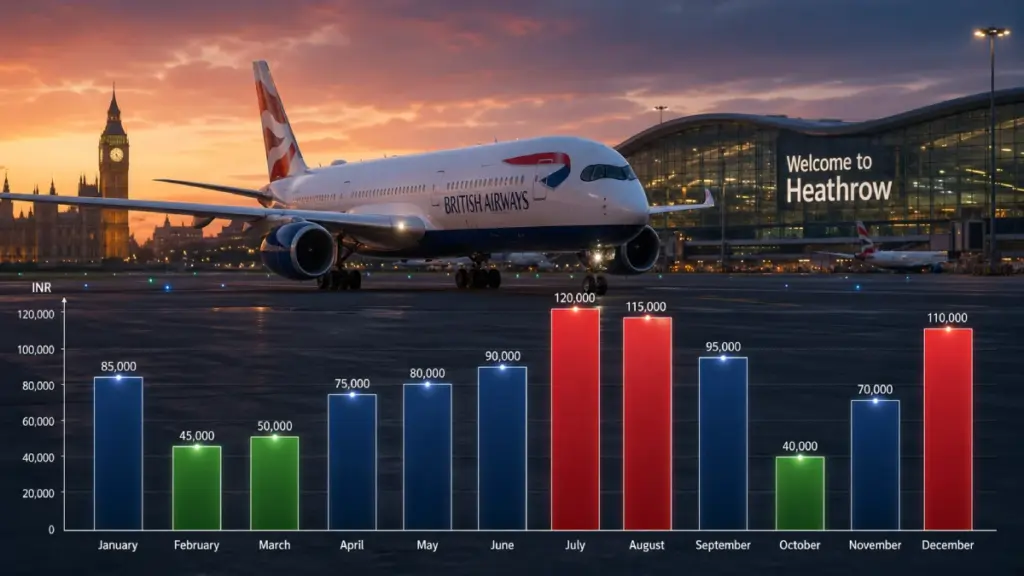
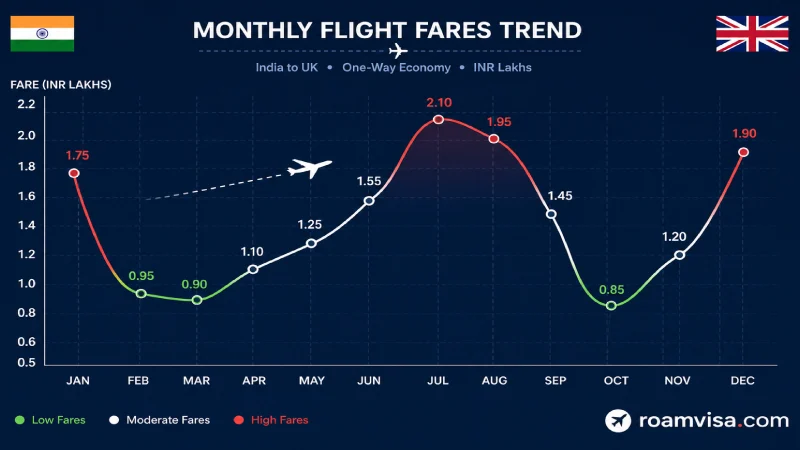
The table below shows average return economy fares across Air India, British Airways, Virgin Atlantic (direct), and the three cheapest connecting carriers (Kuwait Airways, Gulf Air, and Saudia) aggregated from twelve months of booking data. Fares are indicative flash sales can drop 20 to 30 percent below these numbers, and peak days within a low month can add 15 to 20 percent.
| Month | Avg Return Fare (INR) | Demand Level | Best Sub-Window |
| January | 65,000 – 82,000 | Low | Second half after New Year rush |
| February | 58,000 – 72,000 | Very Low (Cheapest) | 20–28 Feb (avoid Valentine week) |
| March | 55,000 – 74,000 | Very Low | 1–20 March (before Easter) |
| April | 72,000 – 95,000 | Medium | First week, before Easter holiday |
| May | 82,000 – 1,10,000 | Medium-High | Early May; avoid Bank Holiday |
| June | 1,05,000 – 1,45,000 | High | First week only |
| July | 1,35,000 – 1,95,000 | Peak (Avoid) | No cheap window book or skip |
| August | 1,40,000 – 2,10,000 | Peak (Avoid) | Last week as demand starts falling |
| September | 85,000 – 1,15,000 | Medium | Mid-month after school resumes |
| October | 62,000 – 85,000 | Low (3rd cheapest) | Last 10 days of October |
| November | 60,000 – 78,000 | Very Low | Entire month except last week |
| December | 75,000 – 1,85,000 | Mixed (Split) | 1–15 Dec cheap; 16–31 Dec very expensive |
Why February, March, and October Are Genuinely Cheaper (It Is Not Random)
Indian travellers often assume airline pricing is arbitrary. It is not. London-bound pricing follows three overlapping demand cycles that any frequent flyer can predict once they know the pattern.
1. The British School Calendar
The UK school system has three long terms with short half-term breaks in October and February, and long breaks at Christmas, Easter, and summer. When British children are in school, domestic and outbound European travel from the UK drops sharply. Airlines fill their India-bound return legs (inbound Indian traffic) with Indian VFR and tourist traffic at discounted fares to maintain load factors. February and late October specifically sit immediately after British half-term weeks, when family travel has ended and fares collapse for two to three weeks.
2. European Summer Tourism Demand
London is a major European tourism hub for Spanish, Italian, French, and German leisure travellers from mid-June through early September. That demand spills over into all transatlantic and Asian long-haul capacity, pushing fares up across the board. From October onwards, intra-European tourism collapses, and long-haul carriers lose their pricing leverage. Between November and March, airlines like British Airways, Virgin Atlantic, and Lufthansa (via Frankfurt) aggressively discount Asian feeder routes including Delhi, Mumbai, and Bengaluru.
3. Indian Outbound Holiday Patterns
Indian summer holidays (mid-April to late-May school break; late-September Diwali run-up; late-December to early-January Christmas and New Year) create three outbound demand peaks that raise fares regardless of what is happening in the UK. The months that fall outside all three Indian peaks and all three UK peaks specifically February, early March, and late October are therefore structurally the cheapest. This is a supply-and-demand fact, not a sale gimmick.
The Three Months to Avoid At Any Cost
July and August Peak Season Tax
July and August together make up the single most expensive eight-week window of the calendar year on the India–London corridor. Average return fares climb to 1.35 to 2.10 lakh rupees from Delhi and Mumbai, with Bengaluru frequently 10 to 15 percent higher due to thinner direct capacity. The combination of Indian summer school break, British and European summer tourism, and year-end corporate and academic travel from India to the UK creates demand that airlines simply do not need to discount. Setting a price alert during this window is almost pointless there is no floor to wait for.
Mid to Late December The Christmas Cliff
Early December (1 to 15 December) is a genuinely low-demand window with fares near February levels. But from 16 December onwards, prices triple virtually overnight. Christmas and New Year travel peaks on 20 December to 2 January are among the most expensive single-day fares of the year, regularly exceeding 1.80 lakh rupees one-way in economy. If your plans are flexible, fly out before 15 December or delay your return to 8 January the difference is often 70,000 to 90,000 rupees per ticket.
Late April and Early May The Hidden Trap
Many Indian travellers assume April and May are low-season because they are not summer. They are wrong. Easter holiday movement in the UK and Europe, combined with early bookings for the Indian summer break, keep fares elevated. Late April specifically hits a sweet spot of high demand with average fares often exceeding September levels. The only value weeks in this range are the first seven to ten days of April, before Easter but that window varies year to year.
Which Airlines Drop Fares First on the India–London Route
Every airline on the Delhi–London, Mumbai–London, and Bengaluru–London corridors does not behave the same way. Some are aggressive on discounting, some are conservative. Knowing who moves first lets you set price alerts on the right carriers and ignore the noise from the others.
Kuwait Airways, Gulf Air, Saudia, Oman Air Fastest to Discount
Middle Eastern connecting carriers routing through Kuwait, Bahrain, Jeddah, and Muscat are consistently the first to cut fares when demand softens. They have weaker brand pull than Emirates or Qatar Airways, which forces them to compete on price. During February, March, and October, these four airlines frequently publish India–London return fares in the 42,000 to 58,000 rupee range often 25 to 35 percent below Air India or British Airways direct. The trade-off is a 2 to 4 hour layover in the Gulf, which many travellers find acceptable for that level of saving.
Air India Best Direct Value
For passengers who will not accept a layover, Air India is the best value direct carrier on this route. The airline runs multiple daily direct flights to both Heathrow and Gatwick from Delhi and Mumbai, and their pricing on the Delhi–Heathrow corridor consistently tracks 10 to 20 percent below British Airways and Virgin Atlantic for the same travel dates. Their advance-purchase fares opened 10 to 12 weeks ahead of departure are often the lowest direct fares available.
British Airways and Virgin Atlantic Slowest to Discount
The two British flag carriers hold their fares firmly through most of the year and rarely discount heavily except in January and September flash sales. Their advantage is in service quality, Heathrow terminal experience, and frequent-flyer earning potential. If your employer is covering the flight or the Avios miles matter, British Airways and Virgin Atlantic are worth the premium. For pure price optimisation, they should not be your first alert.
Emirates, Etihad, Qatar Airways Premium Connecting Carriers
These three are typically priced between the cheap Middle Eastern carriers and the direct British flag carriers. They discount during India–London low seasons but not as aggressively as Kuwait Airways or Gulf Air. Their value proposition is cabin quality, punctuality, and connecting airport experience (Dubai, Abu Dhabi, Doha). For a moderate premium over Kuwait or Saudia, you get a measurably better journey.
The 8 to 12 Week Booking Window Rule
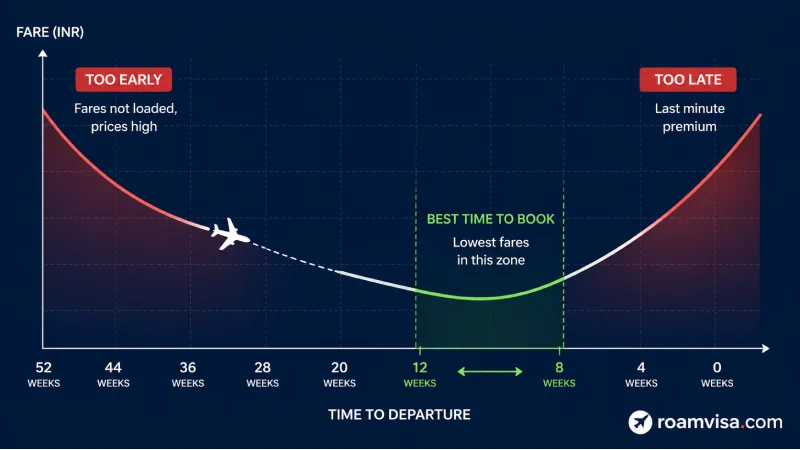
Conventional advice says to book as early as possible. Data disagrees. Cheapflights booking analysis shows that the optimal booking window for India–London Heathrow flights is 8 to 12 weeks (approximately 60 to 86 days) before departure. Booking earlier than 16 weeks out frequently produces higher fares because airlines have not yet begun their demand-based price adjustments. Booking later than 4 weeks out triggers last-minute premium pricing that can add 30 to 50 percent.
Related Articles: Cheapest Days to Fly to the USA – Save Hundreds on Fares
The 8 to 12 week window works because airlines use revenue-management algorithms that monitor bookings against forecast demand. Around 8 to 12 weeks out, if bookings are tracking below forecast, the algorithm releases lower fare buckets to stimulate demand. If you happen to book during these releases, you catch the low. Setting price alerts on Kayak, Skyscanner, and Google Flights 14 weeks before departure and booking the first significant drop in the 8 to 12 week window is the single most effective tactic any Indian traveller can use on this route.
Last-Minute Exceptions (Fewer Than 14 Days)
If you absolutely must travel within two weeks, your best option is not the major aggregators it is a direct check on Kuwait Airways, Gulf Air, and Oman Air websites. These carriers occasionally release empty-seat last-minute fares that never appear on OTAs. For those booking inside the 14-day window, our guide on how to find last-minute cheap flights to London 5 tricks that work covers specific tactics including which airline websites to check and what time of day carriers typically release last-minute inventory.
Best Day of the Week and Time of Day to Fly
Day of the Week
Tuesdays, Wednesdays, and Thursdays are consistently the cheapest departure days from Indian metros to London. Momondo data places Friday departures at around 559 pounds average and Sunday at 580 pounds, while mid-week flights drop 10 to 15 percent below these numbers. Fly out on a Tuesday or Wednesday and return on a Thursday or Saturday (not Sunday) for the best combined weekly saving.
Time of Day
Early morning departures from Delhi or Mumbai (typically before 08:00) tend to be 10 to 15 percent cheaper than afternoon or evening flights. The reason is simple business travellers prefer evening departures to maximise working hours, and airlines price accordingly. For leisure travel, morning flights are not only cheaper but also land in London in the afternoon (14:00 to 16:00 local time), which is the easiest time for public transport and hotel check-in. Evening flights from India land in London in the early hours and often mean a night airport stay or an additional hotel night.
7 Mistakes That Cost Indian Travellers Thousands on London Flights
- Booking too early fares published 6 months out are almost always higher than the same fare 10 weeks out, because airlines have not yet applied revenue-management discounts.
- Booking too late anything inside 14 days triggers premium pricing on every major carrier except occasional last-minute Gulf releases.
- Ignoring Tuesday through Thursday departures flying Friday or Sunday costs 10 to 15 percent more for no benefit.
- Assuming Heathrow is always cheaper than Gatwick Gatwick fares are frequently lower from Mumbai, and the train to central London takes the same 30 to 45 minutes from either airport.
- Ignoring connecting carriers Kuwait Airways, Gulf Air, and Saudia can save 30 to 40 percent for a 3 to 4 hour Gulf layover that many travellers actually welcome as a break.
- Booking round-trip when one-way plus one-way is cheaper checking both options on the same route takes 60 seconds and occasionally saves 15,000 to 25,000 rupees.
- Not setting price alerts 14 weeks before departure missing the 8 to 12 week release window is the single most common cause of overpaying on this route.
Before You Book: A Quick Visa Reminder
Flight timing matters, but so does your visa. Indian passport holders need a Standard Visitor Visa plus, since the rollout, an Electronic Travel Authorisation (ETA) for UK entry in some cases. If you have not sorted your paperwork yet, check our detailed breakdown of UK ETA requirements who needs it, cost, and how to apply before booking a non-refundable ticket, because visa processing timelines can affect your ability to use the cheap fare you just locked in.
Final Thoughts
The cheapest month to fly from India to London is not a secret, a trick, or a seasonal coincidence. It is the structural outcome of British school calendars, European tourism patterns, and Indian outbound holiday cycles overlapping. Fly in February, March, or October and you will pay 30 to 45 percent less than July or August travellers on the same Air India aircraft, for the same 10-hour journey, arriving at the same Heathrow terminal. The only trade-off is cooler weather, which for most Indian travellers is a feature, not a bug.
If you can plan 8 to 12 weeks ahead, set alerts on Kayak and Skyscanner 14 weeks before your intended departure, and stay flexible between Tuesday, Wednesday, and Thursday departures, you will consistently fly to London for between 55,000 and 75,000 rupees return. That is the realistic floor. Anything higher than 90,000 rupees in low season is evidence that you have waited too long, picked the wrong weekday, or chosen the wrong airline. Use the data in this guide, and you will not make those mistakes again.
Frequently Asked Questions
What is the single cheapest month to fly from Delhi to London?
March is the cheapest month on the Delhi–Heathrow corridor based on twelve months of aggregated booking data, with average one-way fares around 20,700 rupees and return fares between 55,000 and 74,000 rupees. The first three weeks of March, before Easter, produce the year’s lowest fares.
Is it cheaper to fly from Mumbai or Delhi to London?
Delhi is marginally cheaper on most routes because of higher direct flight capacity and competition from more carriers. Mumbai fares run approximately 3,000 to 8,000 rupees higher in economy class for the same dates. Bengaluru is typically 10 to 15 percent more expensive than Delhi due to thinner direct capacity.
How far in advance should I book my London flight?
Book 8 to 12 weeks before departure roughly 60 to 86 days. This is the window when airline revenue-management systems release their lowest fare buckets. Booking 6 months out is not cheaper, and booking within 2 weeks triggers last-minute premium pricing of 30 to 50 percent.
Is Air India genuinely the cheapest direct airline to London from India?
Yes, on the Delhi and Mumbai corridors. Air India consistently prices its Heathrow and Gatwick direct flights 10 to 20 percent below British Airways and Virgin Atlantic for equivalent travel dates, especially in the February, March, and October low-fare windows.
Should I choose a direct flight or a connecting flight to save money?
If saving 25,000 to 40,000 rupees on a return ticket matters to you, take a connecting flight via Kuwait, Bahrain, Muscat, or Jeddah on Kuwait Airways, Gulf Air, Oman Air, or Saudia. The layover is 2 to 4 hours, which many travellers welcome. If time matters more than money, Air India direct is the best value option.
Do prices differ much between Heathrow and Gatwick?
Yes, particularly from Mumbai where Gatwick fares are frequently 4,000 to 9,000 rupees cheaper than Heathrow on the same date. The travel time into central London is roughly the same from either airport 30 to 45 minutes by Heathrow Express or Gatwick Express so choose based on price and not on name recognition.