
So your UK visa got rejected. Or maybe you haven’t applied yet, but you’re terrified it might. Either way, you’re in the right place. Because the truth is most visa rejections are completely avoidable. People don’t get rejected because the system is Unfair They Get rejected because they made mistakes that could have been fixed before hitting submit.
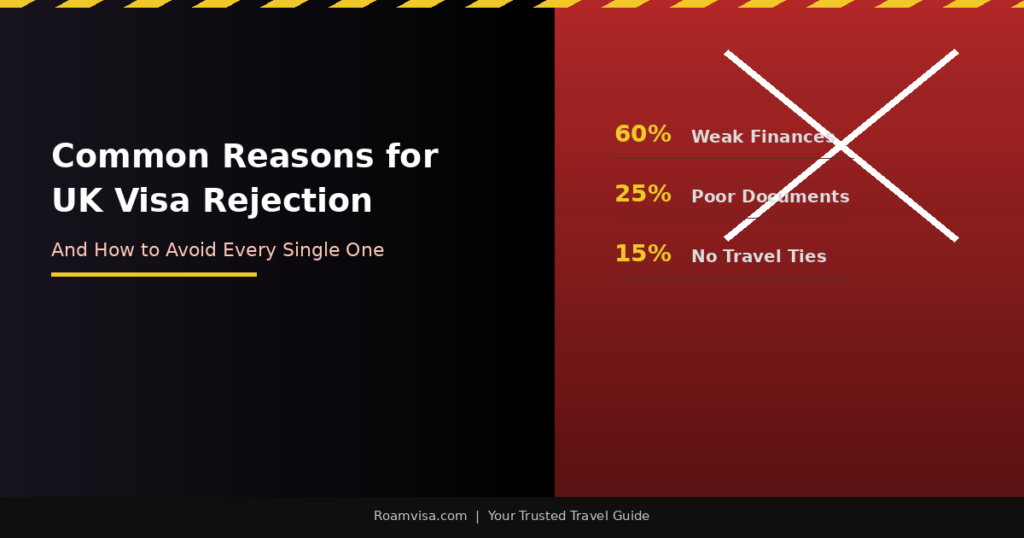
If you understand the Common Reasons for UK Visa Rejection, you are already ahead of most applicants. The same patterns show up again and Again — and once you see them, they are almost predictable. I’ve gone through hundreds of rejection stories, forum posts, and real refusal letters. And the same reasons keep coming up again and again. It’s almost predictable at this point. The good news? If you know what those reasons are, you can build an application that avoids every one of them.
[ez-toc]
How Common Are UK Visa Rejections?
Let’s put this in perspective. The UK processes millions of visa applications every year, and the overall rejection rate hovers around 10-15%. That might sound low, but when you break it down by country, the picture changes. Applicants from South Asia, Africa, and parts of the Middle East face significantly higher rejection rates – sometimes reaching 25-30%.
Why the difference? It’s not about discrimination – it’s about risk profiling. Countries with higher rates of overstaying get more scrutiny. That means your application from India, Nigeria, or Pakistan needs to be stronger than someone applying from the US or Japan. It’s unfair in a sense, but it’s how the system works. The best response isn’t to complain about it – it’s to submit an application so solid they can’t find a reason to say no.
The 8 Most Common Reasons for UK Visa Rejection
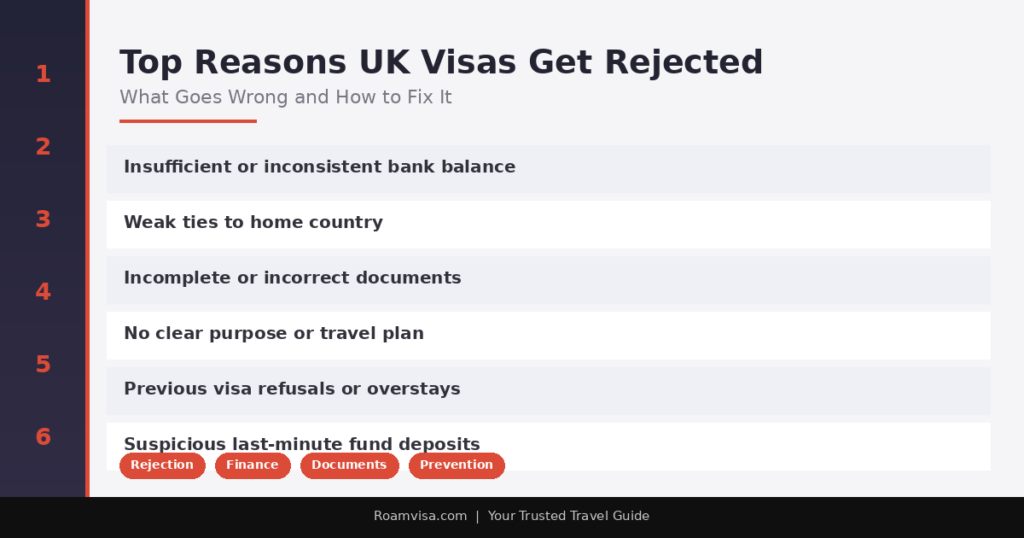
1. Insufficient or Inconsistent Financial Evidence
This is the big one. If I had to guess, I’d say over half of all rejections come down to money – or more accurately, how you present your money. The visa officer doesn’t just want to see a big number in your bank account. They want to see a pattern. Regular income coming in, reasonable spending going out, and a balance that makes sense given your salary. Here’s where people mess up: they borrow money from a friend or relative a week before applying. Suddenly the account shows Rs 5 lakh that wasn’t there before. The officer looks at six months of statements showing an average balance of Rs 30,000, sees a random Rs 5 lakh deposit, and immediately knows what happened. That’s a rejection, and it makes your credibility take a hit too.
What to do instead: Start building your balance 6-8 months before applying. Let your savings grow naturally. If your salary is your main income, that’s perfectly fine – just make sure there are no unexplained large deposits. If you have fixed deposits, mutual funds, or property, include those too. The goal is to paint a picture of someone who’s financially stable, not someone who scraped together money at the last minute.
2. Weak Ties to Your Home Country
The officer’s biggest fear is that you’ll go to the UK and never come back. So they’re looking for evidence that you have reasons to return home. A stable job, a running business, property ownership, a family that depends on you, kids in school – these are all ties that tell the officer you’re not planning to disappear. If you’re young, single, recently graduated, and unemployed, this is where your application gets tricky. Not impossible, but tricky. You’ll need to work harder to show why you’d come back. Maybe you’re enrolled in a course that starts after your trip. Maybe your parents are elderly and depend on you. Maybe you have a job offer starting next month. Whatever it is, document it.
What to do instead: Include employment letters, business registration, property documents, family responsibilities – anything that screams “I have a life here and I’m coming back to it.” If you’re a student, include your enrollment letter and upcoming exam schedule.
3. Incomplete or Incorrect Documentation
This one makes me frustrated because it’s so preventable. Missing signatures, documents in the wrong language, bank statements that aren’t stamped, photos that don’t meet specifications, passport numbers entered incorrectly – these are all things people get rejected for. And the worst part? The visa officer won’t call you to ask for the missing document. They’ll just refuse your application.
What to do instead: Make a checklist and go through it twice. Every document should be in English (get official translations if needed). Bank statements should be bank-stamped, not just printed from your app. Photos should meet UK visa specs exactly. And for the love of everything, triple-check your passport number on the application form.
4. No Clear Purpose of Visit
“I want to visit London” is not a purpose. “I want to explore the UK” is not a purpose. The visa officer needs to understand specifically what you’re going to do, where you’re going to stay, and for how long. A vague application suggests you haven’t actually planned anything, which raises the question – are you really going for tourism, or is there something else going on?
What to do instead: Have a rough itinerary. You don’t need to book every museum ticket in advance, but you should know which cities you’re visiting, where you’re staying, and your return date. If you’re visiting someone, have their invitation letter with their address, phone number, and your relationship explained clearly.
5. Previous Visa Refusals or Immigration Issues
If you’ve been refused a visa before – to the UK or any other country – it doesn’t automatically mean you’ll be refused again. But it does mean the officer will look at your application more carefully. The problem comes when people try to hide previous refusals. The UK immigration system is connected to databases worldwide. They already know. Lying about it is worse than the refusal itself.
What to do instead: Declare all previous refusals honestly. Then address what caused the refusal. If it was financial, show improved finances. If it was documentation, show everything is now complete. A cover letter explaining what changed since the last application can be really powerful here.
6. Inconsistencies in the Application
This is a sneaky one. Sometimes everything looks fine individually, but when the officer compares different parts of your application, things don’t add up. Your form says you earn Rs 50,000 a month, but your bank statement shows Rs 30,000 deposits. You say you’re going for two weeks, but your leave letter only covers one week. You claim to be self-employed, but there’s no GST registration or business proof.
What to do instead: Before submitting, read through your entire application from the officer’s perspective. Do all the numbers match? Do the dates align? Does your story make sense? Get someone else to review it too – fresh eyes catch things you’ll miss.
7. Sponsor Issues
If someone in the UK is sponsoring your trip, their documentation matters just as much as yours. A lot of applications get rejected because the sponsor’s details are incomplete. Just saying “my uncle lives in London” isn’t enough. The officer needs to verify that the sponsor is legally in the UK, can financially support your visit, and has adequate accommodation.
Read More: Best Travel Insurance for UK Trip from India – Honest Comparison 2026
What to do instead: Get your sponsor to provide a signed invitation letter, their passport or BRP copy, recent bank statements, their address proof, and their employment details. The more thorough the sponsor’s documentation, the stronger your application.
8. No Travel History
This one isn’t technically a rejection reason on its own, but it makes everything else harder. If your passport is brand new with zero stamps, the officer has no way to know whether you’ll respect immigration rules. Combine a blank passport with average finances and weak ties, and your chances drop significantly.
What to do instead: If you’ve never traveled internationally, consider visiting countries with easier visa processes first – Thailand, Malaysia, Dubai, or Sri Lanka. One or two stamps in your passport can make a meaningful difference. If that’s not an option, focus on making every other part of your application bulletproof.
What Does a Rejection Letter Actually Say?
When your visa gets refused, you’ll receive a refusal letter that explains the reasons. It’s usually written in formal language and references specific paragraphs of UK immigration rules. The most common ones you’ll see are:
| Reference | What It Means |
| V 4.2 (a) | Not satisfied you will leave the UK at end of visit. Most common ground – means weak ties to home country or officer doubts return intention. |
| V 4.2 (b) | Not satisfied you won’t live in the UK for extended periods through frequent or successive visits. |
| V 4.2 (c) | Not genuinely seeking entry for a permitted purpose – officer suspects real reason differs from what you stated. |
| V 4.2 (d) | Not satisfied you won’t undertake prohibited activities like working or long-term study. |
| V 4.2 (e) | Financial concerns – can’t adequately maintain and accommodate yourself or will need public funds. |
| Part Suitability (replaced Part 9 from Nov 2025) | Covers deception, false documents, previous breaches. SUI provisions can result in mandatory refusal and bans of 1–10 years. |
Read your refusal letter carefully. It tells you exactly what went wrong, and that’s your roadmap for fixing it if you decide to reapply. You can check the full Appendix V rules at gov.uk/guidance/immigration-rules/immigration-rules-appendix-v-visitor and apply through the official portal at gov.uk/standard-visitor.
Important update for 2025: The old Part 9 (Grounds for Refusal) has been replaced by “Part Suitability” from November 2025 under the SUI numbering system. This means deception findings, overstay bans, and criminal history assessments now follow new provisions. Mandatory refusal periods range from 12 months to 10 years depending on severity. If your refusal letter references SUI paragraphs instead of the older 320 paragraphs, that’s the new framework in action.
Current approval rates: According to Home Office statistics, UK visitor visa approval rates stand at approximately 77-87% depending on nationality and application quality. For context, work visas have around 95% approval and student visas around 98%. So visitor visas face the most scrutiny – which is why preparation matters so much.
Useful official links:
- Apply for UK visit visa: gov.uk/standard-visitor
- Check if you need a visa: gov.uk/check-uk-visa
- Immigration Rules Appendix V: gov.uk/guidance/immigration-rules/immigration-rules-appendix-v-visitor
- VFS Global India appointments: visa.vfsglobal.com/ind/en/gbr
Can You Appeal or Reapply?
Here’s the thing most people don’t know – you generally cannot appeal a visitor visa refusal. Appeals are only available for certain visa categories like family visas and human rights claims. For a standard tourist visa? No appeal. Your only option is to submit a fresh application.
The good news is there’s no waiting period. You can technically reapply the very next day. But should you? Probably not. Unless the rejection was due to a silly mistake like a missing document, you need time to fix the underlying issue. Reapplying with the exact same application will get you the exact same result.
When to reapply:
- If rejected for documentation issues – fix the missing/incorrect documents and reapply within a few weeks.
- If rejected for financial reasons – wait 3-6 months to build a stronger financial profile before reapplying.
- If rejected for weak ties – wait until your circumstances change (new job, property purchase, marriage) before trying again.
- If rejected for false information – consult an immigration lawyer before doing anything. This is serious and can have long-term consequences.
How to Build a Rejection-Proof Application
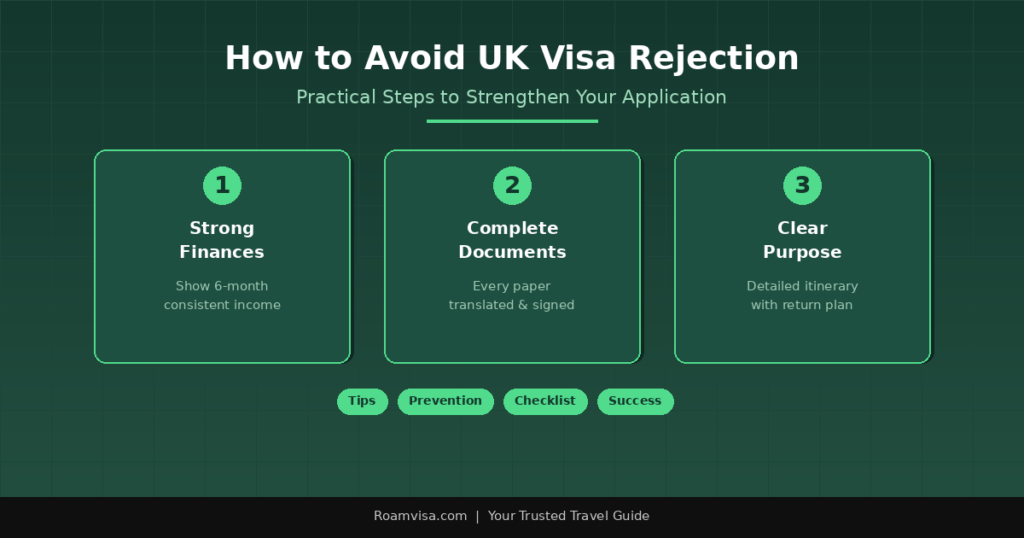
Alright, now for the part you’ve been waiting for. Here’s how to make your application as strong as possible:
Start preparing early
Don’t decide to visit the UK and apply the next week. Give yourself at least 2-3 months of preparation time. This lets you build your bank balance naturally, gather documents properly, and avoid the rushed, sloppy applications that get rejected.
Write a killer cover letter
I can’t stress this enough. A cover letter isn’t mandatory, but it’s your one chance to speak to the officer in your own words. Explain who you are, what you do for a living, why you want to visit the UK, how you’re funding the trip, where you’ll stay, when you’re coming back, and what keeps you rooted in your home country. Keep it genuine and personal. Don’t copy templates from the internet – officers have seen them all.
Make your bank statements tell a story
Your bank statement should show regular income, reasonable spending, and a gradually growing balance. If there are any large deposits, be ready to explain them. A bonus from work? Include the bonus letter. A property sale? Include the sale deed. Don’t leave the officer guessing.
Organize documents like a professional
Put your documents in a clear, labeled folder. Use dividers or tabs: Personal Documents, Financial Documents, Employment Documents, Travel Plan, Sponsor Details. An organized application signals that you’re serious and detail-oriented. It also makes the officer’s job easier, which never hurts.
Don’t lie. About anything. Ever.
I’ve seen people lie about their job, their salary, their relationship status, their travel history. And almost all of them get caught. The UK immigration system has access to international databases, employer verification systems, and previous application records. If you lie and get caught, it’s not just a rejection – it’s a potential 10-year ban. Not worth it.
Get someone to review your application
Before you submit, have someone look over everything with fresh eyes. A friend who’s been through the process, a family member who’s good with paperwork, or even a professional consultant if you can afford one. They’ll catch mistakes you’ve overlooked.
Frequently Asked Questions
Does a UK visa rejection affect future applications?
Yes, but not as much as people think. A single rejection doesn’t blacklist you. You’ll need to declare it in future applications, and the officer will look more carefully, but plenty of people get approved after a previous refusal. The key is addressing what went wrong.
Can I reapply immediately after rejection?
Technically, yes. There’s no waiting period. But unless the rejection was for a simple document error, I’d recommend waiting until you’ve genuinely strengthened your application. Reapplying with the same weak case is a waste of time and money.
Will I get my visa fee refunded if rejected?
No. The visa fee is non-refundable regardless of the outcome. This is another reason to make sure your application is strong before submitting.
Does a Schengen or US visa rejection affect my UK application?
You need to declare all previous visa refusals from any country. While a Schengen rejection doesn’t automatically cause a UK rejection, it does raise a flag. The officer will want to understand why it happened.
Should I hire an immigration lawyer after rejection?
For a simple tourist visa, usually not necessary. But if your case involves deception allegations (Paragraph 320), a complex immigration history, or multiple rejections, a qualified immigration advisor can be worth the investment.
Conclusion
UK visa rejections aren’t random. They follow patterns, and those patterns are predictable. If you take one thing away from this guide, let it be this: the visa officer isn’t your enemy. They’re just doing their job, and their job is to assess whether you’re a genuine visitor. Your application is the only tool you have to convince them.
Strong finances, clear purpose, solid ties to home, honest documentation, and a well-written cover letter – that’s the formula. No shortcuts, no borrowed money, no copied templates. Just an honest, well-prepared application. If you found this helpful, share it with someone who’s going through the process. And if you’ve been rejected before, don’t lose heart. Fix what went wrong, give it some time, and try again. Most people who get rejected eventually get approved once they understand what they did wrong.
Good luck with your application.

Pingback: Best Areas to Stay in London for Indian Tourists Best Areas to Stay in London