
How to Write a Cover Letter for UK Visa Application – Free Sample

Quick question – did you know the UK government doesn’t actually ask for a Cover Letter for UK Visa Application? It’s not on their checklist. Not mentioned on the form. Nowhere in the official requirements. And yet, ask anyone who got their UK visa approved, and most of them will tell you their cover letter made all the difference.
Here’s the thing. There’s no interview for a UK tourist visa. The officer never meets you. Never talks to you. They sit at a desk, flip through your papers, and make a decision. That’s it. Your cover letter? That’s the closest thing you’ve got to actually speaking to them. It’s your voice in a pile of silent paperwork. I’ve gone through dozens of approved and rejected applications. The pattern is clear – people who skip the cover letter leave gaps in their story. People who write one, even a simple one, give the officer context that bank statements and salary slips can’t provide on their own. So yeah, write the letter. It takes 30 minutes and could save your entire application.
What’s in This Article
- What’s a visa cover letter and why bother?
- What goes in it – section by section
- Free sample template you can copy
- The dos and don’ts nobody tells you
- Letters for tricky situations (rejected before, self-employed, no travel history)
- Dumb mistakes that get people rejected
- FAQ
What’s a Visa Cover Letter and Why Should You Care?
A cover letter for a UK visa is basically a one-page letter you write to the visa officer. Some people call it a “personal statement” or “purpose letter” – same thing, different name. In it, you explain who you are, why you’re going to the UK, how you’re paying for the trip, and why you’ll come back home when it’s over.
Picture it like this. The officer picks up your bank statement – they see numbers. They look at your employment letter – they see a job title. They glance at your passport – they see stamps. But none of that tells them your story. None of it explains why a 32-year-old software developer from Pune wants to spend two weeks in London visiting his cousin. The cover letter fills that gap. It connects all the dots. Will it guarantee your visa? Nah. Nothing can. But will it bump up your chances, especially if your profile has a few weak spots? A hundred percent. I’ve seen average applications with great cover letters get approved. I’ve also seen solid applications without a cover letter get refused because the officer had too many unanswered questions.
What Goes in It – Section by Section
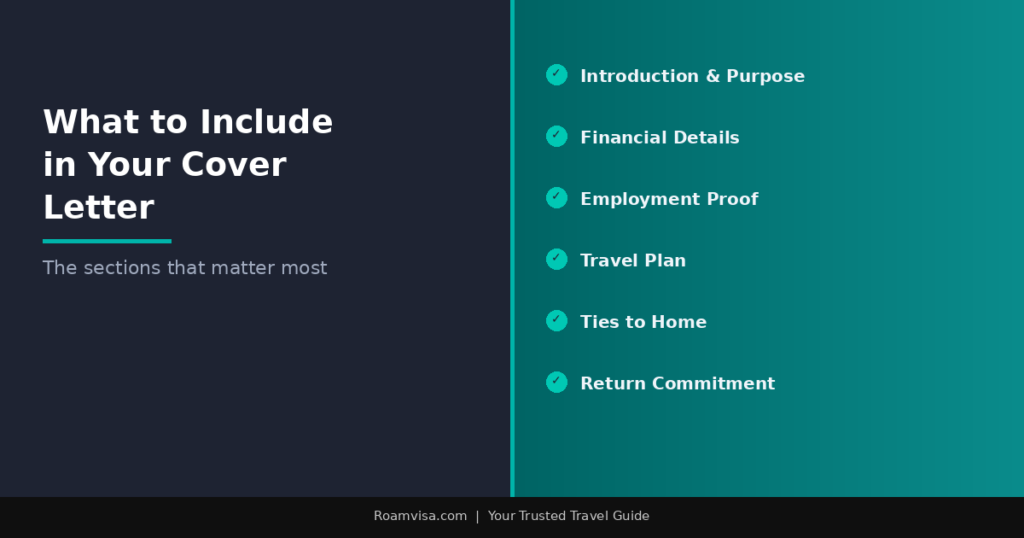
Don’t overthink the structure. You’re telling the officer your story, start to finish. Here’s how I’d break it down:
1. The Intro – Who Are You?
Keep this dead simple. Your name, passport number, DOB, and what visa you’re applying for. Like: “My name is Rahul Mehta, Indian passport number M1234567. I’m applying for a Standard Visitor Visa to visit the UK from 15 March to 29 March 2026.” Done. No “I humbly request your kind consideration” rubbish.
2. Why Are You Going?
This is the meat of the letter. And vague answers kill applications. “I want to visit London” tells the officer nothing. But “I’m spending 5 days in London visiting the British Museum and catching a show at the West End, then 3 days in Edinburgh with my cousin Amit who lives in Leith” – now that’s a real plan. The more specific your trip sounds, the more believable it is.
3. How Are You Paying for This?
Talk about your income and savings. Don’t just say “I can afford it.” Give numbers. “I work at Infosys as a Team Lead, earning Rs 92,000 monthly. I’ve got around Rs 5.2 lakh saved up in my SBI account, which you can see in the bank statements I’ve attached.” If someone else is paying, say who, how you know them, and that their documents are in the file.
4. What Do You Do for a Living?
Mention your job, company, how long you’ve been there, and that your boss has approved your leave. If you run your own business, talk about what it does, when you started, your turnover, and who’ll handle things while you’re away. This section isn’t just about employment – it’s about proving you have something pulling you back home.
5. Why Would You Come Back?
This is the bit the officer really cares about. They want to know you’re not going to vanish into London and never return. So lay it out – your job, your house, your kids’ school, your parents who need you, your EMIs, your business. Whatever keeps you anchored here. A 28-year-old single guy with no job and no property? That’s a harder sell. But a married father with a government job and a home loan? That’s someone who’s clearly coming back.
6. Past Travel + “I’ll Leave on Time”
If you’ve been abroad before, mention it. “I’ve traveled to Thailand, Dubai, and Bali and came back each time as planned.” Simple credibility builder. Then wrap up with a clear line: “I will leave the UK bfore my visa expires and return to India.” Say it directly. Don’t be fancy about it.
Free Sample Cover Letter – Copy and Customize
Alright, here’s a sample you can work with. But listen – don’t just copy-paste this and submit it. The whole point is that it sounds like you. Change every detail. Add your own situation. The officer has seen every generic template floating around the internet, and yours shouldn’t look like one of them.
| Cover Letter for UK Visa Application |
|---|
| [Your Full Name] [Your Full Address] [City, State, PIN Code] India [Date] To, The Visa Officer UK Visas and Immigration Subject: Cover Letter – Standard Visitor Visa Application – GWF: [Your GWF Number] Dear Sir/Madam, I am [Full Name], an Indian citizen holding passport number [Passport Number], valid until [Expiry Date]. I am writing this letter in support of my application for a Standard Visitor Visa to travel to the United Kingdom from [Start Date] to [End Date] for a total duration of [X] days. Purpose of Visit: I intend to visit the UK for [tourism / visiting family / attending an event]. During my stay, I plan to spend [X] days in [City] exploring key attractions and participating in planned activities, followed by [X] days in [City] for [mention purpose – sightseeing / visiting relative / event attendance]. A detailed day-by-day itinerary is enclosed with my application. [If visiting someone: I will also be visiting my [relationship], [Name], who resides at [Full UK Address]. An invitation letter along with their supporting documents has been attached.] Financial Arrangements: I am currently employed as a [Job Title] at [Company Name], where I have been working for [X years/months], earning a monthly salary of INR [Amount]. I have personal savings of approximately INR [Amount] in my [Bank Name] account. I have attached my last six months’ stamped bank statements, salary slips, and Income Tax Returns as proof of financial stability. I will be fully funding my travel expenses, including flights, accommodation, daily expenses, and travel insurance. [OR – If sponsored: This trip is being sponsored by my [relationship], [Name]. Their financial documents and sponsorship letter are enclosed.] Ties to India: I have strong personal and professional ties to India. I have approved leave from my employer for the mentioned travel period and am expected to resume work immediately after my return. Additionally, [mention strong ties such as property ownership / family members residing in India / ongoing home loan / dependent parents / spouse and children]. These commitments ensure my return to India before the expiry of my visa. Travel History: [If applicable: I have previously travelled to [Countries] and have always complied with immigration regulations, returning within the permitted time.] [OR: Although this is my first international trip, I am fully aware of and committed to adhering to all UK visa rules and regulations.] I confirm that I will not undertake any employment, business activity, or study during my stay in the UK, nor will I access any public funds. I fully intend to return to India before the expiry of my visa. Documents Enclosed: Passport copy Visa application form Bank statements (last 6 months) Salary slips Income Tax Returns Employment letter & leave approval Travel itinerary Flight and accommodation bookings Travel insurance Invitation letter (if applicable) Sponsorship documents (if applicable) Thank you for considering my application. I would be grateful for a positive response and am happy to provide any additional information if required. Yours sincerely, [Your Signature] [Full Name] [Phone Number] [Email Address] |
One more time: Don’t submit this as-is. Swap out every bracket. Add stuff that’s real to your life. The more it sounds like a human being wrote it at their kitchen table, the better it’ll land with the officer.
The Dos and Don’ts Nobody Warns You About
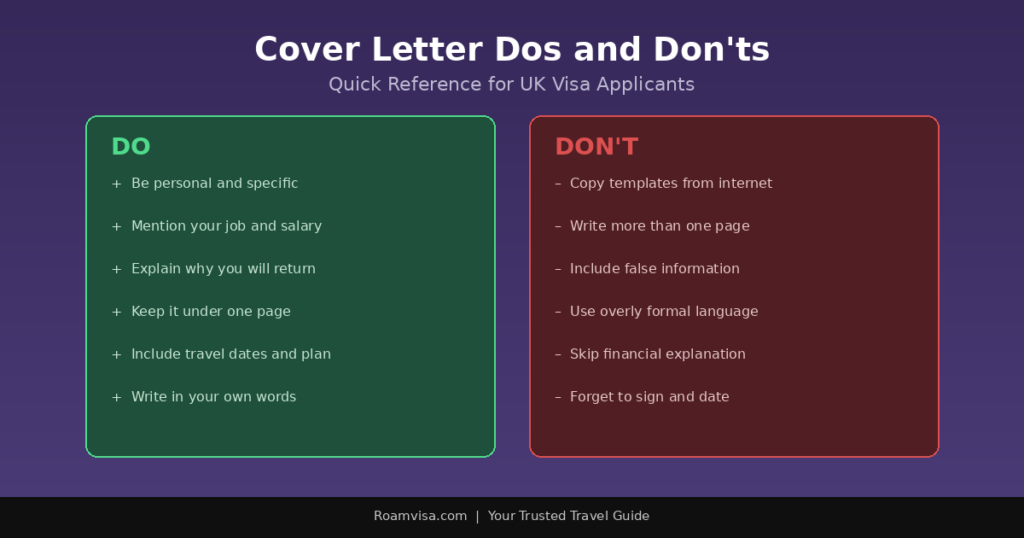
What to Do:
- Write like you talk. First person. “I work at…” not “The applicant works at…” You’re a person, not a court filing.
- Stick to one page. Officers process hundreds of applications. They’re not reading your autobiography. Hit the key points and stop.
- Drop real numbers. “I earn well” means nothing. “Rs 75,000 a month” means something. Be specific about salaries, savings, trip duration.
- Mention your attached documents. A quick line like “my 6-month bank statement is attached” shows you’re organized.
- Sign it. Date it. Sounds stupid that I have to say this, but unsigned letters are more common than you’d think.
- Print clean. White A4 paper. No wrinkles. No weird fonts. Arial or Times New Roman, size 11 or 12.
What Not to Do:
- Don’t copy-paste from Google. The officer has read every template out there. They’ll know within 5 seconds that you copied it. And it makes your whole application feel lazy.
- Don’t get dramatic. “It has been my lifelong dream to set foot on British soil” – nope. Cut the theatre. State your plan plainly.
- Don’t lie. If your letter says Rs 80,000 salary but your payslip shows Rs 55,000, you’ve just handed the officer a reason to refuse you.
- Don’t write in third person. “The applicant wishes to humbly submit…” sounds like a legal filing from 1985. Just say “I.”
- Don’t beg. “Please sir, I promise I won’t cause problems” is desperate and unprofessional. State your case with confidence. You’re requesting a visa, not asking for a favour.
- Don’t repeat your application form. The cover letter should add context and personality, not parrot the same information from the form.
Cover Letters for Tricky Situations
Going to See Family?
Name the person. Say exactly how you’re related. Where they live in the UK. When you last saw them. How long you’re staying at their place. And mention that their invitation letter, address proof, and immigration documents are all in the file. Officers love specifics because specific details are harder to fake.
Self-Employed? Own a Business?
This one needs extra love. Business owners get more scrutiny because it’s easier for the officer to wonder if you’re actually going to the UK to work. So spell it out – business name, what it does, when you started, annual turnover, who’s running things while you’re gone. Reference your GST registration, ITR for the last 2-3 years, and CA certificate. Make the officer feel like your business is too good to abandon.
Someone Else Paying for Your Trip?
State clearly who’s sponsoring, how you know them, and why. If it’s your brother in Birmingham, say that. Include their job details, bank proof, and a letter from them confirming they’re covering your costs. The officer needs to trust that the sponsor is real, willing, and able to pay.
Got Rejected Last Time?
Don’t pretend it didn’t happen. Bring it up yourself. “My previous application from March 2025 was refused because of weak financial proof. Since then, I’ve built up my savings over 8 months and can now show a consistent balance of Rs 4.5 lakh, as my updated bank statements show.” Owning the rejection and showing what changed is ten times better than hoping they won’t notice.
Read More: Best Areas to Stay in London for Indian Tourists – Honest Local Guide 2026
First Time Traveling Abroad?
Don’t apologize for a blank passport. Everyone starts somewhere. Instead, load up on everything else – strong finances, rock-solid job, clear plan, family ties. And add a line like: “This is my first trip abroad, and I’ve put extra care into preparing my application and itinerary. I’m committed to following all UK immigration rules and returning home on [date].” Confident, not defensive.
Dumb Mistakes That Get People Rejected
- Writing 3-4 pages. Nobody’s reading that. If you can’t explain your trip in one page, you’re overcomplicating things.
- Running it through ChatGPT and submitting as-is. AI-written letters have a specific pattern – overly formal, perfectly structured, zero personality. Officers can spot them. And honestly? A simple letter with spelling mistakes but genuine content beats a polished AI letter every day.
- Numbers that don’t match your documents. Your letter says Rs 80,000 salary, your payslip says Rs 62,000. That’s not a typo to the officer – that’s dishonesty. Cross-check everything.
- Forgetting to say you’ll come back. The entire purpose of this letter is to tell the officer you’re returning. If those words aren’t in there somewhere, you’ve missed the whole point.
- Ignoring red flags in your profile. Gap in employment? Random large deposit? Previous refusal? If you don’t explain it, the officer fills in the blanks themselves. And their version is always worse than yours.
How to Format Your Cover Letter
Small thing, but it matters. The way your letter looks on paper says something about you before the officer reads a single word. A clean, well-formatted letter tells them you’re organized and take this seriously. A messy, badly printed one does the opposite.
Use a simple font – Arial or Times New Roman, size 11 or 12. Left-aligned text. Normal margins. Your name and address at the top, the date below that, then “To, The Visa Officer, UK Visas and Immigration” as the recipient. Add a subject line with your GWF reference number so the officer can link it to your application immediately. Keep paragraphs short. Four to five lines max. Nobody likes reading massive blocks of text, and remember – the officer is going through dozens of these every day. Make it easy on their eyes. White space is your friend. At the bottom, put “Yours sincerely,” leave space for your handwritten signature, then type your full name, phone number, and email underneath. That’s the format. Nothing fancy, nothing creative. Just clean and readable.
What If You’re a Housewife or Not Working?
This comes up a lot, especially with applications from India. If you’re a homemaker, you can absolutely get a UK visa – but your cover letter needs to work a bit harder. Since you don’t have your own employment or income, the focus shifts to your spouse or whoever’s sponsoring the trip. Explain your husband’s job, income, and that he’s funding the trip. Mention your kids, their schools, your house – all the things that tie you to home. If you’re traveling with your husband, mention that clearly. If you’re going alone to visit family in the UK, explain why you’ll come back (kids in school, elderly in-laws at home, whatever the real reason is).
One thing I’d add specifically for homemakers – include a joint bank account statement if you have one, or your husband’s bank statement along with your marriage certificate. The officer needs to see a financial connection between you and the sponsor. Without that link, the money proof doesn’t carry the same weight.
Handy Official Links:
- Apply here: gov.uk/standard-visitor
- Full visa form: gov.uk/apply-uk-visa
- Book VFS appointment (India): visa.vfsglobal.com/ind/en/gbr
Frequently Asked Questions
Do I have to submit a cover letter?
Technically no. It’s not on the official checklist. But realistically? Yes. Almost every immigration consultant, forum, and successful applicant recommends it. It’s the cheapest, easiest way to strengthen your application.
How long should it be?
One page. Period. If you’re going past one page, you’re adding stuff that doesn’t need to be there. Cut the fluff and keep the facts.
Handwritten or typed?
Typed. Always. It looks cleaner, reads easier, and comes across as more professional. Print it on white A4 paper and put your actual signature at the bottom with a pen.
Can I write it in Hindi or my regional language?
Nope. Has to be in English. And that’s totally fine even if your English isn’t perfect. Simple, honest English with a few grammar mistakes is a million times better than a polished letter you clearly didn’t write yourself.
Conclusion
Look, writing a cover letter for your UK visa isn’t rocket science. You’re not drafting a legal brief. You’re writing a one-page letter to a real person sitting in an office, telling them who you are, why you want to visit their country, and why they can trust you’ll go back home when your trip’s done.
Best of luck with your application.
[…] Read More: How to Write a Cover Letter for UK Visa Application – Free Sampl […]