
NYC Subway Guide for Tourists – How Not to Get Lost in New York

The New York City Subway is the largest and busiest rapid transit system in North America – 472 stations along 665 miles of track, 25 routes, operating 24 hours a day 7 days a week, 365 days a year. For first-time visitors, especially Indian tourists used to Delhi or Mumbai Metro systems with simpler layouts and fixed operating hours, the NYC subway can look chaotic. Local trains, express trains, uptown platforms, downtown platforms, letter lines versus number lines, lettered signs that seem to share platforms randomly, and a fare system currently in mid-transition from the old MetroCard to the newer OMNY tap-to-pay. It is genuinely more complex than most world metros, and getting lost at some point during your first trip is almost guaranteed.
The good news: the system follows very clear rules once you learn them, and it is genuinely one of the cheapest and fastest ways to move around Manhattan, Brooklyn, Queens, the Bronx, and Staten Island. A single 2.90-dollar subway ride gets you anywhere on the network regardless of distance – a trip 3 stops or 30 stops costs the same. Taxis in Manhattan hit meter increments every few blocks, Uber surges during events, and parking starts at 45 dollars a day. The subway is the default for locals because it actually works, and once Indian tourists understand the system it becomes the default for them too. This guide walks through the fare system, OMNY versus MetroCard, how to read the map, express versus local, uptown versus downtown, and the specific mistakes that cause first-timers to lose time or money.
Quick Facts – NYC Subway Essentials
✓ Fare: 2.90 dollars per ride via OMNY tap or 3.00 for single MetroCard ride
✓ Weekly cap: 34 dollars after 12 rides within 7 days – unlimited rides after
✓ MetroCard being phased out – new sales ended 31 December 2025; existing cards work through 2026 transition
✓ Network scale: 472 stations, 25 routes, 665 miles of track, operates 24 hours 7 days
✓ Use OMNY tap-to-pay with any contactless card or phone wallet – free bus transfer within 2 hours
✓ Uptown = north in Manhattan (higher street numbers); Downtown = south (lower numbers)
✓ Kids under 44 inches tall ride free – up to 3 children with a paying adult
OMNY Versus Metro Card – What Tourists Need to Know Now
Until the end of 2025, NYC subway passengers had two fare payment options: the old yellow MetroCard (swiped through the turnstile) or the newer OMNY tap-to-pay system (tapped on a reader). The MTA has now formally wound down MetroCard sales – as of 1 January 2026 you can no longer buy or refill a MetroCard. Existing MetroCards with value on them continue to work during a transition period, but any remaining balance needs to be used up before the MTA announces the hard cutoff later in 2026. For tourists arriving now, the practical answer is simple: use OMNY.
OMNY – The Current Standard
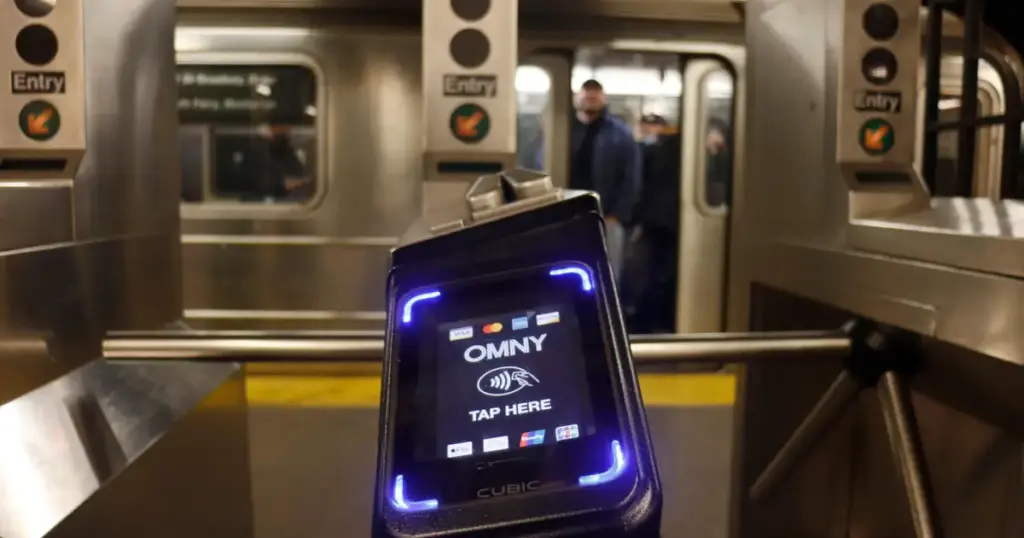
OMNY (One Metro New York) is a contactless payment system. You tap your contactless bank card, phone wallet (Apple Pay, Google Pay, Samsung Pay), smartwatch, or a dedicated OMNY card on the reader at the subway turnstile or bus farebox. The screen says GO in green, the gate releases, you walk through. That is it – no tickets to buy, no cards to load in advance. A single subway ride is 2.90 dollars. The first time you tap any bank card at an OMNY reader it needs a few minutes for your bank to authorise the transaction, but after that it works instantly.
The 7-Day Fare Cap – Effective Unlimited After 12 Rides
The best feature of OMNY for tourists is automatic fare capping. When you tap the same card or device 12 times within a rolling 7-day window, every additional ride within that 7-day period is free. The cap amount is 34 dollars on subway and local bus combined, or 67 dollars if you include express buses. You do not need to pre-buy a weekly pass or opt in – the system automatically caps your fares as soon as you hit the 12-ride / 34-dollar threshold.
For a tourist taking 3 to 5 subway rides per day across a 5 to 7 day visit, this functions like a weekly unlimited pass without any upfront purchase risk. If you only take a few rides, you only pay for those. If you take many rides, the cap kicks in and further rides are free. Note: the cap only works if you tap the same card every time. Switching between your phone and a physical OMNY card during the week resets progress toward the cap, so pick one payment method and stick with it for your full visit.
OMNY Card versus Bank Card Tap
You have two options for the OMNY system.
- Option 1: Tap your own contactless bank card or phone wallet. Free to set up, instant, each ride debited from your normal bank account in USD. Best for most tourists using a contactless-enabled travel credit card (check your card is contactless by looking for the curved wave symbol on the front or back).
- Option 2: Buy an OMNY card at any subway station vending machine for a 1-dollar introductory fee and load cash value. Useful if your bank card is not contactless or if you want separate accounting for your subway spending. Reloadable with cash at any subway station.
Related Articles: Amtrak Train Guide – Best Routes, Passes and Booking Tips
How to Read the NYC Subway Map – The 90-Second Overview
The subway map looks intimidating but follows consistent rules. Once you know the three principles below, the entire network becomes navigable.
Principle 1: Lines Are Lettered or Numbered
Each subway route is identified either by a letter (A, B, C, D, E, F, G, J, L, M, N, Q, R, W, Z) or a number (1, 2, 3, 4, 5, 6, 7). Colours on the map group routes that share sections of track – for example, the 4, 5, and 6 all appear on a green line because they share track through Manhattan – but the colours are just a visual grouping, not separate routes. What matters is the individual letter or number of your train.
Principle 2: Uptown Versus Downtown
In Manhattan, uptown means the train is heading north (toward higher street numbers). Downtown means heading south (toward lower street numbers). The station platform signs are explicit – ‘Uptown and the Bronx’ or ‘Downtown and Brooklyn’. Make sure you are on the correct platform before descending. If you board the wrong direction, get off at the next stop with easy platform transfer (most stations allow same-station transfer to the opposite direction without paying again; some require exiting and re-entering, which you can avoid by noting signs for ‘Free Transfer’ or ‘Subway Transfers Here’).
Principle 3: Local Versus Express
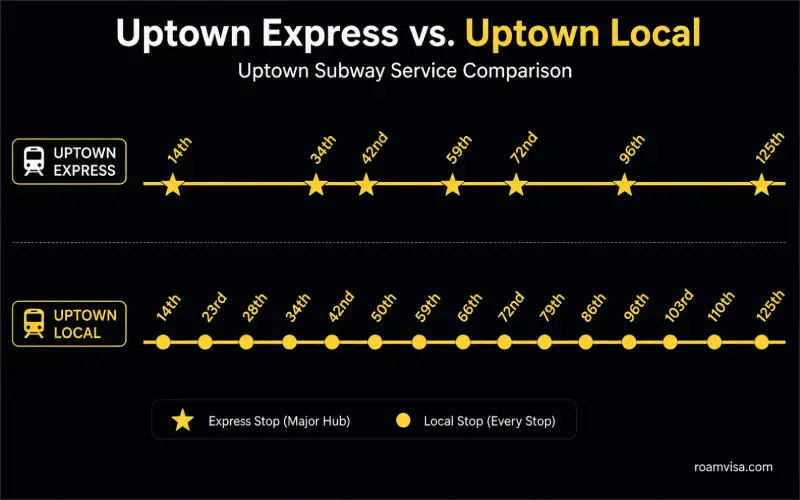
Local trains stop at every station along the route. Express trains skip stations to go faster, stopping only at major hubs. On the same line, the 6 is local and the 4 and 5 are express – they run on parallel tracks and stop at different stations. Always check what kind of train you need. A traveller who needs to get off at 66th Street on the Upper West Side should take the 1 (local), not the 2 or 3 (express) – the express trains skip 66th Street. Look at the station list on the train map before boarding.
Manhattan Directions – Finding Your Station Quickly
Manhattan is laid out on a grid. Avenues run north-south and are numbered west to east (First Avenue is easternmost, Twelfth Avenue is westernmost on the Upper West Side). Streets run east-west and are numbered south to north (from 1st Street downtown to 220th Street at the top of Manhattan). This grid system makes subway navigation much easier than it looks on the map – once you know your destination’s approximate address, you can find the nearest subway station in under a minute.
East Side vs West Side Subway Lines
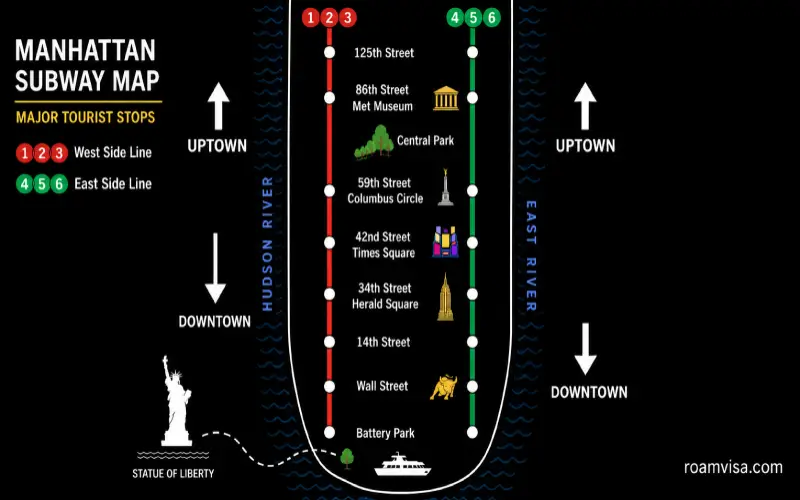
The east-west division of Manhattan is reflected in the subway. The 4, 5, 6 lines run up the East Side – useful for Lexington Avenue, Midtown East, Upper East Side, museums like the Met and Guggenheim. The 1, 2, 3 lines run up the West Side – useful for Midtown West, Times Square, Columbus Circle, Upper West Side, the American Museum of Natural History. The A, C, E lines also run on the West Side/downtown Midtown. The N, Q, R, W lines run through Midtown at Herald Square and Times Square and into Queens. Know which side your hotel is on, and you will usually know which main subway line to use as your home route.
Brooklyn, Queens, and Bronx Connections
If your itinerary includes Brooklyn (Williamsburg, DUMBO, Coney Island), Queens (LaGuardia airport area, Astoria, Flushing), or the Bronx (Yankee Stadium, Bronx Zoo), several lines cross into those boroughs from Manhattan. The L connects Midtown to Williamsburg and deeper Brooklyn. The 7 connects Times Square and Grand Central to Queens and Flushing. The 4, 5 connect Manhattan to the Bronx. The F and D lines connect Midtown to Coney Island in deep south Brooklyn. Know which line serves your specific borough destination before planning your day.
Fare Comparison – What You Actually Pay
The table below compares typical fare scenarios on OMNY versus the retiring MetroCard. For a first-time visitor, the choice is clearly OMNY because MetroCard sales have ended – but understanding the cost structure helps you budget realistically.
| Scenario | OMNY (USD) | MetroCard (USD) | Notes |
| Single subway ride | 2.90 | 3.00 single / 2.90 from loaded card | OMNY saves 10 cents on single rides |
| 12 rides in 7 days | 34.00 (capped) | 34.00 (unlimited 7-day) | Both cap identically |
| 13th ride in same 7 days | 0.00 (included in cap) | 0.00 (unlimited) | OMNY autocaps, MetroCard pre-paid |
| Subway to bus transfer | Free within 2 hours | Free within 2 hours | Same card/device required |
| Express bus one ride | 7.00 | 7.00 | Higher cap at 67 for express |
| OMNY card purchase | 1.00 (intro pricing) | Not applicable | Optional – can use bank card instead |
| Tourist 5-day 20-ride trip | 34.00 (hit cap on day 4) | 34.00 unlimited if pre-bought | OMNY flexibility wins |
Safety, Etiquette, and First-Time Rules
Safety Basics
The NYC subway is safer than its reputation, but basic awareness matters. Stay behind the yellow line at platform edges. Do not lean over to look for approaching trains – every year some tourists get hit or hurt doing this. Ride in busy cars rather than empty ones, especially late at night – empty subway cars in New York after 11 PM are empty for a reason (often a health or odour issue, occasionally safety). If you see something that seems wrong, tell an MTA employee or use the yellow Help Point intercom on every platform. Avoid showing expensive items – not because crime is rampant but because it invites unwanted attention.
Etiquette – Things That Mark You as a Tourist
Let passengers exit before you board. This is the single most violated rule by tourists and the fastest way to annoy every New Yorker on the platform. On escalators, stand on the right, walk on the left – the left lane is for people hurrying through. Do not block doors – if you are standing near the door, step off at each stop to let other passengers exit and then step back on. Do not eat strong-smelling foods on the train – water and snacks are fine, curry and pizza are not.
When You Get Confused or Lost
Every subway station has an MTA employee in a booth or moving along the platform (though booths are increasingly being automated away). If you are confused, ask them. Most are helpful for genuine questions. Use Google Maps for subway directions – it integrates live MTA data and will tell you which train, which direction, how many stops, and the exit you want. The official MTA app and the Transit app are also excellent. Citymapper is particularly good for planning multi-modal trips (subway plus walking).
Mistakes Tourists Make on the NYC Subway
- Trying to use an old MetroCard bought by someone previously – MetroCards sold before 1 January 2026 may still have value but are being phased out. Use OMNY tap-to-pay for reliability.
- Boarding an express train when you need a local station – express trains skip many stations and you will travel past your stop by several miles. Always check the line type (local vs express) for your specific station.
- Tapping twice in quick succession at the turnstile – only tap once and wait for the green GO light. Double-tapping sometimes charges you twice or locks your card temporarily.
- Using different payment methods during a single trip – the 7-day cap only works if you use the same card or device for all 12+ rides. Mixing bank card taps and OMNY card taps resets progress.
- Assuming all subway cars are air-conditioned in summer – most are, but some older cars on certain lines still are not, and even air-conditioned cars can feel warm in July and August.
- Standing next to the door and not moving aside at each stop – even if it is not your stop, other passengers need to get out. Step off, let them exit, step back on.
- Paying 3.00 dollars for a single MetroCard ride instead of using OMNY – at 10 cents saved per ride, over 20 rides this is a real 2-dollar difference that you do not need to pay.
Before You Fly – Time Your NYC Trip for Value
Getting to New York cheaply is half the equation. Our cheapest connecting routes to USA that save 40 percent comparison guide identifies specific airline and hub combinations that deliver the lowest fares from India to New York JFK or Newark, including when Turkish Airlines via Istanbul, Air France via Paris, or Emirates via Dubai consistently beat direct Delhi-JFK pricing by meaningful margins.
Once in the USA, if your trip extends beyond New York to other cities, the NYC subway mastery transfers reasonably well to the Boston, Chicago, and DC metro systems, but flying between these cities is often faster and cheaper than Amtrak. Our Cheapest US domestic flights budget tips guide covers Spirit, Frontier, Allegiant, JetBlue, and Southwest – the budget carriers that make multi-city US itineraries affordable, with the same fare-cap logic that OMNY uses appearing in the major US hotel and transit chains.
Final Thoughts
The NYC subway looks intimidating but is actually simple once you understand five things: OMNY tap-to-pay is now the default fare method, every ride costs 2.90 dollars regardless of distance, your fares automatically cap at 34 dollars after 12 rides in 7 days, local trains stop at every station while express trains skip some, and uptown means north while downtown means south. That is genuinely the whole system in five sentences. The 472 stations and 25 routes seem overwhelming on first look but you will only use a handful during your trip – probably one main line for your hotel to Midtown, one for crosstown or to Brooklyn, and one for airport connections.
For Indian travellers familiar with Delhi Metro or Mumbai local trains, the adjustments are mostly about the 24/7 operation (trains really do run all night, though less frequently after midnight), the distance-flat fare (any ride costs the same regardless of how far), and the lack of conductor checks inside trains (the turnstile is the fare gate; once you are through you can ride anywhere).
The subway will save you hundreds of dollars over a week compared to taxis or Uber, get you places faster than cars in Manhattan traffic, and give you a genuinely local New York experience in the process. Download Google Maps or Citymapper, get comfortable with your OMNY setup on day one, board with confidence, and by day three you will navigate the subway better than most visitors who have been coming to New York for years.
Frequently Asked Questions
Is it true that Metro Cards are being phased out completely?
Yes. As of 1 January 2026, the MTA stopped selling and refilling Metro Cards. Cards already purchased with value on them continue to work during a transition period through 2026, but the exact final cutoff date is yet to be announced. For tourists arriving now, use OMNY tap-to-pay – either tap your contactless bank card or phone wallet, or buy an OMNY card for 1 dollar at any subway station.
What is the cheapest way to use the NYC subway for a 5-day tourist trip?
OMNY tap-to-pay with the same card or device for every ride. Your first 12 rides in any 7-day window cost 2.90 dollars each (up to 34 dollars total), and every additional ride within that 7-day period is free thanks to automatic fare capping. For a typical 5-day visit taking 3 to 4 rides per day (15 to 20 total), you will pay exactly 34 dollars – less than 7 dollars per day for unlimited subway access.
How do I know if I am taking an express or local train?
The digital display on the train and platform signs show the train’s route letter or number plus its status (LCL for local or EXP for express on some lines). The subway map distinguishes local stations (shown as black dots) from express stations (shown as white dots with a black outline). If your destination is a black-dot station, you must take a local train. If it is a white-outlined dot, either local or express works.
Do children ride the NYC subway free?
Up to three children under 44 inches tall ride free with a paying adult. Older children (or taller children) pay the same 2.90 dollar fare as adults. Height is measured at the turnstile if asked – most parents are not questioned, but MTA employees can enforce if obvious abuse is suspected. School-age children travelling without an adult pay full fare.
Is it safe to ride the NYC subway late at night?
Generally yes, with common-sense precautions. Ride in cars with other passengers (avoid nearly empty cars), stand in the busier parts of the platform near active station booths or help points, keep your phone and wallet secured, and stay alert. Most late-night incidents on the NYC subway involve intoxicated altercations rather than crimes against tourists. The system runs 24 hours but service frequency drops significantly between 1 AM and 5 AM – you may wait 20 to 30 minutes for a train, which feels long on an empty platform.
Can I use my credit card from India to tap OMNY?
Yes, if the card is contactless-enabled (look for the curved wave symbol on the card). Most Indian Visa, Mastercard, and AmEx cards issued in the last 5 years support contactless. International transaction fees from your Indian bank may apply – usually 1 to 3 percent – but the OMNY fare itself is in USD and processes normally. If your card is not contactless, buy a 1-dollar OMNY card at any subway station and load USD onto it.