
14 Day Europe Itinerary – Paris, Rome, Barcelona and Amsterdam

14 day Europe itinerary covering Paris, Rome, Barcelona, and Amsterdam is the perfect introduction to the continent for first-time visitors. These four cities represent the absolute pinnacle of what Europe does best: Paris for art, architecture, and the simple pleasure of eating well; Rome for layers of Civilisation stacked so densely that every cobblestone has a story Barcelona for the sheer joyful improbability of Gaudi’s architecture and the energy of a city built around outdoor living and Amsterdam for its extraordinary museum culture, unmatched canal beauty, and the quietly radical spirit that has defined it for centuries.
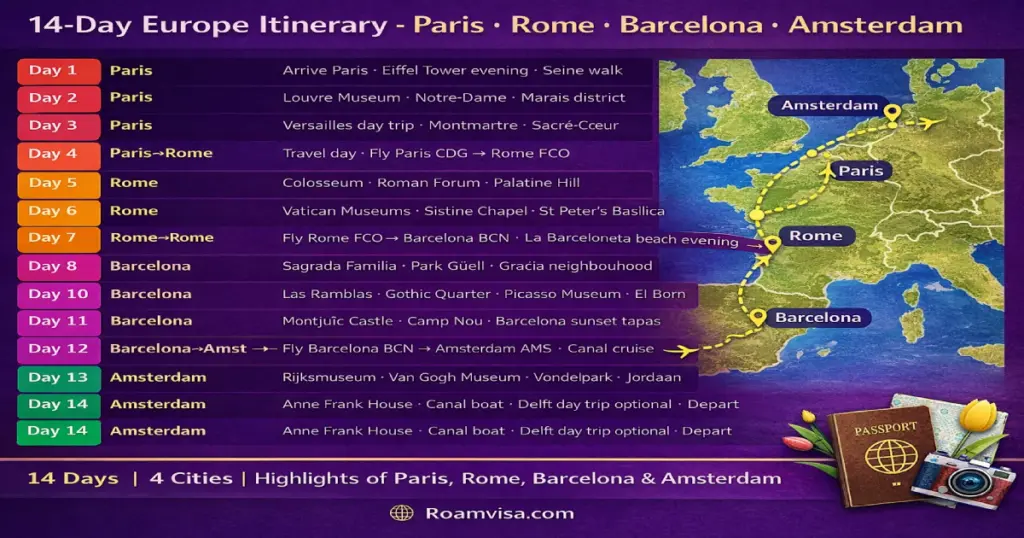
Two weeks is a considered, generous amount of time for this route not so rushed that you are ticking boxes from a tourist bus, and not so slow that you run out of things to discover. Three to four nights in each city gives you time to find the neighbourhood café you will tell people about for years, to get genuinely lost without panicking, and to sit in a piazza or on a canal bridge with no agenda at all, which is often when travel becomes something more than sightseeing.
This guide gives you a complete day-by-day plan built around real priorities rather than exhaustive checklists. It covers the must-see attractions with honest advice about what to skip, practical transport between cities, accommodation recommendations for each tier of budget, and a full cost breakdown. Whether you are planning this trip from Sydney, Mumbai, Toronto, or anywhere else in the world, this is everything you need to make it work.
Quick Facts – 14-Day Paris, Rome, Barcelona & Amsterdam
- Trip Structure: Paris (3 nights) → Rome (3 nights) → Barcelona (3 nights) → Amsterdam (2 nights)
- Inter-City Flights: Paris→Rome from €55 · Rome→Barcelona from €45 · Barcelona→Amsterdam from €35
- Daily Budget: €70–€110 (budget) · €120–€200 (mid-range) · €230–€380 (comfortable)
- Accommodation: Hostels from €20 · Budget hotels from €65 · Mid hotels from €110 · 4-star from €200
- Best Season: April–June or September–October (warm, less crowded than peak summer)
- Visa: Schengen Area check entry requirements for your nationality before booking
- Key Tip: Book all major attraction tickets 2–4 weeks ahead skip-the-line tickets are essential
The 14 Day Route – Structure and Logic
The geographic logic of this route matters. Paris and Amsterdam are both in Western Europe and easily connected by the Thalys high-speed train (a far more pleasant journey than flying). Rome sits at the heart of the Mediterranean and is Europe’s most visited destination for a reason its historical density is unmatched. Barcelona, halfway between southern France and the western Mediterranean, slots naturally between Rome and Amsterdam on a westward arc.
The recommended flight direction Paris, then Rome, then Barcelona, then Amsterdam minimises backtracking and keeps the inter-city hops short and cheap. Flying east-to-west along this arc means each budget carrier sector is competitive and under three hours.
| Segment | Days | Nights | Key Experiences | Travel to Next City |
|---|---|---|---|---|
| Paris | Day 1–3 | 3 nights | Eiffel Tower, Louvre, Versailles, Montmartre | Fly CDG → FCO (2h 05m) |
| Rome | Day 4–7 | 3 nights | Colosseum, Vatican, Pantheon, Trastevere | Fly FCO → BCN (2h 20m) |
| Barcelona | Day 8–11 | 3 nights | Sagrada Família, Park Güell, Gothic Quarter | Fly BCN → AMS (2h 25m) |
| Amsterdam | Day 12–14 | 2 nights | Rijksmuseum, Van Gogh, Anne Frank, canals | Depart from AMS |
Paris – Days 1 to 3
Paris is the opening act, and it is exactly as extraordinary as the reputation suggests possibly even more so. The city operates on a scale and with an aesthetic confidence that is simply unlike anywhere else. Haussmann’s grand boulevards, the curvature of the Seine, the way the light falls on cream-coloured stone buildings in the late afternoon Paris has a visual coherence that makes even a walk to the nearest boulangerie feel cinematic.
Three days is enough to see the headline attractions and get a genuine feel for at least two or three of Paris’s distinct neighbourhoods. The key is not trying to see everything the Louvre alone could occupy a week but being selective and going deep on what you choose.
Day 1 – Arrival and First Evening in Paris
Most international flights arrive at Charles de Gaulle (CDG). The RER B train from the airport to central Paris takes 35–45 minutes and costs around €11 far cheaper and usually faster than a taxi or rideshare. The train stops at Gare du Nord, Châtelet–Les Halles, and Saint-Michel, all excellent central hubs.
Day 1 Plan:
- Arrive CDG · RER B train to central Paris · check in
- Late afternoon: Walk to the Eiffel Tower the first view from Trocadéro plaza across the Seine is one of the great travel moments
- Evening: Book Eiffel Tower summit tickets online (€29–€32) for the last evening slot when the crowds thin and the city is lit up below
- Dinner: Rue Cler market street in the 7th arrondissement a quintessential Paris neighbourhood with excellent food shops and outdoor café tables
Day 2 – The Louvre, Notre-Dame and the Marais
The Louvre is the world’s largest art museum and the most visited in the world over nine million visitors per year. For first-timers, the most important advice is to book skip-the-line tickets online in advance (€22), arrive at opening, and decide in advance which three or four rooms you will focus on. Trying to see the whole Louvre in one visit is a category error the building itself has over 700 rooms. The Mona Lisa, Venus de Milo, and Winged Victory of Samothrace are the three anchor points most first-timers prioritise.
Day 2 Plan:
- 9:00am: Louvre Museum (book skip-the-line timed entry) allow 3 hours; focus on Denon Wing for the Mona Lisa and ancient Greek sculpture
- 12:30pm: Cross the Pont des Arts to the Île de la Cite Notre-Dame Cathedral exterior (restoration continues after the 2019 fire; check current public access status)
- 2:00pm: Walk east into the Marais district Paris’s most characterful neighbourhood, with the Place des Vosges (the city’s oldest planned square), independent galleries, and the Jewish Quarter on Rue des Rosiers
- 4:00pm: Centre Pompidou the controversial-when-built, now beloved inside-out arts centre has a free plaza and excellent views from the external escalators
- Evening: Dinner in the Marais Chez Janou or any of the dozens of excellent bistros in the streets around Place des Vosges
Day 3 – Versailles Day Trip and Montmartre Evening
The Palace of Versailles is 35 minutes from central Paris on the RER C train and deserves a full morning. Louis XIV’s extraordinary statement of royal ambition the Hall of Mirrors, the King’s Grand Apartments, the Grand Canal, and the formal gardens stretching to the horizon is one of the most impressive architectural and landscape achievements in European history. The gardens alone cover 800 hectares. Book timed entry online (€20 palace entry, gardens free on non-fountain days) and arrive at opening to get ahead of the tour groups.
Day 3 Plan:
- 8:30am: RER C train from Paris to Versailles-Château-Rive Gauche station
- 9:00am–1:00pm: Palace of Versailles Hall of Mirrors, State Apartments, Grand Trianon; walk the formal gardens
- 2:00pm: Return to Paris · afternoon rest or optional Musée d’Orsay visit (Impressionist masterpieces in a converted railway station among the finest art collections anywhere)
- 4:30pm: Montmartre the hilltop village neighbourhood above Paris; walk up the steep Rue Lepic, browse the Place du Tertre artists’ square
- 6:00pm: Sacré-Cœur Basilica the white-domed church at Montmartre’s summit with the finest panoramic view over all of Paris
- Evening: Dinner at a Montmartre bistro · early night before tomorrow’s flight to Rome
Paris First-Timer Tips:
✔ Buy a Navigo Découverte weekly pass (€30) unlimited Paris public transport including RER to Versailles and CDG airport
✔ Book Eiffel Tower tickets at least 3–4 weeks ahead same-day tickets are rarely available
✔ The Louvre is free for under-26s from EU countries and free for all on the first Friday evening of each month
✔ Paris arrondissements spiral out from the centre staying in the 1st, 4th, 6th or 7th puts you within walking distance of most sights
✔ Tipping is not mandatory in France , a round-up or small coin is appreciated but not expected
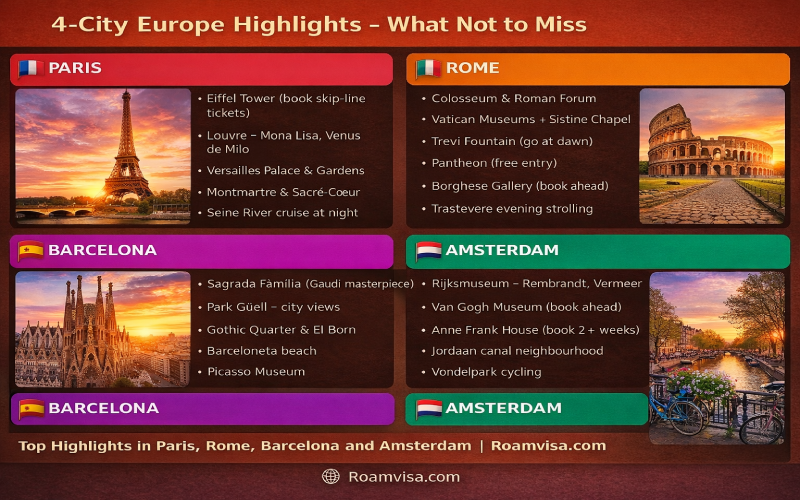
Top attractions in Paris, Rome, Barcelona and Amsterdam for first-time visitors – Roamvisa.com
Rome – Days 4 to 7
If Paris is Europe’s most beautiful city, Rome is its most overwhelming in the best possible sense. Nowhere else on earth are layers of civilisation stacked so densely. Ancient Roman ruins sit alongside medieval churches that incorporate classical columns, which are in turn overlooked by Baroque fountains commissioned by Renaissance popes. Walking any direction from your hotel in Rome’s historic centre, you will encounter something extraordinary within five minutes, often without even looking for it.
The flight from Paris CDG to Rome Fiumicino (FCO) takes about two hours and fifteen minutes. Budget carriers including Ryanair, Vueling, and ITA Airways serve this route from €45–€70 when booked a few weeks ahead. From Fiumicino, the Leonardo Express train connects the airport to Roma Termini in 32 minutes. Book it at the station kiosk to avoid the significant surcharge charged by taxi drivers who approach arriving passengers.
Day 4 – Arrive Rome, Evening in Trastevere
Day 4 Plan:
- Fly Paris CDG → Rome FCO (morning flight recommended arrive early afternoon)
- Leonardo Express train from FCO to Roma Termini (32 min, €14)
- Check in ideally in the historic centre (Campo de’ Fiori area, Trastevere, or near the Pantheon)
- Afternoon: Walk to the Pantheon Entry is now €5 (previously free) but it is one of the most perfectly preserved ancient buildings in the world; allow 45 minutes
- Evening: Trastevere Rome’s most atmospheric neighbourhood, a tangle of narrow medieval streets south of the Vatican with exceptional trattorias; wander and eat slowly
Day 5 – The Colosseum, Forum and Palatine Hill
The Colosseum is the most iconic ancient structure in the world and it needs a full morning to do justice. The combined ticket (€18–€22) covers the Colosseum interior, the Roman Forum, and Palatine Hill three sites that together form the beating heart of ancient Rome and can be explored as a continuous walk. Book timed entry online at least two to three days ahead, or the queue for on-the-day tickets can be 45–90 minutes long.
Day 5 Plan:
- 9:00am: Colosseum arrive at opening with pre-booked timed entry; the underground hypogeum and arena floor access require a separate ticket but are worth it for context
- 11:30am: Roman Forum and Palatine Hill walk through the ruins where Roman senators debated and emperors lived; the views over the Forum from Palatine Hill are spectacular
- 2:00pm: Lunch at a trattoria near the Testaccio neighbourhood Rome’s traditional working-class food neighbourhood, with excellent cacio e pepe and artichokes
- 4:00pm: Circus Maximus the ancient chariot racing track, free to walk through
- Evening: Campo de’ Fiori square for aperitivo hour one of Rome’s most lively piazzas at dusk
Related Articles: USA East Coast Road Trip – NYC to Miami Complete Guide
Day 6 – The Vatican
The Vatican Museums and Sistine Chapel are the most-booked attraction in Rome for good reason Michelangelo’s Sistine Chapel ceiling is genuinely one of the greatest artistic achievements in human history, and the museum corridors leading to it are themselves extraordinary. Book skip-the-line timed entry online at least two weeks ahead, particularly between April and October. The standard visit takes 3–4 hours to reach the Chapel via the Gallery of Maps, the Raphael Rooms, and the Pinacoteca.
Day 6 Plan:
- 9:00am: Vatican Museums book early morning entry; the Sistine Chapel is at the end of the museum route but every room before it is worth your attention
- 12:30pm: St Peter’s Basilica entry is free, though the dome climb (€6–€8) requires energy; the basilica itself is immense and beautiful and takes 45 minutes to explore properly
- 2:30pm: Lunch in Prati neighbourhood (directly north of the Vatican) Rome’s most understated good-food neighbourhood
- 4:30pm: Castel Sant’Angelo the cylindrical fortress on the Tiber with excellent city views from the top terrace (€12 entry)
- Evening: Piazza Navona Rome’s most theatrical Baroque square, with Bernini’s Four Rivers Fountain at its centre
Day 7 – Borghese Gallery, Trevi Fountain and Departure Preparation
Day 7 Plan:
- 9:00am: Borghese Gallery (MUST book in advance visits are strictly timed at 2-hour slots; entry €15) the finest collection of Bernini sculpture in the world in a beautiful villa surrounded by the park of the same name
- 12:00pm: Stroll through Villa Borghese park Rome’s green lung
- 2:00pm: Trevi Fountain go early morning or late evening for manageable crowds; midday is extremely busy
- 3:30pm: Spanish Steps and Via Condotti (Rome’s luxury shopping street even non-shoppers enjoy the architecture)
- Evening: Final Roman dinner pasta carbonara or cacio e pepe at a trattoria in the centro storico
Rome First-Timer Tips:
✔ Book Colosseum, Vatican, and Borghese Gallery well in advance all three have timed entry systems
✔ The Trevi Fountain is most beautiful and least crowded at 6:00–7:30am wake up early for it
✔ Water from Rome’s drinking fountains (nasoni) is safe, cold, and free. Carry a refillable bottle
✔ Many Rome churches are free to enter and contain world-class art Caravaggio’s in San Luigi dei Francesi is unmissable
✔ Never eat at a tourist menu restaurant directly facing a famous piazza walk one street back for 40% lower prices and better food.
Barcelona – Days 8 to 11
Barcelona operates at a different frequency from Paris and Rome. Where those cities invite reverence, Barcelona invites participation. It is a city of beach-goers, football fanatics, late-night diners, and architectural pilgrims all occupying the same streets simultaneously and somehow making it work. Antoni Gaudí’s extraordinary buildings the Sagrada Família, Park Güell, Casa Batlló, Casa Milà give Barcelona a visual identity unlike anywhere else on the planet.
The flight from Rome FCO to Barcelona BCN takes about two hours twenty minutes. Ryanair, Vueling, and ITA Airways all serve this route competitively. Barcelona’s El Prat airport (BCN) connects to the city centre by the L9 Metro (€5.15) or the Aerobús (€6.75) the Aerobús is faster if you are staying near Plaça Catalunya.
Day 8 – Arrive Barcelona, La Barceloneta Beach
Day 8 Plan:
- Fly Rome FCO → Barcelona BCN (morning flight recommended)
- Arrive midday check in; aim for a hotel in the Gothic Quarter, El Born, or Eixample for central access
- Afternoon: La Barceloneta beach Barcelona’s main city beach; a 20-minute walk from the Gothic Quarter or one stop on the L4 Metro
- Late afternoon: Walk the Passeig de Joan de Borbó waterfront promenade to get oriented
- Evening: Tapas in El Born neighbourhood Montiel, Bar del Pla, or any of the excellent pintxos bars on Carrer del Parlament in Sant Antoni
Day 9 – Sagrada Família and Park Güell
The Sagrada Família is the defining image of Barcelona and one of the most extraordinary buildings being constructed anywhere in the world. Gaudí began work on it in 1882 and it is still unfinished the projected completion date is 2026. The interior, completed in recent decades, is a forest of branching stone columns beneath stained glass windows that flood the space with coloured light in a way that no photograph adequately captures. Book timed entry tickets online at least two weeks ahead it is the most-booked attraction in Spain.
Day 9 Plan:
- 9:00am: Sagrada Família (timed entry essential from €26; tower access requires a higher-tier ticket) allow 2 hours minimum
- 11:30am: Walk or taxi to Park Güell (€10 timed entry for the monumental zone; the surrounding free park is also worth exploring)
- 1:30pm: Lunch in the Gràcia neighbourhood below Park Güell Barcelona’s bohemian village-within-a-city, with excellent independent restaurants on Carrer de Verdi
- Afternoon: Casa Batlló or Casa Milà (La Pedrera) two of Gaudí’s residential masterpieces on the Passeig de Gràcia; both require timed entry tickets (€25–€35)
- Evening: Aperitivo at a rooftop bar in Eixample; dinner at 9:30pm–10pm (Barcelona dining runs late respect this)
Day 10 – Gothic Quarter, Las Ramblas and the Picasso Museum
Barcelona’s Gothic Quarter (Barri Gotic) is the medieval core of the city a labyrinth of narrow streets, Roman ruins, and Gothic churches that predates Columbus’s first voyage to the Americas. It is also one of the most atmospheric walking neighbourhoods in Europe, though heavily touristed. Get there early morning before the tour groups arrive and you will have entire streets to yourself.
Day 10 Plan:
- 9:00am: Gothic Quarter Cathedral of Barcelona (free entry early morning), Pont del Bisbe, Plaça de Sant Jaume
- 10:30am: Las Ramblas Barcelona’s famous tree-lined boulevard; it is touristy and pickpocket-heavy but is genuinely pleasant in the morning before it crowds
- 12:00pm: La Boqueria market one of Europe’s great covered food markets; buy fresh fruit and watch the food stalls, but eat elsewhere market-side restaurants are overpriced
- 2:00pm: Picasso Museum in El Born (book timed entry, €15) the finest collection of Picasso’s early work, housed in five medieval palaces
- 4:00pm: El Born neighbourhood wander Barcelona’s most creatively vital area, with independent boutiques and craft cocktail bars
- Evening: Dinner in El Poble Sec or Sant Antoni Barcelona’s emerging restaurant neighbourhoods, excellent and significantly less crowded than Gothic Quarter options
Day 11 – Montjuïc, Camp Nou and Final Tapas
Day 11 Plan:
- 10:00am: Montjuïc Castle take the cable car up from Barceloneta beach for spectacular harbour and city views; the castle itself (€5) has interesting military history
- 12:00pm: Fundació Joan Miró on Montjuïc the finest Miró collection in the world in a beautiful purpose-built building (€14)
- 2:30pm: Optional Camp Nou stadium tour (€30) even non-football fans find it interesting for the scale and atmosphere; book ahead
- 5:00pm: Barceloneta beach for a final swim or sunset walk
- Evening: Final Barcelona dinner a proper seafood paella at 7 Portes (book ahead, it is an institution) or fresh fish at a Barceloneta restaurant
Barcelona Tips – Gaudí Booking is Essential
✔ Book Sagrada Família at least 2 weeks ahead same-day tickets are rarely available
✔ Park Güell timed entry: the monumental zone has limited capacity; the surrounding free park is always accessible
✔ Pickpockets are active on Las Ramblas and in the Gothic Quarter use a money belt and do not carry valuables in an open backpack
✔ Barcelona dining runs late: lunch is 2–4pm, dinner starts at 9pm; restaurants before 8pm are tourist-only
✔ The T-Casual metro card (10 trips, €11.35) covers all your public transport for the Barcelona days
Amsterdam – Days 12 to 14
Amsterdam is the perfect final city for this itinerary it is compact enough to feel manageable after the intensity of Paris and Rome, beautiful enough to reward slow exploration, and culturally rich enough to hold attention for several days without effort. The canal ring, a UNESCO World Heritage Site, forms the frame for almost everything you experience here: 165 canals crossed by over 1,500 bridges, lined with narrow 17th-century merchant houses whose gabled rooftops lean at improbable angles.
The flight from Barcelona BCN to Amsterdam AMS takes about two and a half hours. Multiple carriers including Vueling, EasyJet, and KLM serve this route competitively. From Amsterdam’s Schiphol Airport, the Intercity Direct train connects to Amsterdam Centraal in 17 minutes the most efficient airport transfer of any city on this itinerary. An OV-chipkaart (Dutch transit card) or GVB day pass covers all your Amsterdam public transport needs.
Day 12 – Arrive Amsterdam, Canal Cruise and Jordaan
Day 12 Plan:
- Fly Barcelona BCN → Amsterdam AMS · train to Amsterdam Centraal (17 min)
- Check in aim for a hotel or apartment in the Jordaan district (the most beautiful neighbourhood in the city) or on the Grachtengordel canal ring
- Afternoon: Canal boat cruise the 75-minute hop-on hop-off boats give an excellent orientation to the city’s layout and the canal architecture from water level
- Late afternoon: Jordaan neighbourhood walk the most charming part of Amsterdam, with independent galleries, boutiques, brown cafés (bruine kroegen), and the Westerkerk church
- Evening: Dinner in the Jordaan the neighbourhood has excellent Dutch and international restaurants in the moderate price range
Day 13 – Rijksmuseum, Van Gogh Museum and Vondelpark
Amsterdam’s Museum Quarter contains the two greatest museums in the Netherlands and among the finest anywhere in Europe. The Rijksmuseum houses the Dutch Golden Age masterworks Rembrandt’s Night Watch and Vermeer’s The Milkmaid are anchor exhibits in a collection of extraordinary breadth. The Van Gogh Museum, directly adjacent, tells the full arc of Van Gogh’s life and work with a depth and intelligence that is moving even for visitors who did not consider themselves Van Gogh enthusiasts before entering. Both require advance timed entry booking.
Day 13 Plan
- 9:00am: Rijksmuseum (book timed entry online, €22.50) allow 3 hours; the Night Watch and the Delftware and dollhouse rooms are among the highlights beyond the headline paintings
- 12:30pm: Lunch at the Rijksmuseum café or one of the restaurants on Museumplein
- 2:00pm: Van Gogh Museum (book timed entry, €22) the chronological presentation of Van Gogh’s progression is remarkably well done; allow 2 hours
- 4:30pm: Vondelpark Amsterdam’s equivalent of Central Park; the outdoor café (Blauwe Theehuis) is a local institution
- Evening: De Pijp neighbourhood for dinner Amsterdam’s most vibrant food neighbourhood, with the Albert Cuyp Market (daytime) and excellent international restaurants
Day 14 – Anne Frank House, Final Canal Walk and Departure
The Anne Frank House is the most emotionally significant site in Amsterdam and one of the most important in Europe. The secret annex where Anne Frank and her family hid for two years during the Nazi occupation, and where she wrote her diary, is preserved as it was at the time of their discovery. Tickets must be booked online at least two to three weeks ahead walk-up entry is virtually impossible and the museum sells out completely most days.
Day 14 Plan
- 9:00am: Anne Frank House (pre-booked timed entry essential, €16) allow 1.5 hours; read the diary (or at least part of it) before visiting for maximum impact
- 11:00am: Final canal walk take a slow stroll through the Jordaan and along the Herengracht, Prinsengracht and Keizersgracht canals
- 1:00pm: Lunch at a brown café (try a broodje kroket a classic Dutch snack)
- Optional: Day trip to Delft (35 min by train) the perfectly preserved 17th-century Dutch town and home of Delft Blue pottery; more peaceful than Amsterdam and deeply beautiful
- Afternoon/Evening: Head to Schiphol Airport for departure allow 45 minutes from Amsterdam Centraal by Intercity Direct train
Amsterdam First-Timer Tips:
✔ Book Anne Frank House, Rijksmuseum and Van Gogh Museum tickets well before arrival 2–3 weeks minimum
✔ Rent a bicycle for at least one day Cycling is genuinely the best way to navigate Amsterdam and gives the authentic local experience
✔ Give way to cyclists at ALL times they have right of way on almost every surface in the city
✔ The Amsterdam City Card (24h €67 / 48h €82 / 72h €97) covers museum entry and public transport good value if visiting 3+ museums per day
✔ Coffee shops in Amsterdam are legal cannabis establishments know what you are walking into before you sit down
Getting Between Cities – Flights, Trains and Booking Tips
Inter-city flights, budget breakdown and booking tips for the 14-day Europe itinerary – Roamvisa.com
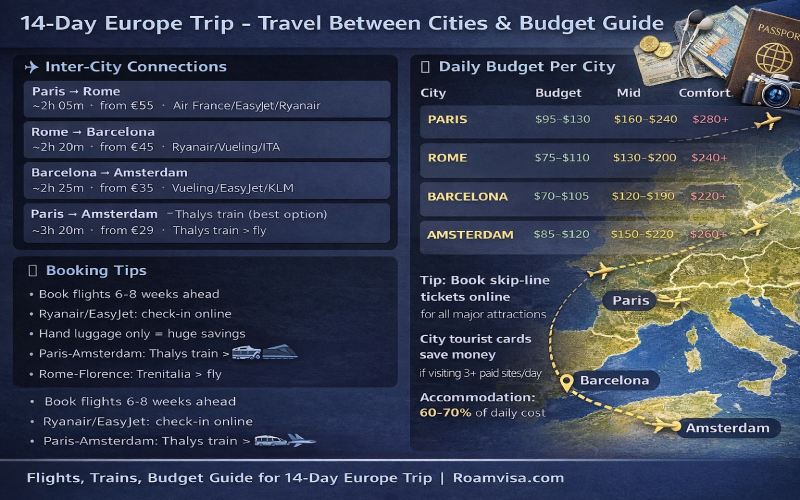
| Route | Best Option | Journey Time | From Price | Booking Tip |
|---|---|---|---|---|
| Paris → Rome | EasyJet / Ryanair / ITA | 2h 05m | €45–€65 | Book 6–8 weeks ahead for best prices |
| Rome → Barcelona | Ryanair / Vueling | 2h 20m | €39–€60 | Check both Ryanair and Vueling side by side |
| Barcelona → Amsterdam | Vueling / EasyJet / KLM | 2h 25m | €35–€55 | KLM often most reliable if fares are close |
| Paris → Amsterdam | Thalys high-speed train | 3h 20m | €29–€99 | Train is city-centre to city-centre preferable to flying |
| Paris → Barcelona | TGV direct train | 6h 30m | €35–€120 | If adding this leg, train is most scenic and easy |
Inter-City Flight Booking Tips:
✔ Book all inter-city flights as soon as the itinerary is confirmed 6–8 weeks ahead gives the best prices
✔ Travel with hand luggage only where possible budget carrier hold-bag fees add €25–€40 each wayv
✔ Check-in online for all budget carrier flights some (Ryanair) charge extra for airport check-in
✔ Paris→Amsterdam by Thalys train is significantly more pleasant than flying you arrive in the city centre with no airport hassle
✔ Use Google Flights calendar view to find the cheapest day for each sector shifting departure by one day can save €30–€50
Budget Breakdown – What This 14-Day Trip Really Costs
| Cost Category | Budget Traveller | Mid-Range | Comfortable |
|---|---|---|---|
| Accommodation (14 nights) | €14–€25/night (hostel) | €65–€130/night | €150–€350/night |
| Inter-city flights (3 sectors) | €120–€180 total | €120–€180 total | €200–€400 business |
| Meals (per day) | €20–€35 | €45–€75 | €90–€160 |
| Attraction entry (per day) | €10–€20 | €25–€45 | €50–€100 |
| Local transport (per day) | €5–€10 | €10–€15 | €15–€30 |
| TOTAL 14-day estimate | €700–€1,200 | €1,800–€3,000 | €3,500–€6,500+ |
Best Time to Do This Trip
| Season | Months | Conditions | Crowds | Value |
|---|---|---|---|---|
| Early Spring | March–April | Cool, occasional rain; Paris and Amsterdam beautiful | Low–Medium | Excellent low season pricing |
| Late Spring | May–June | Warm, long days, pleasant everywhere | Medium–High | Good before peak summer |
| Summer | July–August | Hot everywhere; Rome and Barcelona can be intense | Very High | Worst value peak prices |
| Early Autumn | September–October | Arguably the best weather; warm but manageable | Medium | Best overall value + conditions |
| Winter | November–February | Cold in Paris and Amsterdam; milder in Rome/Barcelona | Low | Good deals; Rome and Barcelona work well |
Frequently Asked Questions
Q1. Is 14 days enough for Paris, Rome, Barcelona and Amsterdam?
Fourteen days gives three to four nights in each city enough to see the main attractions, explore at least two or three neighbourhoods, and develop a genuine sense of each place. It is not enough to exhaust any of these cities (Paris and Rome in particular could each consume a week alone), but it gives an excellent first-timer overview and leaves you wanting to return to each place for a longer stay.
Q2. What is the best order for visiting these four cities?
Paris → Rome → Barcelona → Amsterdam is the most geographically logical and transport-efficient order. It minimises backtracking and keeps all inter-city hops relatively short and cheap. The Thalys high-speed train between Paris and Amsterdam (at the end of the trip) is the most pleasant inter-city connection on the route far better than flying and no longer in terms of total travel time once you factor in airport logistics.
Q3. Which attraction is hardest to book and needs the earliest planning?
The Vatican Museums and Sistine Chapel in peak season (April–October) and the Anne Frank House in Amsterdam are consistently the hardest to book both sell out weeks in advance. The Sagrada Família in Barcelona also requires advance booking, particularly for specific time slots and tower access. Book all three as soon as you have confirmed your travel dates. The Eiffel Tower summit tickets for a specific evening slot are also worth booking early.
Q4. Do I need to speak French, Italian, Spanish and Dutch?
No. English is widely spoken in all four cities, particularly in tourist contexts, hotels, restaurants, and public transport. That said, learning a few words of each language bonjour and merci in Paris, grazie and prego in Rome, gràcies in Barcelona, dank je wel in Amsterdam is noticed and genuinely appreciated. It signals respect for the local culture and will occasionally unlock a warmer response from locals who encounter many visitors who make no effort at all.
Q5. Which city on this route has the best food?
This is a genuinely difficult question because each city has a distinct and excellent food culture. Rome wins on pasta and pizza the simplicity and quality of Roman food is extraordinary, and the carbonara, cacio e pepe, and carciofi alla romana you eat there are unlikely to be replicated at home. Barcelona is the most versatile from Catalan high cuisine to tapas bars to the best seafood paella in Spain, it delivers across all price points. Paris has the finest pastries and café culture anywhere in the world.
Q6. How should I handle money across these four countries?
All four cities use the Euro (France, Italy, Spain, Netherlands are all Eurozone members), which simplifies things considerably. A travel-optimised debit or credit card such as Wise, Revolut, or a no-foreign-transaction-fee credit card from your home bank is the most cost-effective way to pay. Contactless payments are universally accepted in all four cities. ATMs are plentiful.
Conclusion
Paris, Rome, Barcelona, and Amsterdam represent, collectively, an astonishing concentration of human achievement in architecture, art, food, urban design, and the simple craft of building a city that people want to live in and visit for centuries. Fourteen days moving through all four is not just a holiday; it is an education in what Europe does and has done, and why it remains one of the most compelling travel destinations on the planet.
The key to making this trip exceptional rather than merely impressive is pace. Do not try to see everything. Choose the museum that genuinely interests you rather than the one on the checklist. Sit at the café table for a second coffee. Walk the neighbourhood without a destination. The famous sights will be spectacular, but the best memory you bring back from each city will almost certainly be something smaller, more accidental, and entirely your own. Book the Sagrada Família and the Vatican before anything else, get a Navigo pass in Paris, rent a bicycle for one afternoon in Amsterdam, and eat dinner late in Barcelona. The rest will take care of itself.


