This 5-day Dubai itinerary covers everything a first-time visitor needs to experience the best this city has to offer – from the record-breaking heights of Burj Khalifa to the ancient alleyways of the Gold Souk, the red dunes of the desert at sunset, and the gleaming waterfront of Dubai Marina. Five days is the sweet spot for a first Dubai trip. Long enough to see the city’s full range, short enough to keep the pace comfortable without feeling rushed.
5-Day Dubai Itinerary – Day-by-Day Overview for First Timers 2026 | Roamvisa.com
Dubai is one of the most visited cities on the planet for good reason. It delivers on spectacle at every turn. But it also has depth that first-time visitors often miss – an old city that predates the skyscrapers, a creek that has been the center of trade for generations, and a desert landscape on the doorstep that is unlike anything most travelers have experienced. This guide covers all of it.
One honest note before the day-by-day breakdown: Dubai in summer (June through August) is brutally hot, with temperatures regularly exceeding 42°C. The best months to visit are October through April when the weather is genuinely pleasant. This itinerary works year-round but the outdoor days – Desert Safari, creek walk, Marina evening – are significantly more enjoyable in cooler months.
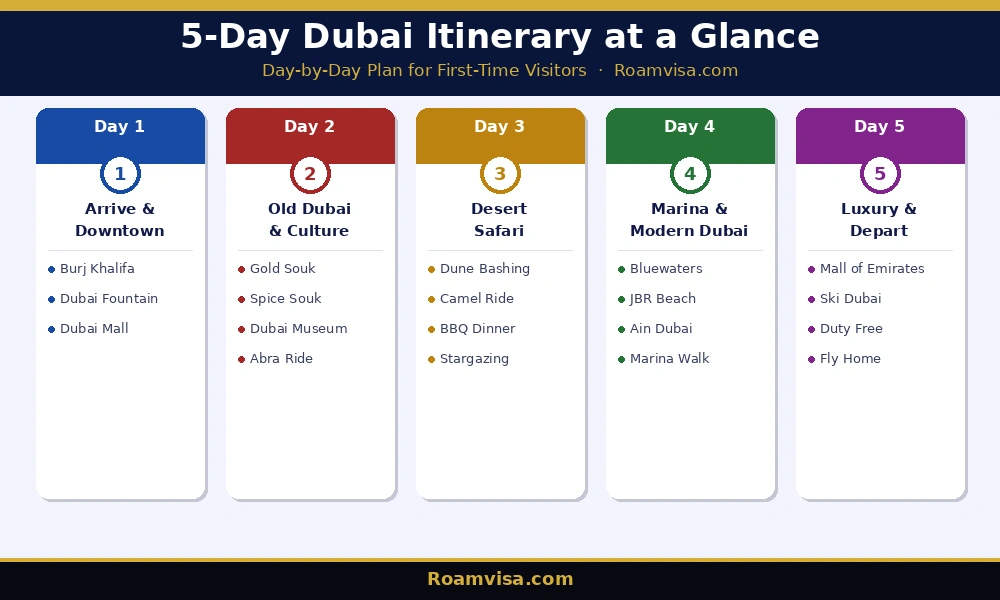
Your 5-Day Dubai Route at a Glance
Day 1 – Arrive and Downtown Dubai · Burj Khalifa · Dubai Fountain · Dubai Mall
Day 2 – Old Dubai · Gold Souk · Spice Souk · Dubai Museum · Abra Creek ride
Day 3 – Desert Safari · Dune bashing · Camel ride · BBQ dinner under stars
Day 4 – Dubai Marina · JBR Beach · Ain Dubai · Bluewaters Island
Day 5 – Mall of Emirates · Ski Dubai · Duty-free shopping · Fly home
Day 1 – Arrive and Explore Downtown Dubai
Most long-haul flights arrive at Dubai International Airport (DXB) in the morning or afternoon. The airport is one of the best connected in the world – Terminal 1 and Terminal 3 are both served by the Dubai Metro Red Line, which takes you to central Dubai in about 25 minutes for around AED 5-8. Take the metro to Union Station or directly to the BurJuman area depending on your hotel location. Check in, freshen up, and head to Downtown Dubai in the late afternoon. This area is the showpiece of Modern Dubai and the right place to start.
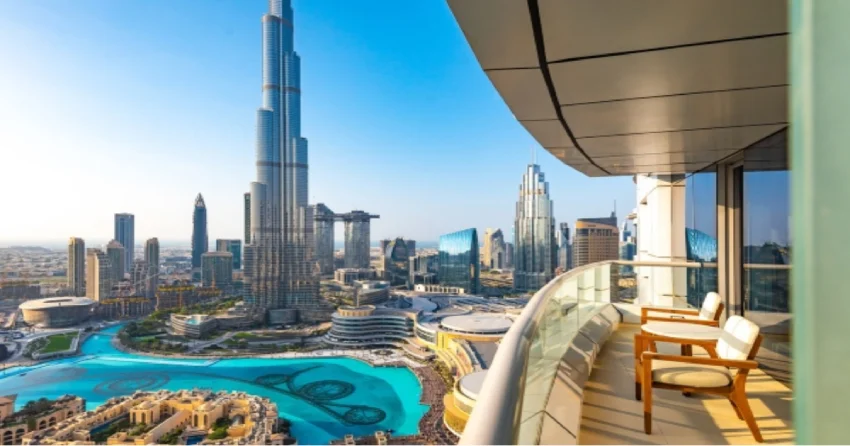
The Burj Khalifa is the obvious anchor – book your At the Top observation deck ticket online before you travel, not at the entrance. Tickets are AED 149 for the 124th floor observation deck (Level 124) or AED 379 for the premium upper deck (Level 148). The evening slot from 6 PM onward gives you both daylight views and the city lighting up as dusk falls. Book at least 48 hours in advance – this sells out regularly. After the Burj Khalifa, the Dubai Fountain show at the base of the tower runs every 30 minutes from 6 PM onward. It is the largest choreographed fountain system in the world and genuinely impressive – water jets reach 150 meters, and the show is synchronized to music. It is completely free to watch from the boardwalk. The best viewing is from the waterfront promenade alongside the Burj Khalifa Lake.
Dubai Mall is directly connected to Burj Khalifa and makes an easy dinner destination. With over 1,200 shops and dozens of restaurants on multiple levels, finding food is not a problem. The Dubai Aquarium and Underwater Zoo inside the mall is worth seeing even if you do not pay for full entry – the giant acrylic viewing panel on the ground floor is visible for free. End the evening early. Tomorrow is a walking-heavy day.
At the Top tickets sell out days in advance during peak season. Book before you travel – the Burj Khalifa website is the official booking platform.
Day 2 – Old Dubai and Creek Culture
Today is a complete contrast to Day 1. Leave the glass towers behind and spend the day in the oldest part of the city. Start at the Dubai Museum in Al Fahidi Historical Neighbourhood, housed in the Al Fahidi Fort – the oldest surviving building in Dubai, built in 1787. Entry is AED 3. The museum is small but well presented and gives useful context for everything you see in the city during the rest of the trip. Allow 45 minutes. Walk through the Al Fahidi Historical Neighbourhood itself. This is the old merchant quarter, and the wind tower architecture – the original form of air conditioning, designed to catch and funnel breezes down into buildings – is unique to this part of the Gulf. The narrow lanes and traditional courtyard buildings feel completely unlike the rest of Dubai. The area has been converted into a cluster of art galleries, independent cafes, and cultural spaces without losing its historic character.
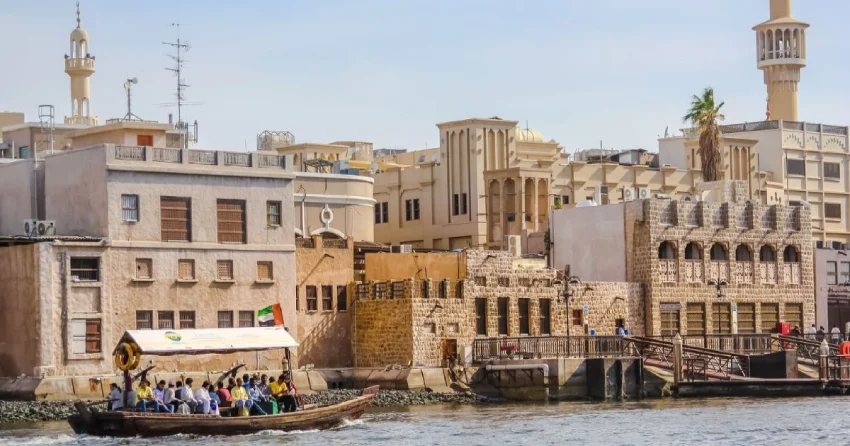
From Al Fahidi, take an abra – a traditional wooden water taxi – across the Dubai Creek to Deira. The fare is AED 1 per person, making it one of the best value experiences in any city anywhere. The creek crossing takes about five minutes and gives you the same view that merchants have had for over a century, now with skyscrapers rising on both banks. It is a remarkable moment of old and new side by side. Deira is where the real souks are. The Gold Souk is the largest in the world by some estimates – an entire district of covered alleyways lined with shops displaying gold jewelry, from traditional Gulf designs to contemporary pieces. You do not need to buy anything, but walking through it is an experience in itself. The Spice Souk, a short walk away, has open sacks of frankincense, saffron, cardamom, dried limes, and dozens of other spices. The smells alone are worth the visit.
Return across the creek by abra in the afternoon. The Textile Souk on the Bur Dubai side is good for fabrics and tailoring at competitive prices. For dinner, the Bur Dubai area has excellent restaurants representing the full diversity of Dubai’s population – you can find Filipino, Sri Lankan, Pakistani, Ethiopian, and Lebanese food within a few blocks of each other, all at prices significantly lower than Downtown Dubai.
Bargaining is expected and normal in the souks. Starting at 50-60% of the first price quoted and settling around 70-75% is standard practice. Never feel obligated to buy.
Day 3 – Desert Safari
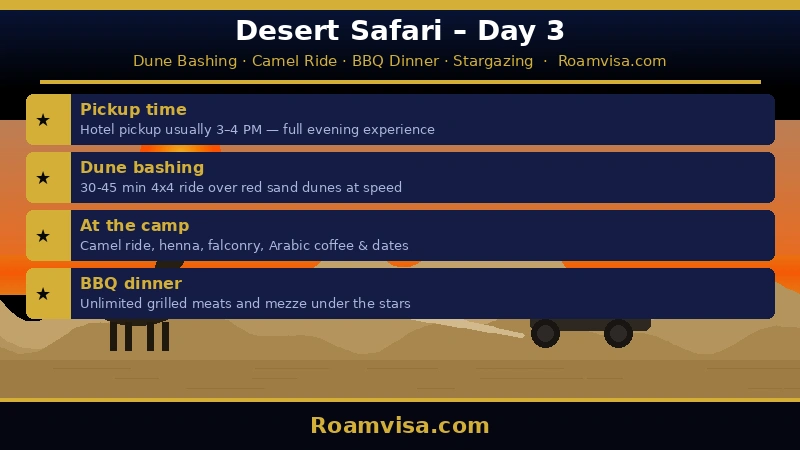
Dubai Desert Safari – Dune Bashing, Camel Ride and BBQ Dinner Under the Stars | Roamvisa.com
Keep the morning free – the desert safari operates in the afternoon and evening, so there is no need for an early start today. Use the morning to visit anywhere you missed in the first two days, do laundry, rest, or explore your hotel neighborhood.
Hotel pickup for desert safaris is usually between 3 PM and 4 PM, depending on the operator. You are driven about 45-60 minutes outside the city to the red dunes of the Dubai Desert Conservation Reserve. This is a genuinely different landscape from the city – rolling red dunes that extend to the horizon, with no buildings visible in any direction. Dune bashing comes first – your driver takes a specially prepared 4×4 Land Cruiser with deflated tires onto the dunes at speed, climbing and descending steep faces in a way that is simultaneously terrifying and exhilarating. Most people love it. If you have motion sickness, take medication beforehand or let your driver know – they can keep it slightly calmer. The session lasts 30-45 minutes.
At the desert camp, the experience opens up into an evening of activities and food. A camel ride around the camp is included – these are gentle, well-handled animals, and the experience of sitting on a camel at sunset against the dunes is a memorable photo moment. Henna painting, sandboarding on a small dune, and a falconry demonstration are typically included depending on the operator.
READ MORE: Best Hotels Near Burj Khalifa – Budget to Luxury Options
Dinner is a BBQ spread in an open-air camp under the stars – grilled meats, mezze, hummus, bread, and usually unlimited non-alcoholic drinks. Alcohol is available as an add-on with some operators. After dinner, some guests stay to lie on blankets and stargaze in a genuinely dark sky far from city light pollution. It is one of the better free things Dubai offers to overnight visitors. You are returned to your hotel by around 9:30-10:30 PM. This is a long day – satisfying but tiring. Book in advance with a reputable operator; prices typically range from USD 50-90 per person for a shared group tour.
Book the desert safari through your hotel concierge or a well-reviewed operator with recent online reviews. Prices vary widely for the same experience – the middle price range usually offers the best quality-to-cost ratio.
Day 4 – Dubai Marina and the Waterfront
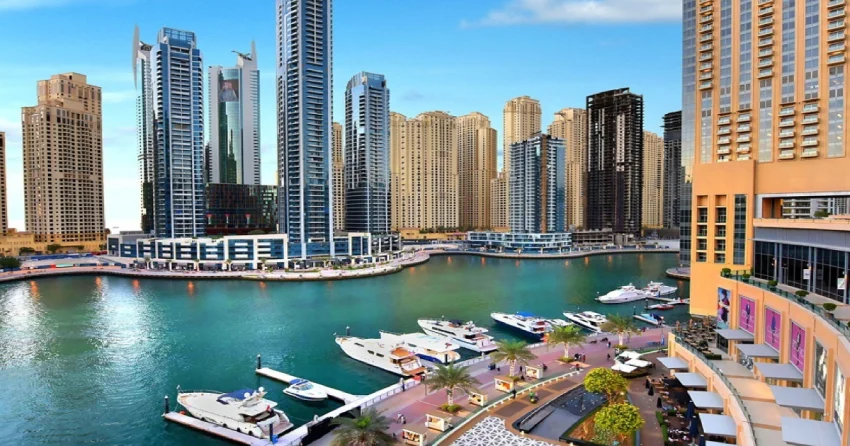
Dubai Marina is the other face of modern Dubai – a purpose-built waterfront district with a 3.5 km man-made canal, 200 skyscrapers, a pedestrian marina walk, and access to the Jumeirah Beach Residence (JBR) beach strip. Take the Metro Red Line to Damac Properties station or DMCC station, or the tram that runs along the waterfront.
Start at The Walk at JBR in the morning. This is a two-kilometer pedestrian promenade running alongside the beach, lined with cafes, restaurants, and shops. The beach itself is free and open to the public. The Open Beach section at the northern end of JBR is the most accessible public beach in Dubai and one of the best in the city. The water is clean, the sand is white, and the Marina towers behind you make for a striking backdrop. In the afternoon, cross to Bluewaters Island – a man-made island connected to JBR by a pedestrian bridge. The main attraction here is Ain Dubai, the world’s tallest observation wheel at 250 meters. A standard cabin ticket costs around AED 130. The views over Palm Jumeirah, the Marina, and the city skyline in all directions are exceptional – especially in the late afternoon as the light softens. The island also has a selection of restaurants and cafes with waterfront terraces.
Return to the Marina Walk for the evening. The Marina promenade at night, with the towers lit up and the boats moored alongside, is one of the most atmospheric places to walk in the entire city. Dinner here has options from casual street food to upscale seafood restaurants – the price range is wide enough to suit any budget. If you want to splurge one evening, this is the place to do it.
The Dubai Tram runs along the Marina waterfront and connects to the metro at DMCC station. A one-way tram journey is AED 3. Far more convenient than taxis for moving along the waterfront.
Day 5 – Mall of Emirates, Ski Dubai, and Departure
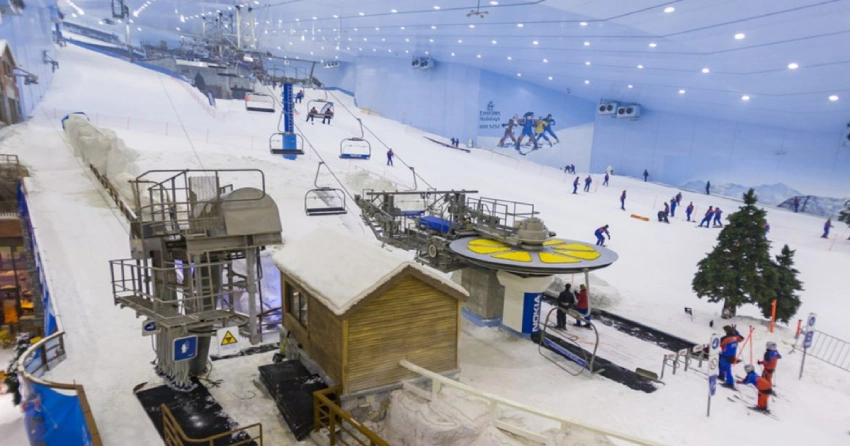
Depending on your departure time, the last day has a clear anchor: Mall of Emirates and Ski Dubai. The Mall of Emirates is one of the city’s major malls, notable primarily for containing an indoor ski slope inside a shopping mall in the desert. Ski Dubai is exactly what it sounds like – a full ski resort with real snow, ski runs, snowboarders, and a penguin encounter experience, all operating at -1°C inside a glass building in a city where outdoor temperatures can reach 45°C. It is genuinely surreal in the best possible way.
Ski Dubai day passes start from around AED 250 and include ski or snowboard equipment, boots, gloves, and a jacket. You do not need to be an experienced skier – there are gentle slopes and a snow park area with sledging and snow play that is suitable for all ages and abilities. Allow two to three hours. It is cold in there – the AED-included jacket and gloves are essential.
After Ski Dubai, the mall itself has every major international retail brand you would expect, plus a good food court and several high-end restaurants. For last-minute shopping before your flight, this is a reliable option. Electronics, cosmetics, clothing, and food items are all available at prices that compare well internationally. Allow at least three hours before your international departure for the airport journey and check-in. Dubai International Airport (DXB) handles enormous passenger numbers and security lines can be long during peak departure times. The Metro Red Line from Dubai Mall station or the Airport Metro link from various city points gets you to Terminal 1 or Terminal 3. Taxis are also reliable and plentiful from any mall.
Dubai Duty Free at the airport is genuinely competitive for perfume, electronics, chocolate, and spirits. Worth browsing if you have time after security – but prices for clothing and fashion brands are not significantly better than city malls.
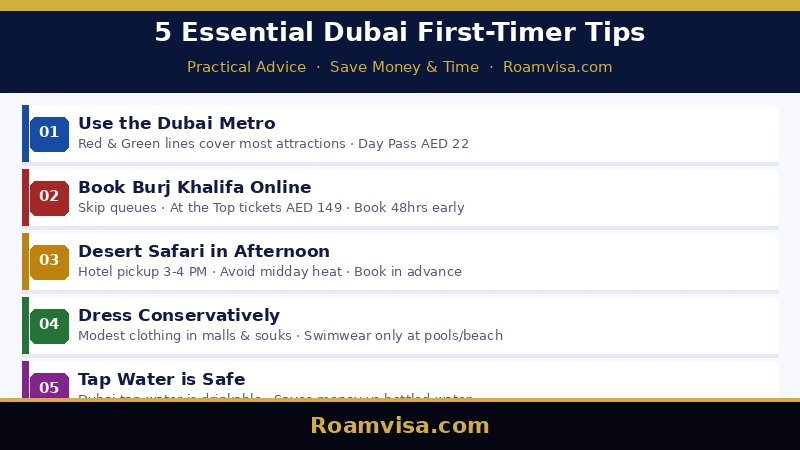
5 Essential Tips for First-Time Visitors to Dubai 2026 | Roamvisa.com
Practical Information for First-Time Visitors
Getting Around: The Dubai Metro is clean, air-conditioned, punctual, and covers all the major attractions on this itinerary. The Red Line connects the airport, Downtown Dubai, and Dubai Marina. Buy a Nol card from any station – AED 25 including AED 19 credit. Reload as needed. Taxis are metered and reliable but noticeably more expensive than the metro. Uber and Careem operate in Dubai.
Dress Code: Dubai is generally relaxed about tourist dress in malls and tourist areas, but modest clothing – covered shoulders and knees – is expected in souks, mosques, and government areas. Swimwear is appropriate only at pools and beaches. Carry a light scarf for coverage when needed. This applies to all visitors regardless of background.
Weather: October to April: 20-30°C, pleasant and comfortable for all outdoor activities. May to September: 35-45°C with high humidity, most outdoor activities are difficult during the day. Summer visitors should plan all outdoor sightseeing for early morning or evening.
Currency and Payments: UAE Dirham (AED). USD 1 ≈ AED 3.67 (fixed rate). Contactless payment is widely accepted across the city. Major credit and debit cards work in all malls, restaurants, and hotels. ATMs are everywhere.
Alcohol: Alcohol is legally available in licensed restaurants, hotels, and bars in Dubai. It is not available in the souks, in public spaces, or in unlicensed restaurants. Do not drink in public places. Behavior under the influence in public is treated seriously.
Photography: Photography of landmarks, skylines, and tourist areas is fine. Do not photograph government buildings, military installations, or individuals without permission. Be respectful in traditional areas including souks and mosques.
Best Things Not to Miss in Dubai
- Burj Khalifa At the Top – the world’s tallest building viewed from inside is a genuinely different experience from photographs
- Dubai Fountain evening show – free, spectacular, runs every 30 minutes from 6 PM alongside Burj Khalifa Lake
- Abra ride across Dubai Creek – AED 1, unchanged for decades, connects old Bur Dubai to Deira
- Gold Souk walking tour – the largest gold souk in the world, even if you do not buy anything
- Desert Safari sunset – dune bashing, camel ride, and stargazing in the real desert
- Dubai Marina Walk at night – the best free evening atmosphere in the city
- Ski Dubai – the novelty of skiing inside a mall in the desert never gets old
- Dubai Museum in Al Fahidi – context for everything else you see, at AED 3 the best value in Dubai
Frequently Asked Questions
1. How many days do I need for a first Dubai visit?
Five days is ideal for first timers – enough to see the major highlights without rushing. Three days is the minimum for a meaningful visit. Seven days allows you to add Abu Dhabi and a second desert experience.
2. Is Dubai safe for tourists?
Dubai consistently ranks among the safest cities in the world for tourists. Petty crime is very low. The main rules to respect are around public behavior, alcohol consumption in public, and dress code in traditional areas – follow these and you will have no issues.
3. What is the best time of year to visit Dubai?
October through April. November through February is peak season with the most comfortable weather (20-28°C). March and April are excellent with slightly fewer crowds. May through September is genuinely hot and outdoor sightseeing during the day is not recommended.
4. Do I need a visa for Dubai?
Passport holders from most Western countries, Australia, New Zealand, and many others receive a free visa on arrival. Check your specific passport’s requirements through the UAE government website before traveling. Visa rules vary by nationality and change periodically.
5. What should I book in advance?
Book Burj Khalifa observation deck and the desert safari before you arrive – both sell out during peak season. Everything else on this itinerary can be arranged on arrival or day-of.
Final Thoughts
The 5-day Dubai itinerary works because it covers the full range of what makes the city worth visiting – the extraordinary modern architecture, the ancient trading history of the creek and souks, the desert landscape that exists just beyond the city limits, and the polished waterfront leisure of the Marina. No other city in the world puts all of these within a 45-minute drive of each other.
First-time visitors often arrive expecting pure spectacle and find the older parts of the city – the creek, Al Fahidi, the souks – to be the unexpected highlight of the trip. Build in time for both. The balance between old and new is what makes Dubai genuinely interesting rather than just impressive. For visa requirements by nationality, hotel recommendations by area, the complete Dubai Shopping Festival guide, and Abu Dhabi day trip planning, visit Roamvisa.com.