
10-Day USA East Coast Road Trip Itinerary

A 10-day USA East Coast road trip itinerary from New York City to Miami is one of the great drives of the world – 1,300 miles of coastline, colonial history, mountain scenery, and white sand beaches, all stitched together by Interstate 95 and some of America’s most storied highways. You start with the world’s most iconic skyline and end with your toes in the warm Atlantic off South Beach. Not a bad ten days.
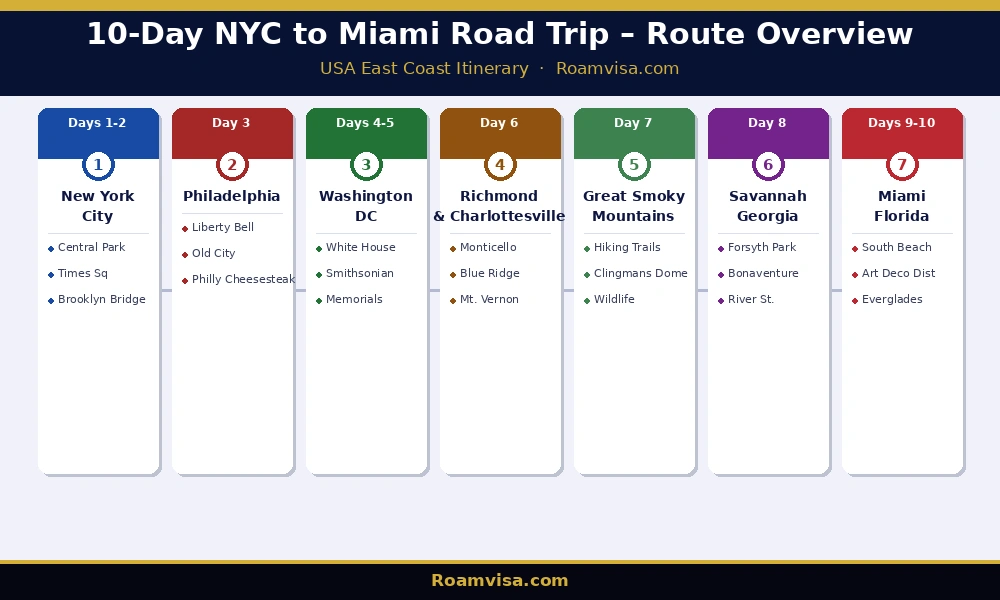
10-Day NYC to Miami Road Trip – Your Complete Route at a Glance 2026 | Roamvisa.com
Here’s the honest version of this trip: you can technically drive NYC to Miami in 19 hours non-stop. But why would you? The East Coast is dense with things worth stopping for – Philadelphia’s Liberty Bell, Washington DC’s free Smithsonian museums, the Blue Ridge Parkway, Savannah’s Spanish moss-draped squares, the Everglades. This itinerary treats the drive as the destination, not just the journey between airports.
Rent a car in New York, drop it off in Miami. Budget around USD 400-600 for the full 10-day rental depending on the car class and rental company. Book it before you fly – American car rental prices fluctuate wildly and early booking consistently saves money.
Your Route at a Glance
Days 1–2: New York City – Manhattan, Brooklyn Bridge, Central Park
Day 3: Philadelphia – Liberty Bell, Old City, Reading Terminal Market
Days 4–5: Washington DC – National Mall, free Smithsonian museums, monuments
Day 6: Richmond, Charlottesville & Blue Ridge Parkway
Day 7: Great Smoky Mountains or Shenandoah Valley
Day 8: Savannah, Georgia – America’s most beautiful city
Days 9–10: Miami – South Beach, Wynwood, Everglades, fly home
Days 1–2: New York City – The Starting Line
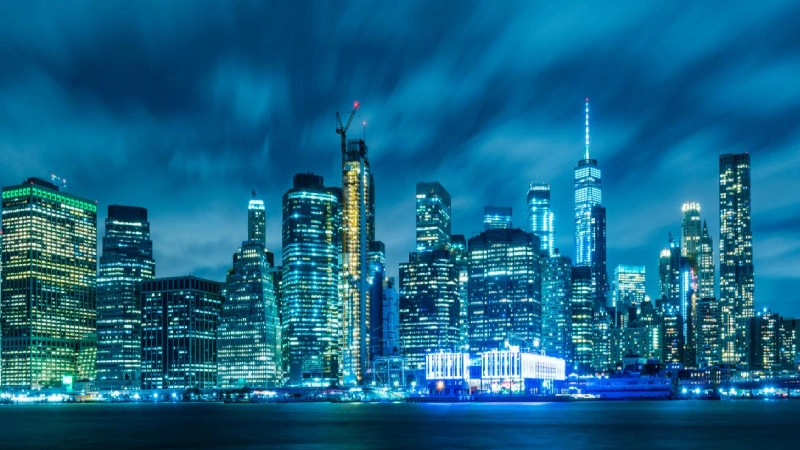
Every great road trip needs a great starting city, and New York City does not disappoint. Fly into JFK, LaGuardia, or Newark, get your rental car sorted (pick it up on Day 3 morning – you do not need a car inside Manhattan), and spend two days in the city before the drive begins.
Day 1 is for Manhattan. Times Square is overwhelming and exhausting and completely worth experiencing at least once. Walk across the Brooklyn Bridge – free, about 1.3 miles, takes 30-40 minutes, and the views of the Manhattan skyline from the midpoint are the best in the city. The High Line, an elevated park built on a disused railway line, runs for 1.45 miles through Chelsea and is one of the genuinely great urban planning successes of the 21st century.
Day 2 goes deeper. Central Park is 843 acres and could absorb a full day on its own – Bethesda Fountain, the Reservoir, Strawberry Fields, the Conservatory Garden. The Metropolitan Museum of Art sits on its eastern edge and is one of the finest art museums on earth. Suggested donation entry (yes, it’s technically optional, though the museum would prefer you didn’t know that). The MoMA, the Guggenheim, and the American Museum of Natural History are all within walking distance. For food, New York rewards exploration. A bagel with lox from any good deli is the correct breakfast. A slice of pizza from a neighborhood slice shop is the correct lunch. The correct dinner depends entirely on what you feel like – New York has every cuisine on earth represented at every price point.
Fun fact: The Brooklyn Bridge took 14 years to build (1869–1883) and was the world’s longest suspension bridge for 20 years. It used more wire than any structure previously built in history.
Pick up your rental car on the morning of Day 3, not Day 1. Parking in Manhattan runs USD 50-80 per day at garages. Save the money and use the subway for your two NYC days.
Day 3: Philadelphia – Two Hours South, Three Centuries Back
Philadelphia is 95 miles south of New York – a 1.5 to 2 hour drive depending on traffic. Leave mid-morning, arrive in Philly by late morning, and you have a full day in one of America’s most underrated cities.
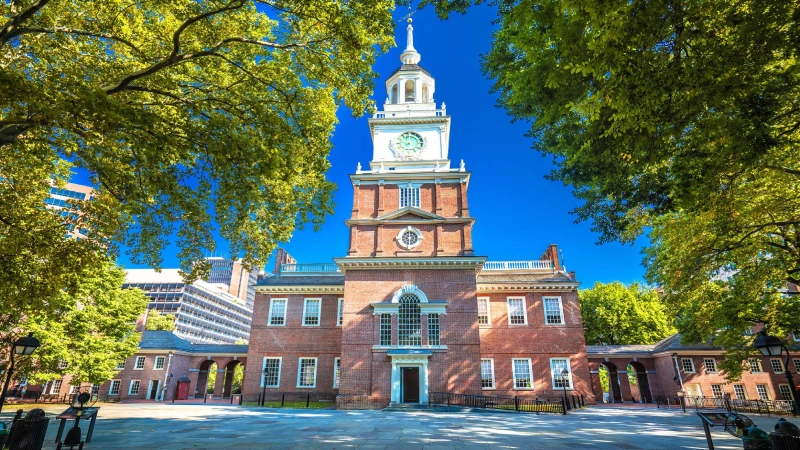
The Liberty Bell is free. Independence Hall, where the Declaration of Independence and the Constitution were signed, offers free timed tours. The Barnes Foundation has one of the greatest private art collections ever assembled, including more Renoirs than France. The Philadelphia Museum of Art – yes, those steps from Rocky – houses Duchamp’s ‘Large Glass’ and a remarkable impressionist collection.
But honestly? Philadelphia’s greatest contribution to world culture might be the cheesesteak. Pat’s King of Steaks and Geno’s Steakhouse face each other at the corner of 9th and Passyunk in South Philly, open 24 hours, and the rivalry between their supporters is genuinely intense. Try both. Form an opinion. This is important. For the evening, the Reading Terminal Market is a covered market with over 80 vendors – Pennsylvania Dutch baked goods, fresh pasta, Bassetts ice cream (America’s oldest ice cream company, founded 1861), and a diner serving breakfast all day. It is one of the best food markets in America and deserves at least an hour.
Independence Hall, Philadelphia, is where George Washington presided over the Constitutional Convention in 1787. The building has been continuously standing for nearly 300 years.
In Philadelphia, ‘wit’ means with Cheez Whiz, and ‘witout’ means without. When ordering a cheesesteak, you need to specify. Ordering incorrectly in front of locals is a rite of passage.
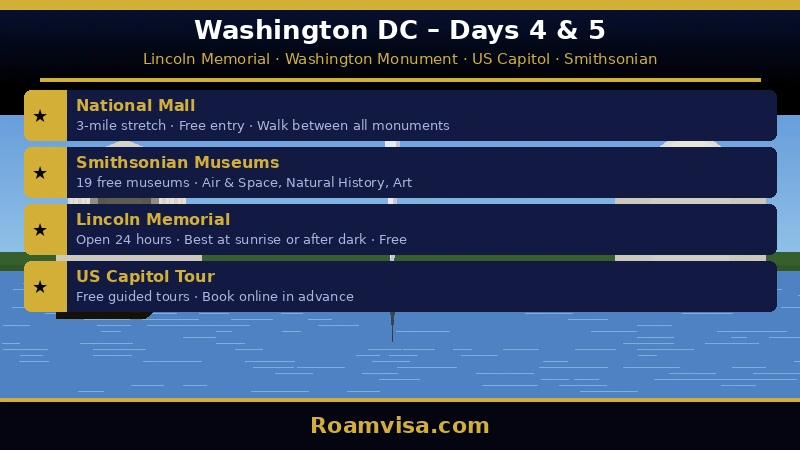
Washington DC – Lincoln Memorial, Washington Monument and the National Mall | Roamvisa.com
Days 4–5: Washington DC – Free is the Best Price
Washington DC is 140 miles south of Philadelphia – about 2.5 hours. Park the car at your hotel when you arrive (DC has good public transport, and driving on the Mall is not allowed anyway) and plan two full days in the capital.
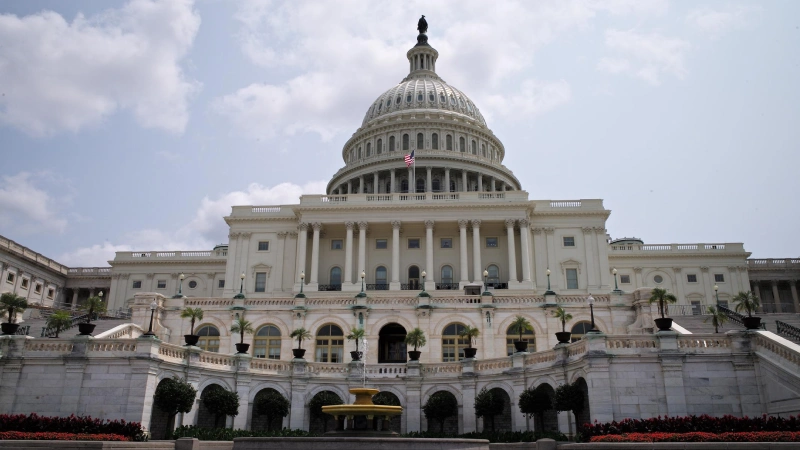
Day 4: Here is the remarkable thing about Washington DC that first-time visitors often do not realise: the Smithsonian Institution operates 19 museums on and around the National Mall, and every single one of them is free. The National Air and Space Museum, the National Museum of Natural History, the National Museum of American History, the National Portrait Gallery, and the Hirshhorn Museum of Modern Art – all free. No ticket booking required, walk in.
The National Mall itself is 3 miles long from the Capitol building at one end to the Lincoln Memorial at the other, with the Washington Monument at the center. Walking the entire Mall takes about 90 minutes at a gentle pace and passes memorials to Lincoln, Vietnam veterans, Korean War veterans, Franklin Roosevelt, and the World War II memorial. Do it on Day 4 afternoon, starting at the Lincoln Memorial at sunset – the reflection in the Reflecting Pool and the illuminated Washington Monument behind it is one of the genuinely great American views.
READ MORE: Best Budget Hotels in London Under 100 Pounds Per Night
Day 5: the Smithsonians. Decide in advance which two or three interest you most and commit to those, rather than rushing through five. The National Air and Space Museum has the original Wright Flyer and the Apollo 11 command module. The Natural History Museum has a 45.52-carat Hope Diamond. The American History Museum has Julia Child’s kitchen and the flag that inspired the national anthem. Each one could take a half-day. Choose wisely.
The US Capitol offers free guided tours – book online in advance through your Senator’s or Representative’s office if you are American, or through the Capitol Visitor Center if international. The Library of Congress next door is open to the public and is architecturally jaw-dropping.
The Smithsonian Institution was founded in 1846 with a gift from British scientist James Smithson, who had never visited the United States. He left his estate to a country he had never seen to create an institution for ‘the increase and diffusion of knowledge.’
The DC Metro is clean, efficient, and gets you everywhere you need to go on the Mall. A day pass costs USD 15. Far better than paying for parking, which runs USD 20-40 per day in central DC.
Day 6: Blue Ridge Parkway – America’s Favorite Drive
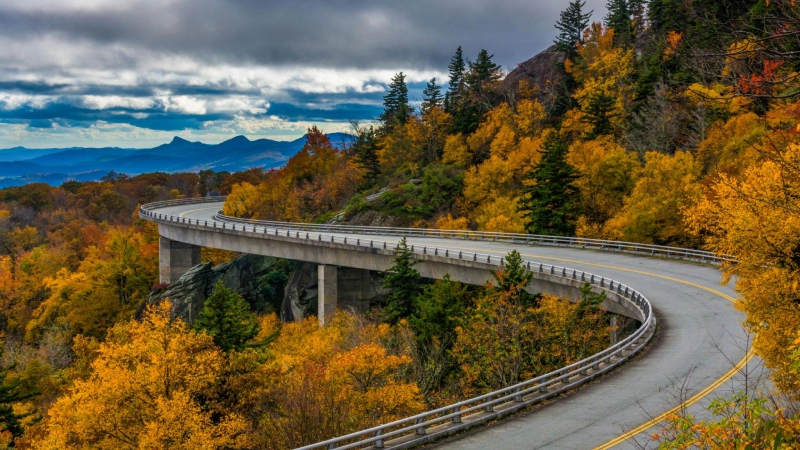
This is the day the road trip earns its name. Drive west from DC into Virginia and pick up the Blue Ridge Parkway, a 469-mile scenic highway running along the crest of the Blue Ridge Mountains. You are not driving the whole thing – a segment of two to three hours gives you the idea, and what an idea it is.
The views from the Parkway pull over points – called overlooks – are sweeping. Forested mountains rolling to every horizon, valleys far below, hawks riding thermals at eye level. In autumn (October especially) the foliage turns the entire landscape into something that looks like it has been painted. In spring, wildflowers cover the verges. In summer, it is cool and green above the heat of the lowlands.
Charlottesville is a worthwhile stop off the Parkway – home to the University of Virginia, designed by Thomas Jefferson, and to Monticello, Jefferson’s home and plantation. The house itself is a UNESCO World Heritage Site. Tours run throughout the day and the architecture alone is worth the USD 35 entry.
End the day in Richmond, Virginia – a city with more Civil War history per square mile than almost anywhere in America, a surprisingly good food scene, and one of the better coffee cultures on the East Coast. Stay the night here before the long push south tomorrow.
The Blue Ridge Parkway has a speed limit of 45 mph and no commercial vehicles are permitted. That is the point. Budget extra time – you will want to stop at every overlook.
Day 7: Great Smoky Mountains or Shenandoah – Your Choice
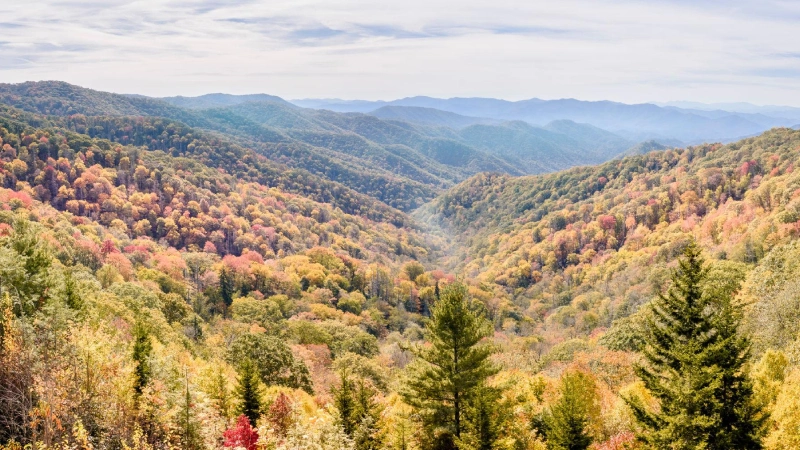
Day 7 is a buffer day with a choice. Option A is to cut southwest to the Great Smoky Mountains National Park – the most visited national park in America, and free to enter (no reservation required for day visits, unlike some other parks). The Smokies have 800 miles of hiking trails, white-water rivers, historic mountain cabins, and the atmospheric mist that gives the mountains their name. Clingmans Dome at 6,643 feet is the highest point in the Appalachian Mountains and has 360-degree views when clear.
Option B is to stay on the Shenandoah route – Skyline Drive through Shenandoah National Park, 105 miles of mountain driving with 75 overlooks, deer wandering freely beside the road, and Luray Caverns nearby if underground geology interests you. This option keeps you closer to the coastal route and saves time.
Either way, get a long night’s sleep. Tomorrow is Savannah, and Savannah rewards arriving fresh and unhurried.
Day 8: Savannah, Georgia – The Most Beautiful City in America
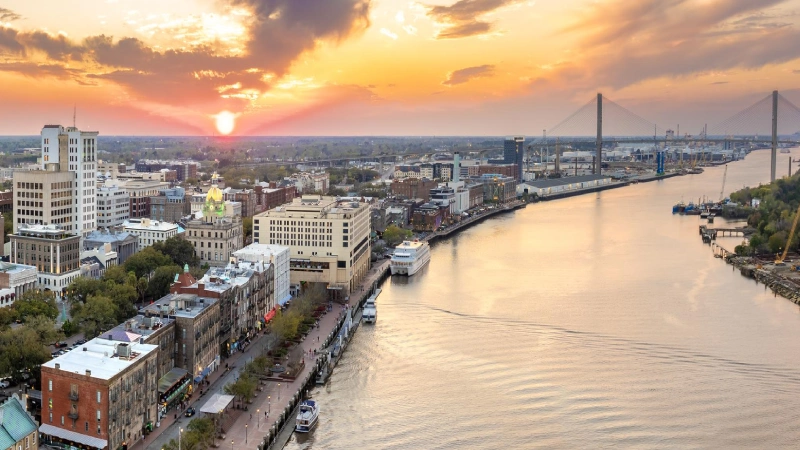
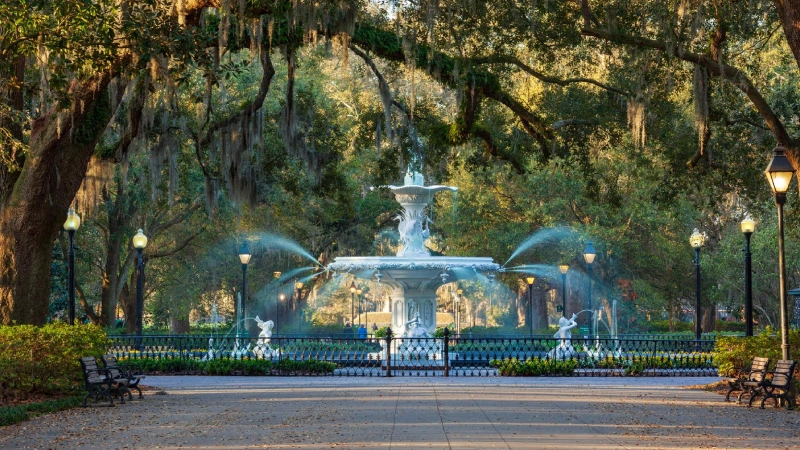
Savannah is a genuine surprise if you have not been before. It was founded in 1733 as the first city in the colony of Georgia, and it is laid out on a grid of 22 historic squares, each a small park shaded by live oak trees dripping with Spanish moss. Walking between the squares in the late afternoon light, with the 19th-century mansions on all sides and the air smelling faintly of magnolia, is an experience that does not exist anywhere else in America.
Forsyth Park is the anchor – a large public park with a magnificent white fountain that photographers queue for at dawn and dusk. The historic district is compact and walkable. Bonaventure Cemetery, made famous by the book and film ‘Midnight in the Garden of Good and Evil,’ is a 20-minute drive from downtown and genuinely beautiful in a moss-hung, melancholy sort of way. River Street runs along the Savannah River and is lined with restaurants, bars, and candy shops (Savannah is obsessed with pralines – buy some). The food scene in Savannah is unexpectedly good for a small city. The Olde Pink House, one of the oldest buildings in Georgia, serves Southern cuisine in a setting that feels like walking into the 18th century.
Savannah was one of the first planned cities in America, laid out by General James Oglethorpe in 1733 on a grid system so elegant that urban planners still study it today. The city was so beautiful that General Sherman refused to burn it during the Civil War – he gave it to President Lincoln as a Christmas present instead. Park the car for the day and walk Savannah. The historic district is only a mile square. Driving makes no sense and parking is limited. The squares are best experienced on foot at a slow pace.
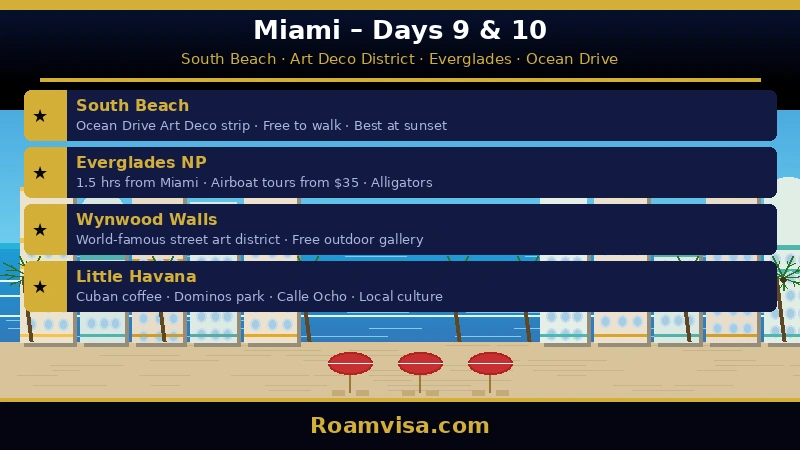
Miami – South Beach, Art Deco District and Ocean Drive – Final Destination | Roamvisa.com
Days 9–10: Miami – Where the East Coast Ends in Style
The final push from Savannah to Miami is about 600 miles – a long day’s drive that takes you through Jacksonville, Florida’s wide flat coastline, and eventually into the surreal city that sits at America’s southeastern tip. Leave Savannah early. Arrive Miami by late afternoon or early evening.
Miami is not subtle. South Beach’s Art Deco Historic District on Ocean Drive is a strip of pastel-painted 1930s buildings that have been meticulously preserved and now house restaurants, bars, and hotels with neon signs and vintage convertibles parked outside. The beach is wide and white and the water is genuinely turquoise. People are beautiful and know it. The energy is completely unlike anywhere else on this trip.
Day 9: is for South Beach and the city. Walk Ocean Drive in the morning when it is quieter. The Wolfsonian Museum’s collection of design, propaganda, and decorative arts is one of Miami’s hidden gems. Wynwood Walls – a neighbourhood of warehouses entirely covered in world-class street art by international artists – is a 20-minute drive from South Beach and completely free to walk around. Little Havana’s Calle Ocho has Cuban coffee (colada, served in small cups, shared with whoever is nearby) and the best pastries south of New York.
Day 10: the Everglades. Everglades National Park is 1.5 hours southwest of Miami and unlike anything else in North America – a slow-moving river of grass, 60 miles wide and 100 miles long, full of alligators, manatees, roseate spoonbills, and anhinga birds drying their wings in the sun. Airboat tours depart from multiple operators near the park entrance and run around USD 35-50 for 30-45 minutes. You will see alligators, possibly very close up. Return to Miami, drop the car at the airport, and fly home having driven America’s most rewarding stretch of coastline end to end.
The Everglades is the only place on earth where alligators and crocodiles coexist naturally. American alligators live in freshwater; American crocodiles prefer saltwater. In the Everglades, the water is brackish enough to support both.
Book Everglades airboat tours online the night before. Morning departures have fewer crowds and better wildlife sightings. Bring insect repellent the mosquitoes here are legendary.
Practical Information for the Trip
Driving: A valid driver’s license from your home country is accepted for driving in the USA. An International Driving Permit is recommended but not legally required in most states. Drive on the right. Speed limits are strictly enforced – cruise control set at the posted limit saves stress and fines.
US Visa: Citizens of 42 countries qualify for the ESTA (Electronic System for Travel Authorization) for visa-free entry to the USA for up to 90 days. Apply online at esta.cbp.dhs.gov at least 72 hours before travel. Citizens of other countries need a B-2 tourist visa – apply at your nearest US Embassy.
Car Rental: Book in advance through Hertz, Enterprise, Avis, or Budget. An SUV or mid-size sedan works well for this route. One-way rentals (pick up NYC, drop off Miami) cost more than round-trips but are entirely manageable. Check whether your credit card provides rental car insurance before paying for the rental company’s coverage.
Gas / Petrol: American fuel prices are significantly lower than Europe or Asia. Budget USD 15-25 per fill-up for a standard car. Gas stations are plentiful on I-95 and all major routes. Never let the tank drop below a quarter on the Blue Ridge Parkway – stations are spaced out.
Accommodation: Book ahead for NYC, Washington DC, and Miami – these cities fill up fast. For Richmond, Charlottesville, and Savannah, same-day or next-day booking usually works fine. Booking.com and Hotels.com both show good East Coast inventory. Motels along I-95 are reliably clean and cheap for overnight stops.
Weather: Spring (April-May) and autumn (September-October) are ideal. Summer is hot and humid south of DC. Hurricane season runs June through November – Florida storms are possible in September and October but most trips proceed without incident.
Frequently Asked Questions
1. How much does a 10-day East Coast road trip cost?
Budget traveler: USD 150-200 per day including accommodation, food, fuel, and activities. Mid-range: USD 250-350 per day. Add USD 400-600 for the car rental total. Flights to New York and home from Miami are separate.
2. Do I need an International Driving Permit for the USA?
Not legally required in most states, but recommended. Your home country license is accepted as long as it is in English or accompanied by a certified translation. Carry it anyway to avoid any roadside confusion.
3. What is the best time of year for this road trip?
April through May and September through October. You get mild temperatures, lower hotel prices than summer, and the Blue Ridge and Smoky Mountains are either blossoming or turning autumn colors.
4. Is it safe to drive this route?
Yes. Interstate 95 and the other roads on this route are well-maintained, well-signed, and have ample rest stops, gas stations, and services throughout. Standard road safety applies.
5. Can I do this trip without a car?
Partially. NYC, Philadelphia, DC, and Miami are all well-served by Amtrak trains. But the Blue Ridge Parkway, Great Smoky Mountains, and Savannah’s full experience require a car. The drive itself is half the point.
Final Thoughts
The NYC to Miami East Coast road trip is one of those journeys that sounds like a checklist of famous places but turns into something more personal than that. The Liberty Bell is smaller than you expect. The Lincoln Memorial is larger. Savannah makes you wish you had an extra day. The Everglades make you feel very small in the best possible way.
Pack light enough to live out of the car for a day if needed. Keep a paper map as backup. Stop when something looks interesting rather than waiting for the next planned stop. The best moments on any road trip are the ones that were not in the itinerary. For US visa guidance by passport, state-by-state road trip laws, the best National Parks to add to this route, and honest hotel reviews for every city on this itinerary, visit Roamvisa.com


