How to Apply for a Schengen Visa – Step-by-Step Guide for Indian Travelers 2026

If you are looking for a clear, no-nonsense guide on how to apply for a Schengen Visa from India, this is the one I keep recommending. The process is not as complicated as it looks. I know it can seem that way when you first start researching. There are embassy websites with long lists, blogs with conflicting information, and well-meaning friends who got their visa three years ago and are not sure if the rules have changed. I get it.

Here is what I have figured out after helping a lot of people through this process – the Schengen Visa is very doable if you understand what the consulate is actually looking for. They want to know that you are a genuine traveler, that you have the funds to support yourself, and that you will come back home when your trip is over. If you can demonstrate those three things clearly through your documents, you are in very good shape.
This guide covers the complete application process from start to finish. Which embassy to apply to, what documents you need, what the fee structure looks like, how to write a good cover letter, and what actually gets applications rejected. I have also included a full FAQ at the end for the questions I see people asking most often.
One thing before we begin. Embassy requirements can change. This guide is current for 2026 but always verify the specific requirements with the embassy or consulate for your destination country before you submit. Use this as your foundation and then confirm the details.
What is a Schengen visa, and do you really need one?
The Schengen Visa is a short-term travel permit that lets you visit 27 European countries for up to 90 days in a 180-day period. Italy, France, Germany, Spain, Greece, the Netherlands, Switzerland, Austria, and 19 other countries are all included. One visa lets you travel to all 27 countries without having to go through border checks. Yes, you need a Schengen Visa if you have an Indian passport. There is no option for a visa on arrival or a visa-free agreement between India and the Schengen Area. Before you can get on the plane, you need to apply for a visa, get it approved, and put the sticker in your passport. There are no exceptions.
Austria, Belgium, Croatia, the Czech Republic, Denmark, Estonia, Finland, France, Germany, Greece, Hungary, Iceland, Italy, Latvia, Liechtenstein, Lithuania, Luxembourg, Malta, the Netherlands, Norway, Poland, Portugal, Slovakia, Slovenia, Spain, Sweden, and Switzerland are the 27 Schengen countries. The Schengen Visa is a well-known system that processes millions of applications every year, which is good news. The rules are clear, the requirements are written down, and if you fill out your application honestly and completely, the chances of getting approved for real Indian travellers are good. People have problems not because the system is unfair, but because they don’t send in all the right papers or give the consulate a reason to doubt what they want.
How Much Does a Schengen Visa Really Cost?
Let me give you the real numbers before the step-by-step process. Most guides only talk about the official visa fee and don’t say anything else. This is how much it really costs for each person to apply for a Schengen Visa:

Schengen Visa cost breakdown for Indian travelers 2026 – all fees included
| Expense | Budget | Comfortable |
|---|---|---|
| Schengen Visa Fee (adult) | EUR 90 (~Rs 8,100) | EUR 90 (~Rs 8,100) |
| VFS Global Service Fee | EUR 30-40 (~Rs 2,700-3,600) | EUR 30-40 (~Rs 2,700-3,600) |
| Travel Insurance | Rs 1,500 – 2,500 | Rs 2,500 – 4,000 |
| Flight Reservation (visa) | Rs 500 – 1,000 | Free (if already bought) |
| Photos, copies, misc | Rs 300 – 600 | Rs 300 – 600 |
| TOTAL PER ADULT | Rs 13,000 – 15,500 | Rs 13,500 – 16,300 |
Children between the ages of 6 and 12 pay half of the visa fee, which is EUR 45. Children under 6 do not have to pay the visa fee at all. The VFS service fee is the same for everyone, no matter how old they are. Important: If your visa is denied, you won’t get any of these fees back. That’s why it’s important to get the application right the first time.
The Full Process for Getting a Schengen Visa
This is the whole process, from start to finish. If you follow each step in order, your application will be complete and well-organised.
Step 1: Find out which embassy you need to apply to
This is the first choice, and it’s more important than most people think. You have to apply to the embassy or consulate of the Schengen country where you will spend the most time. Are you going to spend 8 days in Italy and 3 days in France? Send your application to the Italian Embassy. Spending the same amount of time in two countries? Send your application to the embassy of the country you will enter first.
If you apply to the wrong embassy, your application won’t be sent to the right one. It makes it so that your application is sent back to you. You lose the VFS service fee and have to start over. Before you do anything else, take five minutes to plan out your rough schedule.
Step 2: Find out when you can apply
You can apply as early as six months before your trip and as late as 15 business days before you leave. The best time to do it is four to six weeks before your trip. This gives you enough time to get everything ready and a little extra time in case the consulate needs more papers.
During the busiest travel times, which are usually from June to September, appointment slots at Visa Application Centers fill up weeks in advance. If you want to go to Europe this summer, start planning now. I have seen people rush to get appointments in May for trips in July and then find that everything is booked for three weeks.
Step 3: Get Your Papers Together
The most important part of the application is getting the documents ready. A complete and well-organised set of papers can make the difference between getting approval and being turned down. Take a close look at the checklist in the next section. Don’t think you can skip something just because it seems small or unnecessary. They go through a list at the consulate.
The most important thing to know about Schengen documents is that they all need to tell the same story. Your bank statement, hotel reservation, and flight reservation should all match up with your cover letter. If your cover letter says you’re going to Rome for five days but your hotel reservation only shows three nights, that doesn’t match up, which makes people doubt you even if everything else is perfect.
Step 4: Complete the Application Form
You can get the official Schengen Visa application form from the embassy’s website or the VFS Global portal. Fill it out carefully, one field at a time. Your name, date of birth, and passport number must be exactly the same as what is on your passport. There can’t be any spelling or formatting differences.
READ MORE: Canada Visa for Indians 2026: Step-by-Step Process, Documents Checklist & Latest Fees
Print the filled-out form clearly and sign it by hand where it says to. Don’t use correction fluid or write on a typed form by hand. If you make a mistake, print the page again and fill it out again. Turn in a clean form.
Step 5: Make an appointment at the Visa Application Center.
VFS Global handles most Indian applicants’ Schengen country visas. Visit the VFS Global website, pick the country you want to visit, pick your city, and then make an appointment. When you book, you will pay the VFS service fee online.
Some cities in some countries, like France and Germany, let you make direct appointments at the embassy. If you are applying through VFS or directly to the embassy, check to see if the document requirements are the same.
Step 6: Go to Your Appointment
Arrive 10 to 15 minutes before your appointment. Put all of your papers in a clear folder in the same order as the embassy checklist. The VAC staff will look over your papers to make sure they are all there, take your biometric data (10 fingerprints and a photo), and give you a receipt with your application reference number.
All first-time Schengen applicants and anyone whose biometric data is more than 59 months old must provide biometrics. Fingerprinting is not required for kids under 12. It only takes about five minutes to collect biometric data, and it’s not hard.
Step 7: Pay the Visa Fee
Adults pay the EUR 90 visa fee at the VAC, usually with a credit card. Keep the receipt for your payment. This payment is for the embassy and has nothing to do with the VFS service fee you paid when you made your appointment. No matter what happens, neither fee is refundable.
Step 8: Keep an eye on your application and wait
You can use the reference number on your receipt to find your application online at the VFS portal. It usually takes 10 to 15 business days from the date of your appointment to process your application. Some embassies are faster than others, and processing times get longer during busy times.
During this time, keep an eye on the email address you gave on your application form. If the consulate needs more paperwork or information, they will email you. If they do, answer quickly and fully.
Step 9: Get Your Passport
When the processing is done, you can either pick up your passport from the VAC or have it delivered by courier if that option is available. When you get your passport, open it right away and look at the visa sticker before you leave the collection center. Check that your full name, passport number, visa validity dates, number of entries allowed, and maximum length of stay are all correct. If you see something that doesn’t seem right, tell the person at the counter right away.
The Full Document Checklist
Your passport must be valid for at least three months after your planned return date, must have been issued within the last ten years, and must have at least two blank pages for the visa sticker.
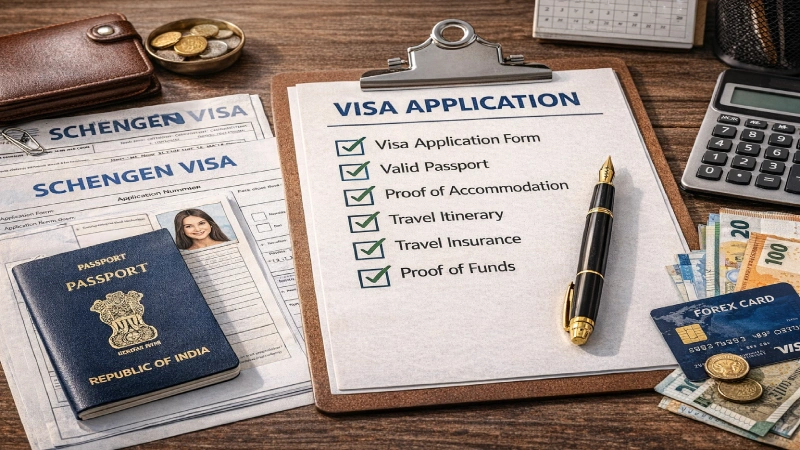
- All of your old passports: Include all of your old passports, especially those with old Schengen or international visa stamps. They show where you’ve been, which is good for you.
- Filled out and signed application form: It must be filled out completely, printed clearly, and signed by hand where needed. Your name must match your passport exactly in every way.
- Two recent passport photographs – photos that are 35mm x 45mm in size, have a white or off-white background, show the whole face, and don’t have glasses. They should have been taken in the last three months. Studio photos are more accurate than photo booths.
- Return flight reservation: A confirmed itinerary that shows when you will enter and leave the Schengen Area. This could be a reservation for a flight, not a ticket that has already been bought. A few services offer this just for visa applications.
- Accommodation proof for every night -Proof of accommodation for each night, such as hotel booking confirmations, Airbnb printouts, hostel reservations, or a notarised invitation letter from a host in Europe. Make sure you have a place to stay every night of your trip.
- Travel health insurance – must cover at least EUR 30,000 and be valid for the whole trip in all 27 Schengen countries. Should pay for emergency medical care, hospitalisation, and getting you back home. This is something you have to do by law, not just because you want to.
- Bank statements (last 3 to 6 months)– that have been certified by the bank and have the branch seal on them. Should show a reasonable, steady balance, not just one big deposit from last week. The average cost is between EUR 50 and EUR 100 per day of your stay.
- Salary slips from the last 3 months – For applicants who are currently employed, pay stubs from the last three months. Should show regular income on company letterhead, including all benefits.
- Employment letter from your company -A letter from your employer on company letterhead confirming your job title, salary, approved vacation dates, and that you will come back to work after the trip.
- Income tax returns: You need to show your last one or two years of filed ITR as extra proof of your finances. Some embassies specifically ask for this, while others think it’s a good idea.
- Cover letter: A letter from you that explains why you’re going, what you’ll do each day, where you’ll stay each night, and that you plan to return to India at the end of the trip.
- Proof of ties to your home country: documents showing that you own property, that you have a vehicle registered, a letter confirming that you have dependent family members, or any other documents that show you have strong reasons to go back to India.
- For self-employed applicants – For people who work for themselves, you need to show proof of business registration, bank statements from the last six months, GST filings, and a letter from a CA confirming that your business is still running and that you are making money.
- For students -If you’re a student, you’ll need an enrolment certificate from your school, a No-Objection Certificate from the principal or registrar, and a sponsorship letter if someone else is paying for the trip.
- Important: Make a full set of photocopies of each document you send in. Put your originals and photocopies in different folders. Put your papers in the same order as the checklist from the embassy. It’s a small thing, but it really helps at the counter and shows that you are organised.
Travel Insurance: Why It’s Required and Not Optional
EU rules say that you must have travel insurance to get a Schengen Visa. This isn’t a suggestion or the best way to do things. It is a strict requirement. If you send in your application without valid insurance, it will be turned down right away.
Your travel insurance must cover at least EUR 30,000 for emergency medical care, hospitalisation, ambulance services, and getting you back to India in an emergency. It needs to be good in all 27 Schengen countries, not just the one you want to go to. And it has to cover every day of your trip, from the day you arrive to the day you leave.
READ MORE: Best Travel Insurance for UK Trip from India – Honest Comparison 2026
Bajaj Allianz, HDFC ERGO, ICICI Lombard, and Tata AIG are some Indian insurance companies that offer policies that meet Schengen requirements. A standard policy for a 10-day trip to Europe costs between Rs 1,500 and Rs 3,000, depending on your age and the level of coverage. Always read the policy document and make sure it says that the minimum coverage is EUR 30,000 and that it is valid in all Schengen countries.
Bring a printed copy of your full insurance policy with you to your appointment. A screenshot on your phone isn’t enough. Don’t just print the coverage summary page; print the whole policy.
The Financial Requirement: What “Sufficient Funds” Really Means
The financial requirement is one of the things that first-time Schengen applicants from India get confused about the most. The consulate needs to be sure that you have enough money to pay for your trip without having to work illegally or be a burden on the host country.
Most Schengen embassies use EUR 50 to EUR 100 per day of your planned stay as a standard benchmark. That means you need to show that you have at least EUR 750 to EUR 1,500 in savings that you can easily get to, in addition to the cost of your flights and hotel. If you’ve already paid for your hotel and flights, the daily amount can be lower because those are your biggest costs.
The consulate is really checking to see if your financial situation looks stable and real. A bank account that shows a healthy balance growing steadily over three to six months looks very different from one that had Rs 5,000 last month and suddenly has Rs 5 lakh this week. Some people call the second pattern “parking funds,” and consultants are taught how to spot it. If your balance really went up because of a bonus, a rise, or the sale of an asset, include proof of that.
What Actually Gets Schengen Visas Rejected
Understanding why applications get rejected is as useful as knowing what to include. The most common reasons Schengen Visas are rejected from India are not obscure or complicated:
- Incomplete documents – Missing even one required document is enough for rejection. The consulate will not contact you to provide what is missing. They will simply reject the application.
- Inconsistencies between documents – Your cover letter says you are staying in Paris for 5 days but your hotel bookings show 3 nights. Your itinerary mentions a connecting flight that does not appear in your reservation. These create doubt even when everything else is strong.
- Insufficient financial proof – Bank balance too low for the planned trip duration, or a suspicious pattern like a sudden large deposit right before applying.
- No clear ties to home country – If you cannot demonstrate strong reasons to return to India – a job, a business, property, dependent family members – the consulate has less confidence that you will leave when your visa expires.
- Applying to the wrong embassy – Your application gets returned, not redirected. You lose the VFS service fee and have to restart the process.
- Previous visa violations – A history of overstaying visas or violating visa conditions in any country is a serious negative that is difficult to overcome.
- Invalid or insufficient travel insurance – Coverage below EUR 30,000, coverage that excludes some Schengen countries, or a policy that does not cover your full travel dates.
If your visa is rejected, you will receive a written notification explaining the specific grounds for the rejection. You have the right to appeal the decision – the rejection letter will explain the procedure. You can also address the rejection reasons and reapply with a stronger application. A first-time rejection does not permanently affect your ability to get a Schengen Visa. Many people who are rejected the first time are approved on their next application.
Things Indian Travelers Should Know
- Write the cover letter yourself. Do not copy a template from the internet. Write it in your own voice, in plain English, describing your actual plans. One page is enough. A genuine personal letter explaining what you want to see and why you will come home is far more convincing than a formal template that sounds like it was written by a visa consultant. Which it probably was.
- Book accommodation with free cancellation. You need hotel booking proof to apply, so you have to book before you get the visa. Use Booking.com or similar platforms and filter for free cancellation options. This way you have the proof you need without being stuck if your visa is rejected. Cancel only after you have the visa in your passport and your travel is confirmed.
- Do not book non-refundable flights before your visa is approved. Use a flight reservation service that provides a confirmed itinerary for the visa application – these are accepted by embassies – and only purchase your actual flights after approval. A rejected visa plus a non-refundable flight is an expensive situation.
- Apply to the right VFS office for your city. VFS Global has centers in multiple Indian cities. Apply at the office in whose jurisdiction your city falls. Mumbai residents apply through the Mumbai VFS office, Delhi residents through Delhi. Going to the wrong city office can cause delays.
- Respond quickly to any requests for additional documents. If the consulate contacts you for clarification or additional supporting documents, respond quickly and completely. Delays in responding can result in rejection even if the original application was strong.
What I Would Do Differently If I Were Applying Today

Here is the honest version. If I were walking someone through a Schengen Visa application today, the advice I would give them is simpler than most guides make it sound.
Start early. Give yourself 6 to 8 weeks from application to departure date. Book your appointment as soon as you have a rough travel plan. Appointment slots fill up and processing takes time.
Be consistent. Before you submit, go through every document and ask yourself – does this tell the same story? Does my cover letter match my hotel bookings? Does my itinerary match my flight reservations? Does my bank balance support the trip I am describing? If anything does not match, fix it.
Be honest. If your financial situation is not ideal, include a letter explaining it and show other assets. If you have a previous rejection or visa violation, disclose it and explain the circumstances. Embassies have access to immigration records and trying to hide things makes the situation worse.
And then book the trip and go enjoy it. Europe in October when the crowds thin out but the weather is still good. The Colosseum first thing in the morning when it is quiet. A slow afternoon in a Roman trattoria. The view from the top of a Swiss mountain on a clear day. The paperwork is worth it. Have a great trip.
Frequently Asked Questions
Is 7 days enough for a first Europe trip on a Schengen Visa?
Seven days is enough for a meaningful first trip. You can cover one country well – Italy, France, or Spain – or do a two-country trip at a relaxed pace. The mistake most first-timers make is trying to hit five or six countries in a week. You end up spending half your time in transit and none of your time actually experiencing any place. Pick two destinations maximum and spend real time in each.
How long does Schengen Visa processing take from India?
Standard processing is 10 to 15 working days from the date of your appointment. In practice, some embassies are faster and some slower. Italian and Spanish visas sometimes run closer to 3 weeks during peak summer months. French visas are often processed faster. Apply 4 to 6 weeks before your travel date to give yourself comfortable buffer time.
Can I apply for a Schengen Visa online without visiting the VAC?
Partially. You can fill out and submit your application form online through the embassy portal or VFS website. But you cannot complete the process remotely. You must visit a Visa Application Center in person to provide your biometrics – fingerprints and a live photograph. There is currently no way around this requirement.
Do I need a separate visa for Scotland when traveling from India?
No, this is a common confusion. Scotland is part of the United Kingdom, not the Schengen Area. If you are traveling to Scotland or anywhere in the UK, you need a UK Standard Visitor Visa – completely separate from the Schengen Visa. Your Schengen Visa does not cover the UK.
What is the Schengen Visa fee in 2026?
The official visa fee is EUR 90 for adults aged 18 and above, EUR 45 for children aged 6 to 12, and free for children under 6. In addition, VFS Global charges a service fee of approximately EUR 30 to EUR 40. All fees are non-refundable. For an adult applicant, the total application cost typically falls between Rs 14,000 and Rs 16,000.
Can I travel to the UK on a Schengen Visa?
No. The United Kingdom left the European Union and is not part of the Schengen Area. Ireland is also not part of the Schengen Area. If your trip includes the UK or Ireland, you need separate visas for each country. A Schengen Visa alone will not get you into the UK or Ireland.