Canada Super Visa Insurance – Cheapest Approved Plans with CAD 100000

The Canada Super Visa is one of the most practical long-term visit options for parents and grandparents of Canadian citizens and permanent residents – it allows stays of up to 5 years at a time, compared to the standard 6-month visitor permit. But it comes with a mandatory insurance requirement that many families underestimate.
Immigration, Refugees and Citizenship Canada (IRCC) requires every Super Visa applicant to have a fully paid insurance policy providing at minimum CAD $100,000 in emergency medical coverage, valid for at least one year from the date of entry into Canada. The word “fully paid” is important – a quote or a payment plan confirmation alone does not meet the requirement. The policy must be active and paid at the time of application.
The cost of Super Visa insurance varies significantly based on age, pre-existing health conditions, deductible chosen, and the province where your parents will be staying. This guide compares the most commonly used IRCC-approved providers, explains what to look for in a policy beyond just the price, and covers the January 2025 rule change that expanded which providers are now eligible.
Quick Facts – Canada Super Visa Insurance
✔ IRCC minimum: CAD $100,000 medical coverage, valid for minimum 1 year from entry date
✔ Must be fully paid – quotes alone are not accepted with Super Visa application
✔ As of January 28, 2025: OSFI-approved foreign insurers now also accepted – not just Canadian companies
✔ Pre-existing conditions: must be stable for 90–180 days depending on provider
✔ Monthly payment plans available – typically 2 months upfront + balance spread over stay
✔ Refund available if visa is refused – confirm refund policy with provider before purchase
✔ Top providers: Manulife, Travelance, GMS, Allianz, TuGo, 21st Century
✔ Indian parents visiting Canada: Indian travel insurance from home does NOT qualify unless OSFI-approved
IRCC Requirements – What the Policy Must Include
To qualify for the Super Visa, the insurance policy must meet all five IRCC criteria simultaneously. A policy that meets four but fails one will be rejected at the application stage:
- Minimum CAD $100,000 emergency medical coverage – this is a hard floor, not a guideline
- The policy must be from a Canadian insurance company OR from an OSFI-approved foreign insurer (as of January 28, 2025)
- Valid for a minimum of one year from the planned date of entry into Canada
- Must cover healthcare, hospitalization, and repatriation
- Must be fully paid – not just quoted or partially paid
The January 2025 change is significant for Indian families. Previously, only Canadian insurance companies were eligible. As of January 28, 2025, foreign insurers approved by the Office of the Superintendent of Financial Institutions (OSFI) are also accepted. However, the foreign insurer must be on the OSFI-approved list, AND the policy must explicitly state it was issued for Canadian use. A standard Indian travel insurance policy does not qualify simply because of this change.
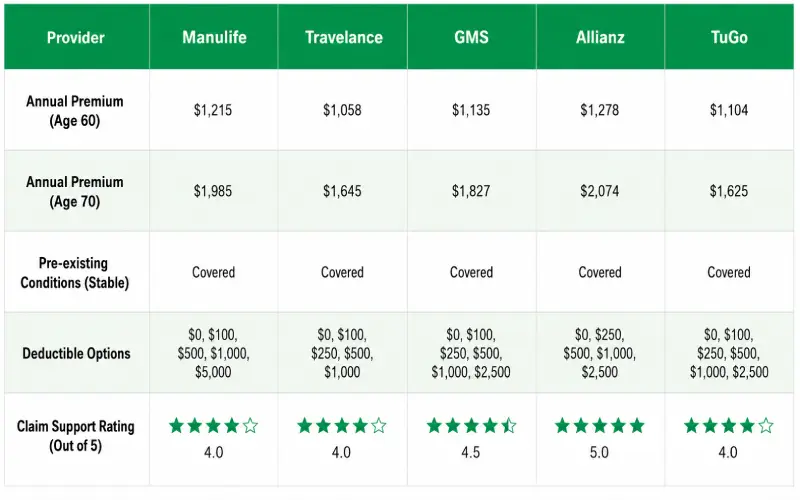
Super Visa Insurance Cost – Annual Premium by Age
| Provider | Annual Premium (Age 55) | Annual Premium (Age 65) | Annual Premium (Age 75) | Pre-Existing Conditions | Deductible Options |
|---|---|---|---|---|---|
| Manulife | CAD $1,200–$1,600 | CAD $2,200–$3,000 | CAD $4,500–$6,000 | Stable 180 days | $500, $1,000, $3,000 |
| Travelance | CAD $1,100–$1,500 | CAD $2,000–$2,800 | CAD $4,200–$5,800 | Stable 180 days | $500, $1,000 |
| GMS | CAD $1,000–$1,400 | CAD $1,900–$2,600 | CAD $4,000–$5,500 | Stable 90 days | $500, $1,000, $5,000 |
| TuGo | CAD $1,100–$1,500 | CAD $2,000–$2,700 | CAD $4,100–$5,700 | Flexible options | $500, $1,000, $2,500 |
| Allianz | CAD $1,200–$1,700 | CAD $2,200–$3,100 | CAD $4,600–$6,200 | Stable 90–180 days | $500, $1,500 |
Note: Premiums are illustrative estimates for a parent from India with stable pre-existing conditions, CAD $100,000 coverage, and $500 deductible. Actual quotes will vary. Always get a personalized quote. Rates are regulated by the Ontario Insurance Act, so brokers cannot offer different prices, but coverage structures differ.
Pre-Existing Conditions – What Stable Means
Every Super Visa insurance provider covers emergency medical treatment. Where they differ is in whether they cover emergencies related to conditions your parent already has – the pre-existing conditions question.
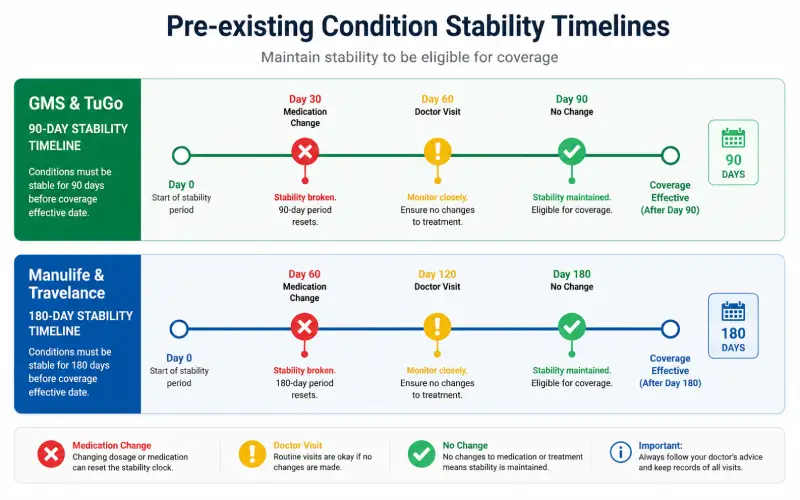
A condition is covered as a pre-existing condition only if it has been stable for the required stability period before the policy starts. “Stable” typically means no new symptoms, no change in medication (dosage or type), no hospitalization, no specialist visits for that condition, and no new diagnosis.
- GMS and TuGo: 90-day stability period – more accessible for conditions managed in the last few months
- Manulife and Travelance: 180-day stability period – stricter but clearer documentation requirements
- If conditions are not stable: these are excluded from coverage – any emergency related to the unstable condition is the parent’s out-of-pocket expense
For Indian parents with managed diabetes, hypertension, or cardiac conditions, the stability period is the most important factor to verify. A condition managed with medication that has not changed in 6 months typically qualifies as stable under most policies. Any medication adjustment in the past 90 or 180 days – even a dose change – may render the condition unstable under the policy’s definition.
Monthly Payment Plans – How They Work
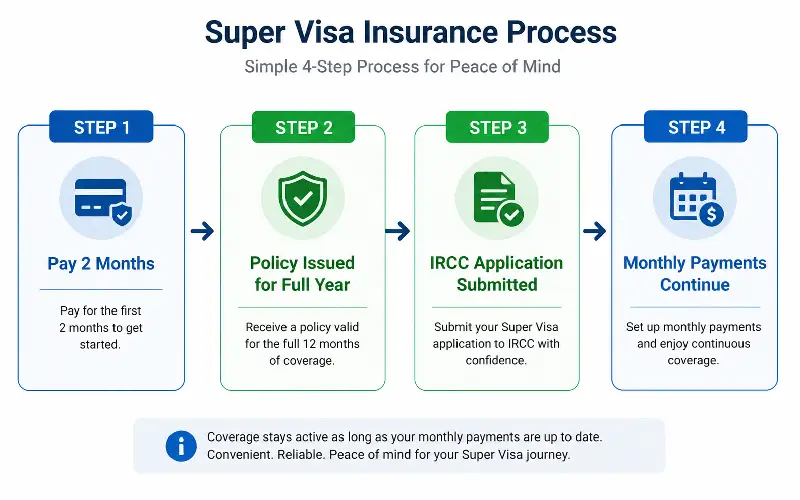
Many families find the upfront Super Visa insurance premium a significant expense. Most major providers now offer monthly instalment plans that IRCC accepts, provided the proof of full coverage is established at application time.
How it works under IRCC rules: you pay the first two months of premium upfront before submitting the application. The insurer provides a policy document confirming full CAD $100,000 coverage for the entire year. IRCC accepts this as proof of paid coverage. The remaining monthly premiums are then paid according to the schedule agreed with the provider.
- Upfront requirement: typically 2 months premium + a small admin fee
- Balance: spread over the remaining months of the one-year coverage period
- If visa is refused: most providers offer a refund of premiums paid minus a small processing fee – confirm the refund policy before purchasing
- If parents leave Canada early: partial refunds for unused months are typically available – again, confirm the policy before purchase
Also Read on RoamVisa
➤ Cheapest Schengen Travel Insurance with 30,000 Euro Coverage
Final Thoughts
Super Visa insurance is not optional, and IRCC is strict about what qualifies. The most important things to verify before purchasing are these: Is the provider Canadian or OSFI-approved? Does the coverage start from the planned entry date? Is the pre-existing condition stability period met by your parent’s health situation? And does the policy include an explicit refund provision if the visa is refused? Between providers, the cost differences are not dramatic – Canadian insurance rates are regulated, so two providers offering the same coverage age and deductible will be within 10–15% of each other. What differs is the stability period definition, the claim process reputation, and the deductible options available.
GMS’s 90-day stability period is particularly useful for parents whose conditions were recently adjusted. Use a licensed broker that works with multiple providers. By law, brokers cannot offer you the insurance at a price lower than the insurer’s regulated rate – so using a broker costs you nothing extra while giving you access to quotes from 5 to 10 providers at once rather than having to approach each insurer separately.
Frequently Asked Questions
What is the minimum Super Visa insurance coverage required by IRCC?
IRCC requires a minimum of CAD $100,000 in emergency medical coverage from a Canadian insurer or OSFI-approved foreign insurer, valid for at least one year from the entry date, covering healthcare, hospitalization, and repatriation.
Can I use Indian travel insurance for the Canada Super Visa?
Only if the Indian insurer is on the OSFI-approved list and the policy explicitly states it was issued for Canadian use. A standard Indian travel insurance policy does not qualify. As of January 28, 2025, IRCC accepts OSFI-approved foreign insurers, but this is a specific list – verify before purchase.
Do Super Visa insurance providers refund if the visa is refused?
Most do, with conditions. The refund typically applies if the visa is refused and the policy has not yet started. You must submit the visa refusal letter within a specified number of days. Refund amounts vary – some providers refund 100%, others deduct a processing fee. Confirm the specific refund policy before purchasing.
Which Super Visa insurance provider is cheapest for age 70?
GMS and Travelance tend to offer the most competitive rates for older applicants. For a 70-year-old with stable pre-existing conditions, GMS’s 90-day stability period requirement may also be easier to satisfy than the 180-day requirement of Manulife or Travelance. Always compare personalized quotes rather than relying on general estimates.
Can Super Visa insurance be extended if parents stay longer than one year?
Yes, most Super Visa insurance policies can be renewed or extended for additional years. However, the extension typically requires a new underwriting review, especially if the parent has had a health event during the first policy year. Confirm the extension process and any premium change provisions with your insurer before the original policy expires.