
Dubai Metro Guide: Map, Routes, Tickets, Nol Card & Travel Tips

The Dubai Metro guide most people need is simpler than they expect. The network has two main lines, a zone-based fare system and one smart card, the Nol card, that works across every mode of public transport in the city. Once you understand how the zones and card types work, getting around Dubai by metro is genuinely easy and very affordable compared to taxis. A journey from Dubai International Airport to the Burj Khalifa area costs less than AED 8 and takes under 30 minutes.
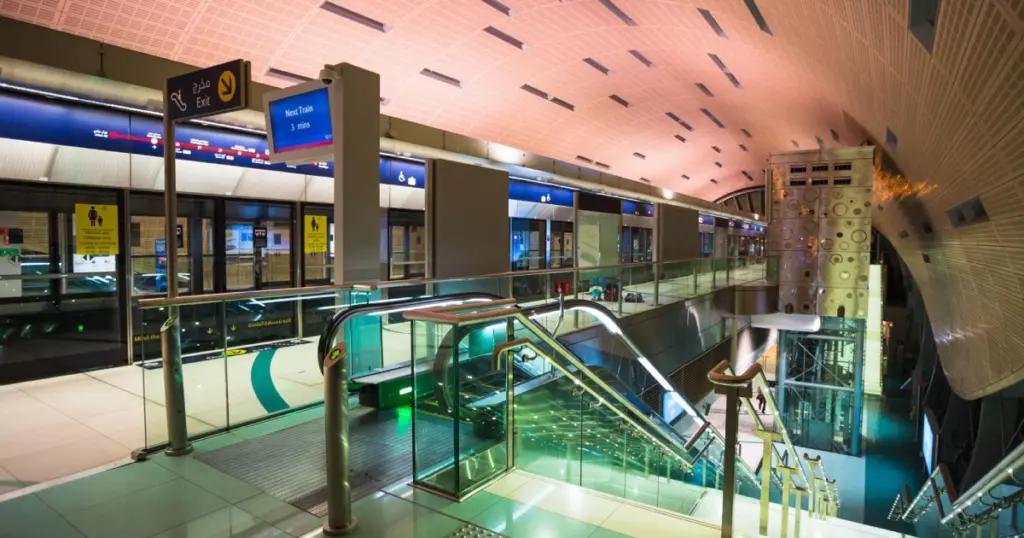
Dubai Metro launched in 2009 and now carries over half a million passengers daily across two main lines and the Route 2020 extension. It is fully automated and driverless, air-conditioned throughout, and generally reliable. For tourists, the key things to learn are which stations serve which attractions, which NOL card to buy, how the zone fares work, and what the operating hours are. This guide covers all of it clearly.
Dubai Metro Quick Facts:
- Lines: Red Line + Green Line + Route 2020 extension
- Total Stations: 64 stations across all lines
- Fare System: Zone-based, 7 zones, AED 3 to AED 8.50 per journey
- Payment: Nol card only; no cash accepted on the metro
- Best card for tourists: Silver Nol Card (AED 25 with AED 19 credit)
- 1-Day Pass: AED 20 regular / AED 40 Gold unlimited travel until midnight
- Operating Hours: Sat–Thu 5:00 am–midnight | Fri 10:00 am–1:00 am
- Airport To Downtown: Under 30 min, under AED 8 vs AED 70–90 by taxi
- No eating, no drinking, no gum AED 200 fine for ticketless travel
- Women + Children Carriage: The first carriage on every train is clearly marked
Dubai Metro Lines and Routes: What Goes Where
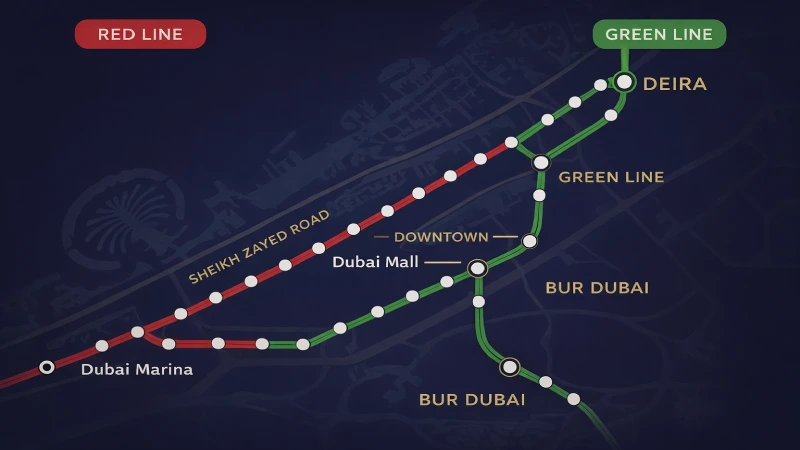
Red Line: The Tourist Backbone
The Red Line is the one most tourists use. It runs approximately 52 kilometers from Centrepoint station (R11) in the north to Expo 2020 station (R76) in the south, following Sheikh Zayed Road through the heart of modern Dubai. All the major tourist destinations are on or directly accessible from the Red Line.
Key Red Line Stations for Tourists
- Airport Terminal 1 (R19) and Terminal 3 (R18) direct airport connection, no transfer needed
- BurJuman (R12) interchange with Green Line, central Bur Dubai shopping
- Union (R13) second interchange with Green Line, Deira access
- Burj Khalifa / Dubai Mall (R23) Burj Khalifa, Dubai Mall, Dubai Fountain, Dubai Aquarium
- Business Bay (R24): Business Bay hotels, canal area
- Dubai Marina (R37): Dubai Marina Walk, Marina Mall, tram connection to JBR and Palm Jumeirah
- Ibn Battuta (R39) Ibn Battuta Mall, connection for Atlantis and Palm buses
- Expo 2020 / Expo City (R76) Route 2020 terminus
Green Line: Old Dubai and Historic Areas
The Green Line runs 22.5 kilometers from Al Qusais (G17) in the east to Jaddaf (G01) in the west, cutting through the older parts of Dubai: Deira, Bur Dubai, and Dubai Healthcare City. It connects with the Red Line at two interchange stations: BurJuman and Union. The Green Line is less tourist-heavy than the Red Line but essential for reaching Dubai Creek, the spice and gold souks area, and the Al Fahidi Historical Neighborhood.
Key Green Line Stations:
- Union (G01) and BurJuman (G08) interchange with Red Line
- Al Ghubaiba (G05): Dubai Creek, abra water taxis to gold and spice souks
- Al Fahidi (G06) Al Fahidi Historical Neighbourhood, Dubai Museum
- Abu Hail (G10) and Al Qiyadah (G13) residential areas in north Deira
Route 2020 The Expo Extension
Route 2020 extended the Red Line south from DAMAC Properties station (R38) to Expo 2020 (R76) in 2021, adding 15 kilometers and seven new stations to connect the Expo City Dubai district, Dubai South, and the Al Maktoum International Airport zone. For tourists, the most relevant station is Expo 2020 itself; the former Expo site is now Expo City Dubai, a permanent destination with museums, attractions, and the 95-meter Al Wasl Plaza dome.
The Nol Card: Which One to Buy and How to Use It
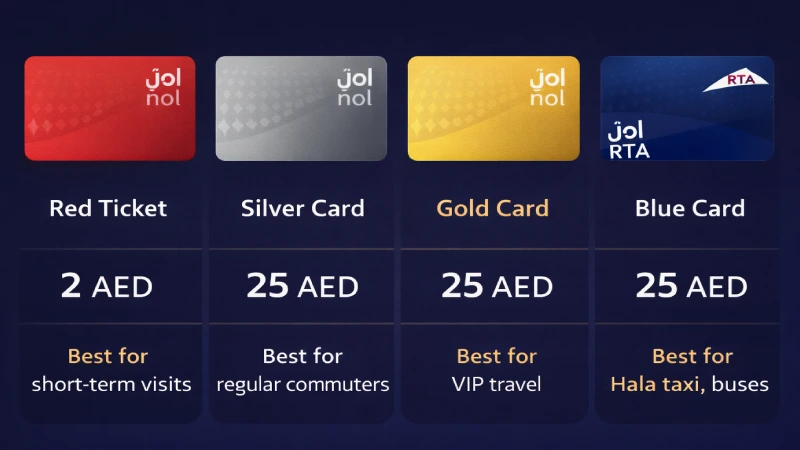
The Nol card is the only way to pay for Dubai Metro. Cash is not accepted at the gates. Every visitor needs one. There are four types, and the right choice depends on how long you are staying and how often you plan to travel.
Red Ticket for Short Visits
The Red Ticket is a paper-based disposable card that costs AED 2 to purchase. It can hold up to 10 single journeys or be loaded as a 1-day pass for AED 20 (regular class) or AED 40 (gold class). The 1-day pass gives unlimited travel until midnight on the day you first tap it. For a tourist spending one or two days in Dubai and making multiple metro trips, the AED 20 day pass is very good value for three or more journeys in different zones, and it has already paid for itself.
Red Ticket Practical Notes:
- Purchase cost: AED 2 for the card itself
- Single journey cost: higher per-journey rate than Silver card
- 1-Day pass: AED 20 unlimited regular class / AED 40 Gold is valid until midnight
- Cannot be replaced if lost; no registered balance protection
- Maximum 10 single journeys before disposal
Related Articles: Dubai Metro Blue Line Guide – New Stations and Tourist Tips
Silver NOL Card: Best for Most Visitors and Residents
The Silver card is the most popular card in the Dubai Metro system and the right choice for most tourists staying three or more days. It costs AED 25, which includes AED 19 of loaded credit. It is a plastic rechargeable card valid for five years. Fares are zone-based and lower per journey than the Red Ticket. The daily fare cap of AED 14 means that however much you travel in a single day, you will not be charged more than AED 14 once that threshold is reached.
Silver Card Passes:
- 7-day pass: unlimited travel for one week, a good value for tourists on longer stays
- 30-day pass: monthly unlimited for frequent visitors or short-term residents
- 90-day and 365-day passes also available
- Daily cap: AED 14 maximum per day regardless of journeys
- Top up: Metro station kiosks, RTA app, Nol Pay app, AED 10 minimum top-up
Gold Nol Card for Gold Class Travel
The Gold card is identical in cost to the Silver card (AED 25 with AED 19 credit) but gives access to the Gold Class cabins on the metro, the first carriage of each train. Gold Class has individual seats, more space, and a quieter environment. Fares are higher (typically around 50% more than Silver class), but for travelers who want more comfort on longer journeys, the Gold card is available. Gold class cabins are also available on the Dubai tram.
Blue Nol Card Students, Seniors and People of Determination
The Blue Card is a personalized card requiring registration with the RTA. It is available to students (UAE-enrolled), senior citizens, and people of determination (disability card holders). It offers concessionary fares; a typical AED 7.50 journey drops to AED 3.75 for eligible Blue card holders. Over 350,000 students in Dubai currently use blue cards. Tourists cannot apply for a Blue Card; it requires valid UAE residency documentation.
Dubai Metro Fares: Zone System Explained
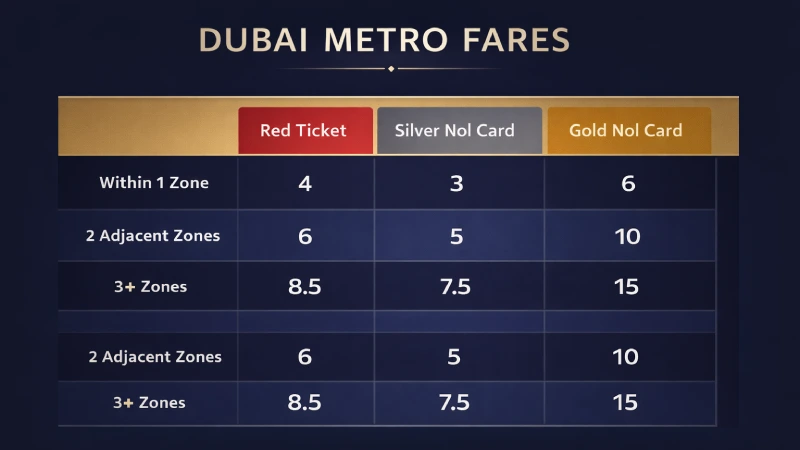
Dubai Metro uses a 7-zone system. Your fare is determined by how many zones you travel through, not by the specific stations. The Nol card reader calculates this automatically when you tap in and tap out. You do not need to know the zone numbers, only to always tap both in and out.
Zone Fare Table
| Zones Crossed | Silver Card (Regular) | Gold Card | Red Ticket |
|---|---|---|---|
| 1 zone | AED 3.00 | AED 5.85 | AED 3.00 |
| 2 zones | AED 5.00 | AED 9.75 | AED 5.00 |
| 3 or more zones | AED 7.50 | AED 14.65 | AED 7.50 |
| Daily cap | AED 14.00 | AED 28.00 | No cap (per journey) |
| 1-Day pass (Red Ticket) | AED 20 unlimited | AED 40 unlimited | Available |
How the 180-Minute Transfer Rule Works
If you transfer between the metro, bus, or tram within 180 minutes of tapping out of one service, the entire journey is treated as a single trip. Your zones are counted cumulatively across all modes, and the fare is capped at the maximum for the zones crossed. This means connecting from the metro to a bus to reach your final destination is not charged as two separate journeys; it counts as one if done within the 180-minute window.
Always Tap Out: Why It Matters
If you forget to tap out when leaving the metro, the system charges you the maximum possible fare for all zones. There may also be an additional penalty charge. Always wait for the green light on the reader when tapping out and check that your balance has been deducted. If the gate does not register your tap-out, report it at the station before you leave.
Practical Fare Examples:
- Dubai Airport (T3) to Burj Khalifa / Dubai Mall: 2–3 zones = AED 5–7.50 Silver vs. AED 70–90 taxi
- Union (Deira) to Dubai Marina: 3+ zones = AED 7.50 Silver
- BurJuman to Dubai Mall: 2 zones = AED 5 Silver
- Nakheel Harbour (R37) to Expo City: 3+ zones = AED 7.50 Silver
Dubai Metro Operating Hours and Frequency
Standard Weekly Schedule
Dubai Metro operates seven days a week. The schedule differs slightly on Fridays to accommodate the UAE weekend pattern and Friday prayer times.
| Day | First Train | Last Train | Notes |
|---|---|---|---|
| Saturday to Thursday | 5:00 AM | Midnight (12:00 AM) | Regular service |
| Friday | 10:00 AM | 1:00 AM (next day) | Late start Jumu’ah |
| Public Holidays | Varies; check RTA app | Varies | Extended hours sometimes apply |
Peak Hours: When to Avoid
The metro gets very busy during rush hours, particularly on the Red Line between Business Bay and Union. Peak times are 7:00am to 9:00am and 5:00pm to 7:00pm on weekdays. During these windows the trains fill quickly, and platforms become crowded. Tourists who have flexibility should travel between 10:00am and 4:00pm when trains run with comfortable space and shorter waits. There is no off-peak discount fare on the Dubai Metro; prices are the same at all times of day.
Train Frequency
During peak hours, trains run approximately every 3–5 minutes on the Red Line and every 5–7 minutes on the Green Line. Off-peak frequency drops to around every 7–10 minutes. Exact current schedules are available through the RTA Dubai app and on digital boards at all stations.
Dubai Metro Rules and Essential Travel Tips
Rules: What Is and Is Not Allowed
Dubai Metro has a clear and enforced set of conduct rules. Inspectors routinely apply the AED 200 fine for travelling without a valid ticket by boarding trains randomly across the network. Other rules that visitors sometimes discover the hard way include the following.
PROHIBITED on Dubai Metro All Passengers:
• Eating or drinking inside the train or station, including water
• Chewing gum is classified as littering and subject to fine
• Playing music or audio without headphones
• Carrying oversized or sharp luggage without clearance
• Boarding the Gold Class carriage with a Silver or Red card
• Males entering the Women and Children’s carriage (first carriage)
• Travelling without a valid Nol card: AED 200 fine
• Eating or drinking inside the train or station, including water
• Chewing gum is classified as littering and subject to fine
• Playing music or audio without headphones
• Carrying oversized or sharp luggage without clearance
• Boarding the Gold Class carriage with a Silver or Red card
• Males entering the Women and Children’s carriage (first carriage)
• Travelling without a valid Nol card: AED 200 fine
The Women and Children’s Carriage
The first carriage of every Dubai Metro train is reserved exclusively for women and children. This section is clearly signed on the platform and at the carriage door. Solo male travelers should board from the second carriage onward. Families with children may use the dedicated carriage. The remaining carriages are mixed and open to all passengers.
Gold Class Carriage
Gold Class is the first section of carriages on every train. Entry is restricted to Gold Nol card holders. The gates at gold class entries will not open for silver or red cardholders. Gold Class offers wider individual seats, lower occupancy, and a quieter environment. Whether it is worth the approximately 50% fare premium depends on journey length and personal preference; for a 20-minute cross-city journey it is a comfort choice, not a necessity.
Practical Tips That Actually Help
- Download the RTA Dubai app before arriving; it has route planning, real-time arrivals, Nol card balance, and the official metro map.
- Buy a Silver Nol card at the airport immediately after landing. The metro saves enormous amounts of money vs. taxis for the airport-to-hotel journey.
- Load at least AED 50 on your Silver card when you first arrive, enough for several days of travel without needing to top up constantly.
- Keep your Nol card separate from other contactless cards. Multiple RFID cards near the reader can cause ‘card clash’ and failed taps.
- The Emaar Nol card (AED 55) offers up to a 40% discount on Burj Khalifa tickets and Dubai Aquarium entry, which is worth considering if you plan to visit both attractions.
- For Dubai Marina and JBR access, the metro gets you to Dubai Marina station, and the Dubai Tram (same Nol card) handles the final connection along the Marina to the beach.
- For Palm Jumeirah, take the metro to DAMAC Properties (R38) and transfer to the Palm Monorail (separate fare, not included in Nol zones).
Most Useful Metro Routes for Tourists
| From | To | Line | Approx. Fare | Notes |
|---|---|---|---|---|
| Dubai Int’l Airport T3 | Burj Khalifa / Dubai Mall | Red | AED 7.50 | Direct no change needed |
| Dubai Int’l Airport T3 | Dubai Marina | Red | AED 7.50 | Direct full Red Line run |
| Union (Deira) | Burj Khalifa / Dubai Mall | Red | AED 5.00 | 2 zones, central route |
| BurJuman | Dubai Mall | Red | AED 5.00 | After Green-Red interchange |
| Dubai Marina | Ibn Battuta Mall | Red | AED 3.00 | 1 zone walkable from mall |
| Al Fahidi | Dubai Museum | Green | AED 3.00 | Walk from the station 5 mins |
| Dubai Marina | Expo City Dubai | Red then R2020 | AED 7.50 | Route 2020 extension |
| Airport T3 | Palm Monorail Gateway | Red | AED 7.50 | Change at DAMAC Properties |
Frequently Asked Questions
Do I need a Nol card for the Dubai Metro?
Yes. Cash is not accepted. Buy a Silver Nol card (AED 25) at any metro station; it is ready to use immediately and works across metro, bus, tram, and water bus.
Which Nol card is best for tourists?
Silver Nol card for most visitors (3+ days, multiple journeys). Red Ticket 1-Day pass (AED 20) for a single heavy-use sightseeing day.
How much does the metro from Dubai Airport to downtown cost?
Under AED 8 by metro. A taxi covers the same route for AED 70–90. The Red Line runs directly from Terminal 3 to the Burj Khalifa / Dubai Mall station with no transfer needed.
Can women and men travel in the same carriage?
Yes, in most carriages. The first carriage on every train is reserved for women and children only. All other carriages are mixed. Solo male travellers must use carriages 2 onwards.Yes, in most carriages. The first carriage on every train is reserved for women and children only. All other carriages are mixed. Solo male travellers must use carriages 2 onwards.
Our Recommendation
Buy a Silver Nol card the moment you clear travelers at Dubai Airport. The metro station is inside the terminal building. Load AED 50 on it. Take the Red Line directly to your hotel area; it will be the cheapest and fastest first transport decision you make in Dubai.
For most tourists on a 4–7 day trip, the Silver card with the daily cap of AED 14 handles everything. If you plan to spend a full day at multiple attractions connected by metro, airport, downtown, marina, or old Dubai, the AED 20 Red Ticket day pass is worth buying for that day instead. Run the math: three standard journeys crossing two zones each cost AED 15 on a Silver card, already more than the AED 20 day pass, which gives unlimited travel for the whole day.
The one tip that saves the most money over a Dubai trip: use the metro to get to your major attractions and take taxis or ride-hailing only when the metro cannot reach them. The metro covers Burj Khalifa, Dubai Mall, Dubai Marina, JBR (via tram), the gold and spice souks (Green Line), Expo City, and the airport. That covers the majority of what most tourists want to do. Keeping taxis for the exceptions rather than the default cuts transport spend dramatically.