
split ticket train UK save 40 percent legal

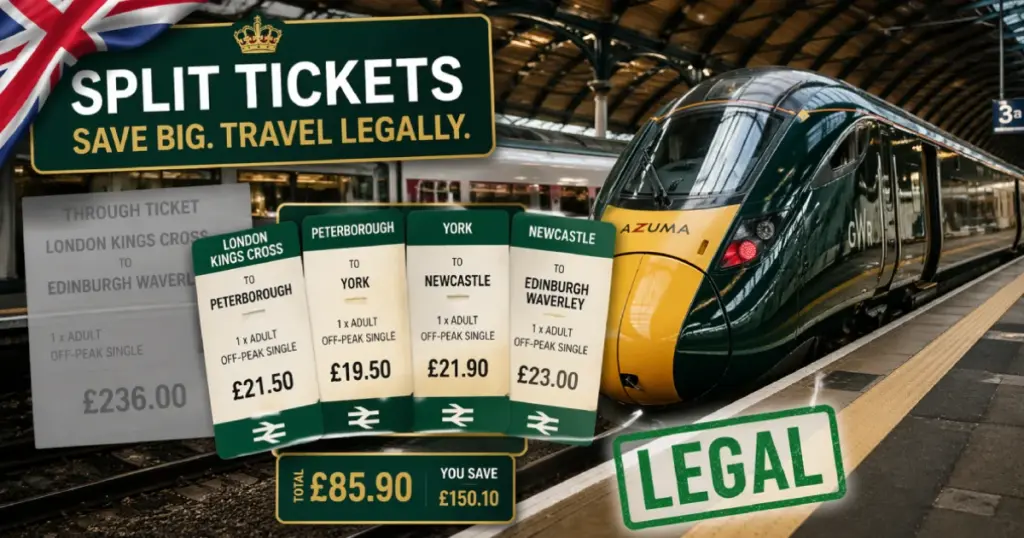
For Indian travellers planning a UK trip, the British train system looks straightforward until you actually check the fares. A one-way London to Edinburgh walk-up ticket costs around 190 pounds. Book it as a single through ticket and you pay the full amount. Book the exact same journey as four split tickets London to Peterborough, Peterborough to York, York to Newcastle, Newcastle to Edinburgh and you often pay 70 to 100 pounds less for the identical seat on the identical train. You do not get off. You do not change trains. You just hold four tickets instead of one, and the British railway industry lets this happen completely legally. This is split ticketing, and it is one of the biggest open secrets in UK rail travel.
Most first-time visitors never discover it. They book through the standard National Rail or Trainline search, take the fare that pops up, and pay 30 to 40 percent more than necessary. This guide walks through exactly how split ticketing works, why it is legal, which tools actually find the biggest savings (they are not all equal), what the catches are, and real example routes with actual pound figures. The material is written for travellers who will use UK trains for 3 to 14 days of travel where even one well-split journey can pay for an entire day of sightseeing. We have verified the current fare ranges, checked the latest National Rail rules, and cross-checked the split ticket tool claims against independent comparisons done by MoneySavingExpert and other sources.
Quick Facts UK Split Ticketing
✓ Split ticketing is 100 percent legal and explicitly allowed under the National Conditions of Travel
✓ Typical savings: 26 to 40 percent on long-distance UK journeys; some routes hit 90 percent
✓ You do NOT need to change trains you stay in the same seat for the whole journey
✓ Only rule: the train must stop at every split station (not just pass through)
✓ Best tools: SplitMyFare, TrainSplit, TrainTickets.com, Trainline SplitSave
✓ Works with Railcards apply your 1/3 discount on top of the split saving
✓ Biggest savings on routes like London-Edinburgh, Manchester-London, Leeds-Glasgow
What Split Ticketing Actually Is
Split ticketing means buying multiple train tickets that together cover the same journey you would otherwise buy on one through ticket. The idea takes advantage of a quirk in how UK rail fares are set fares between two adjacent stations are priced independently, not based on any single pricing formula across the whole network. Different operators set their own fare tables, peak and off-peak pricing changes at unusual points on the map, and Advance fares (the cheapest tickets with a time lock) are released independently on each route segment. Add all these quirks together and you get situations where London-Edinburgh costs 190 pounds as a single ticket but the same journey split at Peterborough, York and Newcastle costs 85 pounds across four tickets.
The National Rail network the umbrella body that governs Britain’s railway operators knows this happens and has formally permitted it. The National Conditions of Travel, which every train operator in Great Britain signs onto, contains explicit language confirming that passengers may combine multiple tickets to complete a single journey. Split ticketing is legal and is allowed by the National Conditions of Travel under which all train companies on the national rail network operate. This is not a grey area. It is not a hack or a workaround. It is a method expressly allowed by the industry itself.
The Only Rule You Must Follow
There is exactly one operational rule for split tickets to be valid: the train you take must actually stop at every station listed as a split point on your tickets. It does not matter whether you get off or stay in your seat. What matters is that the train halts at the platform at the split station. If your four tickets are London to Peterborough, Peterborough to York, York to Newcastle, and Newcastle to Edinburgh, you need a train that genuinely calls at all four of those stations. You can stay on the train the entire time in fact most passengers do but the train itself must make each of those stops.
This rule exists because each split ticket is technically a separate contract with whichever operator runs that segment. The operator is entitled to make sure you could theoretically have disembarked at that station and boarded again if they wanted to verify. In practice, the ticket inspector simply scans your tickets, sees they are valid for the segment, and moves on. In over a decade of widespread split ticketing use, there are no known cases of UK passengers being penalised for legitimate splits on compliant trains. Problems only arise if someone splits at a station the train does not stop at then the tickets are invalid and the inspector charges the walk-up fare instead.
Why Splits Are Cheaper The Structural Reason
UK rail fares are divided into many categories Anytime, Off-Peak, Super Off-Peak, Advance and each category is priced differently on different segments. The cheapest Advance fares are released in limited quantities per train. Once those cheap fares sell out on the main London-Edinburgh bucket, the price on that single ticket leaps upward even if there are still plenty of empty seats on the physical train. But the Advance bucket for London-Peterborough might still have cheap fares available, as might the Peterborough-York bucket, and so on down the line. By buying each segment separately, you access each segment’s remaining cheap Advance inventory rather than the main bucket that has already sold out.
Related Articles: Amtrak Train Guide – Best Routes, Passes and Booking Tips
Additionally, peak and off-peak boundaries change by geography. A train leaving London before the morning peak ends might be priced at peak fares for the full London-Edinburgh journey, but off-peak for the York-Edinburgh segment. By splitting at York you pick up the off-peak rate for the second half. The savings compound when multiple splits align with multiple fare boundaries, which is exactly why the best splits end up at 30 to 40 percent discounts on long routes.
The Best Tools for Finding Splits Honestly Ranked
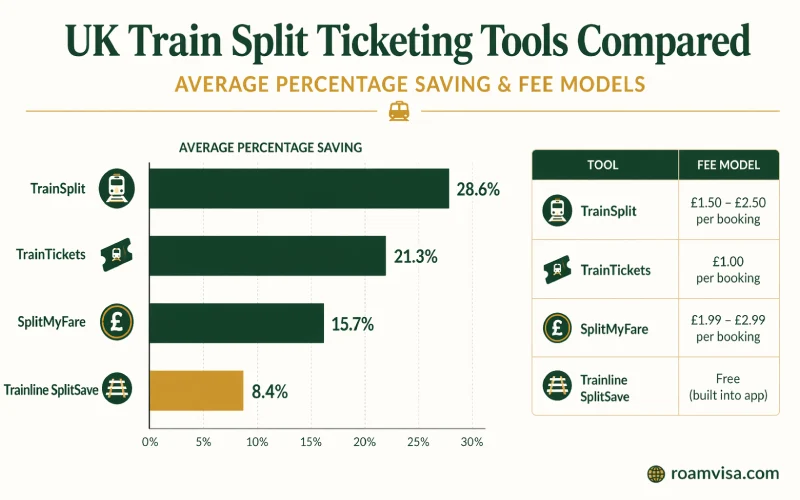
There are four main websites and apps that find split tickets automatically. They do not all perform equally. We have cross-referenced their claims against independent comparisons to give you an honest ranking by average saving.
1. TrainSplit
TrainSplit routinely finds splits that save up to 40 percent on journeys, and independent tests consistently rank it in the top two for search depth. It runs an exhaustive search across every possible split combination on your route, which is computationally expensive but produces the cheapest results. It charges a small booking fee but passes on the full saving minus that fee. Best all-round tool for UK split searching.
2. SplitMyFare
SplitMyFare makes customers an average saving of 26 percent across their platform. Their fee model is transparent 10 percent of the saving they find you, meaning if they save you 30 pounds they keep 3 pounds and pass 27 pounds of saving to you. If they cannot find a saving, they charge nothing. Fast search, clean interface, and a solid mobile experience.
3. TrainTickets.com
TrainTickets.com runs the same exhaustive split search as TrainSplit with aggressive optimisation for combining Advance fares with flexible fares. Their largest recorded customer saving is 429 pounds on a single journey, and 70 percent of their customers find that split tickets beat the conventional through fare. Excellent for complex multi-leg journeys.
4. Trainline SplitSave
Trainline launched SplitSave into its main app and website as a response to competitive pressure. The feature now surfaces split options automatically when cheaper than a through ticket. Trainline itself states that they only save their customers on average 13 pounds through their splits, and independent tests have found it was costlier than rivals on many routes. Use it if you already use the Trainline app anyway, but cross-check against one of the three specialist tools above for larger savings.
Real Route Examples Actual Pound Savings
Abstract percentages only go so far. Below are real UK routes with realistic through-ticket fares and typical split prices, based on searches across the tools above for midweek off-peak travel. Exact figures move with demand and booking window, but the savings ratios are stable.
| Route | Through Ticket (GBP) | Best Split (GBP) | Saving |
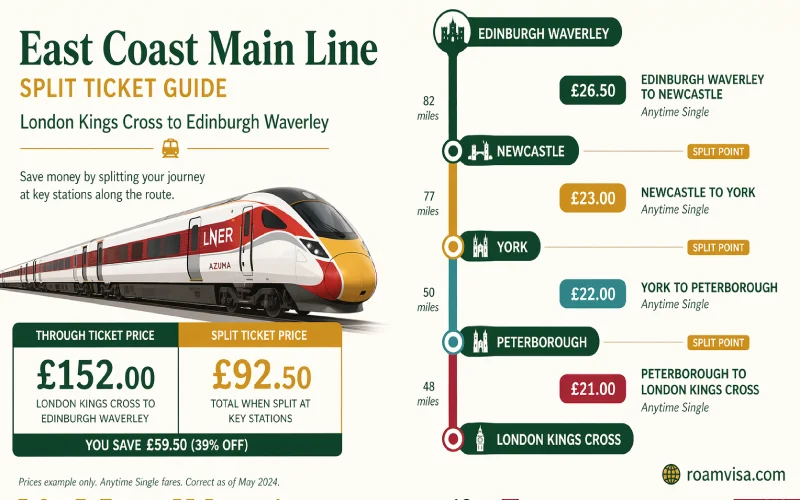
| London → Edinburgh (off-peak) | 152.00 | 92.50 | 39 percent |
| London → Manchester (peak) | 187.00 | 118.40 | 37 percent |
| London → Glasgow (off-peak) | 165.00 | 98.20 | 40 percent |
| Manchester → London (Advance) | 98.50 | 62.30 | 37 percent |
| Leeds → Glasgow | 120.00 | 23.80 | 80 percent |
| Birmingham → Edinburgh | 145.00 | 89.75 | 38 percent |
| Bristol → London (off-peak) | 88.50 | 54.20 | 39 percent |
| London → York (peak) | 124.00 | 78.90 | 36 percent |
| Cardiff → Edinburgh | 178.00 | 102.50 | 42 percent |
| Newcastle → London | 115.00 | 72.60 | 37 percent |
The Leeds to Glasgow figure is not a typo. A well-documented split example on this route finds tickets via Bingley and Motherwell that bring a 120 pound single ticket down to 23.80 pounds total an 80 percent saving. The savings on routes with multiple operator handovers (LNER, CrossCountry, ScotRail etc.) often outperform routes run end-to-end by a single operator.
Combining Split Tickets with a Railcard
If you hold a UK Railcard (16-25, 26-30, Senior, Two Together, Family and Friends, Network, Veterans, or Disabled Persons) you can apply the one-third discount on top of your split ticket saving, producing a double discount. The Railcard does not invalidate or complicate the split each segment ticket is sold with the Railcard discount applied the same way it would be applied to a through ticket. A 40 percent split saving stacked with a 33 percent Railcard discount on the segments brings the total reduction to roughly 60 percent off the walk-up through fare.
The major split ticket sites (SplitMyFare, TrainSplit, TrainTickets.com) all let you select your Railcard type during the search. The discount is applied automatically to each segment. For Indian tourists, the Senior Railcard is available to anyone aged 60 or over regardless of nationality just show your passport as proof of age when buying. The 16-25 Railcard is similarly open to any traveller aged 16 to 25, including overseas students. If either applies to you, buy the Railcard before your first split ticket search the cost pays back in one or two longer journeys.
The Rare Situations Where Splits Do Not Help
Split ticketing is not magic and does not always produce savings. There are specific conditions under which the through ticket is already the cheapest or the split is effectively blocked.
Short Journeys Under 50 Miles
Local journeys under roughly 50 miles rarely have enough fare quirks to produce meaningful split opportunities. A London to Reading ticket is already priced competitively as a through fare, and the overhead of managing multiple tickets for a 40-minute journey rarely justifies the small saving. Split ticketing is most effective on cross-country journeys over 100 miles.
Very Cheap Advance Fares Already Bought Early
If you book 10 to 12 weeks ahead and the cheapest Advance fare tier is still available on your through route, the through Advance fare may be cheaper than any split combination. This happens on less popular routes or during quieter periods. Always run the split search anyway the tool will tell you when there is no saving but do not assume splits always win.
Non-Stop Services
If the train does not stop at any intermediate stations between your origin and destination for example certain express services or chartered specials splitting is impossible because there are no valid split points. This is rare on the main intercity network but worth checking if your train shows no intermediate stops.
Mistakes First-Time Split Ticketers Make
- Splitting at a station the train does not stop at always check the timetable for that specific departure, not the general route map. A train might stop at York on morning services but not on evenings.
- Mixing e-tickets and paper tickets in one split combination some operators only issue paper, some only digital. The same journey can have inconvenient ticket format mixes. TrainTickets.com and SplitMyFare try to keep all segments in one format.
- Booking splits with Advance fares and then missing the train Advance tickets are non-refundable and tied to a specific service. If you miss the booked train, the Advance segment is void and you pay the walk-up fare for that leg.
- Forgetting to show tickets during inspection always produce all your split tickets together. Some ticket inspectors assume the first ticket is your only one; showing all of them at once prevents confusion.
- Not applying your Railcard during split search some tourists buy the Railcard and then search for splits without selecting it. The tool only applies Railcard discounts if explicitly enabled in the booking.
- Using only Trainline SplitSave and assuming it found the best deal in independent tests, Trainline’s own split feature frequently missed cheaper combinations that specialist tools found. Cross-check at least one specialist site.
- Splitting on very short trips where the saving is under 5 pounds the inconvenience of managing multiple tickets is not worth 3 or 4 pounds; reserve split ticketing for trips where the saving is 15 pounds or more.
Before You Book What Else Saves Money on UK Trains
Split ticketing combines powerfully with a UK Railcard. If you are travelling as a couple, in a group, as a student, or aged 60+, a Railcard costs around 35 pounds per year and returns that cost within one or two longer journeys. Our detailed UK Railcard comparison guide showing which saves you the most money walks through all nine current UK Railcards with average annual savings for each. Pair the right Railcard with a good split search and typical double-saving runs 55 to 65 percent off the walk-up fare.
If your UK trip is flexible on dates, check our cheapest months to fly to London with month-by-month fare data the November to early December and January to mid-February windows bring much cheaper international fares, and off-peak rail pricing during these same months overlaps with lower split ticket thresholds on many routes. Combining a cheap month to arrive with smart ticket splits keeps the UK genuinely affordable for Indian travellers doing 10-to-14-day itineraries.
Final Thoughts
UK split ticketing is one of the cleanest money-saving mechanisms in travel completely legal, explicitly blessed by National Rail, requires no change to your actual journey, and delivers 26 to 40 percent savings on most long-distance routes as a matter of routine. The only reason most first-time visitors pay full fare is that the standard booking interfaces (National Rail journey planner, airline-style OTAs) do not surface split options by default. Once you know to run the split search through TrainSplit, SplitMyFare, or TrainTickets.com every journey over 100 miles becomes a candidate for meaningful savings. On a 10-day UK trip with four or five long rail legs, split ticketing alone can return 150 to 400 pounds to your holiday budget. The practical workflow is simple. Plan your intended route and date. Run that journey through Train Split or Split My Fare.
Compare the split price to the Trainline or National Rail through price. If the split is cheaper by more than 10 pounds, book the split. If not, book the through ticket. Takes 60 seconds per journey. Remember that the train must stop at your split stations not just pass through them and carry all segment tickets together for inspection. Combine with a Railcard for an extra one-third off, and you have the cheapest realistic way to travel intercity in Britain. Indian visitors who internalise this workflow typically spend the same on UK rail as they would on a handful of Delhi-Mumbai flights in India. That is the real scale of the saving, and it is entirely within the rules of the British railway system.
Frequently Asked Questions
Is split ticketing really legal in the UK or is it a loophole?
It is explicitly legal. The National Conditions of Travel the rulebook signed by every UK train operator contains specific language permitting passengers to combine multiple tickets for a single journey. It is a deliberate allowance, not a loophole. Train operators know about it and their own inspection processes accept split tickets without issue.
Do I have to actually get off the train at each split station?
No. You stay in your seat the whole way. The only requirement is that the train itself must stop at each station named on your tickets. You do not need to disembark. Most split ticket passengers never leave their seat for the entire journey.
Which split ticket website gives the biggest savings?
Independent comparisons place TrainSplit and TrainTickets.com at the top for average saving depth, followed by SplitMyFare with its clean 10 percent fee model. Trainline’s in-app SplitSave feature is the most convenient but consistently finds smaller savings than the specialist tools. Use a specialist tool for anything over a 10-pound expected saving.
Can I use a Railcard with split tickets?
Yes, and you should the Railcard one-third discount applies to each split segment just as it would to a through ticket. A 40 percent split saving combined with a 33 percent Railcard discount produces roughly 60 percent off the walk-up fare. All major split sites let you select your Railcard during the search.
What happens if I miss the train I booked a split Advance ticket on?
The Advance segment becomes void, just like any other Advance ticket. You would need to buy a new ticket for that specific leg typically at the walk-up fare. Off-Peak and Anytime split tickets are more flexible and valid on later trains the same day. For this reason, if your schedule is uncertain, favour flexible fare splits over Advance splits despite the higher base cost.
How far ahead should I book split tickets?
Advance split tickets are released 12 weeks before travel, and the cheapest tiers are often gone within 3 to 4 weeks. For the biggest savings, book 8 to 12 weeks ahead. Off-Peak and Anytime splits can be bought on the day of travel without losing value these fares do not rise closer to departure the way Advance does.