
Travel Insurance for US Visa – What Coverage Do You Need?

Travel insurance for US visa coverage is a topic that creates a lot of confusion – and given the stakes involved, getting it wrong can be genuinely expensive. The short version is this: for a B-1/B-2 tourist or business visitor visa, travel insurance is not legally required by the US government. But the United States has the most expensive healthcare system on the planet, and there is no public healthcare for foreign visitors. If something goes wrong medically while you are in America without insurance, the bill comes directly to you.
A basic emergency room visit in the USA for a minor injury – a sprained ankle, a cut that needs stitches – routinely costs between $3,000 and $8,000. A three-day hospital stay averages $30,000. A heart attack treated in a US ICU can exceed $100,000. And if you need to be flown home because of a serious condition, medical evacuation from the US to India, the UK or Australia typically costs between $60,000 and $200,000. These are not theoretical worst-case numbers – they are what US hospitals charge at their standard rates, and they apply to every uninsured foreign visitor who walks through the door.
This guide covers exactly what travel insurance you need for every major US visa type, what the coverage should actually include, how much it costs, which plans to consider and what happens when a CBP officer at the border asks about your insurance. By the end of it, you will know precisely what you need – and why.
Travel Insurance for US Visa – Key Facts 2025
B-1/B-2 Tourist Visa: NOT legally required – but strongly recommended. CBP officers can ask.
J-1 Exchange Visitor visa: MANDATORY by US law – minimum $100,000 medical cover required
F-1 Student Visa: Required by most US universities – check your specific institution’s rules
ESTA (Visa Waiver Program): NOT required – but US healthcare is still extremely expensive
H-1B / L-1 Work Visas: Employer provides health insurance – check coverage adequacy
US Healthcare Cost: Doctor visit $250–$350 | ER visit $3,000–$8,000 | ICU/day $10,000+
Best Plans: Atlas America (WorldTrips), Patriot America+ (IMG Global), Safe Travels USA (Trawick)
Cost: From ~$1.50/day for younger visitors to $3–$5/day for those aged 50–65
Buy When: Before you leave your home country – some waiting periods apply after departure
What the US Government Actually Requires – By Visa Type
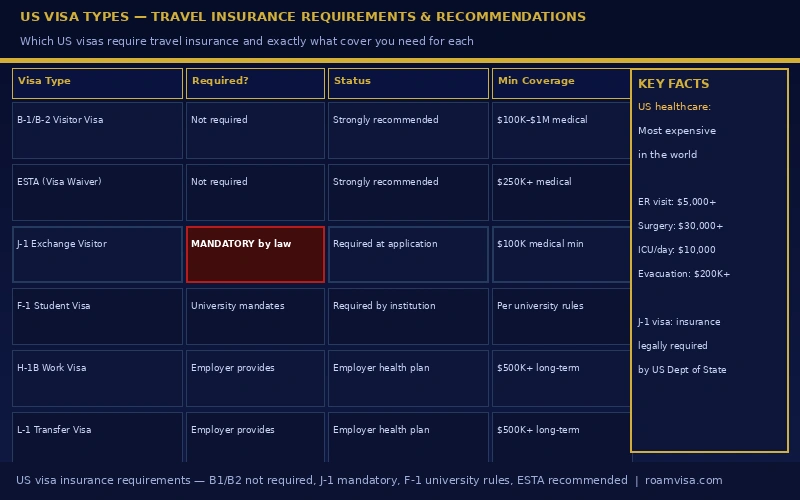
The United States does not have a single blanket rule on travel insurance for all visa types. The requirement – or lack of it – varies significantly depending on the category of visa you hold. Understanding this is important because the rules for a J-1 visa holder are entirely different from those for a B-2 tourist.
B-1/B-2 Visitor Visa (Tourism and Business)
Travel insurance is not a formal legal requirement for entering the United States on a B-1 or B-2 visitor visa. The US Citizenship and Immigration Services (USCIS) does not list travel insurance as a required document, and US immigration officers at the border do not routinely ask for it.
However – and this is a genuinely important caveat – a Customs and Border Protection (CBP) officer has the discretion to ask how you intend to pay for medical treatment if you become ill during your stay. This is more likely to happen with elderly visitors, those who appear unwell, or visitors making extended stays. While not having insurance is not grounds for refusing entry, being unable to demonstrate financial responsibility can raise concerns. Having an insurance certificate with you is straightforward protection against this possibility.
J-1 Exchange Visitor Visa – Mandatory Insurance
The J-1 visa is the one category where travel insurance is not optional – it is a legal requirement under US Department of State regulations. All J-1 visa holders must have health insurance that meets minimum standards throughout their exchange programme. These minimums are:
- Medical benefits of at least $100,000 per accident or illness
- Repatriation of remains coverage of at least $25,000
- Medical evacuation coverage of at least $50,000
- Deductible of no more than $500 per accident or illness
Your J-1 programme sponsor – the organisation or institution that issued your DS-2019 form – is responsible for ensuring you have compliant insurance. Many sponsors provide insurance as part of the programme. If you need to arrange it independently, the Patriot America Plus plan from IMG Global specifically meets J-1 requirements and is widely used by exchange visitors.
F-1 Student Visa
The US government itself does not require travel insurance for F-1 student visa holders, but virtually every US university and college mandates health insurance as a condition of enrolment. Most institutions either require you to enrol in their student health plan or demonstrate equivalent private coverage that meets their specific minimums. These minimums vary by school but typically require $100,000–$500,000 in medical coverage, emergency evacuation and repatriation.
Some universities allow students to waive the institutional plan if they can show a private policy that meets or exceeds their coverage requirements. This waiver option is worth exploring because institutional plans are often significantly more expensive than equivalent private visitor insurance. Check your university’s specific health insurance waiver requirements before assuming any policy will qualify.
ESTA – Visa Waiver Program
If you are travelling to the USA under the Visa Waiver Program using an Electronic System for Travel Authorization (ESTA) – which applies to nationals of countries including the UK, most EU nations, Australia, Japan and South Korea – travel insurance is not required. There is no insurance requirement in the ESTA application process, and you will not be asked for proof of insurance at the border.
That said, everything about the US healthcare cost situation applies to ESTA travellers exactly as it does to visa holders. Being from a visa-exempt country does not give you any preferential access to US healthcare – you are still paying private rates for every doctor visit, every emergency room entry and every hospital night. ESTA travellers from countries with strong public health systems are sometimes the most caught off guard by US healthcare bills, precisely because they are unaccustomed to paying for emergency treatment.
H-1B and L-1 Work Visas
If you are travelling to the United States on an H-1B Skilled Worker visa or an L-1 intracompany transfer visa, your employer is legally required to provide you with health insurance comparable to that offered to US citizen employees doing similar work. This employer-sponsored health plan covers routine and emergency medical treatment in the USA.
The gap to be aware of is international travel. US employer health insurance plans typically cover you while you are in the United States, but may provide limited or no cover for the journey to and from the US, for medical emergencies in transit countries, or for repatriation back to your home country if you are medically unable to fly commercially. A supplementary travel insurance policy that covers these gaps is worth considering even for H-1B and L-1 holders.
| Visa Type | Is Insurance Mandatory? | Who Requires It | Minimum Coverage | Action |
|---|---|---|---|---|
| B-1/B-2 Visitor | No – not legally required | US government does not mandate | $100K+ strongly recommended | Buy before travel – CBP may ask |
| ESTA (Visa Waiver) | No – not required | No formal requirement | $250K+ recommended | Essential given US healthcare costs |
| J-1 Exchange Visitor | YES – MANDATORY | US Dept of State – legally enforced | $100K medical, $50K evacuation, $25K repatriation | Must be in place before programme begins |
| F-1 Student | University mandates it | Individual institution rules | Varies – $100K–$500K typically | Check waiver option at your university |
| H-1B / L-1 Work | Employer provides | US employer legal obligation | Equivalent to US employee cover | Check gaps: transit, repatriation, emergencies |
| O / P Visa (Artist/Athlete) | Not mandated | Recommended | $250K+ medical minimum | Particularly important for physical injury risk |
Why the United States Is Different From Everywhere Else
Most visitors to the USA come from countries with public healthcare systems – India, the UK, Germany, Canada, Australia, most of Europe, much of South-East Asia. In these countries, a serious illness or injury results in treatment first and billing second, if at all. The US operates entirely differently.
Related Articles: Is Travel Insurance Mandatory for a UK Visa? What You Need
The United States has no public healthcare system for foreign visitors. There is no reciprocal healthcare agreement between the USA and any other country. Every single medical interaction – a GP appointment, an A&E visit, an ambulance call, a night in hospital – is billed at private rates to whoever receives treatment. If you cannot pay, US hospitals are legally required to stabilise you in a life-threatening emergency, but they will bill you for every cent of that stabilisation afterwards, and collection agencies will pursue those debts.
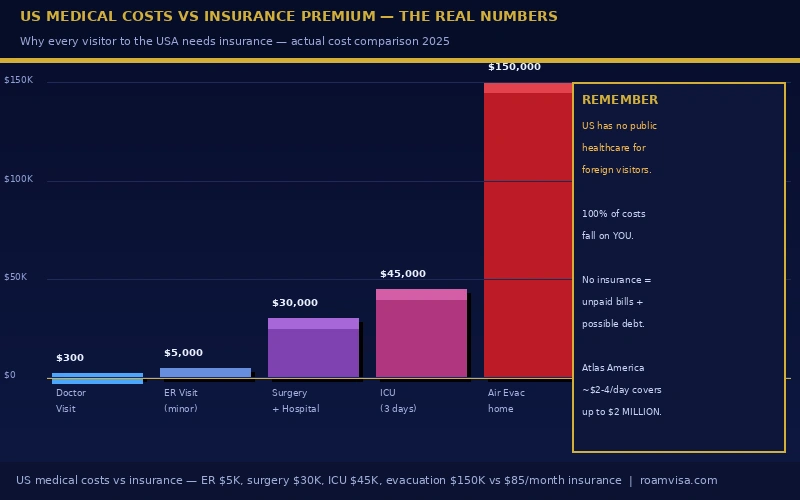
Real US healthcare costs that visitors face in 2025:
- Doctor’s office visit (GP equivalent): $250–$350 for a standard consultation. This is before any tests, prescriptions or referrals.
- Emergency room visit – minor injury (cut, sprain, minor fracture): $3,000–$8,000 including facility fee, physician fee and any basic diagnostics.
- Emergency room visit with imaging (X-ray, CT scan, MRI): $8,000–$20,000 depending on what scans are required.
- Surgery with overnight hospital stay (broken bone requiring surgery): $18,000–$45,000.
- Heart attack or stroke – ICU treatment 3–5 days: $65,000–$130,000. This is not unusual – it is a fairly standard range for cardiac events in US hospitals.
- Medical evacuation by air ambulance from the USA to India, UK, Australia: $80,000–$200,000. This includes the aircraft, medical staff, and ground transportation at both ends.
- COVID-19 hospitalisation (moderate, 7 days with oxygen): $15,000–$40,000.
The number that matters most:
A comprehensive visitor insurance plan for a 45-year-old visiting the USA for 30 days costs approximately $65–$95 depending on coverage level. A three-night hospital stay for pneumonia in a US hospital costs approximately $40,000–$70,000. The insurance premium is 0.1% of a single moderate medical event. This is the calculation every US-bound traveller needs to make before deciding whether insurance is ‘worth it’.
What Your Travel Insurance Must Cover for a US Trip
Not all travel insurance policies are created equal – and for the United States specifically, there are coverage areas that are more important than they would be for a trip to Europe or South-East Asia. The combination of high medical costs, the complexity of the US healthcare system and the distance involved in most emergency evacuations makes certain benefits non-negotiable.
| Coverage Type | Why It Matters for USA | Minimum Recommended | What to Check |
|---|---|---|---|
| Emergency Medical | US hospitals bill $3K–$130K+ for emergencies – all falls on you | $100,000 minimum; $500,000+ recommended for 60+ | Does plan use UHC PPO network? Direct billing vs reimbursement? |
| Medical Evacuation | Air ambulance from USA to home country: $80K–$200K | $500,000 minimum; $1M preferred | Does it cover commercial airline upgrade if medically fit? Air ambulance? |
| Repatriation of Remains | Cost to return remains: $10,000–$25,000 – not covered by family | $25,000 minimum | Is this separate from medical evacuation or combined? |
| Trip Cancellation | Pre-paid flights, hotels, tours lost if you cannot travel | $3,000–$7,500 recommended | Covered reasons must include illness, bereavement, redundancy |
| Baggage & Belongings | Theft and loss common in major US cities – high-value items | $1,500–$3,000 | Per-item limit matters – phones, laptops often $200–$500 sub-limit |
| Pre-existing Conditions | Must be declared – undisclosed conditions void relevant claims | Acute onset minimum; full cover for complex conditions | Safe Travels USA Comprehensive offers best pre-existing terms |
| COVID-19 Treatment | Still possible – US treatment costs same as any hospital stay | Included as standard in most 2025 plans | Confirm explicitly – some older plan documents exclude it |
PPO Network – Why This Matters More in the USA Than Anywhere Else
Most top US visitor insurance plans – Atlas America, Patriot America Plus – use the UnitedHealthcare (UHC) PPO network. This is the largest hospital and physician network in the USA.
When you go to a hospital in the UHC network, the hospital bills your insurer directly. You pay the deductible and the insurer handles the rest. You do not need to pay the full bill upfront and claim reimbursement later.
If you go to an out-of-network hospital, you may need to pay the full bill yourself and claim reimbursement – which can mean having $40,000 on a credit card while waiting for the insurer to process your claim. Always check whether a plan uses PPO network billing before you buy.
Best Travel Insurance Plans for US Visa Holders – Compared
1. Atlas America – WorldTrips (Best Overall for All Visitors)
Atlas America is consistently the most recommended comprehensive visitor insurance plan for anyone visiting the USA. It covers all ages, uses the UnitedHealthcare PPO network for direct hospital billing, and offers coverage from $50,000 up to $2,000,000 per policy period. COVID-19 treatment is included as standard, along with emergency evacuation, repatriation, trip interruption, and 24/7 multilingual emergency assistance.
- Coverage: $50,000 to $2,000,000 – choose based on age, health and planned activities.
- Deductible options: $0 to $5,000 – a $0 or $100 deductible is recommended for most visitors.
- PPO Network: UnitedHealthcare – direct billing at most major US hospitals and clinics.
- Pre-existing conditions: acute onset covered up to policy maximum. Declare existing conditions honestly.
- Best for: first-time US visitors of any age, parents visiting family in the USA, tourists and business travellers.
2. Patriot America Plus – IMG Global (Best for Under 70 and J-1 Visa Compliance)
Patriot America Plus from IMG Global is the go-to plan for visitors under 70 and the most commonly recommended option for J-1 visa compliance. It provides coverage from $50,000 to $1,000,000, uses the UHC PPO network and includes acute onset of pre-existing conditions coverage for travellers under 70. The Patriot Exchange Program version is specifically designed to meet US Department of State J-1 insurance requirements.
- J-1 compliant: the Patriot Exchange Program version satisfies all US State Department minimum requirements for J-1 and J-2 visa holders.
- Coverage up to age 79: comprehensive benefits available to 69; reduced but still solid cover for 70–79.
- Accidental death and dismemberment, natural disaster cover and lost luggage included.
- Best for: exchange visitors (J-1), business travellers, working-age adults under 70.
3. Safe Travels USA Comprehensive – Trawick International (Best for Seniors and Pre-Existing Conditions)
Safe Travels USA Comprehensive is the consistently preferred choice for senior visitors and those with pre-existing medical conditions. Its key differentiator is the pre-existing conditions coverage – after meeting the deductible, the plan pays 100% of covered expenses up to the full policy maximum for acute onset of pre-existing conditions. Most other plans apply a sub-limit. For a visitor with high blood pressure, diabetes or a cardiac history, this distinction is significant.
- Coverage: $20,000 to $1,000,000 – 100% coverage after deductible is met.
- Pre-existing conditions: acute onset covered to the full policy maximum – best terms in the market.
- COVID-19: full treatment coverage included as standard.
- Optional add-ons: sports coverage for active visitors, return to home country cover.
- Best for: visitors aged 60 and above, those with declared medical conditions, anyone wanting the strongest pre-existing cover.
4. Seven Corners Travel Medical USA (Best Budget Option for Short Trips)
Seven Corners is a solid mid-range plan for younger, healthier visitors making shorter trips who want genuine comprehensive coverage at a more accessible premium than the top-tier plans. Maximum coverage is up to $150,000 – lower than Atlas America or Patriot America Plus but adequate for a healthy adult in their 20s or 30s visiting for 2–4 weeks.
- Best for adults under 50 on trips of 1–3 months who have no pre-existing conditions.
- Diagnostics: X-rays, lab tests and MRI covered up to $3,000. Prescriptions up to $350.
- Honest downside: $150,000 maximum is low for visitors over 50 or those with higher health risk.
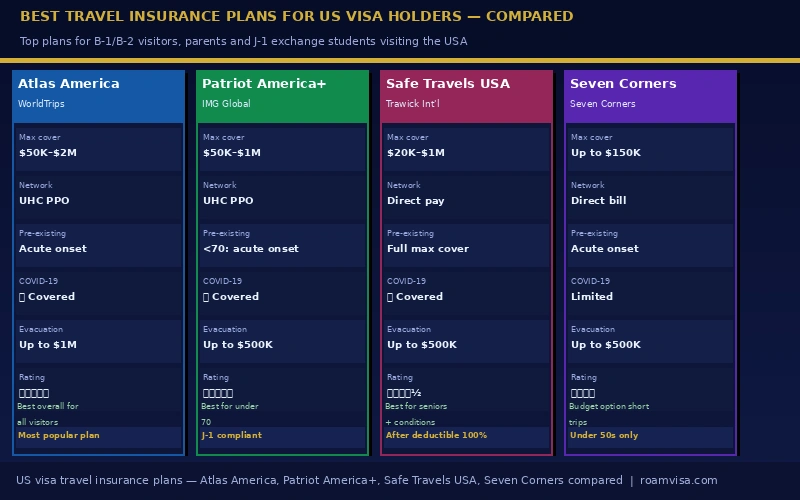
| Plan | Provider | Max Cover | Network | Pre-Existing | Evac | Best For |
|---|---|---|---|---|---|---|
| Atlas America | WorldTrips | $50K–$2M | UHC PPO | Acute onset | $1M | All visitors – best overall |
| Patriot America+ | IMG Global | $50K–$1M | UHC PPO | Acute onset <70 | $500K | Under 70, J-1 compliant |
| Safe Travels USA Comp. | Trawick Int’l | $20K–$1M | Direct pay | Full max – best | $500K | Seniors, pre-existing |
| Seven Corners USA | Seven Corners | Up to $150K | Direct bill | Acute onset | $500K | Budget, under 50, short trip |
| INF Elite | INF | $100K–$300K | Direct bill | Full coverage | Included | Pre-existing, all ages |
| Visitors Care | IMG Global | Fixed benefit | Any hospital | Not covered | Limited | Very short trip, low budget |
How Much Does Travel Insurance for a US Trip Actually Cost?
People frequently overestimate the cost of visitor insurance for the USA. For a healthy adult, it is genuinely inexpensive relative to the risk it covers. The main variables are your age, the coverage maximum you choose and the deductible level.
| Age | $100K Cover / 30 days | $500K Cover / 30 days | $1M Cover / 30 days | Notes |
|---|---|---|---|---|
| 20–29 | $28–$40 | $35–$52 | $45–$68 | Very low cost – no reason not to get $1M cover at this age |
| 30–39 | $35–$50 | $45–$65 | $58–$82 | Still very affordable – annual multi-trip makes sense for frequent travellers |
| 40–49 | $48–$68 | $62–$88 | $78–$112 | Mid-range – consider $500K minimum as medical complexity rises |
| 50–59 | $68–$92 | $88–$125 | $108–$158 | Premiums rising – pre-existing conditions affect price significantly now |
| 60–69 | $95–$142 | $125–$185 | $158–$238 | Use Safe Travels USA or AllClear – better pre-existing terms |
| 70–79 | $148–$225 | $190–$295 | $245–$385 | Limited plan options – Venbrook Premier, Safe Travels, INF best choices |
3 Ways to Reduce Your US Visitor Insurance Cost:
1. Higher deductible = lower premium: A $250 deductible vs $0 typically saves 15–25% on premium. Only choose this if you can genuinely afford the deductible amount out of pocket.
2. Match coverage to your actual trip length exactly: Do not over-buy. Most plans allow extension if your trip changes.
3. Buy before you depart: Some plans require purchase before departure. Waiting until you are in the USA limits options and may mean waiting periods before illness coverage activates.
What Travel Insurance Does NOT Cover for US Visitors
Knowing the exclusions is just as important as knowing the coverage – because a claim declined for a standard exclusion you did not know about is significantly worse than an expected gap you planned around.
❌ Standard Exclusions in US Visitor Insurance Plans
Pre-existing conditions (undeclared): Non-disclosure of a medical condition voids the claim related to it – and can void the entire policy in cases of serious non-disclosure. Always declare everything.
Routine and preventive care: Annual check-ups, routine vaccinations, dental check-ups and standard vision care are excluded. Only emergency treatment is covered.
Self-inflicted injuries: Intentional self-harm, injuries while under the influence of alcohol or drugs, or injuries from illegal activity.
High-risk activities (without rider): Skydiving, base jumping, mountain climbing, professional sport participation – excluded unless you add a sports rider.
Pregnancy and maternity (non-emergency): Planned delivery, elective caesarean and routine ante-natal care are excluded. Emergency complications of pregnancy are covered by most plans.
Travel against FCDO/State Dept advice: If your government has issued a Level 4 Do Not Travel advisory for your destination, your insurance is typically void.
Visa refusal: Most plans do not cover the cost of a denied visa as an insurable event.
Complete Checklist – What to Have When Visiting the USA
| Item | Legally Required? | Notes |
|---|---|---|
| Valid passport (6 months+ validity) | Yes | Must cover entire US stay and return |
| US visa (B-2, J-1, F-1 etc.) or ESTA | Yes | Apply minimum 3–4 weeks before travel |
| Return / onward flight ticket | CBP may ask | Strong evidence of intent to leave USA |
| Proof of accommodation | CBP may ask | Hotel booking or host address and contact |
| Financial evidence | CBP may ask | Bank statements, credit cards – ability to fund stay |
| Travel insurance certificate | No (B-2/ESTA) – Yes (J-1) | Carry on phone AND printed copy |
| Insurance emergency helpline number | Practical necessity | Saved in phone before you fly – not after |
| Prescription medicines with documentation | Yes – for customs | Original prescription labels, enough supply |
| GHIC / EHIC card | Not applicable (no US reciprocal) | GHIC only covers EU countries – not USA |
Frequently Asked Questions
Is travel insurance required to get a US B-2 tourist visa?
No. Travel insurance is not a document required by USCIS for a B-1 or B-2 visitor visa application. The US consulate will not reject your visa for not including it. However, a CBP officer at the US border has discretion to ask how you would fund medical treatment – particularly for older visitors – and having an insurance certificate with you is a simple and sensible precaution.
Is J-1 visa insurance mandatory?
Yes, absolutely and without exception. The US Department of State requires all J-1 exchange visitors to maintain health insurance throughout their programme that meets specific minimums: $100,000 medical coverage, $50,000 emergency evacuation and $25,000 repatriation with a maximum $500 deductible.
Can a CBP officer refuse me entry for not having travel insurance?
Not having travel insurance is not listed as a formal grounds for denial of entry. However, CBP officers have broad discretion in determining whether to admit visitors, and demonstrating that you cannot fund potential medical treatment can raise concerns about your self-sufficiency.
What is the minimum coverage I need for a US visa trip?
For a B-2 visitor visa, there is no legally mandated minimum – but the practical minimum given US healthcare costs is $100,000. For visitors over 50 or those with any health conditions, $500,000 is strongly recommended. For J-1 visa holders, the legal minimum is $100,000 medical coverage.
Does US travel insurance cover pre-existing conditions?
Most plans cover acute onset of pre-existing conditions – a sudden, unexpected medical emergency related to a condition you already have. Safe Travels USA Comprehensive by Trawick International covers acute onset up to the full policy maximum, which is the best available terms. INF Elite is the primary plan offering full pre-existing condition coverage.
When should I buy travel insurance for my US trip?
Before you leave your home country – and ideally as soon as you book your trip. Buying early means your cancellation cover activates immediately from purchase, protecting pre-paid costs if something prevents you from travelling. Some plans also have a waiting period after purchase before illness coverage begins, which is avoided if you buy before departure
Our Recommendation
The United States is genuinely different from most destinations when it comes to medical risk. The gap between what the average visitor expects to pay for healthcare and what US hospitals actually charge is enormous – and unlike most countries, there is no safety net of public healthcare to fall back on. Every medical expense, from a $300 GP visit to a $150,000 air evacuation, falls entirely on an uninsured visitor. If you are visiting on a B-2 tourist visa, buy Atlas America or Patriot America Plus before you fly. Choose at least $500,000 in coverage – more if you are over 50. If you have a declared pre-existing condition, go straight to Safe Travels USA Comprehensive for the best pre-existing terms in the market. If you are on a J-1 visa, get Patriot Exchange Program and make sure it is active before your programme begins.
For parents visiting their children in the USA – a large and growing category of B-2 visitors – this matters more than for any other group. Older visitors have higher medical risk, the distances involved make evacuation costs particularly high, and the emotional and financial burden of an uninsured medical emergency on both the visitor and their US-based family is significant. The cost of a good senior policy for a one-month visit is approximately $100–$180. The cost of a week in a US ICU without insurance is $70,000. The arithmetic is straightforward.


