UK Visa Rejected? 10 Common Refusal Reasons and How to Avoid Them

A UK visa rejection can be frustrating, but understanding the refusal reason is the first step toward a successful reapplication. This guide explains the most common UK visa refusal reasons, including insufficient financial evidence, missing documents, unclear travel plans, and inconsistencies in your application. Learn how to fix each issue, interpret your refusal letter, and improve your chances of UK visa approval in 2026.

The UK Home Office processed over 3 million Visa Applications in 2024, and refusal rates for visitor visas from certain nationalities run as high as 15–20%. That means thousands of people every year face the same situation you might be in right now. The ones who succeed on their second attempt are almost always the ones who did not rush back in with the same documents – they read their refusal letter properly, identified exactly what the caseworker was unhappy with, fixed it, and resubmitted something significantly stronger.
This guide is written to help you do exactly that. We cover every common UK visa rejection reason in plain language, explain what each one actually means, and tell you specifically what to do to fix it. We also explain your three options after refusal – reapply, request an administrative review, or appeal – so you can choose the right path for your situation.
UK Visa Refusal – What You Need to Know First
A refusal is NOT A Ban: You can reapply – there is no mandatory waiting period for most visa types
Read Your Refusal Letter First: It tells you exactly why – address every single point before reapplying
Three Options Exist: Reapply (most common), Administrative Review, or Appeal to the tribunal.
Rushing = second refusal: Reapplying with the same weak evidence almost always fails again
Refusal Rejection: ‘Refused’ means the caseworker assessed your case; ‘rejected’ means an invalid application
Deception Is Serious: False information can ban you from UK visas for up to 10 years
Appeal Deadlines Matter: 14 days if in the UK, 28 days if outside the UK – do not miss them
Complex Cases Need A Lawyer: Multiple refusals, criminal records, family visa refusals benefit from professional help
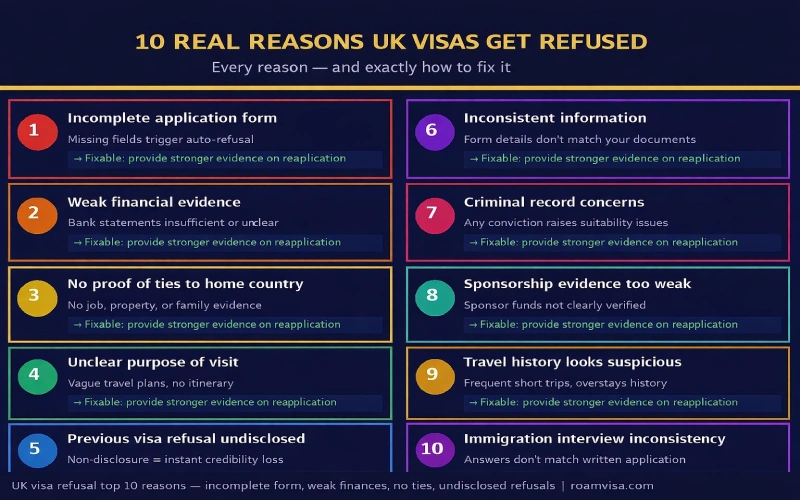
The 10 Real Reasons UK Visas Get Refused – And How to Fix Each One
1. Incomplete or Incorrectly Filled Application Form
This is the most straightforward and most avoidable reason on the list. If you leave sections blank, enter inconsistent dates, or your personal details do not match your passport exactly, the caseworker may refuse the application outright or return it as invalid before it is even assessed. It sounds obvious, but application errors account for a significant proportion of early-stage refusals – particularly among first-time applicants who complete the form quickly without double-checking.
The fix is simple: go through every section of the form again, compare your name, date of birth, passport number, and travel history against your actual documents, and ensure nothing is left blank that should be completed. Small inconsistencies – a missing middle name, a date in the wrong format, an old address entered incorrectly – can undermine an otherwise strong application.
2. Insufficient Financial Evidence
Financial evidence failures are the single most common substantive refusal reason for UK visitor visas. The Home Office needs to be satisfied that you can afford your trip without needing to work illegally or rely on public funds. When your bank statements tell a story that does not add up – a balance that just about covers the trip, a large unexplained deposit right before the application, income that does not match what your pay slips show, or statements covering only a single month – a caseworker will refuse on financial grounds.
What officers are actually looking for is not just a number in your account – they want to see a pattern. Consistent credits matching your stated income. A balance that has been maintained steadily, not manufactured. A realistic ability to fund travel, accommodation and daily expenses for the duration of your intended stay. They can spot sudden deposits for what they often are, so do not park borrowed funds in your account the week before applying.
- Provide 6 months of bank statements – not just the most recent month. Make sure the statements are stamped or certified where applicable.
- Include salary slips for the last 3 months showing regular credits that match your bank statement. If self-employed, include business bank statements, tax returns (ITR/VAT), and invoices.
- Add an employer letter confirming your position, salary, length of employment, and that your leave has been approved.
- The balance you show should comfortably cover your entire trip – accommodation, flights, spending money, and a reasonable buffer.
3. Weak Proof of Ties to Your Home Country
When a UK visa officer reads your application, one of the core questions they are asking is: will this person come back? If your application does not convincingly answer that question, refusal follows. This is not about doubting you personally – it is about the officer following their instructions to be satisfied that you have sufficient reason to return home after your visit.
Ties to your home country come in many forms: employment (the most powerful), property ownership, ongoing business interests, family responsibilities, enrolled education. If you are between jobs, recently graduated, have few assets, and have no immediate family commitments at home, your application needs to work harder in other areas to compensate. A well-written supporting statement explaining your circumstances honestly often makes the difference here.
- Employment Letter: your strongest tie. Confirms you have a job to return to, leave approved for specific dates, and a salary that means you are not financially motivated to overstay.
- Property Documents: mortgage statements, rental agreements, or property ownership papers show a concrete reason to return.
- Family Ties: A marriage certificate, children’s birth certificates, or a letter from a dependent relative can all establish home country connections.
- Ongoing Education: University or college enrollment letters showing you are mid-course and must return to complete your studies.
4. Vague or Unclear Purpose of Visit
A visitor visa application needs to tell a coherent, believable story about why you are going to the UK, what you will do there, where you will stay, and when you are coming back. When applications contain nothing more than ‘tourism’ with no supporting detail, or when the stated purpose does not match the documents submitted, the caseworker doubts the genuine nature of the visit.
- Write a brief supporting statement (one page is ideal) explaining your trip: the specific purpose, the places you want to visit or the people you want to see, the dates, and your travel and accommodation arrangements.
- Attach a basic itinerary – it does not need to be hour-by-hour, but showing you have thought about what you will do and where you will stay makes the visit look genuine and planned.
- If visiting friends or family: include a letter from your host, their UK visa or residence status documentation, and evidence of your relationship (photos, correspondence, and travel history together).
5. Previous Visa Refusals Not Disclosed
One of the most damaging things you can do in a visa application is fail to disclose a previous refusal – from any country. The UK application form asks directly about previous refusals, and if you say ‘no’ when the answer is ‘yes,’ you have introduced deception into your application. Home Office systems are increasingly connected to international databases, and a refusal you did not mention is often found anyway.
Always disclose. A previous refusal that you explain clearly and honestly – showing that circumstances have changed, that the reason for that refusal has been addressed, or that the refusal was in a different context entirely – is much less damaging than an undisclosed refusal discovered by the caseworker. Deception findings can lead to a reapplication ban of up to 10 years.
6. Inconsistencies Between Your Form and Supporting Documents
Caseworkers are specifically trained to spot inconsistencies, and they find them more often than applicants expect. If your application form says your salary is £3,000 per month but your payslips show £2,200, that discrepancy raises a flag. If your stated address does not match your utility bills, if the dates of your employment do not match your letter, or if your travel history entry contradicts your passport stamps – each inconsistency chips away at your credibility.
- Go through your entire application package and cross-reference every piece of information. Name, date of birth, address, employment dates, salary, travel history – every detail should be consistent across every document.
- If there is a genuine discrepancy (for example, you recently changed your address or recently received a pay raise), explain it clearly in a cover letter rather than leaving the officer to draw their own conclusion.
7. Criminal Record or Character Concerns
The UK Immigration Rules contain detailed provisions on character and criminal history under Part 9. If you have a criminal conviction – in the UK or in any other country – it must be disclosed. Whether it leads to refusal depends on the nature of the offense, the sentence received, and how long ago it occurred. A 12-month or longer custodial sentence results in mandatory refusal. Shorter sentences may lead to discretionary refusal depending on circumstances.
Even where discretion exists, a well-presented case that honestly acknowledges the conviction, explains the context, and demonstrates rehabilitation gives the caseworker something to work with. Hiding a conviction does not – and given that background checks are thorough, attempting concealment almost always makes things worse.
8. Sponsorship Evidence Is Weak or Unverifiable
If someone in the UK is sponsoring your visit – paying for your flights and accommodation, hosting you in their home – the evidence of that sponsorship needs to be clear, specific, and verifiable. A vague letter saying ‘I will look after my friend’ without supporting financial documentation is not sufficient. The officer needs to see that your sponsor has the funds to support you, that they have a legitimate connection to you, and that the arrangement is genuine.
- Sponsor letter: should clearly state who they are, their relationship to you, exactly what costs they will cover, for which dates, and their contact details. It should be signed and dated.
- Sponsor’s bank statements: 6 months showing sufficient, consistent funds to support your visit on top of their own living costs.
- Sponsor’s UK status: copy of their British passport, indefinite leave to remain document, or current visa showing they have legal permission to be in the UK.
- Relationship proof: photos together, correspondence history, birth certificates for family relationships – anything that establishes the connection is genuine.
9. Suspicious or Problematic Travel History
Your passport’s travel history tells the officer a story. Frequent short trips to the same countries, previous overstays (in the UK or anywhere else), a gap between your passport issue date and your first stamp suggesting you have another passport, or a travel pattern that suggests economic migration rather than tourism all raise scrutiny. This is not about penalizing normal travel – it is about pattern recognition.
If your travel history looks unusual for reasons you can explain – work travel, family visits, study abroad programs address it proactively in a supporting statement rather than leaving it unexplained. An unexplained pattern invites the worst interpretation. A clearly explained one does not.
10. Inconsistency Between Interview Responses and Written Application
For some visa categories and nationalities, the Home Office or UK visa application centres may conduct an interview. When what you say in an interview does not match what your application states – different dates, different accommodation arrangements, a different purpose for the visit – that inconsistency is treated as a credibility issue, which can result in refusal even where the underlying application is technically complete.
Before any interview, re-read your application and supporting documents thoroughly. You should be able to answer questions about the details of your application without hesitation. Inconsistencies arise most often when an agent prepared the application without the applicant fully understanding its contents.
After Your UK Visa Is Refused – Your Three Options
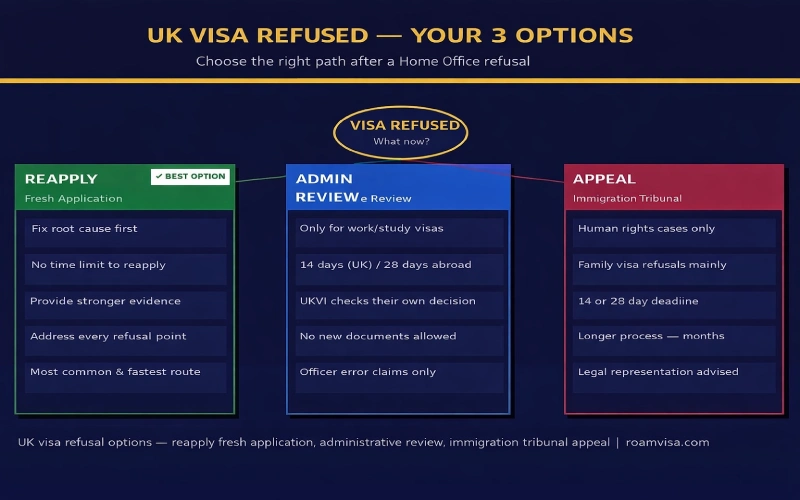
Once you have received a refusal, the first thing to do is read the decision letter carefully – line by line. It tells you why you were refused, and it tells you which options are available to you. Most people have at least one of the following three paths:
| Option | Who It Is For | Time Limit | Allows New Documents? | Typical Timeline |
|---|---|---|---|---|
| Fresh Application (Reapply) | Almost everyone – most common route after refusal | No mandatory waiting period | Yes – provide stronger evidence | 2–12 weeks depending on visa type |
| Administrative Review (AR) | Work and study visa refusals only – if Home Office made an error | 14 days (in UK) / 28 days (abroad) | No – reviews existing decision only | 8–12 weeks for AR decision |
| Immigration Tribunal Appeal | Human rights / family visa cases – if refusal breaches rights | 14 days (in UK) / 28 days (abroad) | Yes – new evidence presented | Several months – can be over a year |
Related Articles: US Visa Dropbox Eligibility – Who Qualifies and How It Works
Which option should you choose?
For most tourist and visitor visa refusals: Reapply with a stronger, corrected application. It is faster, cheaper, and most likely to succeed if you address the actual refusal reasons.
For work or student visa refusals where you believe the officer made an error, request an administrative review. Note – AR reviews the existing decision and does not allow new documents, so it works for procedural errors, not evidence gaps.
For family visa refusals involving human rights (right to family life): Consider an appeal. Get legal advice first – appeals are complex, and the deadlines are strict.
How to Reapply After UK Visa Refusal – Step by Step
UK Visa Reapplication – 6-Step Process
STEP 1: Read your refusal letter line by line. Highlight every reason given. Do not skim it. Each reason is a specific gap that your next application must close.
STEP 2: Map each refusal reason to a concrete fix. Financial evidence weak → 6 months of bank statements + salary slips. No ties shown → employment letter + property documents. Purpose unclear → travel itinerary + supporting statement. Work through them all.
STEP 3: Gather stronger, more complete documents. Everything must be more thorough than last time. Certified where required. Translations were needed (certified English translations for all non-English documents). Consistent across all supporting evidence.
STEP 4: Write a clear covering letter. Address each refusal reason directly. Explain what has changed, what additional evidence you are providing, and why you now meet the requirements. Keep it factual, clear, and focused. One page is ideal.
STEP 5: Double-check every detail before submission. Name, date of birth, passport number, travel history – cross-reference everything. One inconsistency on a reapplication after a refusal carries more weight than it would on a first application.
STEP 6: Submit and respond promptly to any requests. If the Home Office requests additional documents or an interview after submission, respond quickly. Delays extend processing time and can complicate your case unnecessarily.
Documents Checklist for a Strong UK Visitor Visa Application
| Document | What It Must Show | Common Error |
|---|---|---|
| Passport | Valid for entire trip + return, at least 2 blank pages | Using a passport with less than 6 months’ validity from travel date |
| Passport photo | White background, recent, neutral expression, meets UK specs | Photo older than 6 months, shadows, wrong size or background |
| Bank statements | 6 months, consistent income pattern, sufficient balance | Only providing 1–2 months, or statements showing large unexplained deposits |
| Payslips | 3 months, matching bank credits, employer name and address | Payslips that don’t match bank statement income entries |
| Employment letter | Confirms role, salary, permanent/contract status, leave approved | Generic letter without leave approval dates or clear return expectation |
| Travel itinerary | Outline of trip: flights, hotel, activities, return date | No itinerary at all, or a vague one-line ‘tourism’ statement |
| Hotel / accommodation | Confirmed booking in your name with dates and confirmation ref | Tentative search results rather than actual confirmed bookings |
| Return / onward flight | Confirmed ticket with your name, dates and booking reference | One-way ticket only – suggests no intent to return |
| Previous refusal declaration | Honest disclosure with explanation if applicable | Leaving previous refusals undisclosed – treated as deception |
| Sponsor letter (if applicable) | Specific support details, relationship proof, sponsor’s UK status, their bank statements | Vague letter without financial proof or UK status documentation |
Frequently Asked Questions
Can I reapply for a UK visa straight away after a refusal?
Yes. There is no mandatory waiting period for most UK visitor visa refusals. You can reapply immediately – but do not. Take the time you need to properly address every refusal reason first. A rushed reapplication with the same weak evidence almost always results in a second refusal.
Does a UK visa refusal affect future applications?
Yes, to a degree. You must disclose previous refusals on all future UK visa applications. A single refusal that you honestly address and correct does not necessarily harm your next application. Multiple refusals without clear improvement, or any finding of deception, will make future applications significantly harder.
What is an administrative review, and when can I request one?
An Administrative Review (AR) is a request for the Home Office to check whether an error was made in deciding your application. It is only available for specific visa types – mainly work and study visas – and it reviews the existing decision using existing documents. You cannot submit new evidence.
Can I appeal a UK visa refusal?
Appeals to the Immigration Tribunal are only available in limited circumstances – mainly where the refusal engages human rights, such as a family visa refused on the basis of the right to family life. Most tourist visitor visa refusals do not carry a right of appeal. Your refusal letter will state clearly whether you have a right of appeal and the deadline for submitting it.
Do I need a lawyer to reapply after a UK visa refusal?
Not always. For a first refusal caused by clear documentary issues – weak finances, missing documents, no itinerary – a well-prepared self-application addressing those specific points can succeed without legal help.
What should I put in a covering letter when reapplying?
Address each refusal reason directly and specifically. State what evidence you are now providing to satisfy that concern. Explain any changed circumstances (new job, improved financial position, clearer travel purpose).
Final Thoughts
A UK visa refusal is genuinely disappointing – especially when you had real, legitimate plans. But it is worth keeping a clear head about what it actually is: feedback. The Home Office has told you exactly what was missing or unclear in your application. That is information you did not have before, and it makes your next application easier to get right.
Most people who succeed on their second UK visa application do so because they took the refusal letter seriously, worked through each point methodically, and submitted something genuinely stronger. They did not just add more documents randomly – they fixed the specific things the officer identified. That is the approach this guide is built around, and it is the one most likely to get you to the UK on your next attempt.