Australia Tourist Visa 2026: The eTA Confusion and How Indians Actually Apply Online

Let’s clear something up before anything else, because it’s the single most common mix-up we hear from Indian travelers planning an Australia trip. A lot of people search for “Australia eTA” expecting a quick app-based approval like they might get for a country in Europe or Southeast Asia. They read a blog somewhere that mentions a $20 fee and a decision in minutes, get excited, download an app, and then hit a wall, because that app won’t even let them start an application with an Indian passport. It’s not a bug. It’s not a temporary glitch. Indian citizens simply aren’t on the list of passports eligible for Australia’s Electronic Travel Authority, and no amount of retrying is going to change that.
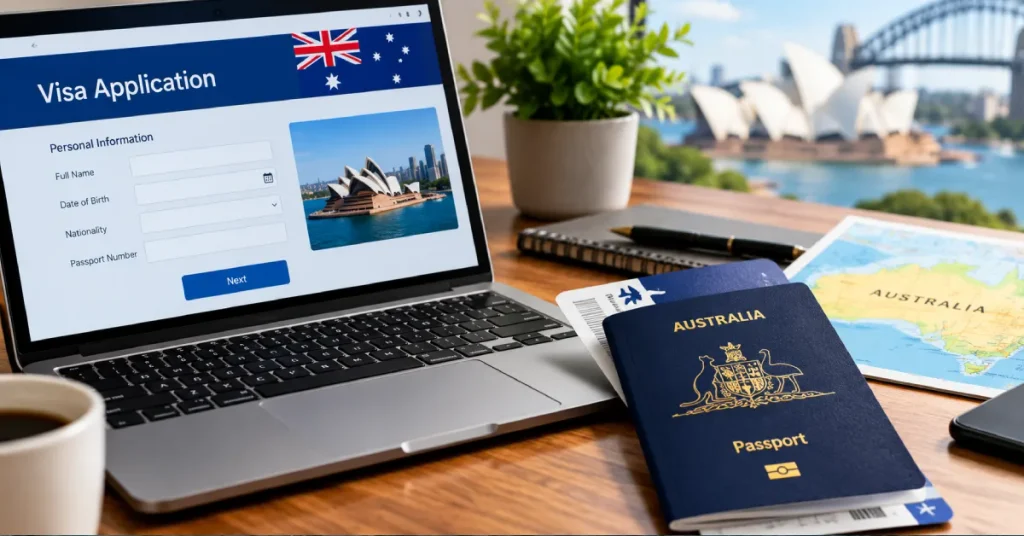
So if that’s where you’ve landed after a bit of searching, first, don’t panic, and second, this article is written specifically to sort out the confusion and walk you through what actually applies to you. The real visa, the one every Indian tourist ends up using, is called the Visitor visa, Subclass 600, Tourist stream. It’s a proper online application, not an instant app tap, and it’s genuinely not that complicated once you know the steps in the right order. That’s what the rest of this guide covers.
Wait, So What Exactly Is The eTA, And Why Doesn’t It Apply To Me?
The Electronic Travel Authority, or ETA (Subclass 601), is Australia’s fast-track entry option. If your passport qualifies, the process really is as simple as its reputation suggests: you download the official Australian ETA app, fill in a short form, pay a AUD 20 service charge, and in most cases get a decision within minutes. It’s linked electronically to your passport, valid for 12 months, and lets you visit as often as you like during that window, staying up to three months each time.
The catch is eligibility. As of 2026, the ETA is open to roughly 34 passports and territories, a list dominated by the US, Canada, Japan, South Korea, Singapore, Hong Kong, Brunei, and most of Western Europe. There’s a separate, similarly instant option called the eVisitor (Subclass 651) for the European Union and a handful of other passports, which works almost identically but doesn’t even charge a fee. Neither list includes India. It isn’t about citizenship or where you currently live, it’s purely about the passport in your hand, and an Indian passport puts you outside both of these streamlined categories.
What this means practically: you’re not missing a trick or applying the hard way by mistake. You’re simply in the category that every Indian traveler falls into, along with citizens of most of the world’s countries. The visa you need is the Subclass 600, and it’s a real, standard visa application, not a downgrade or a workaround.
The Visa You Actually Need: Visitor Visa, Subclass 600, Tourist Stream
The Subclass 600 is Australia’s standard visitor visa, and the Tourist stream within it is exactly what it sounds like, built for holidays, sightseeing, and visiting friends or family. There’s a separate business visitor stream for short trips involving meetings, conferences, or negotiations, and it matters which one you pick. Applying under the wrong stream, using Tourist when your actual purpose is business, or the reverse, is one of the more common and entirely avoidable reasons applications get delayed or refused. If in doubt about which stream fits your trip, it’s worth a few minutes’ thought before you start filling in the form rather than after.
A few basics worth knowing upfront. The visa is generally granted for stays of three, six, or occasionally twelve months, though the specific length you’re approved for is decided case by case, based on your circumstances and what you’ve asked for, not automatically maxed out. It doesn’t allow paid work in Australia under any circumstances; that’s a different visa category entirely, and it’s assessed entirely online through a government portal called ImmiAccount. There’s no in-person embassy interview requirement the way there is for, say, a US tourist visa, which is honestly one of the more traveler-friendly aspects of the whole process. You do everything, application, document upload, fee payment, and status tracking, from one account.
Setting Up ImmiAccount And Actually Filling In The Form
Here’s where the process starts in practice, and it’s less intimidating than it sounds once you’re in front of the screen.
First, you create an ImmiAccount at the Department of Home Affairs’ official site. Use a personal email address you actually check regularly, not a work address you might lose access to, because every update on your application, requests for more documents, decisions, everything, comes through that inbox. Once the account is set up, you select the Visitor visa (Subclass 600) and choose the Tourist stream, then indicate that you’re applying from outside Australia, which will be true for essentially every Indian applicant applying for their first trip.
From there it’s a form, admittedly a fairly long one, asking for personal details, passport information, travel history, and the specifics of your planned trip, dates, purpose, and where you’ll be staying. A genuinely useful thing to know here: you don’t have to finish it in one sitting. The system lets you save progress and come back, which matters because gathering everything correctly the first time, rather than rushing through it, tends to be the difference between a clean application and one that gets flagged for missing information.
Once the form is complete, you upload your supporting documents directly into the same portal, pay the application fee by card, and submit. After that, the application sits with a case officer, and depending on your situation, you might also be asked to attend a biometrics appointment.
The Document Checklist That Actually Matters
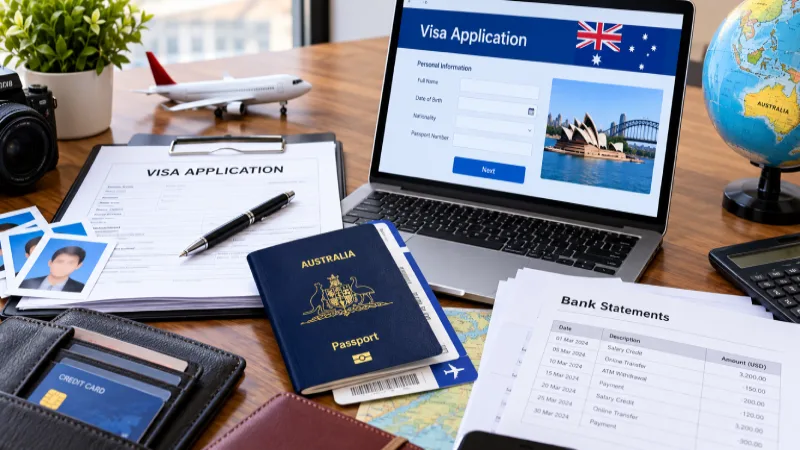
This is the part where a lot of applications either sail through or run into trouble, and it’s worth treating seriously rather than assembling at the last minute.
Your passport. It needs to stay valid well beyond your planned return date, and you’ll upload a clear scan of the bio page.
A recent passport-style photograph, meeting the standard Australian specifications, 45 mm by 35 mm, with a plain white background, taken within the last six months, with the face fully visible with no shadows across it.
Proof of funds. This is one area where people either over-worry or under-prepare, and both are worth avoiding. There’s no fixed minimum bank balance the department publishes; applications are assessed on whether your funds look sufficient, lawful, and consistent with the trip you’re describing, not against some magic number. What actually helps is showing your last three to six months of bank statements with a stable, explainable balance. A sudden large deposit right before you apply, with no clear source, tends to raise more questions than it answers, so if you’re topping up an account for the trip, doing it early and with a paper trail is the smarter move.
Evidence of your ties to India. This one surprises first-time applicants the most, because it feels indirect, but it’s genuinely central to how the application gets assessed. The case officer isn’t just checking whether you can afford the trip; they’re weighing whether you’re likely to return home afterward. Stable employment with a letter from your employer confirming your role, salary, and approved leave dates; property ownership; family responsibilities; and an ongoing course of study, all of this builds the picture. If you’re self-employed, business registration documents and recent income evidence serve a similar purpose.
Your travel itinerary. Flight intentions (you generally don’t need to have paid for tickets yet, but a clear plan helps), accommodation bookings or at least a realistic plan for where you’ll stay, and a short cover letter explaining the purpose of the trip and its duration. This last part is one of the easiest things to get right and one of the easiest to skip; don’t skip it. A specific, dated itinerary reads far better to a case officer than a vague “I want to see Australia.”
If a relative in Australia is hosting or funding part of your trip, you’ll also need a sponsorship letter along with their own financial documents, and if it’s a first visit to family, an invitation letter helps tie the whole story together.
None of these documents are complicated to gather individually. What trips people up is treating the checklist as a formality rather than as the actual case being made to a stranger who’s never met you and has to decide, from paper alone, whether you’re a genuine short-term visitor.
What It Costs In 2026
The Department of Home Affairs revised its visitor visa charges on 1 July 2026, so if you’ve seen older figures floating around, that’s likely why they don’t match what you’re seeing now. As things stand, the Tourist stream base charge is AUD 250 per applicant when applying from outside Australia, which covers the vast majority of Indian applicants. If you’re already in Australia on another visa and applying to extend as a visitor, the onshore charge is considerably higher, AUD 630.
Every applicant on the trip pays their own share; there’s no family bundle discount, so a couple applying together is looking at AUD 500 between them, plus a small card surcharge, typically around 1.4%, depending on how you pay. And one thing worth knowing before you hit submit: this fee is non-refundable, whether your visa is granted or refused, so getting the application right the first time isn’t just about avoiding delay; it’s about not paying twice. Beyond the base fee, budget a little extra for room for biometrics if you’re asked to attend an appointment, and for a medical exam if one is requested, which happens in some cases depending on your travel history and planned length of stay, typically costing somewhere between AUD 200 and 400 if it applies to you.
How Long It Actually Takes
This is the question we get asked most, and the honest answer is that it varies more than most people expect. Processing times depend on how complete your application is, whether the case officer needs to come back to you for anything, and general volume at the time you apply. There isn’t a fixed number of days the department guarantees, and treating any specific figure you find online as a promise rather than a rough average is the safer approach.
What tends to hold true in practice: a clean, complete application with strong, consistent documentation moves noticeably faster than one that leaves the case officer with questions. Every round of “please provide additional information” adds real time to the process, sometimes weeks, so the effort you put into the document stage upfront isn’t just about approval odds, it’s about not sitting in limbo waiting on a response you could have avoided needing in the first place.
Given that uncertainty, the practical advice is simple and a little unglamorous, apply as early as you reasonably can. Don’t book non-refundable flights or make firm plans around a visa that hasn’t been granted yet, but do start the application process well ahead of your intended travel dates rather than in the weeks right before. A month or two of buffer has saved more than a few travellers from a stressful last-minute scramble.
Where Applications Tend To Go Wrong
A handful of patterns come up again and again in refused or delayed applications, and knowing them in advance is genuinely useful.
Picking the wrong stream, tourist versus business, is one, already mentioned above but worth repeating because it’s such an easy mistake to make without realising it. Weak or unclear financial evidence is another, not necessarily insufficient funds, but funds that are hard to explain or inconsistent with the applicant’s stated income. Vague travel plans are a third, just want to see Australia doesn’t give a case officer much to assess against, whereas a dated, specific itinerary does. And a genuinely important one, any past immigration violation, an overstay on a previous visa anywhere, tends to make approval significantly harder, and it’s not something worth glossing over or hoping goes unnoticed, since the application does ask about travel and visa history directly. None of these are exotic pitfalls. They’re mostly about care and completeness rather than anything mysterious about how Australia’s immigration system works.
What Happens After You Hit Submit
Once your application is lodged, it sits in a queue for assessment, and this is the part where patience genuinely matters more than anything else you can actively do. You’ll be able to log back into ImmiAccount at any point and check the status, which usually just says something fairly unhelpful like “application received” for a good stretch of the wait. That’s normal, and refreshing it daily won’t make it move any faster.
If the case officer needs something more from you, a clearer bank statement, an updated employer letter, anything, you’ll get a request through your ImmiAccount and the email tied to it, usually with a deadline to respond. This is worth checking your inbox and spam folder for regularly during the wait, because missing that window can stall or even jeopardise the application in a way that’s entirely avoidable. If biometrics are required, you’ll receive a letter with instructions to book an appointment, generally at a nearby visa application centre, and this step needs to be completed before a final decision is made.
Australia Couples Holiday 2026: Best Places, Costs And A Realistic Itinerary
When a decision comes through, it arrives by email, either a grant notice, which includes the conditions of your visa, how long you can stay, whether multiple entries are allowed, and any conditions attached, or, less happily, a refusal with the reasons behind it. Reading the grant notice properly matters more than people expect, since misunderstanding your stay length or entry conditions is an easy way to accidentally overstay without meaning to.
A Quick Word On The eVisitor, Since It Comes Up Too
While we’re clearing up confusion, it’s worth mentioning the eVisitor (Subclass 651) as well, since it sometimes gets mixed up with the ETA in the same searches. It works almost identically to the ETA, free, fast, app-based, but it’s reserved for European Union and a small number of other eligible passports. Like the ETA, it simply isn’t available to Indian citizens, so if you come across it while researching, know that it’s the same story, a faster lane that exists, just not one this passport can use. The Subclass 600 remains the only route in for Indian tourists, and honestly, once you’ve been through the process once, it stops feeling like the inconvenient option and starts feeling like just… the process.
Frequently Asked Questions
Can Indian citizens apply for the Australia ETA?
No. The ETA (Subclass 601) is limited to around 34 eligible passports, mostly the US, Canada, Japan, South Korea, and much of Western Europe. India isn’t on that list, and Indian travellers need to apply for the Visitor visa (Subclass 600) instead.
Is the Subclass 600 application fully online?
Yes. The entire process, form, document upload, payment, and tracking, happens through the Department of Home Affairs’ ImmiAccount portal. There’s no requirement to submit a paper application or attend an embassy interview, though a biometrics appointment may be requested separately.
How much does the Australia tourist visa cost for Indians in 2026?
The Tourist stream base charge is AUD 250 per applicant when applying from outside Australia, following the fee update that took effect on 1 July 2026. This is a non-refundable government charge, separate from any biometrics or medical exam costs that might apply.
Is there a minimum bank balance required?
There’s no fixed number published by the Department. What matters is that your funds look sufficient for the trip you’re describing and consistent with your income, generally shown through three to six months of bank statements.
How long does the visa take to process?
There’s no guaranteed timeline, it depends on application completeness and current volume. A well-prepared, complete application with clear documentation tends to move faster than one that prompts follow-up questions from the case officer, which is the biggest single factor within your control.
Can I apply through a travel agent instead of doing it myself?
Yes, plenty of Indian applicants use a registered migration agent or visa consultant, particularly for more complex situations. But there’s nothing in the process that requires it, the ImmiAccount system is built for individual applicants to use directly, and a well-organised applicant can absolutely complete this without paid assistance.
Final Thoughts
If you started out searching for an Australia eTA and ended up here, the short version is this, you’re not doing anything wrong, you were just looking for a shortcut that this particular passport doesn’t have access to. The Subclass 600 isn’t a lesser or more difficult path, it’s simply the standard one, and it works perfectly well once you treat the document stage with the attention it deserves rather than rushing it the night before you plan to submit. Get your financial and ties-to-home documentation solid, pick the right stream, apply with enough runway before your trip, and this becomes a fairly routine piece of pre-travel admin rather than the ordeal it can feel like from the outside looking in.