
Wild Animal Safaris in Europe – Bears, Wolves and Lynx Watching

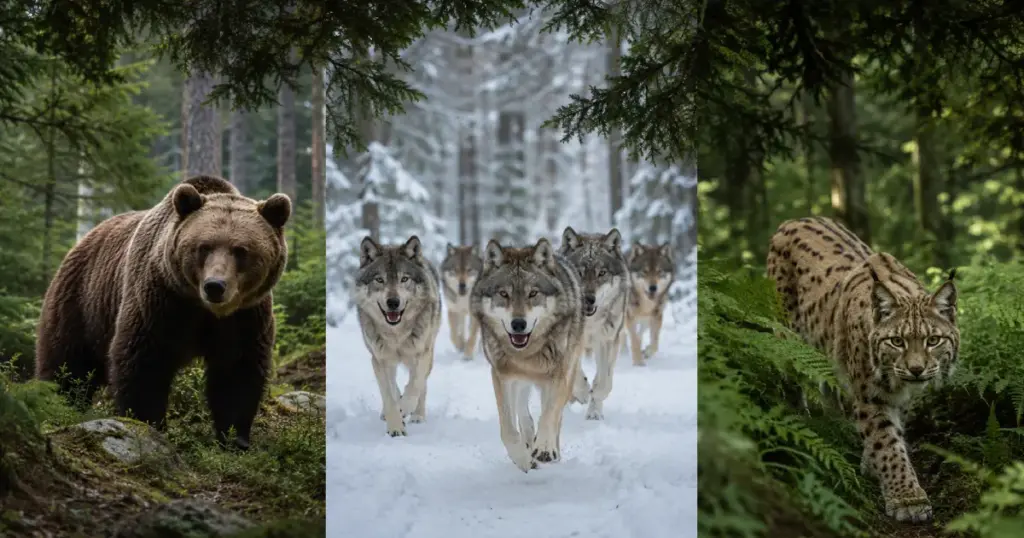
Europe has a wild animal safari scene that most travellers – including many Europeans – do not realize exists. The continent holds substantial populations of large carnivores and herbivores that rival or exceed what you find in equivalent North American or Asian wilderness. Romania alone has roughly 6,000 brown bears – more than the entire lower 48 US states combined. Poland’s Białowieża Forest hosts Europe’s largest European bison herd and significant wolf populations. Germany’s Bavarian Forest National Park is the European Lynx capital. Finland, Slovenia, Slovakia, and parts of Italy and Spain round out the list of countries delivering genuine wild wildlife experiences.
For Indian tourists with multiple Europe visits already under their belt (London, Paris, Amsterdam, and Rome) or travelers looking for something substantially different from city-focused European tourism, these wildlife safaris deliver unexpected dimensions. This guide covers the top European wild animal safari destinations with honest assessments of what each delivers, which operators run the best experiences, the realistic success rates for spotting the headline species, and practical logistics for Indian travelers. Research was cross-referenced from the European Wildlife Foundation, Carpathian Wildlife Expeditions, Bear Camp Transylvania, Białowieża National Park, Bavarian Forest National Park, the Slovenian Forest Institute, and wildlife photography hide operators across Romania, Poland, Finland, and Slovenia.
Quick Facts – Europe Wild Animal Safaris
✓ Europe has 17,000+ brown bears, 17,000+ wolves and 9,000+ lynx in wild populations
✓ Romanian Carpathians hold Europe’s largest brown bear population – 6,000+ bears
✓ Polish Białowieża Forest is Europe’s best wolf-watching destination
✓ Bavarian Forest National Park (Germany) is prime European lynx territory
✓ Best brown bear watching: April-October | wolves year-round | lynx May-September
✓ Typical guided wildlife safari: 500 to 2,500 EUR per person for 3-7 day package
✓ Wildlife hides (photography hides) deliver 80-95 percent success rates versus 20-40 percent self-drive
Brown Bear Watching – Romania’s Carpathian Mountains
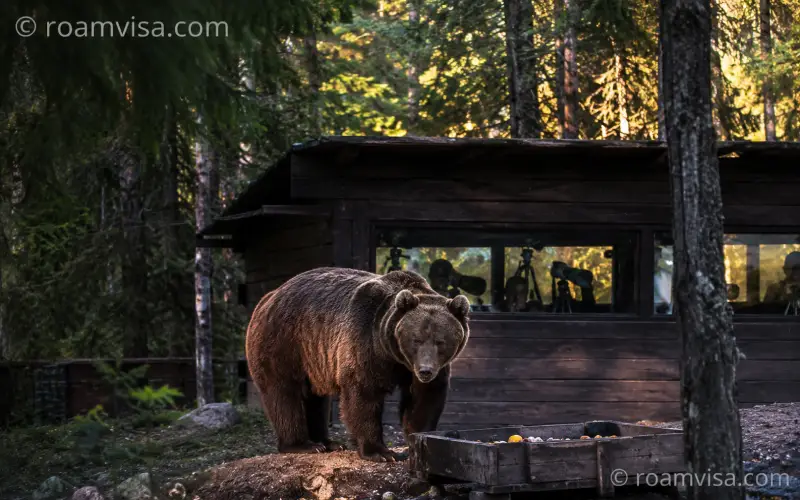
Romania’s Carpathian Mountains hold Europe’s largest brown bear population – approximately 6,000 bears, representing 60 percent of the EU total. The best bear-watching happens in the Transylvania region’s forests, particularly around Brașov, Zarnesti, and the Piatra Craiului National Park. Professional wildlife operators run guided hide-based bear watching, where you spend 4-8 hours in purpose-built observation hides with one-way glass while bears come to feeding stations at dusk. Success rates at established hides reach 80-95 percent during the April-October season.
Top operators include Carpathian Wildlife Expeditions, Bear Camp Transylvania, and Libearty Bear Sanctuary (which does rescue and conservation rather than wild watching). Typical full-day hide experiences cost 80-200 EUR per person; multi-day packages with accommodation cost 500-1,500 EUR. The best season is May through September when bears are most active before hibernation. Peak months are July-August. The experience is the most accessible wild bear viewing in Europe – significantly easier and cheaper than equivalent North American brown bear tours in Alaska or British Columbia.
Realistic expectations: at professional hides, you will almost certainly see 2-6 bears during a 4-6 hour evening session. Photography is excellent through the one-way glass. The rides are comfortable with seating, restrooms, and a quiet atmosphere. Hiking-based bear watching without hides has significantly lower success rates (20-40 percent) and is not recommended for photography. Budget 1-2 hide sessions for a proper bear-watching trip, combined with Transylvanian culture (Bran Castle, Brașov old town, Sighișoara) for a complete 4-5 day trip.
Wolf Watching – Poland’s Białowieża Forest
Białowieża Forest on the Poland-Belarus border is Europe’s last primeval forest and holds a thriving wolf population alongside the continent’s largest European bison herd. About 25 wolf packs live within the Polish side of the forest, with a total wolf population of around 100-150 individuals. The forest itself covers 1,500 square kilometers of ancient woodland – forest that has been continuously forested since the last ice age. This makes it fundamentally different from managed European forests: mossy old-growth trees, fallen logs decaying in place, and understory flora that exists nowhere else on the continent.
Wolf watching in Białowieża is challenging but genuinely rewarding for committed wildlife enthusiasts. Wolves here are wild and wary – success rates are lower than Yellowstone’s highly studied packs. Professional wildlife guides (Natourist, Białowieża Wildlife, Bison Safari Poland) track pack movements and lead 2-7 day expeditions with early morning and evening trail walks, spotlighting sessions, and specialised audio playback (ethically used). Typical 4-day wolf tracking packages cost 800-1,800 EUR per person. Success rates for wolf sightings: 40-70 percent depending on season, weather, and guide skill.
The bonus experience at Białowieża is European bison – the continent’s largest land mammal, now recovered from near-extinction. About 500-600 bison roam the forest, and sighting rates during dedicated bison safari tours reach 80-95 percent. Moose, red deer, wild boar, and lynx (rarely) add to the wildlife variety. Best time: March-April and October-November, when leaves are off trees, improving visibility, or January-February for snow-based tracking of wolf packs.
European Lynx – Germany’s Bavarian Forest National Park
Germany’s Bavarian Forest National Park (and the contiguous Czech Sumava National Park across the border) is Europe’s prime Eurasian lynx territory. The lynx population in this region is around 80-120 individuals – part of the broader Central European lynx population that extends through Slovakia, Slovenia, and Italy. The Bavarian Forest combines genuine wild lynx (visible to patient and lucky observers) with the Bavarian Forest Wildlife Park (Tierfreigehege), a large semi-wild enclosure where lynx, wolves, brown bears, European bison, and other species live in natural forest conditions.
Wild lynx sightings in the national park are genuinely rare – typically 5-15 percent success for committed wildlife photographers doing 3-5 day hikes. Lynx are elusive, primarily nocturnal, and sparsely distributed. What works better for most travellers: visiting the semi-wild Tierfreigehege enclosure where lynx sightings are virtually guaranteed in a large naturalistic habitat. The park operates daily April through October. Adult tickets are EUR 5-10 – remarkable value for European wildlife viewing.
The Bavarian Forest accommodation base is Grafenau or Zwiesel – small mountain towns with hotels, restaurants, and access to both the national park and Tierfreigehege. The region also has excellent European beaver populations (visible along the Ilz and Regen rivers), capercaillie (wood grouse), black woodpeckers, and cross-border hiking trails. Best combined with Prague or Munich for broader Central European trips. A 3-4 day commitment is the minimum for serious lynx hunting; 1-2 days suffice for the semi-wild Tierfreigehege focused experience.
Additional Wild Animal Safari Destinations in Europe
Finland – Brown Bears and Wolverines
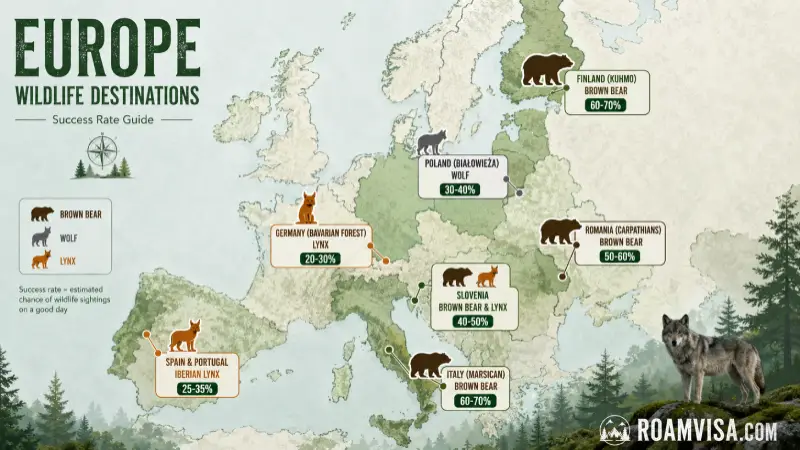
Finland’s eastern border regions (Kuhmo, Lieksa, and Kuusamo) host brown bear populations of 1,800+ alongside smaller populations of wolves and the elusive wolverine. Professional operators like Wild Brown Bear Centre, Articirkka, and WildLife Travel Finland run hide-based bear watching with success rates comparable to Romania’s. The best season is May-August. Costs 200-400 EUR per hide session; 3-5 day packages are 800-2,000 EUR. The remote Arctic Circle location adds Northern Lights potential (September-March) and bear season; plus, the early Northern Lights season overlaps in late August through September for a combined experience.
Slovenia – Brown Bears and Balkan Lynx
Slovenia’s Notranjska region holds approximately 1,000 brown bears alongside the rare Balkan lynx (a specific subspecies different from the Eurasian lynx elsewhere in Europe). The Slovenian Forest Institute runs structured bear-watching tours, and Ljubljana-based operators like Escape Travel Slovenia and Slovenia Explorer offer 2-4 day wildlife packages. Costs 300-800 EUR per package. Best combined with Lake Bled and Ljubljana for a complete Slovenian itinerary (4-7 days total). Easier accessibility for first-time Europe-safari travelers than Romania or Poland due to proximity to major European hubs.
Spain and Portugal – Iberian Lynx and Wolves
The Iberian lynx (a different species from the Eurasian lynx) is one of Europe’s most critically endangered mammals – only 1,600+ individuals in wild populations in Spanish Andalusia (Doñana National Park, Sierra de Andujar) and Portuguese Alentejo. Wildlife conservation tours with operators like Wild Iberia and Iberian Lynx Safari deliver 30-50 percent sighting success. 3-day Iberian lynx tours cost 500-1,200 EUR. The Iberian wolf in northern Spain (Sierra de la Culebra, Asturias) and Portuguese mountains adds a complementary wolf-watching experience. Best combined with Madrid, Seville, or Lisbon cultural trips.
Italy – Apennine Wolves and Marsican Brown Bears
Italy’s Abruzzo National Park in the Apennine mountains holds Italy’s unique Apennine wolves (~2,400 individuals countrywide) and the rare Marsican brown bear (only 50-60 individuals). Wildlife tourism is smaller scale than in Romania or Finland but works well for travelers wanting to combine wildlife with classic Italian tourism. Day trips from Rome to Abruzzo National Park 80-150 EUR per person; multi-day packages 500-1,200 EUR.
Comparison Table – Europe Wildlife Safari Destinations
Head-to-head comparison of top European wild animal safari destinations with the criteria that matter most for planning.
| Country | Headline Species | Best Season | Success Rate | Package Cost (EUR) |
| Romania | Brown bear | May-Oct | 80-95% | 500-1,500 |
| Poland | Wolf, European bison | Oct-Apr, May-Sep | 40-70% wolf, 80-95% bison | 800-1,800 |
| Germany | Eurasian lynx | May-Sep | 15% wild, 100% Tierfreigehege | 300-800 |
| Finland | Brown bear, wolverine | May-Aug | 75-90% bear | 800-2,000 |
| Slovenia | Brown bear, Balkan lynx | Apr-Oct | 70-85% | 300-800 |
| Spain/Portugal | Iberian lynx, wolves | Nov-Mar | 30-50% | 500-1,200 |
| Italy | Marsican bear, Apennine wolf | Apr-Oct | 30-50% | 500-1,200 |
Practical Logistics for Indian Travellers
Getting There – Fly-In Routes
Romania: fly to Bucharest (Henri Coandă OTP) then train or drive 3 hours to Brașov; budget airlines Wizz Air and Ryanair connect major European hubs to Bucharest. Poland: Fly to Warsaw, then drive 3 hours to Białowieża; alternatively, fly to Vilnius, Lithuania, then cross into Poland. Germany: Fly to Munich or Prague, then a 2-3 hour drive to the Bavarian Forest region. Finland: Fly to Helsinki, then take a 1-hour domestic flight to Kuusamo or Kuopio. Slovenia: fly to Ljubljana, then drive for 1 hour. All destinations work as extensions to broader Central or Eastern European city itineraries.
Schengen Visa Coverage
All seven countries covered (Romania, Poland, Germany, Finland, Slovenia, Spain, and Italy) are part of the Schengen area. A single Schengen visa covers travel across all of them. Apply 4-6 weeks ahead of travel with bank statements, an employment letter, hotel bookings, wildlife tour confirmations, and return tickets. Romania technically joined full Schengen in 2024 – a welcome simplification for wildlife tour planning.
Total Trip Budget for Indian Travellers
Realistic 8-day Europe wildlife trip for two travelers, including flights from India:
| Cost Category | Budget (INR) | Mid-Range (INR) | Premium (INR) |
| Return flights for 2 (in Europe) | 90,000-130,000 | 110,000-160,000 | 170,000-240,000 |
| Wildlife tour package | 80,000-120,000 | 130,000-200,000 | 250,000-450,000 |
| Hotel nights outside tour | 20,000-35,000 | 40,000-80,000 | 100,000-200,000 |
| Meals outside tour | 12,000-18,000 | 20,000-32,000 | 35,000-55,000 |
| Local transport and fuel | 8,000-12,000 | 15,000-25,000 | 25,000-45,000 |
| Schengen visa and insurance | 18,000-22,000 | 18,000-22,000 | 18,000-22,000 |
| TOTAL for 2 (8 days) | 228,000-337,000 | 333,000-519,000 | 598,000-1,012,000 |
A European wildlife safari delivers genuinely good value versus African or Alaskan alternatives. The 3-5 lakh INR mid-range budget compares favorably to 8-15 lakh for equivalent African or Alaskan bear viewing trips.
Mistakes Indian Tourists Make on Europe Wildlife Safari
- Expecting African-safari density of wildlife sightings – European wildlife is wild and sparse compared to managed African reserves. Even professional hides require patience and commitment.
- Booking self-drive or non-guided wildlife trips – success rates for seeing target species drop from 80-95 percent (guided hides) to 10-30 percent (independent). The extra cost of guided tours is genuinely worth it.
- Visiting the wrong season – bears hibernate November-March (useless for Romania); wolf tracking works best with snow (November-April for Poland); lynx are summer-active. Match destination to season.
- Skipping hide-based watching for ethical reasons without understanding – professional hides in Romania, Finland, and Slovenia use supplementary feeding that supports local bear populations. Wildlife operators are professionally vetted and ethical.
- Packing inadequate outdoor gear for Eastern European weather – Romanian Carpathians can see heavy rain, cold mountain nights, and mosquitoes. Proper hiking boots, layered clothing, and insect repellent are essential.
- Not applying for a Schengen visa with sufficient buffer time – 4-6 weeks minimum, more during peak travel seasons. Wildlife tour operators will provide the required invitation documentation, but you need time to assemble everything else.
- Trying to cover too many countries in one trip – spreading a 10-day trip across 3 countries means rushing through each. Pick one wildlife destination and combine it with 1-2 cultural cities for a balanced itinerary.
Plan the Complete European Trip
If you want to combine a European wildlife safari with the iconic European city experience on a longer trip, our Best European Honeymoon Destinations Top 10 Honestly Ranked Guide covers Europe’s most romantic and scenic destinations that pair naturally with wildlife trips – Santorini after Romanian bears, the Amalfi Coast after Slovenian lynx, or Prague combined with the Bavarian Forest lynx. The guide helps decide which cities to pair with your wildlife destination for a complete 2-week Europe itinerary.
For Africa-scale safari experiences that Europe cannot match, our Africa safari from Europe, with the cheapest flights and best budget packages, covers how European-based tourists (or Indian tourists transiting Europe) can extend into African safaris using budget airlines Kenya Airways, Ethiopian, and Turkish Airlines via European hubs. Combining European wildlife with a short African safari delivers the complete global safari experience on a single trip.
Final Thoughts
Europe’s wild animal safari scene is underappreciated relative to its quality. Romania’s Carpathian brown bears, Poland’s Białowieża wolves and European bison, Germany’s Bavarian Forest lynx, Finland’s brown bears and wolverines, and Slovenia’s bears and Balkan lynx collectively deliver some of the best wildlife watching on the continent at significantly lower cost than African or Alaskan alternatives. Professional hide-based operators consistently deliver 70-95 percent success rates for primary target species during the right seasons. For Indian tourists who have already done Europe’s cultural hits multiple times (Paris, Rome, Amsterdam, and Barcelona) or those looking for something substantially different from standard European tourism, these wildlife destinations add genuine, memorable dimensions to a Europe trip. Practical recommendations: for a first-time Europe wildlife safari, book a 4-5 day Romania brown bear trip (Brașov base, professional hide operator, combined with Transylvania castle tourism) – this delivers the highest success rates at moderate cost.
Second-time wildlife travelers can tackle Polish Białowieża wolves (more challenging, more rewarding for serious wildlife enthusiasts). A budget of 3-5 lakh INR is mid-range for an 8-day combined wildlife plus culture trip for two, including flights from India. Apply for a Schengen visa 6 weeks ahead with a tour confirmation letter. Travel in May through September for most reliable wildlife activity and weather. Use professional operators (Carpathian Wildlife Expeditions Romania, Bison Safari Poland, Wild Brown Bear Centre Finland, and Slovenia Explorer) rather than attempting DIY wildlife tracking. Done this way, European wildlife safari joins African safari and Yellowstone winter as one of the world’s genuinely rewarding serious wildlife destinations – and notably more accessible for Indian travelers than either alternative.
Frequently Asked Questions
Are there real wild animal safaris in Europe?
Yes – Europe has 17,000+ brown bears (concentrated in Romania), 17,000+ wolves (across Poland, Italy, Spain, and Scandinavia), and 9,000+ Eurasian lynx (Central Europe). Professional wildlife operators run hide-based safari experiences delivering 70-95 percent success rates for primary species during correct seasons. European wildlife safaris are smaller-scale than African equivalents but genuine and increasingly accessible.
Where is the best place to see brown bears in Europe?
Romania’s Carpathian Mountains (Brașov, Zarnesti, and Piatra Craiului National Park regions) hold 6,000+ brown bears – 60 percent of the EU total. Professional hides here deliver 80-95 percent success rates in the May-October season. Finland’s eastern border regions (Kuhmo and Kuusamo) are the second best destination with 1,800+ bears and slightly higher-quality hide infrastructure. Slovenia’s Notranjska region is third with 1,000+ bears.
Can you see wolves in Europe?
Yes, but with patience – wolves are more elusive than bears. Best destinations: Poland’s Białowieża Forest (100-150 wolves, 40-70 percent success rate with professional guides), Italy’s Abruzzo and northern mountains, Spain’s Sierra de la Culebra and Asturias, and Scandinavia’s northern forests. Winter tracking (November-April) delivers better wolf visibility than summer due to snow prints and easier visuals through leafless forests.
How much does a European wildlife safari cost?
Professional wildlife packages cost 500-2,500 EUR per person for 3-7-day experiences depending on destination and operator quality. Romania’s budget bear hides: 500-1,000 EUR. Poland wolf tracking: 800-1,800 EUR. Finland bear tours: 800-2,000 EUR. Total 8-day trip from India for two people including flights: 3-5 lakh INR mid-range. Substantially cheaper than equivalent African safaris (8-15 lakh INR) or Alaska bear tours (10-18 lakh INR).
What is the best time for a European wildlife safari?
May to September is optimal for most European wildlife. Brown bears are most active April-October (Romania, Finland, Slovenia). Wolves work year-round, but winter (Nov-Apr) delivers better visual tracking. Eurasian lynx best from May to September. European bison are sighted year-round but best October-April with leaf-off visibility. July-August has peak animal activity but also peak tourist season – May-June and September are ideal compromises between animal activity and accessibility.
Do I need special permits for a European wildlife safari?
Most wildlife tourism uses professional licensed operators who handle all permits and access. National park entry fees are typically 5-20 EUR per day. A Schengen visa covers travel to all the main European wildlife destinations (Romania, Poland, Germany, Finland, Slovenia, Spain, and Italy). Romania technically entered full Schengen in 2024. Budget 18,000-22,000 INR for a Schengen visa plus travel insurance for Indian travelers. Apply 4-6 weeks before travel with tour confirmation documentation.


