A Schengen visa rejected notification is one of the most deflating things a traveller can read – especially when you had flights booked, plans made and people waiting for you. The Schengen area covers 29 European countries and processes millions of visa applications every year, with refusal rates running between 10% and 35% depending on the applicant’s nationality. But behind almost every single refusal is a documented, specific reason – and under EU law, every applicant has the legal right to know that reason and to challenge the decision.
The important thing to understand straight away is this: a Schengen refusal is not permanent. Under Article 32(3) of the EU Visa Code, you have the legal right to appeal any refusal. You also have the option to reapply with a stronger, corrected application without waiting for an appeal to be decided. Most travellers who are refused on their first attempt are approved on a subsequent one – not because the rules changed, but because they finally understood what was missing and fixed it.
This guide covers every common Schengen visa rejection reason in plain language, explains the legal framework for appeals, walks you through the process step by step and tells you when appealing makes more sense than simply reapplying. Whether you have just received a refusal letter or you are trying to avoid one, this is the complete picture.
Schengen Visa Rejection – Key Facts at a Glance:
Legal Right To Appeal: Article 32(3) EU Visa Code gives every applicant this right
Appeal Deadline: Typically 15–30 days from refusal – check your specific refusal letter
Where To Appeal: Embassy or consulate of the Schengen country that issued the refusal
Reapply: No mandatory waiting period – you can reapply immediately after fixing the issue
Most Common Reasons: Weak ties to home country, insufficient financial proof, vague travel purpose
Travel Insurance: Minimum €30,000 medical cover is mandatory for all Schengen visa applications
Previous Refusal: Must be disclosed on all future Schengen applications – non-disclosure = deception
52.2% of 2024 Schengen visas were Multiple Entry – clean travel history matters significantly
Top 10 Reasons Schengen Visas Get Refused – And the Fix for Each
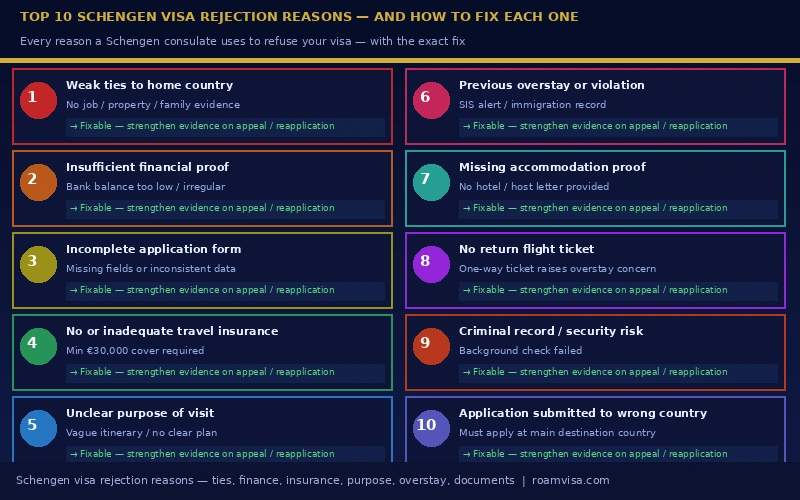
1. Weak Proof of Ties to Your Home Country
This is the single most common Schengen refusal reason. When a consular officer reviews your application, the fundamental question they are trying to answer is whether you will leave the Schengen area before your visa expires. If your application does not convincingly prove that you have strong reasons to return home – a job, a business, property, enrolled education, dependent family – the officer will refuse the visa.
Ties to your home country are the evidence that answers this question. Employment is the strongest single tie. An employment letter confirming your role, your salary, your leave approval dates and – critically – a statement confirming you are expected back at work on a specific date tells the officer exactly why you will return. Other strong ties include property ownership documents, a running business, ongoing enrolled education, or dependent family members whose care you are responsible for.
- Fix: employment letter with your return date explicitly stated, last 3 months’ payslips, and employment contract showing an ongoing role. Self-employed: business registration, tax returns, active invoices.
- For students: university enrollment confirmation showing ongoing courses. For property owners: ownership deeds or mortgage statements.
- Write a brief cover letter that lists your ties specifically – do not leave the officer to search your documents for this information.
2. Insufficient Financial Proof
Consulates need to verify you can fund your entire stay without working illegally or relying on public funds. The general benchmark is approximately €50–€100 per day of your trip. If your bank statements show a low or irregular balance, a large unexplained deposit right before the application, or income that does not match your stated salary, the application will be refused on financial grounds.
- Fix: submit six months of bank statements, not just one or two months. Consistent income over time is far more convincing than a large recent balance.
- If a sponsor is funding your trip: they must provide their own six months of statements, a signed sponsorship letter specifying exactly what costs they are covering, and their own employment or income proof.
- Irregular income (freelance, business): provide matching invoices, bank credits and tax returns to explain the pattern clearly.
3. Incomplete or Inconsistent Application Form
A surprising number of refusals come from basic form errors – blank fields, dates that do not match between the form and supporting documents, names spelled differently in different places, or information in the form that contradicts the evidence. Schengen consulates apply EU checklists strictly. Your flight dates, hotel booking dates, insurance dates and visa application dates must all be consistent with each other.
- Fix: before submitting, read every field of your completed form against your passport, documents and travel bookings. Name spelling, date of birth, passport number and dates must match exactly across everything.
4. No Travel Insurance or Inadequate Cover
Travel insurance is not optional for a Schengen visa – it is a mandatory requirement. Your policy must cover all 29 Schengen member states, be valid for the entire duration of your stay, and provide a minimum of €30,000 in medical coverage including emergency repatriation. A policy that covers fewer countries, has a lower medical limit, or expires before your return date will cause an automatic refusal.
- Fix: buy Schengen-compliant insurance before your visa appointment and submit the certificate with your application. The certificate must show your name, coverage dates, Schengen area coverage and €30,000+ medical cover.
- If your refusal was specifically about insurance: get a compliant policy, obtain the certificate and submit it with your appeal or reapplication.
5. Unclear or Unbelievable Purpose of Visit
Your stated reason for visiting must be clear, consistent and backed by documents. Writing ‘tourism’ with no itinerary, no hotel bookings and no explanation of what you plan to do gives the officer nothing to verify. For business visits, vague statements without invitation letters or company correspondence raise doubts.
- Fix: submit a detailed travel itinerary with actual hotel bookings or confirmed reservations, a day-by-day plan covering activities and places, and a short specific cover letter explaining why you are visiting at this particular time.
- For business: provide an invitation letter on official letterhead from the European company, naming you, your role and the purpose and dates of your visit.
6. Previous Overstay, SIS Alert or Immigration Violation
The Schengen Information System (SIS) is a shared database used by all member states. A previous overstay – even a brief one – or a prior return decision in any Schengen country shows in the SIS and triggers refusal. This is the most difficult category to resolve. If the SIS data is incorrect you can request a correction. If the overstay was genuine, you typically need to demonstrate a significant change in circumstances before a new application can succeed.
7–10. Other Common Reasons
- No accommodation proof: hotel bookings, a confirmed host invitation letter with address and contact, or evidence of where you will stay throughout. Saying you will ‘find somewhere’ is not accepted.
- No return flight ticket: a one-way ticket raises immediate overstay concerns. A confirmed return or onward ticket matching your visa application dates is required.
- Criminal record: background checks are conducted. Conviction for fraud, immigration violations or serious offences requires disclosure and can result in refusal. Non-disclosure is worse than disclosure.
- Applied to the wrong country: you must apply to the consulate of your main destination – the country where you will spend the most nights. Applying to a different, more convenient consulate when your main stay is elsewhere is a standard refusal trigger.
| Refusal Reason | Root Cause | The Fix | Best Path After |
|---|---|---|---|
| Weak home country ties | No job / property / family evidence | Employment letter + return date + property docs | Reapply with stronger ties evidence |
| Insufficient funds | Low / irregular bank statements | 6 months statements + salary slips + sponsor letter | Reapply or appeal with updated statements |
| No / wrong travel insurance | Below €30K or wrong dates / area | Buy Schengen-compliant policy – €30K+, full area | Reapply – attach compliant certificate |
| Incomplete form | Missing fields / date mismatches | Re-check every field vs every document | Reapply – correct form + consistent docs |
| Unclear travel purpose | No itinerary, vague letter, no bookings | Detailed itinerary + hotel bookings + cover letter | Reapply – full documentation |
| SIS alert / overstay | Prior overstay / immigration record on file | Time + changed circumstances; SIS correction if wrong | Appeal if data wrong; else wait + reapply |
| No accommodation proof | No hotel or host letter | Hotel confirmations or host invitation letter | Reapply – include confirmed bookings |
| Wrong country applied to | Applied to non-main-destination consulate | Apply fresh to the correct consulate | Fresh application only |
Related Articles: Best Travel Insurance for UK – Top Plans Compared Honestly
After Refusal – Your Three Options Under EU Law
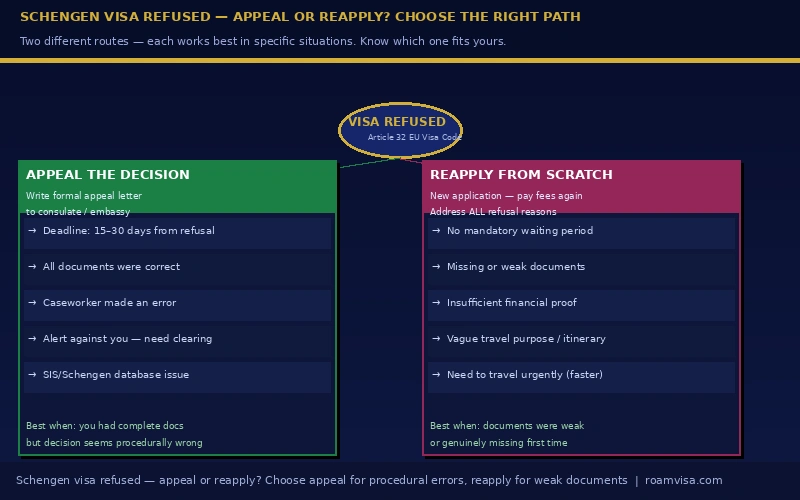
When a Schengen visa is refused, your refusal letter should tell you which options are available. Under EU law and Article 32(3) of the EU Visa Code, every refused applicant has specific rights. In practice, three paths exist.
Option 1 – Formal Appeal (Article 32(3) EU Visa Code)
Every applicant whose Schengen visa is refused has the right to appeal under Article 32(3). The appeal is filed with the same embassy or consulate that refused the application. The deadline is typically 15–30 days from the refusal date – your specific letter will tell you the exact timeframe for that country.
An appeal works best when: your documents were complete and correct but you believe the officer made an error assessing them, there is a SIS database issue to correct, or you have new information that directly addresses the stated reason for refusal. An appeal that simply repeats the same information emotionally will not succeed. A successful appeal directly addresses the specific legal basis for refusal with targeted, factual evidence.
- France: Ministry of Foreign Affairs – Commission de recours contre les refus de visa (CRRV)
- Germany: Administrative Court (Verwaltungsgericht) – typically in Berlin
- Italy: Regional Administrative Tribunal (TAR) – note: this is a slower route, reapplication is often faster
- Netherlands: District Court (Rechtbank) with territorial jurisdiction
- Spain: Administrative Court of the relevant province
- Sweden and Nordic countries: the Migration Agency first, then Migration Court if the decision is unchanged
Option 2 – Informal Re-examination Request
Some countries allow an informal written request for reconsideration submitted within 2 months of the refusal. This is less formal than a full legal appeal and faster in some cases. It does not allow new documents – it asks the consulate to review what was already submitted. Use this only when you are confident the original documents were complete and the refusal was genuinely an officer error, not a document gap.
Option 3 – Fresh Application (Most Commonly Used)
There is no mandatory waiting period before reapplying for a Schengen visa after a refusal. You can apply again the next day – provided you have corrected the refusal reason. This is the most commonly chosen route because it is typically faster than waiting for an appeal, it allows entirely new and stronger documentation and it gives you a clean opportunity to address every concern the original application raised.
The discipline required is to address every single point in your refusal letter – not just the headline reason. Applicants who reapply without correcting the stated cause get refused again, often faster than the first time.
How to Write a Schengen Visa Appeal Letter
The appeal letter is not a place for emotion or personal appeals. It is a formal legal document addressed to an administrative authority. It needs to be structured, factual, specific and supported by evidence. Reference the exact wording of the refusal. Cite Article 32(3) of EU Regulation 810/2009. Provide targeted evidence that directly contradicts or addresses the basis for refusal.
Schengen Visa Appeal Letter – Structure:
OPENING: State your name, application reference number, date of refusal and the visa you applied for. Confirm you are appealing under Article 32(3) of EU Visa Code (Regulation 810/2009).
QUOTE THE REFUSAL REASON: Use the exact wording from your refusal letter – do not paraphrase. Address each reason separately.
RESPONSE TO EACH REASON: 2–3 factual sentences per reason. Cite each attached document by name.
Example: The refusal states insufficient financial means. I attach 6-month certified bank statements showing consistent monthly credits of €2,800 from my employer [Company Name], as confirmed in the attached employment letter and payslips.’
DOCUMENTS LIST: Number every attachment and list them clearly in the letter body.
CLOSING: Respectfully request reconsideration. Include contact details and confirm intention to comply with visa conditions. Sign and date.
TONE: Professional and factual throughout. No emotional language. No accusations. No demands. It is a formal administrative submission.
Documents to Attach With Your Schengen Visa Appeal:
1. Copy of original refusal letter
2. Copy of your original application form and all previously submitted documents
3. Updated bank statements – 6 months, certified/stamped where possible
4. Updated employment letter – with confirmed return date if original lacked this
5. Schengen-compliant travel insurance certificate – €30,000+ cover, correct dates, full Schengen area
6. Return flight ticket confirmation
7. Hotel bookings or host invitation letter with host’s address
8. Any new evidence directly addressing the stated refusal reason
9. Passport biodata page copy
10. Property, family dependency, or business documents (for home country ties)
Send by Registered Mail:
Submit all appeal documents by registered mail with signed delivery confirmation. This proves the date you submitted – critical if you are near the deadline – and confirms the consulate received everything. Keep copies of every page you send.
Appeal Deadlines and Timelines by Schengen Country
| Country | Appeal Authority | Your Deadline | Processing Time | Key Note |
|---|---|---|---|---|
| France | Ministry of Foreign Affairs – CRRV | 2 months from refusal | 2–4 months | France’s dedicated visa appeal commission |
| Germany | Administrative Court (Verwaltungsgericht) | 1 month from refusal | 3–6 months | Court process – legal help advisable |
| Italy | Regional Administrative Tribunal (TAR) | 60 days from refusal | 3–12 months | Very slow – reapplication is often faster |
| Spain | Administrative Court – relevant province | 1 month from refusal | 2–6 months | Can request informal re-exam first |
| Netherlands | District Court (Rechtbank) | 4 weeks from refusal | 2–4 months | Objection (bezwaar) available before court |
| Sweden | Migration Agency then Migration Court | 3 weeks from decision | 4–8 weeks (agency) | Agency reviews first, then court if unchanged |
| General Schengen | Embassy / Consulate visa section | 15–30 days (see letter) | 2–8 weeks | Always check your specific refusal letter |
What to Do If Your Appeal Is Refused
Not every appeal succeeds – and going in with realistic expectations is important. If your appeal is refused, you still have options.
- Reapply with a significantly stronger application addressing every point in both the original refusal and the appeal refusal. An unsuccessful appeal sometimes gives additional clarity about what the consulate specifically needed.
- Get professional legal advice: if you have had both a refusal and a failed appeal, an immigration lawyer specialising in EU visa law can identify procedural errors, challenge the legal basis of the decision and advise on whether judicial review through national courts is a viable step.
- Build travel history: if you have limited prior international travel, your Schengen approval chances improve meaningfully after one or two successful trips to countries that do not require visas – the UK, UAE or USA all demonstrate that you can travel and return as required.
- Consider applying via a different Schengen country if your trip plans allow flexibility – not to game the system, but because different consulates may assess similar applications with different weighting on specific evidence.
Frequently Asked Questions
Can I reapply for a Schengen visa immediately after refusal?
Yes. There is no mandatory waiting period. You can reapply the following day – but only if you have genuinely corrected the reason for refusal first. Reapplying with the same weak application almost always results in a second refusal, often processed more quickly than the first.
Do I have to declare a previous Schengen visa refusal on a new application?
Yes, always. The Schengen application form asks directly about previous refusals. Failing to disclose is treated as misrepresentation and can lead to a much longer-term bar. Disclose honestly, explain what has changed, and address the original refusal reason clearly in your new application.
How long does a Schengen visa appeal take?
It varies by country. Informal re-examination requests typically take 2–4 weeks. Formal consular appeals take 4–12 weeks. Court-level appeals in Germany or Italy can take several months. If you need to travel within a reasonable timeframe, reapplying with stronger documents is usually faster than waiting for an appeal outcome.
Is Schengen travel insurance really mandatory?
Yes – it is a mandatory document under EU Visa Code regulations. Your policy must cover all 29 Schengen member states, must be valid for your entire stay, and must provide minimum €30,000 in medical coverage including emergency repatriation. Missing or non-compliant insurance causes automatic refusal regardless of how strong your other documents are.
What is Article 32 of the EU Visa Code?
Article 32 of EU Regulation 810/2009 sets out the grounds on which a Schengen visa may be refused and requires that applicants be informed of the reason. Article 32(3) specifically gives every refused applicant the legal right to challenge the decision through the national administrative law of the deciding Schengen member state. It is the legal foundation for every Schengen visa appeal.
Does a Schengen refusal affect applications to other countries?
Yes, it can. Countries, including the UK and the USA, ask whether you have previously been refused a visa anywhere. A Schengen refusal must be disclosed and is a factor that officers consider. It does not automatically cause refusal elsewhere but adds scrutiny – particularly if the reason is related to finances or travel intent.
Our Recommendation
The most important step after receiving a Schengen refusal is to read your refusal letter slowly and carefully – not just the headline tick-box reason but every line of it. The specific language used is not bureaucratic padding. It is a precise description of what the deciding officer found insufficient. Your response – whether appeal or reapplication – needs to address that specific language with specific evidence.
For most refusals, the right path is a fresh, stronger application rather than a formal appeal. This is not because the appeal right is unimportant – it is protected by EU law and genuinely valuable when a procedural error has been made. But for the majority of cases where the reason is genuinely weak documentation or insufficient evidence, an appeal cannot change the documents. A fresh application can. If you do appeal, appeal strategically. Quote the EU Visa Code. Address the exact legal ground stated for refusal. Attach targeted evidence. Do not write an emotional letter asking the officer to reconsider your personal situation – write a factual, well-structured rebuttal of the stated basis for refusal, supported by documents that were either not submitted the first time or have materially changed since.
On insurance: if your refusal mentioned anything about travel cover – wrong dates, inadequate limit, wrong coverage area – fix this before doing anything else. A Schengen-compliant policy is not expensive and no level of strong financial evidence will compensate for a non-compliant insurance certificate. It is a mandatory checklist item and it is checked. The Schengen visa system is not designed to permanently exclude genuine travellers. Most refusals happen because the application did not give the consulate enough evidence to tick its legal checklist – not because the applicant was ineligible. Fix the evidence gap, and the outcome almost always changes.