Amalfi Coast Road Trip – Complete Driving Guide Italy

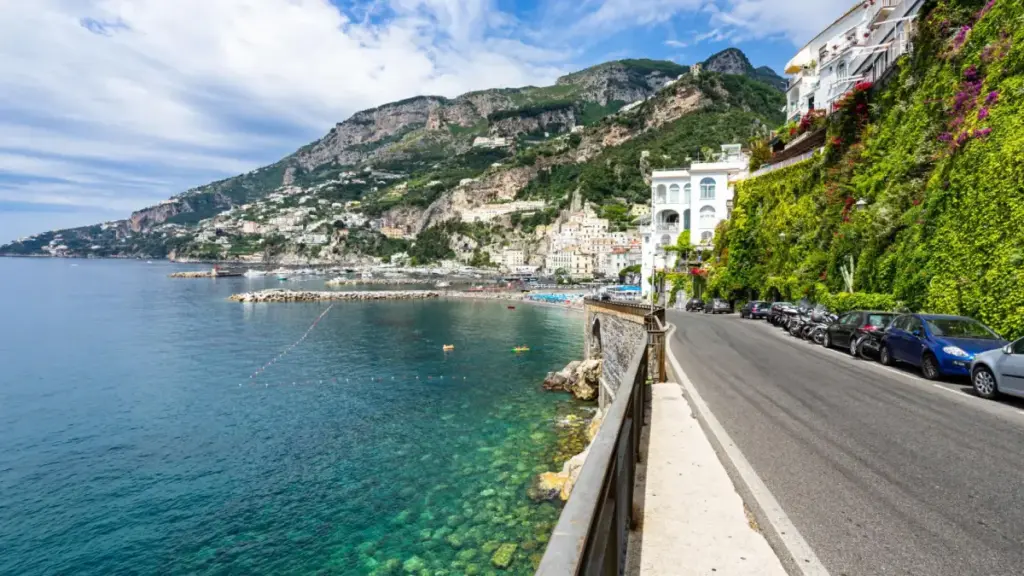
An Amalfi Coast road trip is one of the most talked-about drives in the world and it earns that reputation. The SS163 Amalfitana winds for 60 kilometres along the southern edge of the Sorrentine Peninsula in Campania, threading between cliff faces and the Tyrrhenian Sea, passing through some of the most photogenic towns in Italy and delivering views that arrive around every bend without warning. It is also genuinely challenging to drive narrow roads, sharp hairpin turns, buses coming the other way and summer traffic that turns a 60km route into a half-day event.
This guide gives you what you actually need to make the drive work: the route from Sorrento to Vietri sul Mare explained town by town, the 2025 alternating licence plate traffic rules that catch many visitors by surprise, realistic parking expectations, the best time of year to go and a practical itinerary for both 3-day and 5-day visits. The Amalfi Coast is a UNESCO World Heritage Site it deserves more than a frantic half-day dash and this guide is designed to help you give it proper time.
Amalfi Coast Road Trip Quick Facts
- Road: SS163 Amalfitana 60 km from Sorrento to Vietri sul Mare
- Driving time without stops: 2 hours with stops, easily a full day
- Direction: Either way works west to east (Sorrento→Salerno) is more popular
- UNESCO World Heritage Site: Designated 1997 entire Amalfi Coast
- Key towns: Sorrento, Positano, Praiano, Furore, Amalfi, Atrani, Ravello, Minori, Maiori
- Licence plate rule: Alternating even/odd plates June–September 10am–6pm SS163
- Parking: €3–€10/hour very limited, book accommodations with parking
- Best months: May, June (pre-peak), September, October fewer crowds, full access
- Car size matters: Book the smallest car available Fiat 500, Panda or equivalent
- ZTL warning: Town centres have restricted zones follow signage carefully to avoid fines
The SS163 Amalfi Drive The Route Explained
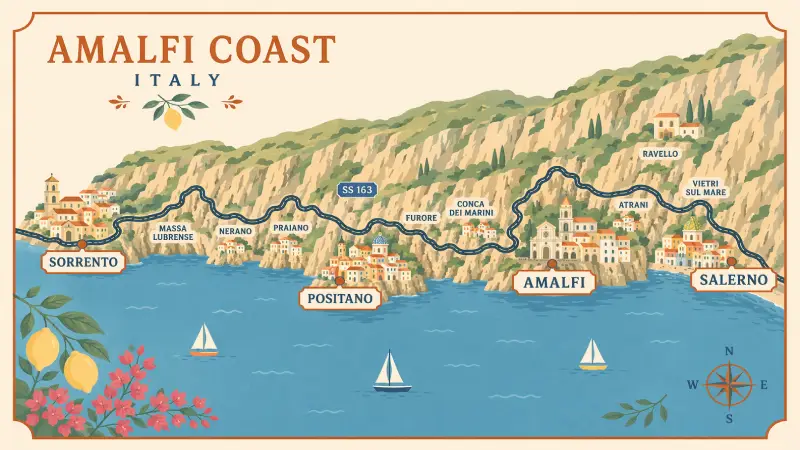
The SS163 begins at Sorrento on the west and ends at Vietri sul Mare near Salerno on the east or vice versa. The road follows the coastline tightly, cut into the cliffs above the sea for most of its length. It is a single main road with no real alternative routing: if there is a traffic incident or a bus meeting another vehicle at a tight bend, everyone waits. This is simply how it works and accepting that pace is part of the experience.
Which Direction to Drive West to East or East to West?
Most drivers start from the Sorrento side and drive east toward Salerno. This puts the sea on your right as you drive, which means the driver has unobstructed clifftop views on the left and easier access to pull-off viewpoints. For a solo driver, east to west (Salerno to Sorrento) means the sea views are directly in front of you as you come around bends some find this more dramatic. Either direction works and the difference is minor. More practically: start early from Sorrento heading east if you want to reach Positano before the day-trippers arrive by bus and ferry around 10am.
How Long Does the Drive Take?
Without stops, the 60km route takes approximately 2 hours. With even one stop in each major town Positano, Amalfi, Ravello it becomes a full day. Most travellers who base themselves on the coast for 3 or more nights divide the route over multiple half-days rather than trying to do it all in one pass. This is a much better approach: you see each town properly, deal with parking once per town and avoid the frustration of spending your best daylight hours in traffic.
Getting to the Amalfi Coast Where to Pick Up a Car
Naples International Airport (Capodichino) is the main gateway for the Amalfi Coast. The drive from Naples airport to Sorrento takes approximately 1 hour to 1 hour 30 minutes depending on traffic through Naples. Avoid driving into downtown Naples with a rental car the city centre is chaotic, parking is nearly impossible and ZTL cameras cover large areas. Either fly in and drive straight out on the motorway to Sorrento, or arrange to collect your rental car at Sorrento station.
Car Size This Matters More Than You Think
Book the smallest car available. A Fiat 500, Panda or similarly compact city car is the right vehicle for the SS163. SUVs and large saloons are technically possible but add significant stress at every tight bend and in every car park. The road is narrow enough in places that two passing cars require both to carefully edge past each other a small car makes this routine rather than terrifying. Full comprehensive insurance is strongly recommended: the risk of minor scrapes and dings on the SS163 is real.
Driving Rules, Traffic Restrictions and Parking What You Must Know
The Alternating Licence Plate Rule 2025
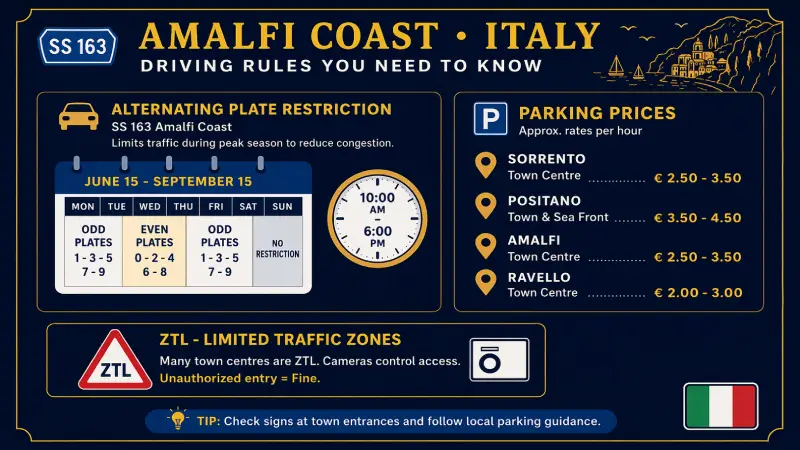
This is the rule that catches most visitors by surprise. To manage summer congestion on the SS163, Italian authorities impose an alternating licence plate system on the Amalfi Drive: on even-numbered calendar dates, only cars with even-numbered licence plates may drive the SS163 between 10am and 6pm. On odd-numbered dates, only odd-numbered plates. This applies on specific days between spring and autumn.
2025 Schedule for the Alternating Plate Rule (SS163)
- Easter week (April 13 to May 1): every day, 10am–6pm
- 1–2 June and surrounding weekends: every Saturday, Sunday and public holiday
- June 1 to July 31: every weekend and public holidays
- June to September 30: check the RTA Campania official announcements for daily application
- Motorcycles and scooters: NOT affected by the rule only cars
- If you are a guest at a registered hotel, B&B or agriturismo on the coast: you are allowed to reach and leave your accommodation regardless of your plate number but you cannot drive the full road for leisure
Important note on the Sorrento Coast: stricter rules apply between 8am and 7pm on the stretch from Sorrento. Check local signage and official RTA updates before driving rules can be updated by authorities during the season.
Parking on the Amalfi Coast Expect to Pay and Plan Ahead
Parking is the single most stressful practical aspect of the Amalfi Coast for drivers. There is very little of it, it is expensive and the most popular towns Positano, Ravello, Amalfi have severe limitations. The general rule is to book accommodation with parking if you are staying multiple nights, arrive in each town before 9am if you want to park independently, and accept that parking in Positano in July without a reservation is nearly impossible.
Parking Costs and Key Car Parks
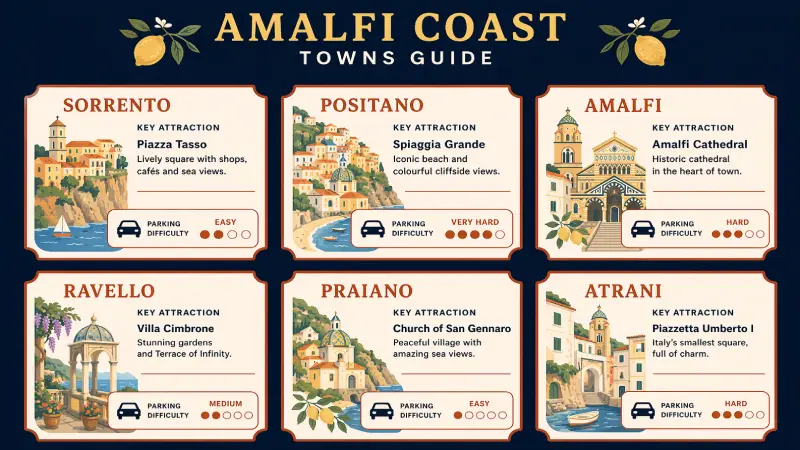
- Positano: garages from €20–€25/day book in advance in summer. Walking from the car park involves many stairs.
- Amalfi: garage just past the harbour bend from €5–€8/hour. A few spaces along the waterfront road extremely limited.
- Ravello: small car parks near the main piazza from €3–€5/hour easier than Positano but still limited in peak season.
- Sorrento: underground Parcheggio Comunale Achille Lauro, €2/hour for first 3 hours then €3/hour most practical for day visits.
- General Amalfi Coast: minimum €3/hour, average €5–€6/hour, up to €10/hour in prime summer spots.
ZTL Zones The Automatic Fine Risk
ZTL stands for Zona Traffico Limitato a restricted traffic zone covering the historic centres of many Italian towns. Cameras record every licence plate entering a ZTL. If your plate is not registered in the system, you receive a fine in the post weeks or months later sometimes after you have returned home. Following Google Maps on the Amalfi Coast can lead you into ZTL zones accidentally. Watch for the white sign with a red circle and ZTL text. If you are staying at accommodation inside a ZTL, your accommodation should register your plate with the local authority.
Best Towns to Stop on the Amalfi Coast Drive
Positano The Most Photographed Town on the Coast
Positano is the iconic image of the Amalfi Coast pastel-coloured buildings stacked vertically down a steep hillside to a small pebble beach. It is genuinely beautiful and worth the effort of getting there and parking. It is also expensive, crowded in summer and physically demanding the town is built on stairs and if you park at the top, reaching the beach involves descending and re-ascending several hundred steps. Most hotels have valet parking or dedicated garages.
Positano Practical Notes
- Allow 3–4 hours minimum for a proper visit the walk up and down takes longer than it looks
- Best photo spot: from the road on the approach from Sorrento, before you turn into the town pull over at the viewpoint layby
- Arrive before 9am in summer to get a parking spot in the garage
- Key stop: Spiaggia Grande beach, the church of Santa Maria Assunta with its majolica-tiled dome
Amalfi Historic Maritime Republic
Amalfi was one of the great maritime powers of medieval Italy a republic that rivalled Venice and Genoa and traded across the Mediterranean. The town’s cathedral, the Duomo di Sant’Andrea, is the centrepiece of the main piazza and one of the finest examples of Arab-Norman architecture in Italy. The striped black-and-white facade and the Chiostro del Paradiso a Moorish cloister with delicate archways and a tropical garden are worth an hour on their own. The narrow lanes leading up from the harbour are full of lemon-themed shops and local ceramics.
Amalfi Key Stops
- Duomo di Sant’Andrea: free to enter the exterior and piazza small fee for the cloister and crypt
- Chiostro del Paradiso: the most atmospheric spot in town arrive early before tour groups
- Museo della Carta: the Paper Museum tickets €7 Amalfi was once a centre of paper production
- Parking: garage past the harbour, just around the bend from the main waterfront arrive before 10am
Ravello Above the Coast, Away from the Crowds
Ravello sits above the SS163 on a high ridge, reached by a steep road turning off at Atrani. It requires leaving the main coastal route and climbing, but the reward is a fundamentally different atmosphere quieter, cooler, with gardens and terraces that look down over the coast from hundreds of metres above sea level. Wagner composed part of Parsifal here. Gore Vidal lived here for decades. The Villa Rufolo and Villa Cimbrone gardens both have terraces with views across the Tyrrhenian Sea that are consistently described as among the most beautiful in Italy.
Ravello Highlights
- Villa Rufolo: 11th-century Moorish tower and gardens hosts the Ravello Festival each July
- Villa Cimbrone: the Terrace of Infinity Greta Garbo famously honeymooned here
- Duomo di Ravello: 11th century, art gallery inside worth 30 minutes
- Parking: easier than Positano car parks near the main piazza from €3–€5/hour
Praiano The Quiet Alternative
Praiano is five kilometres east of Positano and has everything the more famous town offers clifftop location, sea views, traditional restaurants, small beaches without a fraction of the crowds. It is a genuine fishing village that has remained liveable rather than becoming a stage set for tourism. If you are basing yourself on the coast for several nights, Praiano offers better value accommodation, easier parking and shorter queues at restaurants. The drive to Positano and Amalfi from Praiano is 15–20 minutes each way.
Atrani The Most Overlooked Town on the Coast
Atrani sits directly beside Amalfi you can walk between them in ten minutes and is one of the smallest towns in all of Italy. Most day-trippers walk straight past without noticing it. The town has a small piazza, a beach, a church and the feeling of a place that genuine Italians still live in rather than one that exists entirely for tourists. Parking is very limited but if you are parked in Amalfi, the walk to Atrani is easy. It is the best argument on the entire coast for straying even slightly off the main tourist circuit.
Sorrento The Practical Base
Sorrento is the largest and most practical town at the western end of the Amalfi Coast. It sits on a high cliff above the Bay of Naples with views across to Mount Vesuvius and Capri. It is not as visually dramatic as Positano but it has a wide range of accommodation at lower prices, a proper town centre with restaurants and shops that serve locals as well as tourists, and excellent transport connections ferries to Capri and Naples, the Circumvesuviana railway to Naples and Pompeii. For most visitors, Sorrento works well as a base for both the Amalfi Coast drive and day trips to Pompeii and Capri.
Amalfi Coast Road Trip Itinerary 3 Days and 5 Days
| Day | Base | Drive / Route | Key Stops | Notes |
|---|---|---|---|---|
| Day 1 | Sorrento or Positano | Sorrento → Positano arrival | Positano beach, Santa Maria Assunta church, sunset from the hillside | Arrive by 9am for parking. Positano is best explored on foot once parked. |
| Day 2 | Positano or Praiano | Positano → Praiano → Amalfi → Atrani | Furore Fjord viewpoint, Amalfi Cathedral, Chiostro del Paradiso, Atrani walk | Start early Amalfi fills up by 11am. Allow 4 hours in Amalfi and Atrani combined. |
| Day 3 | Amalfi area | Atrani → Ravello → Minori → Salerno | Villa Cimbrone terrace, Ravello Duomo, Minori beach, Salerno old centre | Ravello requires 45 min drive up from the coast. End day in Salerno easier parking. |
READ MORE: USA East Coast Road Trip – NYC to Miami Complete Guide
5-Day Amalfi Coast Itinerary The Deeper Version
| Day | Base | Plan | Notes |
|---|---|---|---|
| Day 1 | Sorrento | Arrive, settle, walk Sorrento town centre and cliffs | Pick up rental car on arrival. Avoid driving into Naples downtown. |
| Day 2 | Sorrento | Drive Sorrento → Positano, full day in Positano | Boat tour option: best views of Positano are from the sea |
| Day 3 | Positano / Praiano | Positano → Praiano → Furore → Amalfi | Visit Furore Fjord (roadside viewpoint), full afternoon in Amalfi |
| Day 4 | Amalfi area | Amalfi → Atrani → Ravello day | Morning Atrani, afternoon Ravello gardens, evening return |
| Day 5 | Amalfi / Maiori | Maiori → Cetara → Vietri sul Mare → Salerno | Cetara for lunch (tuna speciality), Vietri ceramics, Salerno for ferry or train home |
Best Time to Drive the Amalfi Coast and Practical Tips
Best Months When to Go
May and the first two weeks of June are consistently the best time to drive the Amalfi Coast. The weather is warm and settled, all restaurants and attractions are open, the Hornblower cruise season has started if you are also visiting Naples, and the summer peak crowds have not yet arrived. The alternating licence plate rule begins in earnest from June 1 but the pre-peak May window avoids it entirely except during Easter week.
- May: best overall warm, uncrowded, no weekend licence plate restriction
- June (early): still good beat the peak before Italian schools finish for summer
- September: excellent shoulder season heat reduces, crowds drop, full access, harvest atmosphere
- October: the hidden gem month quiet, warm enough for the coast, autumn light is extraordinary for photography
- July–August: genuinely beautiful but very crowded, full licence plate restrictions in force, parking extremely difficult
- November–March: quieter and cheaper some restaurants and hotels close, but the coast is atmospheric and uncrowded
Driving Tips That Make the Difference
- Leave before 8am: the SS163 in summer is manageable before 9am and chaotic by 11am early starts transform the experience
- Give way to buses: SITA buses run the full length of the SS163 and have right of way at tight sections if a bus is coming, stop and let it through
- Use your horn: Italian drivers on the Amalfi Coast use their horns at blind bends as a warning, not an insult do the same
- Never stop on the road: there are layby viewpoints at the best spots use them instead of stopping in traffic lanes
- Sat nav caution: GPS sometimes routes you through town centres with ZTL cameras follow road signs as well as the map
- Petrol: fill up before you leave Sorrento or Salerno petrol stations are limited on the SS163 itself
- Scooter rental: a popular alternative for confident riders scooters are excluded from the licence plate restriction and require far less parking space
Frequently Asked Questions
Is driving the Amalfi Coast difficult?
Yes it is a narrow, winding road with sharp hairpin turns, buses, and significant summer traffic. It is manageable in a small car for a confident driver. Not recommended for nervous drivers or those unfamiliar with driving on the right.
What is the alternating licence plate rule?
From June to September, even-numbered plates drive the SS163 on even-numbered dates, odd plates on odd dates between 10am and 6pm. Hotel guests can access their accommodation regardless. Check official RTA Campania updates before driving.
How long does it take to drive the Amalfi Coast?
Minimum 2 hours non-stop. With stops in Positano, Amalfi and Ravello, plan a full day. Most visitors spread the drive over 2–3 days from a base on the coast.
Where is the best base for the Amalfi Coast?
Sorrento for practical value and connections. Positano for the iconic experience but at a premium. Praiano for the best combination of atmosphere and affordability. Amalfi for a central position on the coast.
Can you do the Amalfi Coast without a car?
Yes, SITA buses cover the entire SS163 route and are cheap and reliable. Ferries run between towns in season. Not having a car in summer actually makes transport less stressful, though you lose the freedom to stop spontaneously.
Our Recommendation
Drive the Amalfi Coast in May or September. These are the months when the experience is closest to what you imagine when you picture this coastline: warm, accessible, uncrowded enough to park and walk without planning your day around queues. If you must go in summer, go in the very first week of June before Italian schools break for the season.
Base yourself in Praiano. It is five kilometres from Positano, costs a fraction of the price, has actual parking and feels like an Italian village rather than a film set. From there, drive to Positano early in the morning (before 9am), spend the day in Amalfi, take a half-day to drive up to Ravello and use the afternoons on the smaller, less-visited towns like Atrani, Cetara and Vietri sul Mare.
Book at least one boat trip. The towns of the Amalfi Coast are best understood from the sea from the water, you see the scale of the cliffs, the way the villages are built into the rock and the relationship between the coast and the sea that you cannot fully appreciate from the road. The small group boat tours from Sorrento or Positano are consistently one of the most recommended activities on the entire coast and change the way you understand what you are looking at when you are back on land.