Canada Flight Delay Compensation: How to Claim Up to $1,000 (2026 Guide)

Key takeaways
- If your flight to, from or within Canada arrived 3+ hours late and the cause was within the airline’s control and not safety-related, you’re owed $400–$1,000 from a large airline, or $125–$500 from a small one.
- You must claim from the airline first. There is no government portal that pays you. The airline has 30 days to pay or explain in writing why it won’t.
- You have 1 year from the disruption to file with the airline, and 2 years to sue.
- Do not default to the Canadian Transportation Agency. Its backlog sits at roughly 92,500 complaints and a case can wait more than two years for review. For a straightforward denial, small claims court is usually faster.
- The rules are about to change – the amended APPR shifts the burden of proof onto airlines – but as of August 2026 those amendments are still not in force. Your claim is judged under the 2019 rules.
What most people get wrong about this
Search “Canada flight delay compensation” and almost every result tells you the same three numbers – $400, $700, $1,000 – then points you at the Canadian Transportation Agency.
That advice is incomplete in a way that costs people real money. The CTA does not pay compensation. It is a dispute-resolution body, and it is currently sitting on a backlog of about 92,500 complaints, with wait times exceeding two years before a file is even reviewed. Sending your claim there as a first move is the single most common mistake Canadian passengers make.
The correct sequence is: airline → written denial → then choose your escalation route. This guide walks that path in order, and tells you exactly which link to click at each step.
1. Am I eligible? A 30-second check
Answer all five. One “no” and you have no APPR compensation claim.
| # | Question | Why it matters |
|---|---|---|
| 1 | Was the flight to, from, or within Canada? | The APPR follows the route, not the airline. Emirates DXB→YYZ counts. Emirates DXB→LHR does not. |
| 2 | Did you arrive at your final destination 3+ hours late? | Departure delay is irrelevant. Only arrival delay at your final ticketed destination counts. |
| 3 | Were you told 14 days or fewer before departure? | 15+ days’ notice = no compensation, no exceptions. |
| 4 | Was the cause within the airline’s control? | Crew shortages, overbooking, IT failures, commercial decisions = yes. Weather, ATC instructions, bird strikes, security threats, airport closures = no. |
| 5 | Was it not classified as “required for safety”? | This is the loophole. See section 3. |
Connecting flights count as one journey if they were on a single ticket. Two separately booked tickets are two separate journeys, and a missed self-transfer is your own risk.
2. How much you’re owed
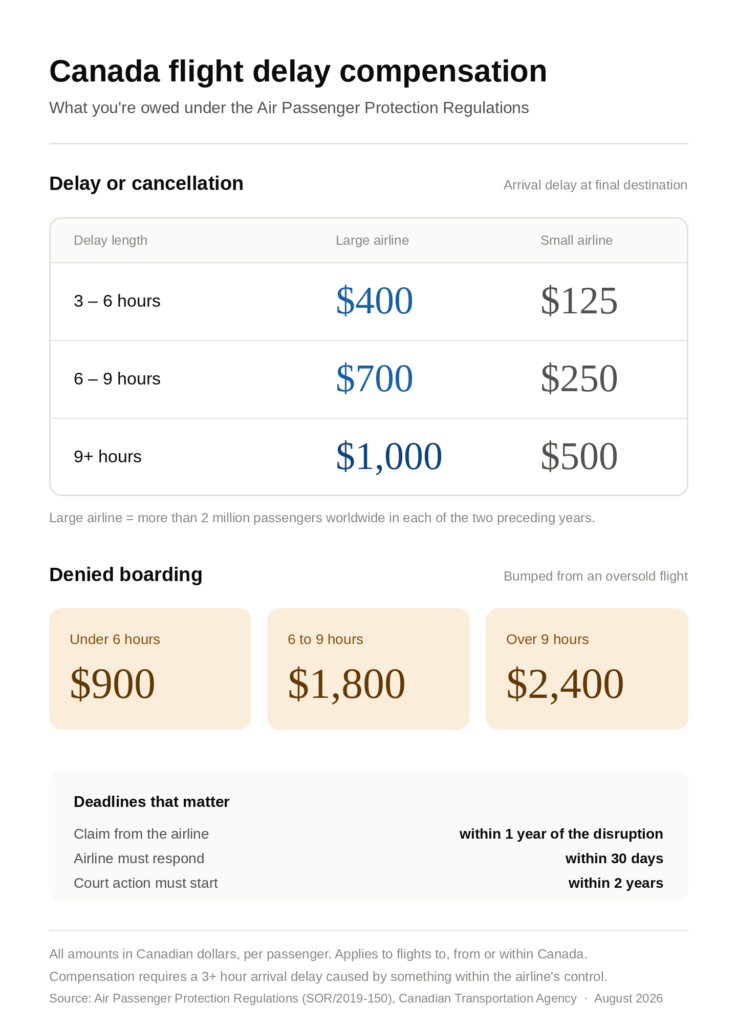
The APPR splits carriers into two tiers. A large airline carried more than 2 million passengers worldwide in each of the two preceding calendar years. Everyone else is small – and pays roughly a quarter as much.
Delay or cancellation (compensation for inconvenience)
| Arrival delay at final destination | Large airline | Small airline |
|---|---|---|
| 3 to under 6 hours | $400 | $125 |
| 6 to under 9 hours | $700 | $250 |
| 9 hours or more | $1,000 | $500 |
| You declined the rebooking because it no longer served your purpose | $400 | $125 |
Denied boarding (bumped from an oversold flight)
Involuntary denied boarding pays substantially more, and the tier split does not apply:
| Arrival delay | Compensation |
|---|---|
| Under 6 hours | $900 |
| 6 to 9 hours | $1,800 |
| Over 9 hours | $2,400 |
Air Canada, WestJet, Air Transat, Delta, United, American, British Airways and Emirates are all large carriers. Smaller regional operators – Air North, Canadian North, PAL Airlines – pay the lower band. A few carriers sit near the 2-million line and can change tier between years; if yours is borderline, the tariff on the airline’s own website states which band it falls into.
Separately from compensation, you’re also owed standards of treatment if you’ve waited 2+ hours past your original departure time on a controllable delay: food and drink, a means of communication, and – if you’re stuck overnight – a hotel plus transport to and from it. This is a different entitlement, claimed as expense reimbursement, and you can claim it alongside the cash compensation.
3. The one exclusion that kills most claims
Under the current (2019) APPR, disruptions fall into three categories, not two:
- Within the airline’s control → full compensation
- Within the airline’s control but required for safety → rebooking and treatment, but no compensation
- Outside the airline’s control → rebooking only
Category 2 is where most claims die. An unscheduled mechanical issue discovered during a pre-flight check is within the airline’s control – it owns and maintains the aircraft – but airlines routinely classify it as “required for safety” and refuse to pay. So do many crew-scheduling problems, once they’re framed as a duty-time limit.
Two practical consequences:
- Get the stated reason in writing at the airport. Airlines are legally required to tell you why. A gate agent’s verbal “it’s a maintenance issue” is worth far less than the same words in the app notification or an email, which is what you’ll need later.
- A labour disruption at the airline itself currently counts as outside the carrier’s control under the APPR’s own list. This is why passengers caught in airline strike action generally get rebooking and refunds but no cash compensation – a point worth checking if your disruption falls in a strike window.
If the airline’s denial letter cites “required for safety” without explaining what the safety issue was, that vagueness is itself grounds to push back. You are entitled to a fulsome explanation, not a category label.
4. Step 1: Claim from the airline – the only correct first move
Every APPR claim starts with the operating carrier. Not your travel agent, not the airline you booked through, not the CTA. The airline that physically operated the delayed flight. If you booked Air Canada but flew a codeshare on United metal, you claim from United.
The airline then has 30 days to either pay you or send a written explanation.
Where to file, by airline
| Airline | Where to claim | Notes |
|---|---|---|
| Air Canada (incl. Rouge, Express) | Claim portal via Flight Disruptions | Eligibility check built into the form |
| WestJet | Delay & cancellation claims | Needs your 6-letter reservation code, name and DOB to match the booking exactly. Screenshot before submitting – you can’t retrieve it later |
| Emirates | Customer Affairs / complaints form | Separate refund request form for ticket refunds |
| Delta | Canada passenger rights notice → Customer Care | |
| Any other carrier | Search “[airline] APPR compensation claim“ | Every carrier serving Canada must publish a Canadian passenger-rights notice and a claims channel. |
What to include
Attach these to the claim. Missing documentation is the second most common reason claims stall:
- Booking reference and ticket number
- Boarding pass (photo is fine)
- Scheduled vs. actual arrival time at your final destination
- Any written notification of the delay – app push, SMS, email – showing the timestamp and reason
- Receipts, if you’re also claiming meals or hotel
- One line stating the amount you’re claiming and why: “Arrival delay of 7h 20m, within carrier control, compensation of $700 requested under s.19 of the APPR.”
Be specific about the number. Vague claims get vague responses.
5. Step 2: They denied you. Now what?
Read the denial carefully. Airlines must give a real explanation, not a category. If the letter says only “this delay was outside our control” with no stated cause, reply and demand the specific reason before escalating. That reply is often enough on its own, and it creates the paper trail you’ll need if it isn’t.
If the reason they give is verifiable and wrong – for example, they claim weather, but the airport was operating normally and other carriers departed on time – say so, cite what you can show, and give them 14 days. Flight-tracking history and airport departure boards are public record.
Only after a genuine denial do you escalate. You now have three routes, and they are not equivalent.
6. CTA vs. small claims court vs. claim agency
| Canadian Transportation Agency | Small claims court | Claim agency (AirHelp, Compensair, etc.) | |
|---|---|---|---|
| Cost to you | Free | ~$100–$250 filing fee, province-dependent, recoverable if you win | 25–40% of the payout, no win no fee |
| Realistic timeline | 2+ years (≈92,500-case backlog; 54 days once actually reviewed) | Weeks to a few months | Weeks to months |
| Effort | Moderate – one form, then wait | High – you file, serve and appear | Near zero |
| Binding on airline | Yes | Yes | No – they negotiate, then litigate if needed |
| Best when | You don’t need the money soon and want it on the record | The claim is clear-cut and the amount justifies the effort | You want it handled and don’t mind losing a third |
The honest recommendation: for a clean, well-documented denial on a $700–$1,000 claim, small claims court is usually the fastest real path to money. Airlines frequently settle before a hearing date rather than send counsel over $700. Filing is designed to be done without a lawyer.
The CTA is still worth filing with – it’s free, it’s binding, and complaints are what drive enforcement and regulatory pressure. Just don’t file it instead of a faster route, and don’t plan around getting paid this year. Note that the federal government announced in the Spring 2026 economic update that it will bring in a third-party dispute-resolution organisation to clear the backlog, so this timeline may improve. It has not yet.
Watch the clock: 1 year to claim from the airline. 2 years to start court action. Time spent waiting in the CTA queue does not pause the court limitation period – which is precisely why filing with the CTA alone can leave you with nothing.
7. What the 2026 rule changes will fix – and when
Parliament amended the Canada Transportation Act in June 2023 to overhaul this regime. The changes are significant:
- The three disruption categories are eliminated. Compensation becomes payable for any disruption unless the airline proves an “exceptional circumstance.”
- The burden of proof flips onto the airline. Today you effectively have to disprove their classification. Under the new rules, they have to justify it.
- Exceptional circumstances get a defined, closed list – war, political strife, bird strikes requiring immediate assessment, unscheduled airport closures, labour disputes.
- Maximum penalties rise from $25,000 to $250,000 per violation.
- A new refund right where the Government of Canada issues a travel advisory for your destination.
Critically: these amendments are not yet in force as of August 2026. Draft regulations were published for consultation in December 2024 and final regulations remain pending. Any article telling you the burden of proof is already on the airline is wrong.
And when they do land, they apply only to flights departing after the coming-into-force date. A flight taken today will be judged under the 2019 rules even if your claim is decided in 2028. Don’t wait for better rules – claim under the ones that exist.
8. Frequently asked questions
Does APPR compensation apply if I booked with points?
Yes. Compensation is for inconvenience, not the fare. It does not scale with what you paid, and award tickets are covered on the same terms as cash tickets.
Can I claim both compensation and a refund?
Yes, but they’re different things. Compensation is the $400–$1,000 inconvenience payment. A refund applies when you decline the airline’s rebooking and abandon the trip. If you declined a rebooking that no longer served your purpose, you’re entitled to a refund of the unused portion plus $400 compensation.
What if I was delayed on a flight from Canada to the EU?
You may be covered by both the APPR and EU261. You can’t be paid twice for the same event, but you can pick the regime that pays more. EU261 tops out at €600 but has a lower delay threshold in some cases, so compare before filing.
Does the 3-hour threshold count departure or arrival delay?
Arrival, at your final ticketed destination. A flight that pushes back four hours late but makes up time and lands 2h 50m late pays nothing.
How long does an airline have to respond?
30 days from receiving your claim. If they miss it, that silence is useful evidence in a small claims filing.
Can I claim for a delayed flight from two years ago?
No. The APPR claim window with the airline is one year from the disruption. Court action must start within two years.
Do I have to accept a travel voucher instead of cash?
No. Compensation under the APPR is payable in money. Airlines may offer a voucher or travel credit – often at a nominal premium – but you can decline it and insist on cash. Vouchers frequently carry restrictions the headline value hides.
What about delayed or lost baggage?
That’s a separate regime under the Montreal Convention, not APPR compensation. Claim it through the airline’s baggage channel, not the delay-compensation form.
The bottom line
If you were delayed three hours or more arriving in Canada and the cause was the airline’s own operation, file with the operating carrier today – the WestJet and Air Canada portals both take under ten minutes. Get the denial in writing if it comes. Then decide between small claims court and a claim agency based on how much your time is worth.
The one thing not to do is file with the CTA and assume that’s the process working. It’s a two-year queue, and your court clock is running the whole time.
This guide explains general consumer rights and is not legal advice. For a specific claim, consult a lawyer or your provincial consumer protection office.
Changelog Updated August 2026: verified compensation bands against current airline tariffs; added CTA backlog figures (≈92,500 complaints) and the Spring 2026 third-party resolution announcement; confirmed the amended APPR is still not in force; added airline-by-airline claim links.
Related reading
- Best Travel Insurance for Trip Delay Coverage
- EU261 vs. APPR: Which Pays More on a Canada–Europe Flight?
- How to Read an Airline’s Tariff (and Why It Matters)
Sources
- Air Passenger Protection Regulations – Canadian Transportation Agency
- Strengthening Air Passenger Protection in Canada – CTA backgrounder
- Flight delay and cancellation claims – WestJet
- Flight delays, cancellations and disruptions – Air Canada
- Canadian Air Passenger Protection Regulations notice – Emirates
- Canada Passenger Rights – Delta
- Canadian Air Passenger Protection Regulations – Compensair
- Canada Regulation – RefundMe
- Transport minister vows to clear 97,000 air travel complaint backlog – CP24
- Minister MacKinnon highlights plan to clear the backlog of air travel complaints – Canada.ca
- Preparing for Takeoff: The Amended Air Passenger Protection Regulations – Fasken
- Refused Compensation? You are Entitled to an Explanation – Air Passenger Rights