Cheapest Way to Fly to USA from India (Save Up to 40%)

Flying from India to the USA directly is simple, fast, and expensive. Air India operates the only nonstop flights from India to major US cities: Delhi to New York JFK, Newark, Chicago, San Francisco, and Washington DC. Flight time is 14 to 16 hours, and economy returns land between 95,000 and 138,000 rupees in peak weeks. This is the option most Indian travellers default to because they have heard that connecting flights are slow, stressful, or otherwise inferior. What they miss is that a well-chosen connecting route can be 30 to 45 per cent cheaper for only 4 to 8 additional hours of travel time. On a family trip, that is the difference between 4 and 6 lakh rupees – significant money for a night or two of additional jet lag.
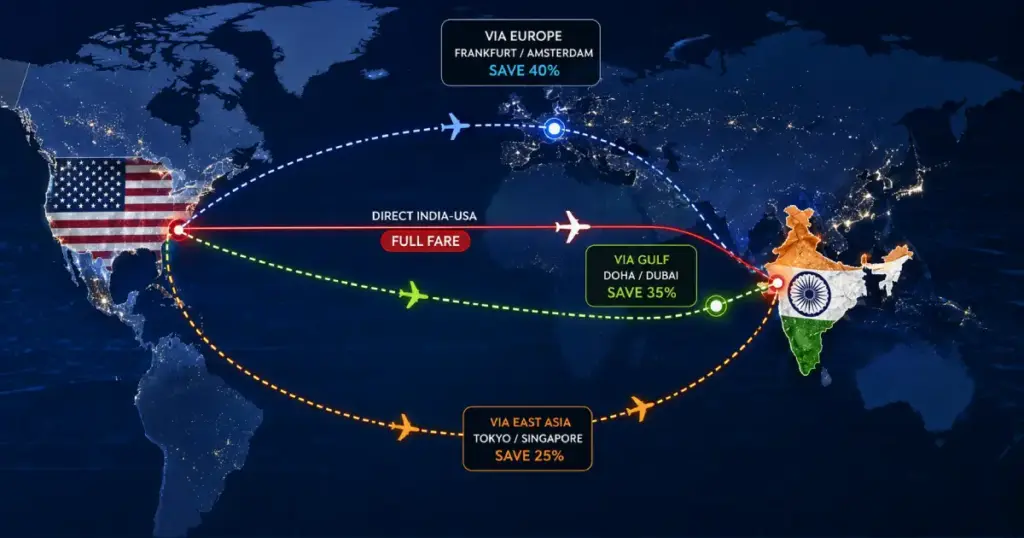
This guide breaks down the specific connecting routes to the USA that consistently save 40 per cent or more versus direct Air India fares, identifies which Gulf, European, and East Asian hubs work best for each US destination, and explains the two-ticket booking strategy that unlocks another 15 to 25 per cent of savings for flexible travellers. We also cover which connecting routes to avoid because their time penalty outweighs the fare savings and which US destinations genuinely reward connecting routes versus which are better flown direct. By the end, you will know the three optimal routing options for every major US city you might fly to from India.
Quick Facts – India to USA Connecting Flights
✓ Direct Delhi to New York on Air India: typically 95,000 to 138,000 rupees return in economy
✓ Best connecting via Europe (Lufthansa through Frankfurt or KLM through Amsterdam): 62,000 to 82,000 rupees return
✓ Best connecting via Gulf (Qatar Doha or Etihad Abu Dhabi): 58,000 to 78,000 rupees return
✓ Best connecting via East Asia (Singapore or Tokyo): 72,000 to 92,000 rupees return
✓ The Emirates Dubai route is often 10 to 20 per cent higher than Qatar’s and Etihad’s – compare all three.
✓ Two-ticket bookings (India to hub + hub to USA separately) can save an additional 15 to 25 percent for flexibletravelers.s
✓ Total journey time 18 to 26 hours for connecting versus 14 to 16 hours direct — the time vs money trade
Why Connecting Flights Can Be So Much Cheaper
The fare gap between direct and connecting flights from India to the USA is not accidental. It reflects a structural imbalance in the market. Air India operates the only direct flights on this route, which gives them pricing power. British Airways, Delta, United, and American Airlines all run one-stop services via London or Europe but do not compete aggressively on India originations. Meanwhile, Qatar Airways, Emirates, Etihad, Lufthansa, KLM, and Turkish Airlines run dense long-haul networks optimised for connecting traffic through their hubs, where empty-seat economics force them to discount heavily to maintain load factors. When you fly from India to the USA via Doha, you are not paying for a premium direct service – you are filling two flight segments that the airline needed filled anyway.
The second reason is route competition. Qatar Airways, Emirates, and Etihad all fly from Delhi and Mumbai to the US via their Gulf hubs, and all three compete on price. European carriers like Lufthansa and KLM compete with the Gulf carriers and with each other. This constant price competition benefits the passenger. On the direct India to USA leg, Air India has no direct competitor; every other option is a connecting flight, which means Air India’s pricing benchmark is the cheapest connecting fare plus a premium for the time saved. That premium is typically 25,000 to 45,000 rupees per ticket.
The Three Hub Regions: Gulf, Europe, East Asia
Gulf Hubs – Fastest Connecting Option
The Gulf hub route is the most commonly used by Indian travellers heading to the USA. Flights depart Delhi, Mumbai, or Bengaluru in the late evening or early morning, land in Doha, Dubai, or Abu Dhabi 3 to 4 hours later, connect within 2 to 4 hours, and depart for New York, Washington, Chicago, or San Francisco on a 14 to 16 hour long-haul leg. Total journey time is 18 to 22 hours. Qatar Airways via Doha and Etihad via Abu Dhabi are consistently the best value here, with return fares in the 58,000 to 78,000 rupee range during shoulder season. Emirates via Dubai is typically 10 to 20 percent more expensive than Qatar and Etihad for the same routing, reflecting its stronger brand pull.
European Hubs – Best for US East Coast
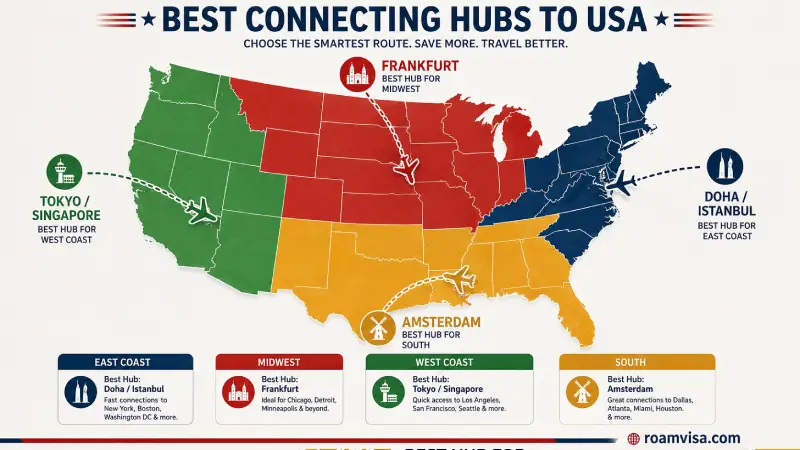
The European hub route via Frankfurt (Lufthansa), Amsterdam (KLM), London (British Airways), or Paris (Air France) works well for US East Coast destinations like New York, Boston, Washington DC, Philadelphia, and Atlanta. The first leg to Europe is 8 to 9 hours, the connection is 1.5 to 3 hours, and the transatlantic leg is 8 to 9 hours. The total journey is 19 to 22 hours. Return fares are typically 62,000 to 82,000 rupees, placing this route between the Gulf and East Asia in cost. The key advantage is that Schengen transit visa requirements are straightforward for most Indian passport holders on these connections, and the hub airports are genuinely efficient.
East Asia Hubs – Best for US West Coast
For the US West Coast (San Francisco, Los Angeles, Seattle), connecting via Singapore, Tokyo, Seoul, or Hong Kong can be genuinely faster and comparable in cost to Gulf routes. Singapore Airlines runs strong Delhi-Singapore-San Francisco connections. Japan Airlines and ANA operate via Tokyo Narita or Haneda. Korean Air flies via Seoul Incheon. Return fares are typically 72,000 to 92,000 rupees higher than Gulf but not by much, and the journey is often 2 to 4 hours shorter to the West Coast US because the Pacific route is more direct than going West via Europe or the Gulf.
The Specific Routing Comparison – Delhi and Mumbai to New York JFK
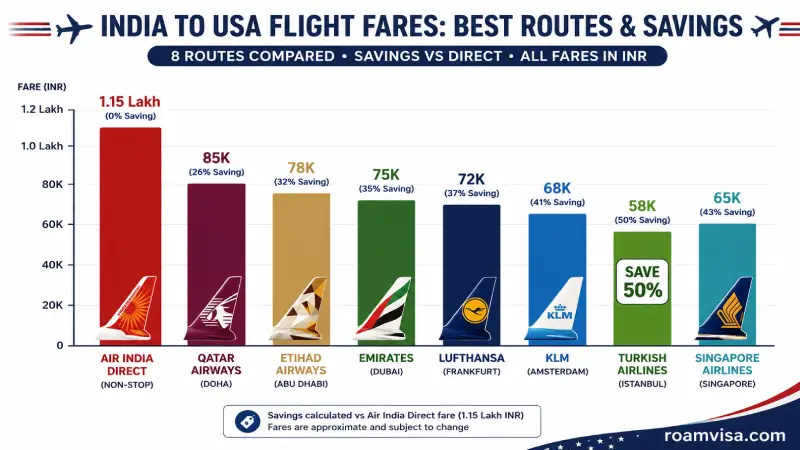
The table below shows realistic return economy fares from Delhi and Mumbai to New York JFK across the major connecting and direct options during a typical shoulder-season week (October or March). Fares are indicative – flash sales can drop 15 to 25 percent below these numbers during January or September.
| Routing | Avg Return INR | Total Journey | Layover Hub |
| Air India Direct Delhi-JFK | 115,000 – 138,000 | 14h 45m | None |
| Qatar via Doha | 62,000 – 78,000 | 19h 20m | Doha DOH (2.5h) |
| Etihad via Abu Dhabi | 64,000 – 80,000 | 20h 10m | Abu Dhabi AUH (3h) |
| Emirates via Dubai | 72,000 – 92,000 | 19h 55m | Dubai DXB (2.5h) |
| Lufthansa via Frankfurt | 68,000 – 88,000 | 20h 30m | Frankfurt FRA (2h) |
| KLM via Amsterdam | 65,000 – 85,000 | 20h 45m | Amsterdam AMS (2.5h) |
| Turkish via Istanbul | 58,000 – 76,000 | 21h 10m | Istanbul IST (3.5h) |
| Air France via Paris | 70,000 – 92,000 | 21h 05m | Paris CDG (2.5h) |
| Singapore via Singapore | 78,000 – 98,000 | 22h 40m | Singapore SIN (3h) |
The comparison above makes the savings visible. Turkish Airlines via Istanbul at 58,000 rupees is approximately 50 per cent less than Air India’s 115,000-rupee direct fare, a 57,000-rupee saving per ticket. For a family of four, that is 2.28 lakh rupees saved on one set of tickets. Qatar, via Doha, at 62,000 rupees saves 46 per cent. Even the most expensive connecting option, Singapore via Changi, is still 20 to 30 per cent cheaper than flying Air India direct.
READ MORE: Last Minute Cheap Flights to London – 5 Tricks to Save Big in 48 Hours
The Two-Ticket Strategy – Another 15 to 25 Per Cent Saving
The routings above are all single-ticket itineraries; one airline or airline alliance covers both legs. The two-ticket strategy splits your journey into two separate bookings: a cheap India-to-hub ticket, plus a separate hub-to-USA ticket. When done well, this saves an additional 15 to 25 per cent over even the cheapest single-ticket connecting option. When done badly, it costs you a missed connection and thousands of rupees in rebooking fees.
How the Two-Ticket Mechanics Work
Example: Book a Delhi to Istanbul ticket on Indigo or Turkish for around 22,000 rupees. Separately, book an Istanbul to New York ticket on Turkish Airlines for around 32,000 rupees.
Total: 54,000 rupees. Compare this to the single-ticket Turkish Delhi-Istanbul-JFK at 58,000
rupees; the two-ticket version saves 4,000 rupees. On the surface this is a modest saving. The real win comes when you combine a cheap Indian carrier (IndiGo Delhi-Istanbul at 15,000 rupees) with a separate US-bound carrier from Istanbul, Warsaw, or Amsterdam at 28,000 to 35,000 rupees.
The combined fare can hit 43,000 to 50,000 rupees, roughly 12,000 rupees below the cheapest single-ticket Turkish fare and 65,000 rupees below the direct Air India fare.
The Risk You Are Taking
With a single-ticket booking, if your first leg is delayed and you miss the second leg, the airline rebooks you for free. With two tickets, no one owes you anything. If your Delhi-Istanbul IndiGo flight is delayed and you miss the Istanbul-JFK Turkish flight, you have lost the Turkish ticket completely and must buy a new one at last-minute premium pricing. The correct way to mitigate this risk is to leave a generous buffer between your two bookings, ideally 6 to 10 hours in the connecting hub. An overnight hotel stay in Istanbul for 5,000 rupees turns a stressful same-day connection into a comfortable overnight split that is still cheaper than the single-ticket option.
Best Two-Ticket Combinations for Indian Travellers
The combinations that consistently work for India-USA two-ticket bookings are the following:
(1) IndiGo or low-cost to Istanbul + Turkish to USA
(2) IndiGo or Air Arabia to Dubai + Emirates or JetBlue via Doha to USA
(3) IndiGo to Singapore + Singapore Airlines or United to San Francisco
(4) IndiGo or Air India Express to Doha + Qatar Airways to East Coast USA. Always allow a minimum 6-hour buffer in the hub, and always re-check your bag rather than through-checking, because through-checking requires a single booking.
Which US Destinations Reward Connecting Routes Most
New York, Newark, Philadelphia, Boston, Washington DC
The US East Coast is where connecting routes deliver the biggest savings. The Atlantic crossing from European or Gulf hubs is efficient, airlines compete aggressively in this sector, and direct Air India fares are highest. Expected savings are 40 to 55 percent off direct fares. Qatar via Doha and Turkish via Istanbul are the two strongest options.
Chicago, Detroit, Cleveland
US Midwest cities work well with Lufthansa via Frankfurt, United via Newark or Washington, or Emirates via Dubai. Savings versus direct Delhi-Chicago on Air India typically run 35 to 45 percent. Qatar Airways also flies Doha to Chicago directly, making it a strong option.
San Francisco, Los Angeles, Seattle
The West Coast USA rewards East Asian connections as much as or more than Gulf routing. Singapore Airlines via Changi, ANA via Tokyo Narita, and Korean Air via Seoul are consistently competitive. Savings versus direct Delhi-San Francisco on Air India typically run 25 to 40 percent slightly less than East Coast routes because Air India’s direct competition is stronger for the West Coast.
Dallas, Houston, Atlanta, Miami
US South and Southeast cities are best served by a single European or Gulf connection plus a short US domestic leg. Qatar Airways to Atlanta direct is competitive. KLM via Amsterdam to Atlanta or Dallas also works. Savings versus Air India direct (which requires its own US domestic connection anyway) run 30 to 40 percent.
Five Pitfalls That Destroy Connecting Route Savings
- Booking a connection with less than a 2-hour layover at the hub: immigration, security, and gate transit can eat the full two hours at busy hubs like Dubai DXB and Frankfurt FRA.
- Not checking transit visa requirements for your specific hub – Schengen transit rules for Amsterdam and Frankfurt are more permissive than for Paris or Madrid; the UK requires a transit visa for non-Heathrow connections.
- Choosing a hub that is geographically backwards, connecting through Tokyo when flying to New York, adds 8 to 10 hours for minimal savings because Tokyo is the wrong direction.
- Through-checking luggage on a two-ticket booking- airlines will not through-check on separate tickets, and you will lose time re-checking bags at the hub.
- Booking the cheapest connecting fare without factoring in meals and entertainment – Turkish Airlines and Qatar include full meals and in-flight entertainment; some budget European connections do not.
Before You Book – Domestic US Connections Matter Too
If your US destination is outside the main international gateways, for example, flying to Cleveland, Austin, Minneapolis, or Nashville you will need a domestic US connection on top of your international leg. Our dedicated guide on the cheapest US domestic flights and how to find budget fares every time covers the airlines and booking tactics that keep the domestic leg affordable, which matters because a 15,000 rupee domestic add-on can erase much of your connecting-route international savings.
The connecting route strategy also depends on your US visa status. Indian travelers going to the USA need a valid B1/B2 tourist visa or equivalent, which takes 4 to 12 months to secure depending on the consulate and season. Before booking any non-refundable flight, confirm your visa is in hand. Our companion article on the cheapest months to fly to London with full month-by-month data shows a similar pattern of seasonal savings that applies across long-haul routes, so if you are comparing European destinations alongside USA travel, those timing rules hold too.
Final Thoughts
Flying from India to the USA does not have to cost 1.2 lakh rupees. The direct flight premium exists because Air India has no nonstop competitor and can price accordingly. Every other option is a connecting flight, and connecting flights are structurally cheaper because Qatar Airways, Turkish Airlines, Lufthansa, KLM, and Emirates compete with each other for the same traffic. The best connecting routes via Doha, Istanbul, or Amsterdam consistently save 40 to 55 percent versus direct Air India fares, for only 4 to 8 additional hours of travel. For most leisure and family travellers, that trade heavily favours connecting. If you are willing to add one more layer of complexity, the two-ticket strategy saves another 15 to 25 percent.
Combine a cheap Indian carrier to a Gulf or European hub with a separate Turkish, Qatar, or Etihad ticket onwards, leave a 6 to 10 hour buffer, and you can fly Delhi to New York for 45,000 to 55,000 rupees return. That is structurally half the direct fare, for a journey that is 4 to 6 hours longer. Make this trade consciously – if you are young, single, or travelling on leisure without tight connections, the saving is enormous. If you are a family with children or elderly parents, the direct flight premium may be worth it for the reduced fatigue. Both answers are correct for different travellers.
Frequently Asked Questions
What is the single cheapest connecting route from India to the USA?
Turkish Airlines via Istanbul consistently delivers the lowest return economy fares on India to USA East Coast routestypically 58,000 to 76,000 rupees from Delhi to New York JFK. Qatar Airways via Doha is a close second at 62,000 to 78,000 rupees. Both save 40 to 55 percent versus Air India’s direct fare.
Is the two-ticket booking strategy legal and safe?
Yes, entirely legal. You are buying two separate tickets that happen to form a useful itinerary. The risk is operational if your first flight is delayed, the second airline owes you nothing. Mitigate by leaving a minimum 6-hour buffer between flights and booking the two segments on your own credit card so you have payment leverage for any issues.
How much longer is a connecting flight versus a direct flight from India to the USA?
Connecting flights add 4 to 8 hours versus direct. Delhi to New York direct on Air India is 14h 45m. Delhi to New York via Qatar Airways is 19h 20m, adding about 4.5 hours. Via Turkish, Istanbul adds 6.5 hours. This is the time cost for saving 40 to 55 percent on the fare.
Do I need a transit visa for connections through Dubai, Doha, or Frankfurt?
Most Indian passport holders do not need separate transit visas for Doha, Dubai, or Frankfurt airport-only transit (under 24 hours, no exit from international zone). UK Heathrow and Paris CDG require more paperwork for longer stopovers. Always check current rules for your specific passport and layover length before booking.