
Dubai to Abu Dhabi Road Trip – Best Route, Stops and Tips

The Dubai to Abu Dhabi road trip is the most driven intercity route in the UAE and one of the most underestimated. Most people treat it as a commute: 140 kilometers of Sheikh Zayed Road, a couple of hours, arrive, done. But the journey between the UAE’s most glamorous city and its quietly confident capital has more to offer than the highway suggests. There is a mid-route beach that barely anyone knows about. There is a theme park island that is worth a half-day stop. There is the most architecturally stunning mosque in the Arab world waiting at the far end. And there is a drive that, at the right time of day, past the date palm farms and the desert haze of the Gulf, is genuinely beautiful in the specific way that the Arabian Peninsula is beautiful: wide, warm, and utterly itself.
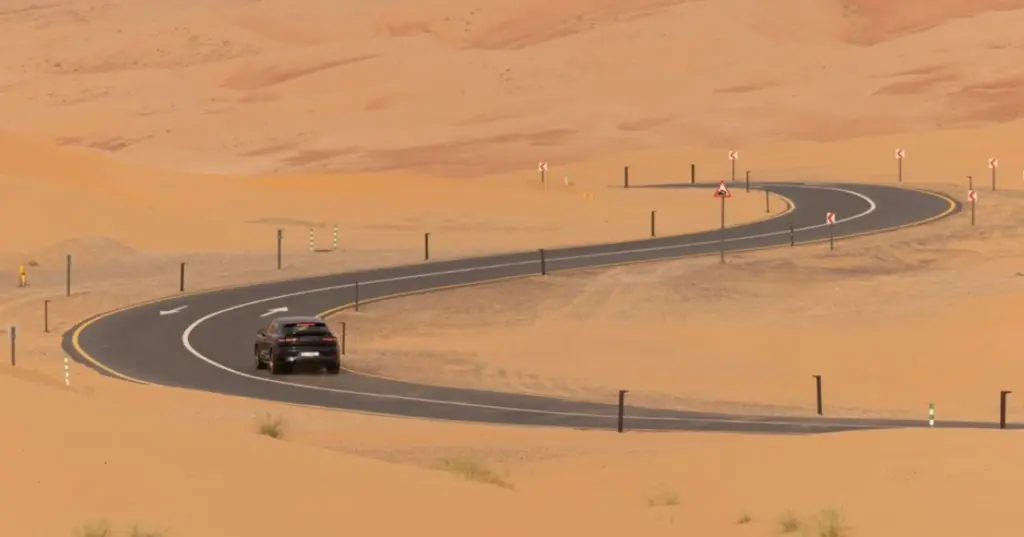
The route is simple by the standards of any road trip: two highways, one direction, and no navigational complexity, but simple does not mean there is nothing to know. The Salik toll system can catch first-time UAE drivers off guard. The difference between the two main routes matters depending on your timing and your tolerance for traffic. The best time to leave makes a 45-minute difference to your journey time. And Abu Dhabi as a day-trip destination rewards the visitor who plans the afternoon, not just the drive.
This guide covers all of it: the two routes and when to use each, every worthwhile stop between the two cities, the full Abu Dhabi day-trip itinerary, practical driving rules in the UAE, and the tips that make the difference between a forgettable highway drive and a genuinely enjoyable day out.
Quick Facts – Dubai to Abu Dhabi Road Trip
Distance: 140–160 km, depending on the starting point in Dubai
Drive Time: 1.5 to 2 hours in normal traffic · avoid 7–9am and 5–7pm weekdays
Main Route: E11 Sheikh Zayed Road direct, coastal views, toll road (AED 4 per Salik gate)
Alternative: E311 Sheikh Mohammed Bin Zayed Road parallel, faster in peak hours, toll-free
Salik toll: AED 4 per gate on E11 · register a Salik tag or top up before the journey
Speed limits: 120–140 km/h on open highway · strictly enforced by cameras throughout UAE
Best Season: November to March temperatures 20–28°C; comfortable for driving and sightseeing
Best Departure Time: Before 7am (sunrise drive is stunning) or 10am–2pm (off-peak smooth flow)
Dress Code: Modest dress required at Sheikh Zayed Grand Mosque: shoulders and knees covered
The Two Routes: E11 vs E311
E11 – Sheikh Zayed Road: The Scenic Main Highway
The E11 Sheikh Zayed Road is the most famous highway in the UAE and the standard route for the Dubai to Abu Dhabi drive. It leaves Dubai heading southwest along the coast, passing through Jebel Ali and out into the open desert before reaching the Abu Dhabi emirate boundary and continuing into the capital. The E11 is a six-lane motorway, well-maintained, clearly signed, and equipped with multiple service stations along the way that are genuinely worth stopping at; many of them have decent cafés, prayer rooms, clean restrooms, and ENOC, ADNOC, or Emarat fuel stations.
The downside of the E11 is the Salik toll system and peak-hour congestion. Salik is Dubai’s automated road toll cameras above the highway that photograph your number plate as you pass under a gate and deduct AED 4 from your pre-registered account. If you are driving a rental car, the rental company will have registered the vehicle and will charge the toll to your card with an administrative fee on top. If you are driving your own car, top up your Salik account online before the journey. There are two Salik gates between Dubai and the Abu Dhabi border; a third may be encountered depending on where you join the E11 in Dubai. At peak hours weekday mornings from 7am to 9am and evenings from 4:30pm to 7pm the E11 can slow significantly from Dubai’s southern exits. On weekend mornings, it runs smoothly throughout.
E311 – Sheikh Mohammed Bin Zayed Road: The Faster Alternative
The E311 runs parallel to the E11 but cuts further inland, bypassing the coastal stretches and most of the urban centres along the southern Dubai corridor. It is toll-free with no Salik gates and during peak hours it is consistently faster than the E11 as it does not carry the same volume of commuter traffic. The road passes through areas like Arabian Ranches and Dubai World Central (near Al Maktoum Airport), and the views are more purely desert than the E11’s coastal stretches, but the overall drive time is similar on an open road. When Google Maps suggests the E311, it is usually because there is an accident or congestion on the E11 accept the reroute. Both highways merge as you approach Abu Dhabi’s outer ring roads.
| Feature | E11 Sheikh Zayed Road | E311 Sheikh Mohammed Bin Zayed Rd |
|---|---|---|
| Toll | AED 4 per Salik gate (2–3 gates) | Toll-free |
| Scenery | Coastal views, Jebel Ali, open Gulf | Inland desert, Arabian Ranches area |
| Peak hour traffic | Can be slow Dubai exits congested | Generally faster than E11 at peak |
| Service stations | Multiple well-equipped stops | Fewer stops; some ADNOC stations |
| Best for | Leisure drives, scenic experience | Peak hour travel, saving time |
| Google Maps | Default route in off-peak | Suggested when E11 has congestion |
Best Stops Between Dubai and Abu Dhabi
1. Last Exit Dubai (E11, near Jebel Ali)
One of the most talked-about roadside stops in the UAE, Last Exit is a food truck park concept just before you leave Dubai on the E11. The site has a retro American road-trip aesthetic, neon signs, vintage cars, mismatched outdoor furniture, and around 20 food and beverage trucks serving everything from burgers and tacos to specialty coffee and desserts. It is a great early stop for breakfast or coffee before committing to the highway, and the atmosphere is genuinely enjoyable in the cooler months. It sits on the left side heading out of Dubai and has clear signage. Open daily from early morning to late evening.
2. Ghantoot Beach (Dubai–Abu Dhabi Border Area)
This is the road trip’s best-kept secret. Ghantoot lies right on the Dubai–Abu Dhabi border, a coastal area with quiet sandy beaches and the upscale Golden Tulip Ghantoot Resort. The beach itself is accessible to resort guests and day visitors who purchase a pass from the hotel. It is one of the calmest stretches of Gulf coast along this entire route with no development noise, soft sand, clear water, and virtually no other tourists. If you are making this a slow road trip rather than a day commute, a couple of hours at Ghantoot in the morning before the Abu Dhabi heat peaks is one of the best midpoint stops on the UAE highway network.
3. Al Samha Rest Stop (Midway, Both Routes)
Located roughly halfway between Dubai and Abu Dhabi, Al Samha is the most practical fuel and refreshment stop on the route. It is accessible from both the E11 and E311, has ADNOC and other petrol stations, clean restrooms, prayer rooms, and several café and fast food options. It is not a destination in itself it is the reliable, efficient stop that long-distance drivers in the UAE know well. If you are making an early start and skipped breakfast in Dubai, Al Samha is the right place to stop. It is also the last decent rest point before you enter Abu Dhabi’s urban approaches.
4. Yas Island (Abu Dhabi First Stop on Arrival)
Yas Island sits just off the Abu Dhabi coast, connected by bridge from the E11, and it is the most entertainment-dense piece of real estate in Abu Dhabi. Ferrari World Abu Dhabi home to Formula Rossa, the world’s fastest roller coaster, and the largest indoor theme park roof in the world is the flagship attraction. Yas Waterworld and Warner Bros World Abu Dhabi are on the same island. The Yas Marina Circuit hosts the Abu Dhabi Formula 1 Grand Prix every November, and on non-race days the circuit walk is free. Yas Mall is one of Abu Dhabi’s largest shopping centres if retail therapy is needed after the highway.
For most visitors on a day trip from Dubai, Yas Island works best as either a morning destination before the city heat peaks or an afternoon destination after the cultural sites. Ferrari World requires pre-booked tickets and a half-day at minimum do not underestimate the park’s size. The drive from the main E11 to Yas Island is clearly signed and takes about 10 minutes off the highway.
Abu Dhabi Day Trip – The Best Itinerary
Abu Dhabi is the UAE’s capital and the seat of its federal government, and it has a completely different personality from Dubai. Where Dubai is propulsive and competitive, always building the tallest, the largest, the most extreme, Abu Dhabi is more assured, more culturally focused, and considerably more relaxed in its approach to visitors. The city has two UNESCO-recognised cultural institutions, two of the world’s best theme parks on a single island, and the Grand Mosque. That alone is more than enough for a day trip from Dubai. Here is the itinerary that gets the most from Abu Dhabi in a single visit.
Morning: Sheikh Zayed Grand Mosque
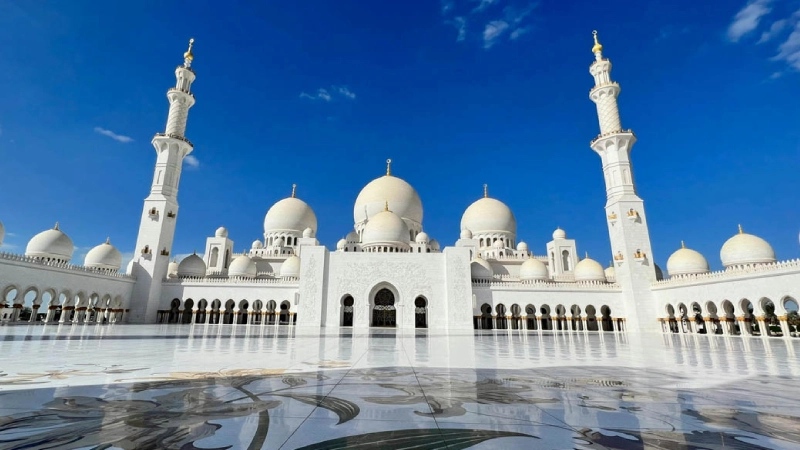
The Sheikh Zayed Grand Mosque is one of the most extraordinary buildings in the world not in the hyperbolic way that many attractions are described, but genuinely. The mosque covers 22,412 square metres and can accommodate 41,000 worshippers. It has 82 domes, over 1,000 columns, and the world’s largest hand-knotted carpet (5,627 square metres, woven by 1,200 artisans). The main prayer hall contains a chandelier that took two years to install and weighs 9 tonnes. None of these statistics prepare you for the actual experience of standing in the main courtyard and seeing the white marble reflect the morning light in every direction.
Related Articles: Best Road Trips in Europe- Top Routes for First-Time Drivers
Entry is completely free. The mosque is open to non-Muslim visitors from 9am–10pm daily (closed during Friday prayers; reopen at approximately 4:30pm on Fridays). Modest dress is mandatory: both men and women must cover shoulders and knees; women must also cover their hair. Abayas and head coverings are available for loan at the entrance at no charge if you have not brought your own. Go in the morning for the best light. The white marble and the reflective pools are extraordinary in early morning sun. The guided tours (free, departing regularly from the visitor centre) are excellent and explain the architectural and historical context far better than self-guiding.
Midday: Louvre Abu Dhabi
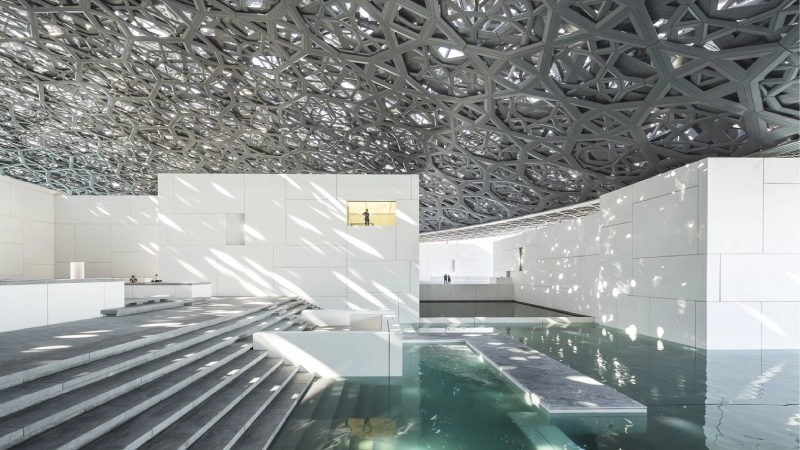
The Louvre Abu Dhabi, opened in 2017 on Saadiyat Island, is one of the most architecturally significant museum buildings constructed anywhere in the world in the last 30 years. Jean Nouvel’s design a vast disc roof that filters the Gulf sunlight into a rain of light patterns across the museum and the surrounding water, is itself worth the visit before you enter the galleries. Inside, the permanent collection tells the story of human civilization across cultures and centuries in a genuinely non-Eurocentric way that is unusual among major world museums. The Egyptian, Mesopotamian, Islamic, and modern art collections are all strong. Admission is AED 63 for adults; children under 13 are free.
Saadiyat Island, where the Louvre sits, also hosts the Zayed National Museum (opening 2025–26) and the Guggenheim Abu Dhabi (under development). The ‘Cultural District’ ambition is real and the beach at Saadiyat wide, clean, and some of the best in Abu Dhabi is a rewarding stop after the museum if you have time before the drive back.
Afternoon: Corniche and Etihad Towers
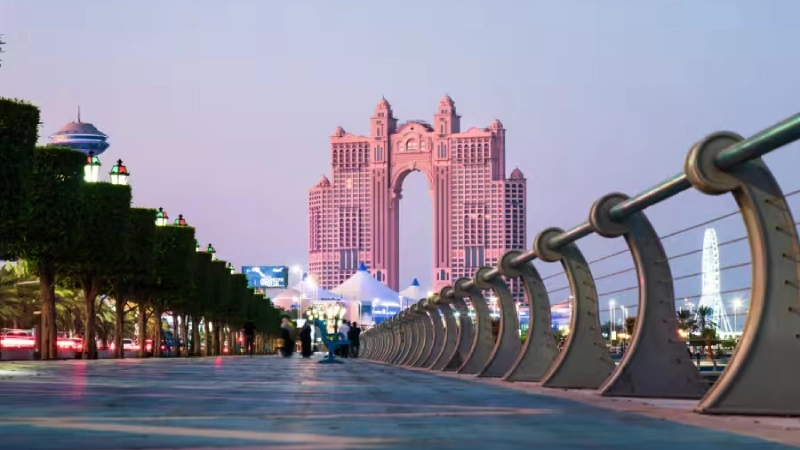
Abu Dhabi’s Corniche is an 8-kilometre public waterfront promenade along the Gulf cleaner, calmer, and significantly less crowded than Dubai’s equivalent stretches. The beach at the Corniche is free (there are paid sections with facilities and free sections; both are good), the views across the Gulf are clear on most days, and the line of towers behind the Corniche including the Etihad Towers gives Abu Dhabi its unmistakable skyline. The observation deck at Etihad Towers (305 metres up) has Gulf views in every direction and on clear days the visibility extends to Dubai. Afternoon light here is excellent.
Driving in the UAE – Rules Every Visitor Must Know
Speed Limits and Cameras
The UAE takes road speed enforcement seriously. Speed cameras are common, fixed, and often do not give any visible warning. The standard open highway limit is 120 km/h, with some sections of the E11 signed at 140 km/h. Most cameras have a tolerance of approximately 20 km/h above the posted limit before issuing a fine, but this tolerance is not guaranteed and should not be relied upon. Speed fines in the UAE are significant. Cruise control at the posted limit is the practical advice on any UAE highway. In towns and on smaller roads, the limit drops to 60–80 km/h; in residential areas and near schools it drops to 40 km/h.
Salik Tolls How They Work
Salik is Dubai’s electronic road toll system. The name means ‘smooth’ in Arabic and the system genuinely is seamless once registered. Cameras above toll gates photograph your vehicle’s number plate as you pass under them. If you drive your own UAE-registered car, top up your Salik account at a Salik kiosk, online at salik.ae, or at any petrol station displaying the Salik logo before you travel. If you rent a car, the rental company handles the toll but will charge you the toll amount plus an administrative fee per gate, per trip typically AED 4 toll + AED 5–15 admin. Check your rental agreement to understand what the fee structure is before you drive.
The E311 has no Salik gates at all, making it the cost-free alternative if you are paying tolls on a rented vehicle. The Abu Dhabi side of the highway currently has no equivalent toll system, so all charges apply only on the Dubai section of the E11.
Other Key Driving Rules
- Zero tolerance for drink driving: the legal blood alcohol limit in the UAE is 0.0% not 0.05%, not 0.08%. No alcohol before driving, ever
- Mobile phone use: illegal to hold your phone while driving hands-free only; fines are immediate and steep
- Seatbelts: mandatory for all passengers including rear seats fines for non-compliance
- Right of way: in UAE roundabouts, vehicles already in the roundabout do not have automatic right of way watch local traffic patterns
- Flashing headlights: in the UAE, flashing from behind means ‘move over, I want to pass’ move to the right lane promptly
- Parking in Abu Dhabi: paid parking operates in the centre check metres or the Mawaqif app for zones and rates
Sample One-Day Dubai to Abu Dhabi Road Trip Itinerary
| Time | Activity | Duration | Notes |
|---|---|---|---|
| 7:00am | Depart Dubai on E11 (off-peak) | 90 min drive | Early start avoids heat; sunrise on highway |
| 8:30am | Sheikh Zayed Grand Mosque | 2–3 hours | Pre-book online; arrive at opening for best light |
| 11:30am | Saadiyat Island Louvre Abu Dhabi | 2 hours | AED 63 adult; under 13 free; café inside |
| 2:00pm | Yas Island Ferrari World or Yas Waterworld | 3–4 hours | Pre-book tickets; half-day at minimum |
| 5:30pm | Abu Dhabi Corniche sunset walk | 45 minutes | Free; excellent sunset views over the Gulf |
| 6:30pm | Dinner on the Corniche or Yas Island | 1 hour | Wide choice of restaurants; Yas has international options |
| 7:30pm | Return drive to Dubai on E311 | 90 min drive | E311 avoids any remaining evening congestion |
Tips for the Dubai to Abu Dhabi Road Trip:
✔ Best departure time: Before 7am (empty roads, gorgeous sunrise) or between 10am–2pm (off-peak smooth drive)
✔ Return via E311: At 7–8pm the E311 is faster and toll-free save both time and money on the return leg
✔ Ferrari World: Buy tickets online in advance gate prices are higher and queues at the ticket desk add time
✔ July–September heat: 38–42°C plan all outdoor activity before 10am or after 6pm; stay indoors 11am–4pm
✔ November–March: Ideal weather comfortable temperatures for Corniche walks, mosque visits, and Yas Island outdoors
✔ Rental car Salik: Ask the rental company exactly how Salik is billed before you leave Dubai to avoid bill surprises
✔ Photography at the mosque: Photography is permitted in the courtyards and gardens; ask before photographing worshippers
Extend the Trip: What Else to Explore Near Abu Dhabi
Al Ain – The Garden City (45 minutes from Abu Dhabi)
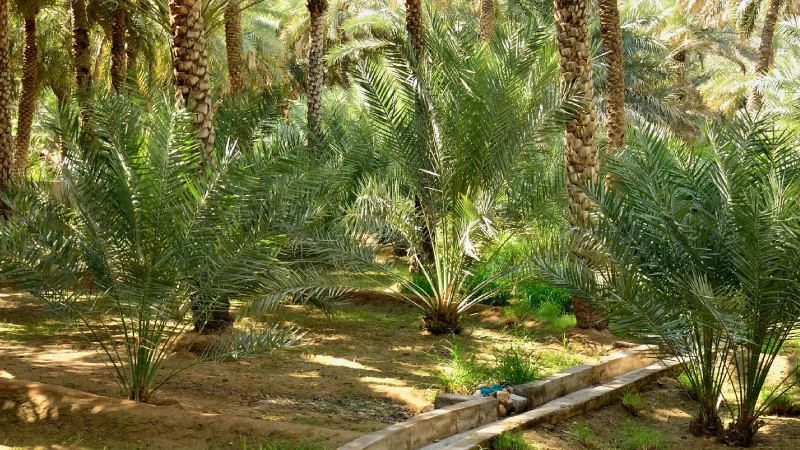
Al Ain is Abu Dhabi’s second city and one of the most pleasant places in the UAE for a two-day extension. The city is significantly greener than the coast hence its ‘Garden City’ nickname and sits at the base of Jebel Hafeet, a 1,249-metre mountain with a winding road to the summit that is one of the best drives in the UAE. Al Ain Oasis is a UNESCO World Heritage Site: date palm gardens irrigated by the ancient falaj channel system, cool and fragrant, with paths running through thousands of trees. Al Jahili Fort at the heart of the oasis is one of the finest preserved forts in the Arabian Peninsula. Drive time from Abu Dhabi city: approximately 90 minutes on E22.
Eastern Abu Dhabi – Liwa and the Empty Quarter
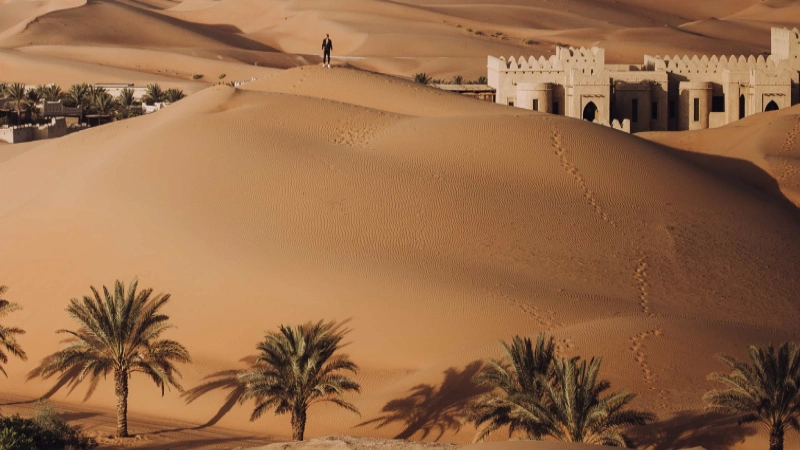
For travellers who want the full desert experience, the road south from Abu Dhabi towards the Saudi border leads into the Liwa Oasis and the edges of the Rub’ al Khali the Empty Quarter, the largest continuous sand desert in the world. The dunes here are on a different scale from anything near Dubai: 200 metres high in places, with an orange-red colouring that deepens towards sunset. A 4WD is essential for any off-piste exploration, but the road to Liwa itself (Highway E45 south from Abu Dhabi) is paved and can be driven in any car. The Liwa Oasis town has hotels, fuel, and good local restaurants. This is an overnight trip rather than a day trip 250 km from Abu Dhabi city.
Frequently Asked Questions
Q1. How long is the drive from Dubai to Abu Dhabi?
Approximately 1.5 to 2 hours in normal traffic. The distance is 140–160 km depending on your starting point in Dubai. Avoid weekday rush hours (7–9am and 5–7pm) to keep the journey at the lower end of this range.
Q2. Which is better, E11 or E311?
E11 (Sheikh Zayed Road) is the standard scenic route with coastal views, more service stations, but has Salik tolls (AED 4 per gate). E311 is toll-free, slightly more inland, and faster during peak hours. Use E311 when E11 has congestion, or for the return journey in the evening.
Q3. Do I need to pay Salik tolls on the Dubai to Abu Dhabi drive?
Yes, if you take the E11. Salik gates charge AED 4 each; there are 2–3 gates between Dubai and the Abu Dhabi border depending on where you join the highway. If you rent a car, the rental company charges the toll plus an admin fee. The E311 is entirely toll-free.
Q4. What is the dress code for Sheikh Zayed Grand Mosque?
Both men and women must cover shoulders and knees. Women must also cover their hair. Abayas and head scarves are available on loan at the entrance for free if you have not brought your own. Open-toed shoes are fine but you will be asked to remove footwear before entering the prayer hall.
Q5. Is Abu Dhabi worth a day trip from Dubai?
Absolutely. The Sheikh Zayed Grand Mosque alone justifies the drive. Add Yas Island’s Ferrari World or the Louvre Abu Dhabi and you have a genuinely full and varied day. November to March is the ideal time to visit.
Conclusion
The Dubai to Abu Dhabi drive is one of those journeys that rewards the traveller who treats it as a destination in its own right rather than simply a transfer. The E11 is smooth, the desert views are wide and warm and particular to this corner of the world, and the city at the end quieter, more assured, and less frantically ambitious than Dubai offers some of the finest architecture and cultural experiences in the entire Middle East. The Grand Mosque at opening hour, with the morning light catching the white marble and the reflective pools still and silent, is one of those experiences that people carry home and find difficult to describe adequately.
Leave Dubai before 7am if you can manage it. Watch the highway empty out into the desert as the city falls behind. Stop at Last Exit for coffee while it is still cool. Pull over at Ghantoot and walk to the water for ten minutes. Arrive at the mosque before the tour groups. The drive takes 90 minutes on an open road. What you make of the day at the other end is entirely up to you but Abu Dhabi is one of the places that reliably delivers more than most visitors expect, and that is the best thing you can say about any destination.v


