Dubai Visa on Arrival vs Apply in Advance – Which Is Safer

Planning a trip to Dubai sounds exciting, but one question confuses many travellers: should you rely on a visa on arrival or apply in advance?
While visa on arrival may seem convenient, it is not always the safest option for every nationality or travel situation. Airport delays, document issues, changing immigration rules, or airline boarding checks can sometimes create unexpected problems at the last minute.
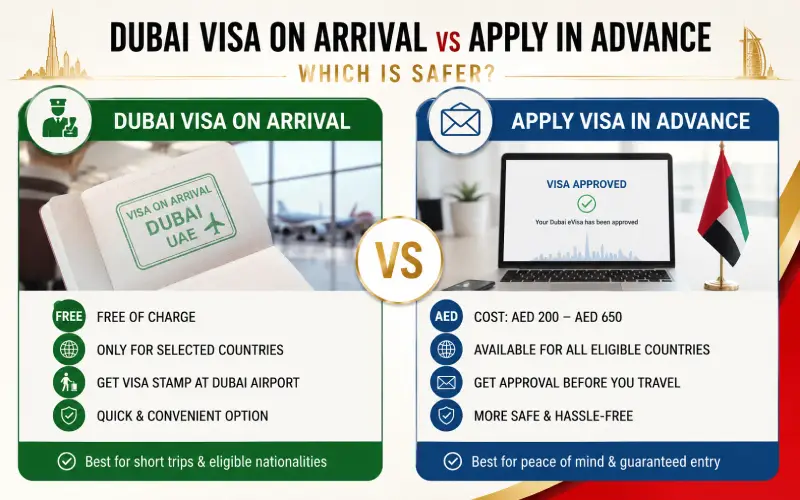
Applying in advance usually gives travellers more peace of mind because your visa approval is already confirmed before departure. It also helps avoid long queues and uncertainty after landing in Dubai. However, visa on arrival can still work well for eligible passport holders who meet all UAE entry requirements and prefer flexible travel plans.
In this guide, we compare both options honestly-including safety, approval certainty, processing time, costs, risks, and which travelers should choose each route before booking flights to Dubai.
Quick Facts: Dubai Visa on Arrival vs Advance
✔ Visa on arrival: free, 30–90 days, available to select nationalities only at UAE airports
✔ Advance visa: required for Indians unless holding a valid US, UK, or Schengen visa
✔ Processing: on arrival = instant at airport | advance = 2–5 working days
✔ Cost: on arrival = free | advance = AED 200–650 depending on duration
✔ Safer option: advance visa – no airport uncertainty, no queue, no discretion risk
✔ Indian passport: 14-day visa on arrival available if holding valid US Green Card or qualifying residency
How Dubai’s Visa System Works
Dubai follows a nationality-based entry system. Your passport determines whether you receive a visa on arrival, need to apply in advance, or enter visa-free as a GCC citizen. There are three
Categories: visa-free (GCC nationals), visa on arrival (selected nationalities), and advance visa required (most Asian and African passport holders, including Indians).
Understanding which category you fall into is the first – and most critical – step in planning your Dubai trip. Assuming you qualify for a visa on arrival when you do not can result in being denied boarding at your departure airport, days before you even reach Dubai.
Who Gets a Visa on Arrival in Dubai?
Visa on arrival at UAE airports is available to passport holders of specific countries. The key groups are:
30-Day Visa on Arrival – Free of Charge
- Citizens of the USA, UK, EU countries, Canada, Australia, Japan, South Korea, Singapore, Hong Kong, New Zealand, Malaysia, Brunei, Mauritius, Monaco, Ukraine, and several others
- British, American, Australian, and most Western passport holders receive a free 30-day stamp on arrival – extendable once for another 30 days
90-Day Visa on Arrival – Free of Charge
- Citizens of all Schengen Area countries receive a 90-day multiple-entry visa on arrival, valid for 6 months from issue date
- Citizens of Brazil, Argentina, Chile, and selected Latin American countries also qualify for 90 days on arrival
Indian Passport Holders – Special Cases
- Holders of a valid US permanent resident (Green Card) valid for at least 6 months: eligible for 14-day visa on arrival, fee USD 63
- Indian passport holders with EU residence permits (from select countries), Australian, Canadian, Japanese, New Zealand, South Korean, or Singaporean residence permits – eligible for on arrival
- Indian nationals with normal passports and no qualifying foreign residency: must apply for a visa in advance
Advance Visa – Who Needs It and How It Works
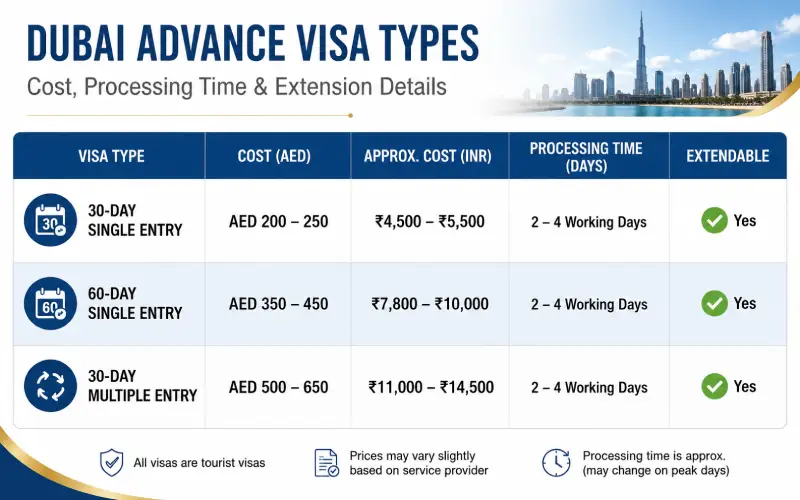
If your nationality is not on the visa-on-arrival list, or if you prefer the certainty of a confirmed approval before you leave home, an advance Dubai visa is the answer. It is applied for online through GDRFA, ICP, or authorized travel agents and sent to you by email before your trip.
| Visa Type | Duration | Cost (AED) | Approx. INR | Processing |
|---|---|---|---|---|
| 30-Day Single Entry | 30-day stay | AED 200 | ≈ ₹4,600 | 2–3 working days |
| 60-Day Single Entry | 60 days stay | AED 300 | ≈ ₹6,900 | 3–5 working days |
| 30-Day Multiple Entry | 30 days/visit | AED 650 | ≈ ₹14,950 | 3–5 working days |
| Transit 48-Hour | 48 hours | Free (airline) | – | Pre-travel |
| Transit 96-Hour | 96 hours | AED 50 | ≈ ₹1,150 | Via airline |
READ MORE: Dubai Visa for Indians – A Complete Step-by-Step Guide (Updated 2026)
On Arrival vs. Advance Visa – Which Is Safer?
If you are eligible for a visa on arrival, it is technically safe – millions of travelers use it without issue every year. However, ‘eligible’ and ‘guaranteed’ are not the same thing. UAE immigration officers retain discretion at the border. If your passport is worn, your documents raise questions, or the officer has concerns about your intent, they can refuse entry even to on-arrival eligible nationalities.
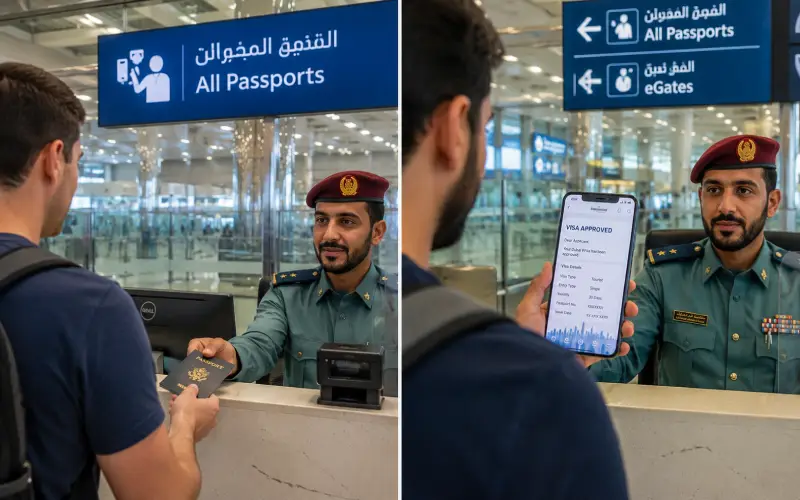
An advance visa removes that uncertainty entirely. You have confirmed government-issued permission before you leave home. Airlines can see your approval. Border processing is faster. There is nothing to doubt at the immigration counter.
- On arrival: convenient, free, no paperwork ahead of time – but subject to discretion at the airport
- Advance visa: costs AED 200–650, takes 2–5 days, but you board your flight with certainty
- For Indian travellers: advance visa is not optional – it is mandatory unless you hold a qualifying foreign residency permit
Final Thoughts
For most travelers from Western countries, a Dubai visa on arrival is a seamless experience – free, fast, and reliable. It has been working smoothly for millions of visitors for years, and there is no reason to overcomplicate it if your nationality qualifies cleanly. For Indian passport holders, the answer is clear: apply in advance. The advance visa process is straightforward, costs around ₹4,600 for a 30-day visa, and takes 2 to 3 working days online.
That is a small price for knowing your Dubai trip is confirmed before you board your flight. Whichever route applies to you – check your eligibility on the official UAE government portal or Emirates Airline’s visa information page before booking anything. Rules change, nationality lists update, and assumptions at the boarding gate are where Dubai trips go wrong.
Frequently Asked Questions
Do Indian passport holders get Dubai visas on arrival?
Generally no. Indian nationals with a standard passport must apply for a Dubai visa in advance. The exception is Indian passport holders with a valid US Green Card or select EU residency permits or qualifying residency from Australia, Canada, Japan, New Zealand, Singapore, or South Korea.
How long does a Dubai visa on arrival last?
30 days for most qualifying nationalities, extendable once for another 30 days. Citizens of Schengen countries and certain Latin American nations receive 90 days. Mexican passport holders receive up to 180 days.
Is it cheaper to get a Dubai visa on arrival or in advance?
Visa on arrival is free for qualifying nationalities. An advance visa costs AED 200 to AED 650 depending on type and duration. For nationalities that qualify for both, arriving saves money – but advancing gives certainty.
Can I be refused entry on a Dubai visa on arrival?
Yes. UAE immigration officers have discretion at the border. Even if your nationality qualifies, you can be refused if the officer has concerns about your documents, purpose, or intent. An advance visa does not completely eliminate this risk but significantly reduces it.
How far in advance should I apply for a Dubai visa?
Apply at least 5 to 7 working days before your travel date. Most advance Dubai visas are processed within 2 to 5 working days, but applying early avoids stress from any processing delays.