
Interrail vs. Eurail Pass is one of the most searched questions in European train travel, and the answer is, at its core, entirely simple. The two passes are almost identical in how they work, what they cover, and what they cost. The one difference that matters is who can buy them. If you live in Europe, you need an Interrail pass. If you live outside Europe, you need a Eurail pass. That is genuinely the complete answer to the Interrail vs Eurail question.

Where it gets more interesting and where most travellers actually need guidance is in the broader question of whether either pass is worth buying at all. A Eurail or Interrail Global Pass sounds like a liberating way to explore 33 countries by train. And it can be. But it comes with a price that startles most first-time buyers, a network of seat reservation fees that can add significantly to the base cost, and a set of conditions particularly around high-speed trains in France and the Eurostar that catch people off guard.
This guide cuts through the confusion. It explains exactly who qualifies for which pass, how the different pass types work, what 2025 prices look like, when a pass genuinely saves money over buying individual tickets, and what the seat reservation reality means for popular routes. By the end, you will know clearly whether a pass is the right choice for your specific trip and if it is, exactly which one to buy.
Quick Facts – Interrail vs Eurail
Eurail Pass: For travellers who live OUTSIDE Europe USA, Canada, Australia, Asia, Africa, etc.
Interrail Pass: For Travellers who are European citizens or legal residents of a European country
Rule: Where you LIVE determines which pass you buy not your passport nationality
Price: Both are essentially the same price; Interrail is occasionally slightly cheaper
Coverage: 33 countries for both passes Interrail covers 33; Eurail covers 33 (identical network)
Home Country Rule: Interrail holders can only use the pass in their home country on 2 travel days
Both Are Digital: Mobile pass via the Rail Planner app no paper required
Seat Reservations: Required on most high-speed trains an EXTRA cost on top of the pass price
Children Aged 4–11: Need their own pass, but it is FREE when travelling with an adult
Youth Discount: Ages 12–27 get a significantly reduced Youth Pass rate
The One Real Difference: Who Can Buy Each Pass
The eligibility rule for Interrail and Eurail is based entirely on where you live, not on which passports you hold. European residence whether you are a citizen of a European country or hold official legal residency there means you buy an Interrail pass from interrail.eu. Non-European residence if your home is in North America, Asia, Africa, South America, Australia, or anywhere else outside Europe means you buy a Eurail pass from eurail.com.
If you have dual citizenship one European passport and one non-European passport the rule is still based on where you actually live. Live in Europe: Interrail. Live outside Europe: Eurail. If you hold two European passports and live in a third European country, use the passport of the country where you live. A driver’s licence or temporary residency document is not accepted as proof; you need an official passport or national ID card. The UK is included in the European network for both passes despite Brexit UK residents buy Interrail.
The practical implication of the home country rule matters specifically for Interrail holders. An Interrail pass cannot be used for unlimited travel within your own country. You are allowed just two travel days within your country of residence: one outbound journey at the start of your trip, and one inbound journey on your return. After those two days are used, your pass is not valid for domestic travel in your home country. This does not affect Eurail holders at all, since they are travelling from outside Europe and have no ‘home country’ within the network.
| Criteria | Interrail Pass | Eurail Pass |
|---|---|---|
| Who can buy | European citizens & legal residents | Non-European residents (USA, Asia, etc.) |
| Where to buy | interrail.eu | eurail.com |
| Countries covered | 33 European countries | 33 European countries (same network) |
| Home country travel | 2 travel days only (in/out) | No restriction no home country in network |
| Price | Essentially same (Interrail sometimes cheaper) | Essentially same as Interrail |
| Digital pass | Yes Rail Planner app | Yes Rail Planner app |
| Youth rate (12–27) | Yes | Yes |
| Senior rate (60+) | Yes 10% discount | Yes 10% discount |
| Children 4–11 | Free pass with adult | Free pass with adult |
| Max validity | Up to 1 month for Global Pass | Up to 3 months for Global Pass |
Pass Types: Global Pass, One Country Pass, Flexi vs Consecutive
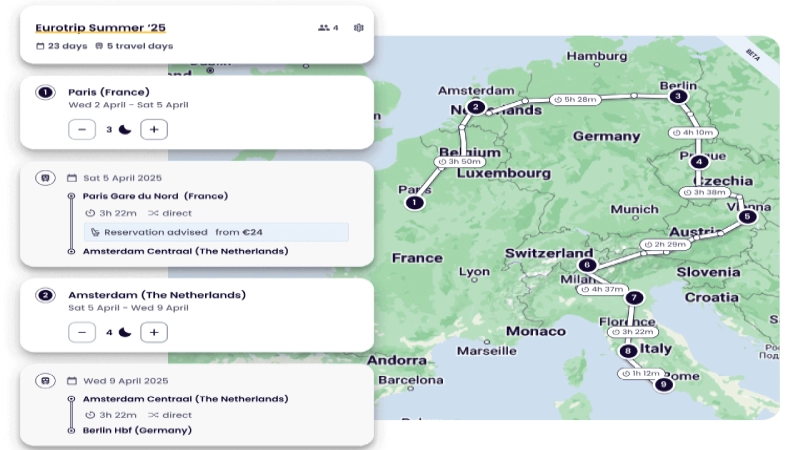
Both Interrail and Eurail offer the same types of passes, and the terminology is identical. The first decision is between a Global Pass which covers all 33 countries in the network and a One Country Pass, which covers unlimited travel within a single country of your choice. The second decision, for the Global Pass, is between a Consecutive Pass and a Flexi Pass.
Global Pass vs One Country Pass
The Global Pass makes sense if your trip covers three or more countries, particularly if those countries include expensive rail markets like Switzerland, France, or the Netherlands. If you are spending two weeks in Italy, for example, a One Country Pass for Italy is likely better value and cheaper than a Global Pass. The Benelux Pass covers Belgium, the Netherlands, and Luxembourg under a single One Country Pass useful for a focused trip through those three. The Scandinavia Pass covers Denmark, Finland, Norway, and Sweden. Note that Great Britain and Switzerland are only covered by the Global Pass there are no One Country Passes for those two countries.
Consecutive Pass vs Flexi Pass
A Consecutive Pass covers every single day for its entire validity if you buy a 15-day consecutive pass, you have 15 consecutive days of unlimited train travel from the activation date. This is only good value if you are genuinely on a train every day. A Flexi Pass gives you a fixed number of travel days within a longer period for example, 7 travel days within a 1-month window, or 15 travel days within a 2-month window. On any one travel day, you can take as many trains as you like. The Flexi Pass is significantly more popular and better value for most travellers, because it lets you have rest days, city exploration days, and days off the train without burning through your pass.
A critical and often-overlooked rule: on a Flexi Pass, if you use a free benefit included in your pass on a particular day a museum entry, a ferry discount, or similar that counts as one of your travel days, even if you do not board a single train. Be aware of this when using the Extra Benefits section of your Rail Planner app.
| Pass Type | Options | Best For | Watch Out For |
|---|---|---|---|
| Global Consecutive | 15 days / 22 days / 1 month / 2 months / 3 months | Daily train travellers; long backpacking trips | Only worth it if you genuinely travel every day |
| Global Flexi | 4, 5, 7 days in 1 month · 10 or 15 days in 2 months | Most leisure travellers; mixed city/travel itineraries | Counting days carefully; benefits use a day too |
| One Country Pass | 3–8 travel days within 1 month | Single-country deep dives | Not available for UK or Switzerland |
| Benelux Pass | 3–8 days in 1 month | Belgium, Netherlands, Luxembourg only | Smaller network; city-to-city is often just as cheap |
| Scandinavia Pass | 3–8 days in 1 month | Nordic countries multi-stop trip | Ferries between countries not always included |
2025 Prices – What Does a Pass Actually Cost?
Pass prices change regularly and vary by age category, class, and pass type. The prices below are approximate 2025 figures for the Eurail Global Flexi Pass the most popular option. Check eurail.com or interrail.eu for current exact pricing before buying. Both passes are currently available as mobile passes only for most options; paper passes can still be ordered but take several weeks to arrive by post.
| Age Category | 4 days / 1 month | 7 days / 1 month | 10 days / 2 months | 15 days / 2 months |
|---|---|---|---|---|
| Youth (12–27) | from €185 | from €260 | from €325 | from €420 |
| Adult (28–59) | from €245 | from €345 | from €435 | from €560 |
| Senior (60+) | from €220 | from €310 | from €390 | from €505 |
| Children (4–11) | FREE | FREE | FREE | FREE |
Notes on pass pricing: travelling as a group of 2–5 adults unlocks a 15% group discount. The Youth Pass rate applies up to age 27, which is an improvement over the previous age-25 cutoff. Senior travellers aged 60 and over receive a 10% discount. First Class passes cost approximately 30–40% more than Second Class but unlock access to both First and Second Class carriages worth considering if you value the quieter, less crowded First Class environment, especially for a long trip. The price difference between First and Second Class on rail passes is generally smaller than the price difference on regular tickets, which means the upgrade makes more relative sense on a pass basis.
The Seat Reservation Reality – The Hidden Extra Cost
This is the part of the Interrail and Eurail pass experience that catches the most people off guard, and it is worth understanding before you buy. The pass covers your right to travel it does not automatically include a seat. On most regular trains, regional services, and slower intercity trains across Europe, you simply board with your pass and sit down. No reservation required. But on many of Europe’s most popular routes the high-speed trains a separate seat reservation is mandatory for passholders, and this adds a real cost on top of the pass price.
Routes With Significant Reservation Fees
- Eurostar (London ↔ Paris/Brussels/Amsterdam): €30–€38 per journey for passholders one of the most expensive reservation fees
- TGV in France (especially Paris ↔ South of France/Switzerland): €10–€35 per journey; passholder quota is limited book early
- High-speed trains in Spain (AVE, AVLO): €8–€35 per journey; Spain is one of the trickier countries for passholders
- Trenitalia high-speed Italy (Frecciarossa): €13 per journey reliably available, usually day-before booking works
- Nightjet sleeper trains: €10–€45 depending on accommodation type (seat, couchette, sleeper cabin)
- Glacier Express, Switzerland: CHF 13–33 seasonal reservation fee; scenic train but required booking
- Germany ICE, Austria, Benelux, Scandinavia: low or no reservation fees the most pass-friendly countries
The Rail Planner app (free, available on iOS and Android) shows which trains require reservations and what the fee is. It is the essential tool for planning any pass-based trip. Before buying a pass, do a rough calculation using the Rail Planner app for your specific route: add up the pass cost plus the expected reservation fees and compare it to the cost of buying individual point-to-point tickets for the same trains. For routes that are heavy on France, Spain, or the Eurostar, the reservation fees can erode the pass’s cost advantage significantly.
Is a Eurail or Interrail Pass Actually Worth It?
The honest answer is: it depends entirely on your specific itinerary, and there is no universal answer. The pass is genuinely excellent value for some trips and genuinely not worth buying for others. Here are the conditions under which a pass tends to make financial sense and the conditions under which buying individual tickets works out cheaper.
When a Pass Is Worth Buying
- You are visiting 3 or more countries and travelling between them the pass pays for itself on long international journeys where point-to-point tickets are expensive
- Your dates are flexible and you do not want to commit to fixed trains the pass lets you change plans without rebooking fees
- You are travelling for 3+ weeks and do not know your exact route the Consecutive Global Pass removes all planning pressure
- You are heavy on Germany, Austria, Switzerland, Benelux, or Scandinavia low reservation fees in these countries mean the pass cost is the main expense
- You plan to use night trains to save accommodation costs the pass plus a couchette reservation (€10–€20) replaces both a ticket and a hostel night
- You want to take spontaneous regional trains and hop between smaller cities regional trains rarely require reservations, and the pass makes this completely free
When Individual Tickets Are Better
- You are visiting only one country a One Country Pass or direct point-to-point tickets are almost always cheaper than a Global Pass
- Your itinerary is fixed well in advance booking individual Advance tickets 6–12 weeks ahead is often cheaper than a pass plus reservation fees
- Your route is heavy on France, Spain, or Eurostar reservation fees on these routes add up quickly and reduce the pass’s cost advantage
- You are doing a short trip of 3–5 days the cheapest Flexi passes start at €185 for youth and €245 for adults; direct tickets for a short trip often cost less
- You are travelling to just one or two countries with well-priced rail systems Germany’s domestic tickets and Italy’s budget Trenitalia fares are sometimes cheaper individually
How to Buy, Activate, and Use Your Pass

Buying Your Pass
Buy a Eurail pass at eurail.com and an Interrail pass at interrail.eu. Both are available as mobile passes that download directly to the Rail Planner app on your phone. Paper passes are still available but must be ordered by post and take several weeks for most travellers, the mobile pass is the better option. Both passes must be purchased before your trip; buying at a European train station once you have arrived is not standard practice and prices will be higher if available at all. Activate the pass within 11 months of the issue date, either online or in the Rail Planner app.
Related Articles: London to Edinburgh Train – Tickets, Times and Best Seats
The Rail Planner App
The Rail Planner app is the essential companion for any Eurail or Interrail trip. It works offline, which means you can use it without data even in remote areas. The app shows all train timetables, flags which trains require reservations (shown in orange), allows you to add journeys to your trip diary, generates the QR code that train conductors scan on board, and in many countries lets you book seat reservations directly. Download and set up the app including adding your pass before you travel, and take a screenshot of your pass and QR code as a backup.
Seat Reservations
For trains requiring reservations, book as early as possible for France, Spain, and the Eurostar passholder seat quotas are limited and the good times sell out. For Italy, Germany, Austria, and most of Central Europe, reservations are available on the day or the day before, which gives you genuine flexibility. In Portugal and Greece, reservations often need to be made at a local station in person as the online system does not support passholder bookings for those countries. For Spain, the Eurail app itself handles most Spanish high-speed reservations.
Practical Tips for Getting the Most from Your Pass
- Use night trains strategically a Vienna to Venice or Berlin to Zurich Nightjet costs €10–€20 for a couchette reservation and replaces both a train ticket and a hostel night
- Germany and Austria are the most pass-friendly countries almost no reservation fees on domestic and cross-border trains; ideal for a pass-heavy itinerary
- Switzerland is expensive for individual tickets but has lower reservation fees on standard trains the pass genuinely pays off here
- France requires careful planning the passholder TGV reservation quota sells out early; book the moment you know your travel dates
- Extra benefits: your pass includes discounts on some ferries (50% off Finnlines ferries in Finland, 30% in Ireland and Greece), free or reduced museum entries, and other perks listed in the Rail Planner app
- Do not activate your pass until you are ready to take your first train activation starts the clock on both Consecutive and Flexi passes
- Flexi pass tip: plan your heaviest travel days as your pass travel days; use point-to-point tickets for short cheap journeys like a €5 regional train
- Group discount: if 2–5 adults are travelling together, book as a group at eurail.com or interrail.eu for a 15% saving on all passes
- Buy your pass before flying to Europe prices at European train stations are usually higher; the best deals are online, bought at home
Mistakes to Avoid with Interrail and Eurail Passes:
❌ Buying a Global Pass for a single-country trip a One Country Pass or individual tickets are cheaper
❌ Not budgeting for seat reservations France + Eurostar + Spain can add €100–€200 on top of the pass cost
❌ Activating the pass before your first journey the validity starts counting from activation day
❌ Using a free Extra Benefit on a non-travel day this unexpectedly counts as one of your Flexi travel days
❌ Booking Eurostar reservations too late passholder quota is very limited; the earliest trains and Fridays sell out quickly
❌ Expecting to use Interrail in your home country for unlimited travel you only get 2 travel days (in + out)v
❌ Not downloading Rail Planner offline before going to remote areas the app works offline once loaded
❌ Assuming the pass includes all scenic trains Glacier Express, Bernina Express, and some others have specific fees
Frequently Asked Questions
Q1. What is the difference between Interrail and Eurail?
Only one thing: eligibility. Interrail is for European residents; Eurail is for non-European residents. The passes cover the same 33 countries, cost the same, and work identically on board. Where you live determines which one you buy.v
Q2. Can Americans buy an Interrail pass?
No. Interrail is exclusively for European citizens and legal residents. Americans and all non-European residents must buy a Eurail pass from eurail.com.
Q3. Is the Eurail Global Pass worth buying in 2025?
Yes, if you are visiting 3+ countries with flexible dates, travelling for 3+ weeks, or doing heavy rail across Central Europe, Germany, or Switzerland. No, if you have fixed dates booked well in advance, are visiting one or two countries, or are doing a France/Spain/Eurostar-heavy route where reservation fees significantly add to the cost.
Q4. What is the Flexi Pass and how does it work?
A Flexi Pass gives you a set number of train travel days within a longer period e.g., 7 travel days within a 1-month window. On each travel day, you can take unlimited trains. Days between travel days are rest days where the pass is not counted. It is cheaper and more practical than a Consecutive Pass for most leisure travellers.
Q5. Do I need to reserve seats with a Eurail pass?
On regional trains and most standard services, no reservation is needed just board and show your pass. On high-speed trains in France, Spain, Italy, and on the Eurostar, a seat reservation is mandatory and costs extra (€8–€38 depending on the route). Germany, Austria, and Benelux have minimal or no reservation fees excellent for pass holders.
Q6. How far in advance should I buy a Eurail or Interrail pass?
Buy before you leave home. Both passes can be activated within 11 months of purchase, so there is no rush on activation. For mobile passes, you can buy them right up to your departure date. For paper passes, order at least 3–4 weeks ahead to allow for postal delivery.
Conclusion
The Interrail vs Eurail question answers itself in one sentence where you live determines which pass you buy, and then both work identically. The more useful question is whether to buy a pass at all, and the answer comes down to your specific itinerary. If you are heading through multiple countries with flexible plans and a few weeks to spend, a Global Flexi Pass gives you an extraordinary amount of freedom in exchange for a single upfront payment. If you know exactly where you are going and when, buying individual advance tickets is often cheaper especially for routes that carry high reservation fees.
The Rail Planner app is your planning tool from the moment you start considering a pass to the moment you step off your last train. Use it to model your specific route, see which trains carry reservation fees, and calculate whether the pass or individual tickets produce a lower total. That calculation, done for your actual trip rather than a theoretical one, will give you the answer that no general guide can: whether the pass is genuinely worth it for you.