
There is a moment somewhere around Loch Assynt when everything clicks. You have been driving single-track roads all morning, waving at passing drivers in the Highland way, and then Ardvreck Castle appears on the loch shore with Suilven mountain rising behind it like something from a myth. You stop the car. You stare. And you understand completely why people keep calling this one of the great road trips in the world.
The North Coast 500 is Scotland’s most famous driving route 516 miles of circular road around the very top of the country. It starts and ends in Inverness and takes in sea cliffs that drop straight into the Atlantic, white sand beaches that genuinely look Caribbean until you put your hand in the water, ancient castles crumbling dramatically into lochs, mountain passes that demand real respect, and an emptiness that feels rare in a small crowded island.
But the route also requires honest preparation. The Instagram version skips the campsite booking reality, the midge situation, the single-track etiquette that catches people out, and the fact that turning up in a remote Highland village in August without a bed booked is a genuine problem. This guide covers all of that.
Quick Facts – North Coast 500 Scotland
✔ Total distance: 516 miles (830 km) circular loop starting and ending in Inverness
✔ Minimum time needed: 5 days. Recommended: 7 to 10 days to enjoy it properly
✔ Best direction: Anti-clockwise east coast up to John O’Groats, then west and south via Assynt
✔ Best months: April–May and September fewer midges, quieter roads, brilliant light
✔ Midges: June to August on the west coast they are brutal. Bring repellent or reconsider timing
✔ Accommodation: Books up a year in advance for July and August. This is not an exaggeration
✔ Bealach na Ba: One of the UK’s most dramatic mountain roads not for campervans or caravans
✔ Fuel tip: Fill up fully in Ullapool heading north. Never assume the next village has petrol
Why Anti-Clockwise Works Better
Anti-clockwise means heading north from Inverness up the east coast first gentler, more pastoral, full of castles and history then crossing the top of Scotland at Durness and turning south along the west coast. This saves the best scenery for the second half when you are fully in the rhythm of Highland driving. The west coast Assynt, Torridon, Wester Ross, Applecross is the main event. Arriving there on day four or five when you are relaxed makes a real difference to how much you absorb.
Going clockwise puts the drama early when you are still getting used to single-track roads. The east coast is genuinely lovely it is just the right warm-up. Anti-clockwise is the right direction.
Section 1 Inverness to John O’Groats
East Coast About 110 miles
Leave Inverness early on the A9 and head north. This is the gentler half of the route rolling farmland, fishing villages, proper towns with actual supermarkets, and the odd distillery sign pulling you in from the road.
Chanonry Point on the Black Isle, forty minutes from Inverness, is one of the most reliable dolphin-watching spots in the UK. A spit of land juts into the Moray Firth and the tidal movement creates a feeding area that brings bottlenose dolphins very close to shore around high tide. No boat tour needed. No entry fee. Just pull up and watch genuinely wild dolphins working the water in front of you.
Dunrobin Castle near Golspie looks like someone moved a French chateau into the Scottish Highlands fairytale turrets, formal gardens, falconry displays. The castle has been home to the Earls of Sutherland since the 13th century. Give it ninety minutes minimum and check the falconry display times when you arrive.
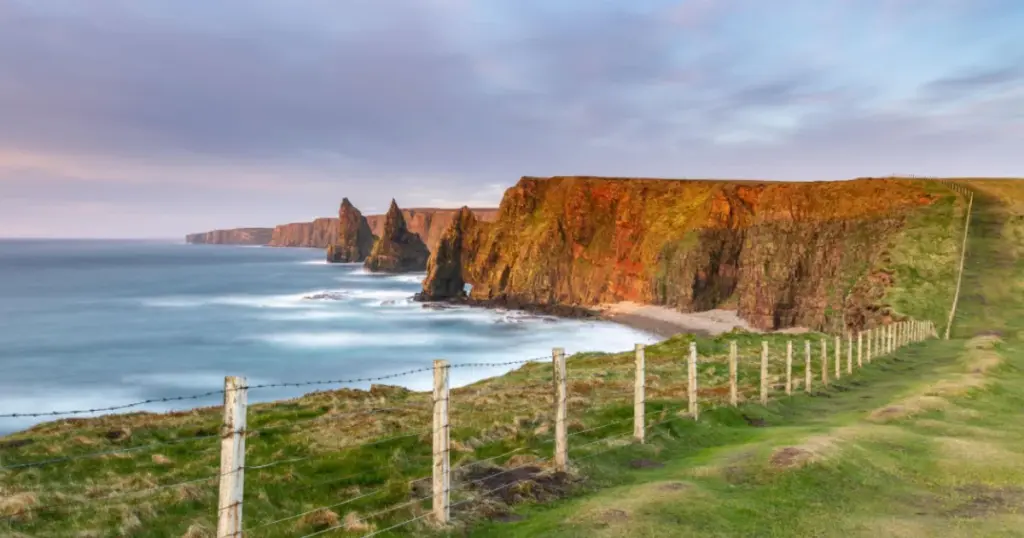
John O’Groats needs expectation management. It is famous, touristy, and worth exactly one photo at the sign. The real stop is twenty minutes east. Walk ten minutes south from Duncansby Head Lighthouse and the Stacks of Duncansby appear two enormous sea stacks rising sixty metres from the Pentland Firth, conical and wild in a way photographs cannot capture. This is one of the NC500’s genuine unmissable moments. Do not let John O’Groats distract you from it.
Section 2 The North Coast
John O’Groats to Durness About 100 miles
The road along Scotland’s top edge runs through some of the most sparsely populated country in the UK. Wind, light, and the sense of being properly at the edge of things settle in here.
Smoo Cave near Durness is a genuine highlight. The cave entrance is about fifteen metres high one of the largest in Britain and it combines sea and freshwater geology. The outer chamber is free and extraordinary. Paid boat tours from spring through early autumn take you into the inner chambers to see an underground waterfall that most NC500 travellers never find. Book the tour if the timing works. It is the kind of experience people talk about for years.
Just east of Durness, Sango Sands Beach will make you question whether you are still in Scotland. The water is turquoise in a way that belongs in the Maldives. The sand is white. The clifftop setting is dramatic. The campsite above it is one of the best-located on the entire route book it very far in advance.
Durness village has the Cocoa Mountain chocolate shop in Balnakeil Craft Village handmade chocolates and genuinely excellent hot chocolate in a former Cold War early-warning station that artists have occupied for decades. Stock up on supplies in Durness before pushing south into the wilder sections.
Section 3 Assynt and the Wild Northwest
About 80 miles The Best Section of the Entire Route
Heading south from Durness, the mountains begin appearing one by one. Quinag, Suilven, Canisp, Stac Pollaidh they rise individually from a flat moorland plateau in a way that looks nothing like normal British mountains. This is Lewisian Gneiss country, some of the oldest rock exposed anywhere on earth. Driving past these mountains, the geological timescale starts to feel real.
Kylesku Bridge is a clean cable-stayed bridge over the narrows of Loch a’ Chàirn Bhàin, with mountains on every side and water below. Pull over on the southern side, walk down to the waterside, and take a moment. A small cafe operates nearby in peak season and the view across the loch while eating a sandwich is unreasonably good.
Lochinver Larder makes pies venison, steak and ale, vegetarian, fish that have built a reputation far beyond what a small fishing village bakery has any right to. They are genuinely excellent. Lochinver itself is a lovely working fishing village with views of Suilven across the harbour. Get to the Larder early. They sell out.
Achmelvich Beach, a short detour from the main road, is one of those spots where Scotland forgets to look like Scotland. The water is crystal clear turquoise. The sand is white. There is complete quiet except for waves and seabirds. People who stop for twenty minutes find themselves still there two hours later.
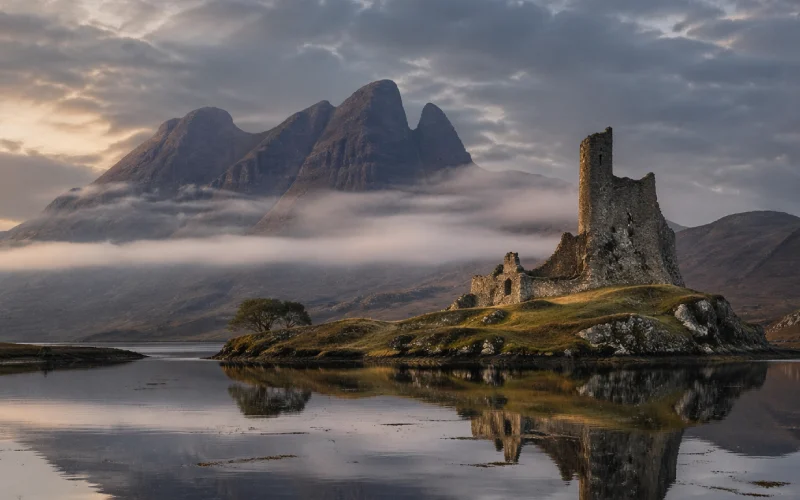
Ardvreck Castle on the shores of Loch Assynt is a 15th-century ruin that belongs in a painting. The castle sits on a small peninsula jutting into the loch with Quinag rising behind it and mountain reflections shifting in the water. Free to visit, a short walk from a roadside car park, and photogenic in virtually any light.
Section 4 Ullapool, Torridon, and Wester Ross
About 90 miles Take Two Full Days Here
Ullapool hits differently after a few days of remote Highland driving. There is a proper supermarket, real restaurants, a fish and chip shop voted among the best in Scotland, and a harbour of white-painted houses reflected in Loch Broom that is genuinely pretty. Resupply here. Rest if you need to. The Corrieshalloch Gorge nearby a dramatic box canyon with a suspension footbridge above the Falls of Measach is worth an hour.
South of Ullapool, the road enters Torridon and this is where even experienced travellers tend to go quiet in the car. The mountains here Liathach, Beinn Eighe, Beinn Alligin are made of ancient red Torridonian sandstone, around 750 million years old. The drive through the Torridon glen with mountain walls pressing in on both sides is one of those stretches of road that people describe for the rest of their lives.
Shieldaig is a tiny village with whitewashed cottages, a pine-covered island directly in front of the main street, and a pub. Stay the night if you can early morning light on the loch is worth setting an alarm for.
Gairloch has good beaches and accommodation options. The Beinn Eighe National Nature Reserve nearby is Britain’s first national nature reserve ancient Caledonian pinewoods, red squirrels, red deer, and a real possibility of seeing golden eagles on the hillside trails. Inverewe Garden near Poolewe is one of the NC500’s more surprising stops subtropical plants including Himalayan blue poppies and Chilean fire trees, growing in the Scottish Highlands because of the Gulf Stream’s warming influence. It should not work. It does.
Section 5 Bealach na Ba and Return to Inverness
About 80 miles The Dramatic Finale
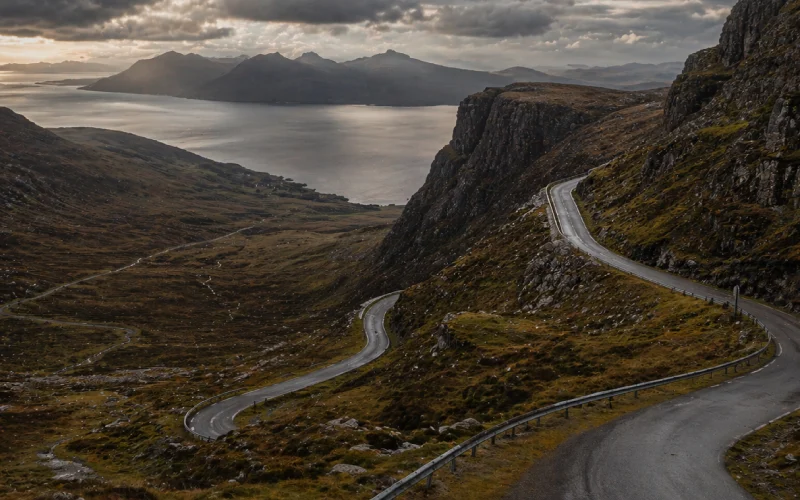
The Bealach na Ba Gaelic for Pass of the Cattle is the NC500’s most famous single stretch of road. A single-track road climbs to 626 metres through tight hairpin bends with warning signs at the bottom specifically advising against campervans, caravans, and drivers not comfortable on steep narrow mountain roads.
In a normal car, driven carefully without time pressure, it is challenging and genuinely magnificent. The climb is intense. The summit arrives and the views open up west Isle of Skye, Raasay, the Inner Hebrides spread across the sea below you. The descent into Applecross village, with its small beach and the Applecross Inn right on the seafront, is one of those road trip moments where everything comes together exactly right.
Campervans and large vehicles should take the coastal alternative from Shieldaig to Applecross. It is a beautiful road in its own right and gets you to Applecross without the mountain pass stress.
From Applecross, the route runs south through Loch Kishorn and east via the A890 back to Inverness. The final section is quieter and less dramatic your decompression drive giving you time to process what you have just driven before arriving back in the city where it all started.
| Stop | Best For | Time | Cost | Honest Tip |
|---|---|---|---|---|
| Chanonry Point | Wild dolphins close to shore | 1–2 hrs | Free | Go at high tide for best sightings |
| Dunrobin Castle | Fairytale architecture + falconry | 1.5 hrs | Paid | Check falconry times on arrival |
| Duncansby Stacks | Most dramatic sea stacks on route | 1.5 hrs | Free | 10 min cliff walk from lighthouse |
| Smoo Cave | Sea cave + underground waterfall | 1–2 hrs | Free/Tour paid | Book boat tour in advance |
| Sango Sands | Turquoise Caribbean-looking beach | 1–2 hrs | Free | Best light late afternoon |
| Ardvreck Castle | Most atmospheric ruin on NC500 | 45 mins | Free | Small car park on main road |
| Lochinver Larder | Best pies on the entire route | 30 mins | Cost of pie | Go early they sell out fast |
| Achmelvich Beach | Hidden turquoise beach surprise | 1–2 hrs | Free | Hostel accommodation on the beach |
| Torridon Glen | Most epic mountain driving in UK | Half day | Free | Best in morning light go slow |
| Bealach na Ba | Most dramatic pass on NC500 | 1.5 hrs | Free | Not for campervans full stop |
| Applecross Inn | Seafood with Skye views across sea | Meal | Cost of meal | Book ahead in summer season |
Campsite Booking The Reality
If you are camping or campervanning between May and September, accommodation must be booked well in advance. The most popular west coast campsites Sango Sands near Durness, Clachtoll Beach, Achmelvich fill up months ahead for July and August. When experienced NC500 travellers say “book a year in advance,” they mean exactly that.
The cleanest solutions are these: book everything far ahead for summer travel, or travel in shoulder season. April, May, and September are better in almost every way lighter traffic, easier accommodation, manageable midges, and often more interesting light. Wild camping is legal in Scotland under the Scottish Outdoor Access Code, but it requires genuine responsibility and is not a substitute for poor planning.
Single-Track Road Basics
A large portion of the NC500 runs on single-track roads with passing places the wider sections marked with white diamond posts. When you meet oncoming traffic, one vehicle pulls into a passing place. If the passing place is on your left, you pull in. If it is on your right, you wait opposite it.
Never park in a passing place they are for passing, not photography stops. Let local traffic through promptly. A small wave of acknowledgement when someone gives way is universal on Highland roads and entirely genuine. Give the wave. It is the right thing to do and part of the experience.
Midges The Honest Version
Highland midges are tiny biting insects that arrive in huge numbers on the west coast from June through August. On a still, humid summer evening in Torridon or Durness, they can make standing outside without protection genuinely unpleasant. They are not dangerous but they are real.
Solutions that work: DEET repellent at 30% or higher, a midge head net for camping in sheltered spots, and the Avon Skin So Soft dry oil spray inexplicable but widely documented as effective. The cleanest solution is April, May, or September travel when midges are not a significant issue and the light is often better anyway.
Also Read on Roam Visa
➤ Best Road Trips in Europe – Top Routes for First-Time Drivers
Final Thoughts
The NC500 rewards patience above all else. The people who come away genuinely moved by this route are the ones who gave themselves ten days, stopped whenever something looked interesting from the car window, spent evenings in small harbour pubs, and arrived at famous viewpoints early enough to have them to themselves. The people who are slightly disappointed are the ones who tried to cover it in five days in July without booking accommodation. Practically, the single most important preparation step is downloading Google Maps offline for the whole route before you leave phone signal, which happens frequently on the west coast sections.
Carry a paper map as backup. Keep petrol above half at all times on the west and north coasts. Scotland’s weather is part of this route’s character. Pack waterproofs regardless of the forecast. Some of the finest moments on the NC500 happen in rain and mist Loch Assynt under a grey sky, Torridon appearing through cloud, Sango Sands in dramatic Atlantic light. Embrace it. The conditions are not an inconvenience. They are why this landscape looks like nowhere else.
Frequently Asked Questions
How many days do you need for the NC500?
7 to 10 days is the sweet spot. Five days is a minimum if you push it. Less than that and you spend more time driving than experiencing.
Clockwise or anti-clockwise?
Anti-clockwise. East coast first as a warm-up, west coast saved for the dramatic finale when you are fully in the rhythm.
When is the best time to go?
April–May or September. Quieter roads, fewer midges, easier accommodation, and often better light than peak summer.
Can campervans drive the Bealach na Ba?
No. The signs at the bottom say not to and they mean it. Take the coastal alternative from Shieldaig to Applecross instead.
Do you need to book campsites in advance?
Yes months in advance for summer, especially west coast sites. Shoulder season travel makes this significantly easier.