
2 Weeks in Europe Itinerary – Best Route for First-Time Visitors

Europe in two weeks is one of the world’s great travel experiences – and one of the world’s most frequently over-planned disasters. The temptation when you look at a European map is to connect every dot: London to Paris to Brussels to Amsterdam to Berlin to Prague to Vienna to Budapest to Rome. The distances seem small on the map. In practice, spending three nights in each of those cities means a travel day every third day, luggage in and out of hotels nine times, and very little actual time in any of them.
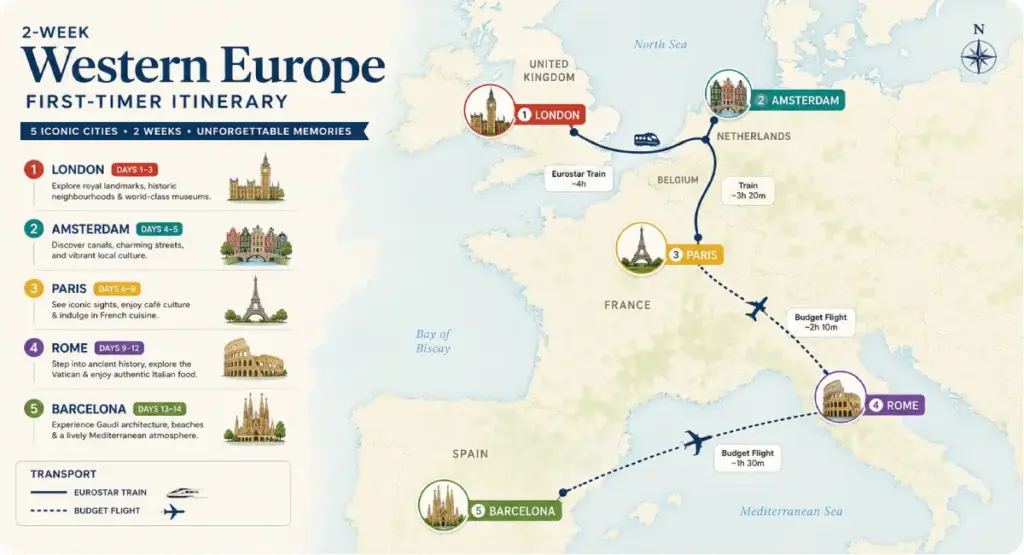
Two weeks done right means choosing four to five cities, giving each of them enough nights to actually settle in and explore properly, and accepting that you will leave Europe with a long list for the next trip. The itinerary below – London, Amsterdam, Paris, Rome, Barcelona – is the classic European circuit for a reason. These five cities offer an extraordinary concentration of art, history, architecture, food, and culture, and they connect reasonably well by train and budget flight.
The honest timing note: 3 nights in each major city is the minimum that allows you two full sightseeing days (arrival and departure days are partial). Cities like Rome and Paris arguably deserve 4–5 nights. If you are genuinely on a first trip to Europe, consider reducing to 4 cities and giving each one more time – 4 nights in Paris and 4 nights in Rome is a better experience than 3 nights in each of 5 cities.
Quick Facts – 2 Weeks Europe Itinerary
✔ Best 14-day route: London (3 nights) → Amsterdam (2 nights) → Paris (3 nights) → Rome (3 nights) → Barcelona (2 nights)
✔ London to Amsterdam: Eurostar train (4 hrs from St. Pancras) – or fly (1 hr + airport time)
✔ Amsterdam to Paris: Eurostar/Thalys train 3hrs – the most efficient inter-city connection in Europe
✔ Paris to Rome: FLY – train is 11hrs+, budget flight on Ryanair/easy Jet: €30–€80 each way
✔ Rome to Barcelona: FLY – no practical direct train, Vueling/Ryanair €25–€90
✔ Schengen visa covers Amsterdam, Paris, Rome, Barcelona – UK requires separate visa.
✔ Best months: April–May and September–October – lower crowds, better weather, moderate prices
✔ Book: Eiffel Tower (Paris), Colosseum (Rome), Sagrada Familia (Barcelona) WEEKS ahead in summer
Days 1–3: London – Gateway Without the Language Barrier
London is the ideal starting point for first-time European visitors – English is the language, the transport system (the Tube) is intuitive and reliable, and the city provides a gentle cultural introduction before the full immersion of continental Europe begins. Three nights gives you two full sightseeing days: the classic London circuit – Tower of London, Tower Bridge, the South Bank, Borough Market, Tate Modern, St Paul’s Cathedral – on day one; the Westminster and museums circuit – Westminster Abbey, Houses of Parliament, Buckingham Palace, the National Gallery (free), and the British Museum (free) – on day two.
The Tube is efficient (Oyster or contactless, Zone 1–2 daily cap approximately £8) and connects you to every major London sight. Note for Indian visitors: London is NOT in the Schengen area. Your UK Standard Visitor Visa is separate from the Schengen visa required for Amsterdam, Paris, Rome, and Barcelona. Apply for both simultaneously but separately – do not assume one covers the other.
- Visa note: UK Standard Visitor Visa is separate from Schengen – apply for both
- Must pre-book: Tower of London (£32 adult), Westminster Abbey (£27) – sells out in summer
- Free: British Museum, National Gallery, Tate Modern, National History Museum
- Oyster/contactless on all Tube and bus – Zone 1–2 daily cap ~£8.10
- Heathrow Express to Paddington: 15 min, £25 | Piccadilly Line to city: 50min, £5.60
Days 4–5: Amsterdam – Canals, Art, and Two Days Well Spent
The Eurostar runs from London St Pancras International to Amsterdam Centraal in 4 hours. 15 minutes – a genuinely excellent train journey that passes through Kent and under the Channel before emerging in Belgium and then the Netherlands. Book tickets on Eurostar.com 4–6 weeks ahead; advance prices start around €50–€80 each way. Amsterdam deserves at least two full nights (three is better), but with limited time, two focused days work.
Day one in Amsterdam: the Rijksmuseum (Dutch Golden Age painting, Rembrandt’s Night Watch – book timed entry well ahead, €22.50 adult) and the Van Gogh Museum (€22 – extremely popular, timed entry essential, book weeks ahead). Day two: a canal boat tour (€15–€20 for a 1-hour guided boat) in the morning to orient yourself to the city’s layout, then the Anne Frank House (€16 – book 6–8 weeks ahead in summer; it sells out completely). Amsterdam’s Jordaan neighborhood, with its narrow streets, independent galleries, and canal-side cafes, is the finest area for a slow afternoon.
- Train: London St Pancras → Amsterdam Centraal, 4hrs 15min, Eurostar
- Rijksmuseum: €22.50 – book timed entry well ahead | Van Gogh Museum: €22 – book weeks ahead in summer
- Anne Frank House: €16 – books out 6–8 weeks ahead in summer. This is NOT an exaggeration
- Canal boat tour: €15–€20, 1 hour – multiple operators, some running through the Jordaan
- Accommodation: €120–€200/night mid-range | Book early; Amsterdam hotels fill fast
Days 6–8: Paris – Three Days in the City of Light
The train from Amsterdam to Paris (Eurostar or former Thalys route, now branded Eurostar) takes 3 hours 20 minutes from Amsterdam Centraal to Gare du Nord in central Paris – book in advance for €29–€79 each way. Paris on 3 nights gives you two full days and one partial day. The critical advance booking: the Eiffel Tower timed entry (€29.40 for the summit) is essential – booking opens 60 days ahead, and peak summer dates sell out in minutes. Book on the official Eiffel Tower website (toureiffel.paris) the moment your 60-day window opens.
Day one in Paris: the Louvre (€22, at least 3 hours minimum – the Mona Lisa is smaller than you expect, but the surrounding galleries are extraordinary; afternoon along the Seine and to Notre-Dame Cathedral (now restored after the 2019 fire, reopened late 2024). Day two: the Eiffel Tower (booked); Musée d’Orsay across the river (€16, Impressionists – one of the world’s finest collections); evening in Montmartre; and dinner in the Marais. Day three (partial): Versailles day trip if time allows (1 hr by RER C from Paris, €22 entry; get there early for gardens).
- Train: Amsterdam → Paris Gare du Nord, 3hrs 20min – book advance on eurostar.com
- Eiffel Tower: €29.40 summit – book on official site EXACTLY 60 days ahead, sells out fast
- Louvre: €22 – book timed entry online. Closed Tuesday
- Musée d’Orsay: €16 – Impressionist collection, often less crowded than the Louvre
- Versailles: 1hr by RER C – palace €22 + gardens – get there 9am to beat the crowds
Related Articles: 14 Day Europe Itinerary – Paris, Rome, Barcelona and Amsterdam
Days 9–11: Rome – Three Days in the Eternal City
Fly from Paris to Rome – the train (11+ hours with connections) makes no sense for a time-limited trip. Ryanair and easyJet typically offer fares of €30–€80 each way booked 4–6 weeks ahead, flying from Paris Beauvais or Orly to Rome Ciampino or from CDG to Fiumicino. Allow 3.5–4 hours total journey time including airport transfers. Book your flights when you confirm your trip, as these routes fill up and prices rise significantly in summer.
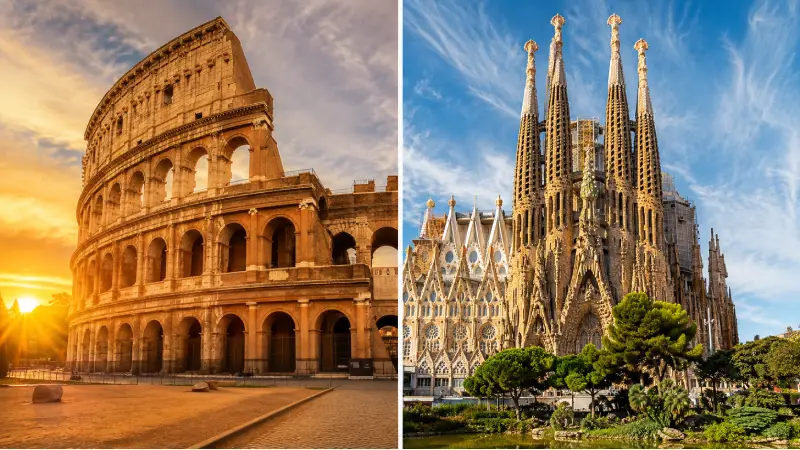
Rome on 3 nights requires ruthless prioritization. The Colosseum and Roman Forum (€18 combined, timed entry mandatory – book on coopculture.eu 1–2 weeks ahead minimum; sells out in summer) is the morning of day one. The Vatican (Sistine Chapel + St Peter’s Basilica + Vatican Museums – €21 for museums, free for the Basilica; book museums well ahead) is the dedicated day two experience – arrive at opening (9am) to beat the crowds. Day three: the Pantheon (€5, no pre-booking required), Trevi Fountain (free but extremely crowded – visit early morning), Campo de’ Fiori market, and the Spanish Steps.
Rome’s food is one of the trip’s highlights – a plate of cacio e pepe at a Trastevere trattoria (€10–€14), supplì (fried rice balls, €2 each), and gelato from a proper gelateria (look for gelato stored in metal containers with lids, not displayed in pyramidal mounds with bright colors). Avoid tourist-trap restaurants on Via Veneto and immediately around major attractions.
- Flight: Paris → Rome, Ryanair/easyJet/Vueling, €30–€80 – book 4–6 weeks ahead
- Colosseum + Roman Forum: €18 – book on coopculture.eu 1–2 weeks ahead minimum
- Vatican Museums: €21 – book on museivaticani.va; morning slot essential
- Pantheon: €5 entry – timed entry online or walk-up when available
- Best neighbourhoods: Trastevere (dinner), Prati (near Vatican, good restaurants), Campo de’ Fiori (lunch)
Days 12–14: Barcelona – Architecture, Beach, and Gaudi
Fly Rome to Barcelona – Vueling is the natural carrier on this route, typically €30–€70 in advance. Barcelona’s airport (El Prat) is connected to the city by Aerobús (€6.75, 35 minutes) or the Aerobus shuttle. Three nights gives you two full days in a city that could absorb many more.
The must-book in advance: Sagrada Familia – the Gaudí masterpiece that has been under construction since 1882 and is scheduled for completion in 2026. Entry is €36 for the towers, €26 without. Book on sagradafamilia.org well ahead – it sells out daily in summer. Casa Batlló (€35–€45) and Park Güell (€10 for the monumental zone, timed entry) complete the Gaudí circuit. The Gothic Quarter (Barri Gòtic) is an afternoon of medieval lanes and tapas bars. Barceloneta Beach is 20 minutes by metro from the centre and genuinely excellent – Barcelona is the only major European city with a real urban beach.
- Flight: Rome → Barcelona, Vueling/Ryanair, €30–€70 – book advance
- Sagrada Familia: €36 with towers – book on sagradafamilia.org weeks ahead
- Park Guell monumental zone: €10 – timed entry required, Book Online
- Gothic Quarter: free to explore – narrow medieval lanes, Cathedral (free)
- Barceloneta Beach: free – metro L4 to Barceloneta station, 20min from centre
Final Thoughts
The London–Amsterdam–Paris–Rome–Barcelona circuit is the right 2-week Europe itinerary for most first-time visitors because it concentrates the most extraordinary cities in Europe into a logical geographic arc. The trains between London, Amsterdam, and Paris are exceptional – fast, central station to central station, and no airport security theater. For Rome and Barcelona, the budget airlines are the correct choice; the train alternatives add many hours for little benefit. Book early and book specifically. The Eiffel Tower 60-day window, the Anne Frank House 6–8 weeks ahead, the Colosseum timed entry, and the Sagrada Familia tickets – all of these sell out during summer and require advance planning.
Building a 2-week European itinerary without securing these key bookings in advance is the single most common mistake that leads to disappointed travellers standing outside sold-out landmarks. Accept that two weeks is not enough to see all of Europe, and that is genuinely fine. The cities on this itinerary – London, Amsterdam, Paris, Rome, and Barcelona – are each inexhaustible. You will leave each one with a list of what you did not get to. That list is the reason for the second trip. Build the itinerary around experiencing four or five cities well rather than touching eight or ten superficially.
Frequently Asked Questions
Is 2 weeks enough time for Europe?
Two weeks is enough to experience 4–5 European cities properly, giving each destination 2–3 full days of exploration. The classic first-timer’s circuit – London, Amsterdam, Paris, Rome, Barcelona – fits comfortably in 14 days. Trying to add more cities reduces each destination to a rushed half-day, which defeats the purpose of travelling.
What is the best order to visit European cities in 2 weeks?
For the classic circuit, the best order is London (start – no language barrier, easy introduction) → Amsterdam (Eurostar train, 4 hrs) → Paris (train, 3 hrs) → Rome (budget flight, 2hrs) → Barcelona (budget flight, 2 hrs, fly home). This follows a geographical arc west to east and back, minimizing backtracking.
Do Indian tourists need different visas for UK and Europe?
Yes. The UK is not part of the Schengen area. Indian tourists need a UK Standard Visitor Visa for London (separate application, UK Visas and Immigration) AND a Schengen tourist visa for Amsterdam, Paris, Rome, and Barcelona. Apply for both simultaneously but through separate channels. Do not assume one covers the other – this is the single most common visa mistake made by Indian travelers to Europe.
How far in advance should I book the Eiffel Tower?
Book the Eiffel Tower as soon as you know your Paris dates – specifically, book on the official website (toureiffel.paris) exactly 60 days before your visit date, which is when that day’s tickets are released. In summer, popular time slots (sunset and evening) sell out within hours of release. Daytime visits are less competitive but still require advance booking in peak season.
Is the train or plane better for Paris to Rome?
Fly. The direct train from Paris to Rome takes 11+ hours with connections and costs more than a budget flight. Ryanair and easyJet typically offer fares of €30–€80 each way from Paris Beauvais or Orly to Rome Ciampino, with a 2-hour flight time. Including airport time (2–3 hours each end), total door-to-door is 5–6 hours versus 11+ by train – the flight wins comfortably for a 2-week trip.


