
Rocky Mountaineer vs VIA Rail: Which Train Is Worth the Price

Canada has two famous rail experiences, and both are premium-priced, but they are genuinely different products aimed at different travelers. Rocky Mountaineer is a luxury daylight-only scenic train that operates April to October between Vancouver and points in the Canadian Rockies – Banff, Lake Louise, Jasper, and Whistler. Passengers ride during the day in glass-domed coaches with gourmet meals and onboard hosts providing commentary, then disembark each evening to sleep in hotels included in the package. VIA Rail’s The Canadian is a true sleeper train that runs continuously for 4 days and 4 nights between Toronto and Vancouver, with passengers eating and sleeping onboard across the entire journey.
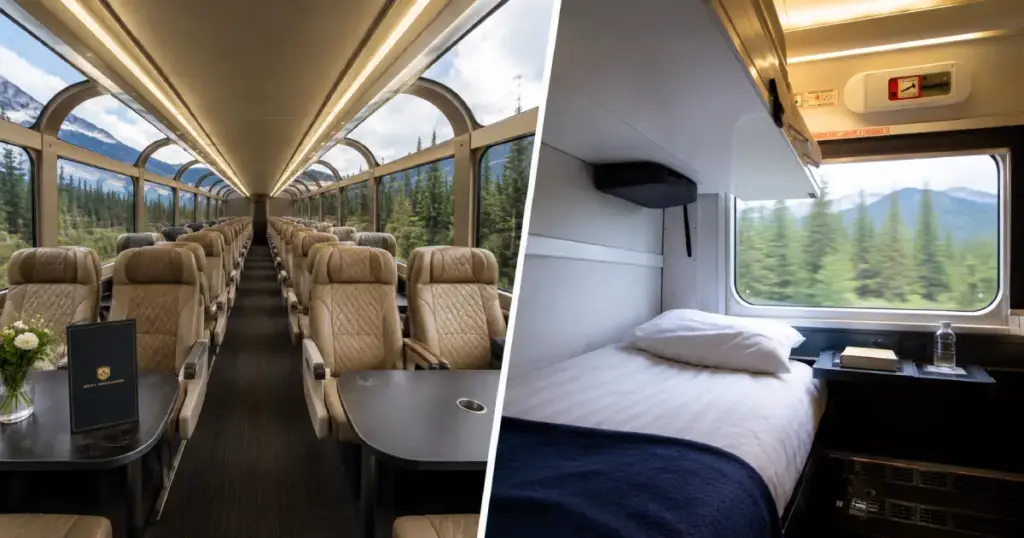
The honest question most Indian tourists ask is which is worth the significant price difference – and that depends entirely on what you want out of the trip. Rocky Mountaineer is the premium scenic sightseeing product; you are paying for daylight-only rail with exceptional service, gourmet dining, and hotel stays. VIA Rail is the transcontinental experience; you are paying for the continuity of 4 days on a train crossing an entire country. This comparison walks through route differences, service levels, total costs including what is and is not included, onboard experience, and which Indian tourist profiles should pick which train. We have cross-referenced recent traveler reports across multiple service levels to give an honest verdict rather than either operator’s marketing.
Quick Facts – Rocky Mountaineer vs VIA Rail
- Rocky Mountaineer: A luxury daytime-only train with overnight hotel stays – no sleeping on board.
- VIA Rail The Canadian: A sleeper train with cabins runs continuously from Toronto to Vancouver across 4 days.
- Rocky Mountaineer routes: 2- to 3-day packages between Vancouver and Banff, Jasper, or Lake Louise.
- Rocky Mountaineer: SilverLeaf from 2,294 CAD per person; GoldLeaf from 3,114 CAD per person
- VIA Rail Canadian: Sleeper Plus cabin, 3,000 to 5,000 CAD per person; Prestige, 5,500 to 8,000 CAD
- Rocky Mountaineer operates April to October only; VIA Rail runs year-round.
- Rocky Mountaineer covers Vancouver-Banff/ Jasper scenic routes: VIA covers full transcontinental Toronto-Vancouver
The Fundamental Difference – Daylight vs Continuous
This single difference drives everything else about the two operators’ products. Rocky Mountaineer is a daylight-only experience. The train departs early morning, travels all day through the Rocky Mountains, and arrives at an overnight destination (Kamloops, Quesnel, or Whistler depending on route) in late afternoon or early evening. Passengers disembark and spend the night in a hotel included in the package price. The next morning, the train departs again and continues. This means you see 100 percent of the scenery because you never travel at night. It also means you sleep in a stationary hotel bed each night rather than a moving train cabin – better sleep quality for most travelers.
VIA Rail’s The Canadian is the opposite – a continuous 4-day journey with sleeping accommodations on board. The train keeps running through the nights across Ontario, Manitoba, Saskatchewan, and parts of BC – you sleep in your cabin (or berth, or seat) while the train moves. You see some scenery but miss significant portions that happen overnight. The trade-off: VIA Rail covers the full transcontinental Toronto-Vancouver route in one train; Rocky Mountaineer only covers the BC to Alberta scenic stretch. For Indian tourists coming from Toronto or combining the journey with Toronto sightseeing, VIA Rail provides the full coast-to-coast feel. Rocky Mountaineer is a regional scenic product.
Rocky Mountaineer – What You Actually Get
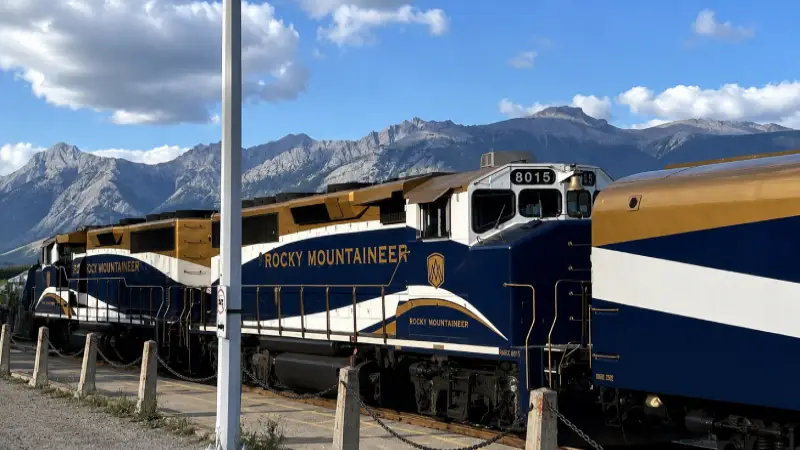
The Routes – Three Main Options
First Passage to the West: 2-day route Vancouver to Banff or Lake Louise, passing through the Fraser Canyon and Spiral Tunnels. Overnight in Kamloops. Most popular Rocky Mountaineer route. Journey through the Clouds: 2-day route from Vancouver to Jasper via Kamloops overnight. Offers different scenery through the Monashee Mountains and past Pyramid Falls. Rainforest to Gold Rush: 3-day route Vancouver-Whistler-Quesnel-Jasper with two hotel overnights. The longest route includes Whistler’s coastal mountain scenery and BC’s interior plateau. All routes operate April to mid-October only – Rocky Mountaineer does not run in winter.
SilverLeaf Service – The Entry Level
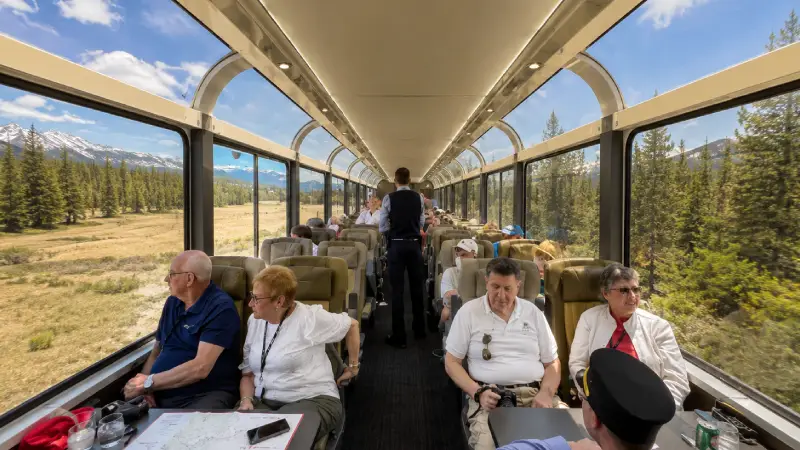
SilverLeaf is a single-level coach with oversized panoramic windows, comfortable reclining seats, hot meals served at your seat (restaurant-quality food prepared fresh onboard), complimentary non-alcoholic and alcoholic beverages throughout the day, onboard hosts providing commentary, and access to a small covered outdoor vestibule for photos. No dining car – everything served airline-style at your seat. 2-day SilverLeaf packages start around 2,294 CAD per person, including an overnight hotel stay. This is already a very comfortable product – equivalent to first class on a normal train or premium economy on a long-haul flight.
GoldLeaf Service – The Premium Experience
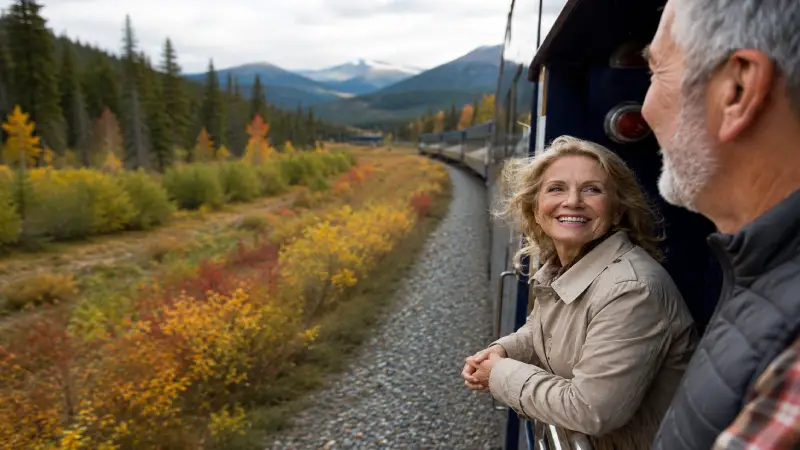
GoldLeaf is a bi-level glass dome coach with upper-level panoramic seating under near-complete glass windows and a lower-level dining car where multi-course meals are served restaurant-style. Wider heated reclining leather seats that swivel to create group seating arrangements, a larger exclusive outdoor viewing platform, premium alcoholic beverages including signature cocktails, a larger host team providing more attentive service, and a full culinary team preparing meals fresh onboard. 2-day GoldLeaf packages start around 3,114 CAD per person. The upgrade cost from SilverLeaf is roughly 500 CAD per person per route segment – worth it for travelers who want the premium dome view and separate dining experience.
What Is Included
Rocky Mountaineer packages include daytime train travel, all onboard meals and beverages, a night in a hotel (moderate category, pre-selected and assigned at boarding), luggage handling between train and hotel, and transfers at both ends of the route. What is not included: dinner (since you arrive at the hotel in the evening, dinner is on your own), gratuities (Rocky Mountaineer recommends 10 to 20 CAD per host/server), and any pre- or post-train accommodation in Vancouver, Banff, Jasper etc.
VIA Rail The Canadian – What You Actually Get
The Route: Toronto to Vancouver
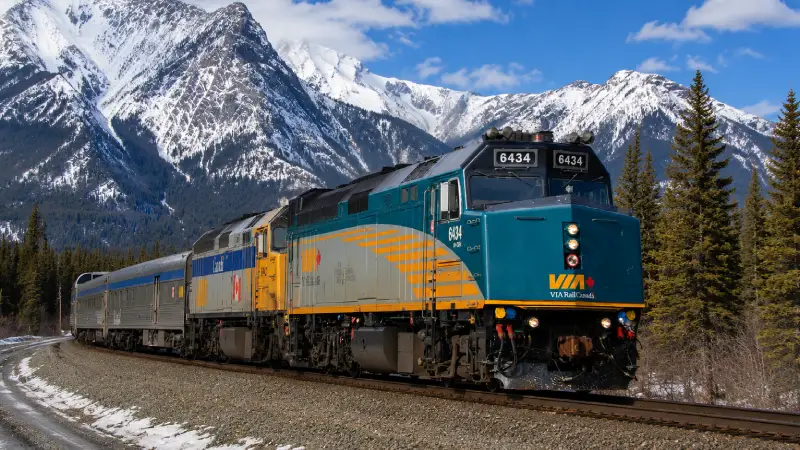
VIA Rail’s flagship long-distance service runs from Toronto Union Station to Vancouver Pacific Central, 4,466 kilometers across 4 days and 4 nights. Stops at Winnipeg, Saskatoon, Edmonton, Jasper, and Kamloops, among others. It passes through the Canadian Shield forests, vast prairies of Manitoba and Saskatchewan, the Rocky Mountains at Jasper, and the Fraser Canyon into Vancouver. Runs year-round, with reduced frequency (2 departures per week) rather than daily.
Economy, Sleeper Plus, and Prestige Classes
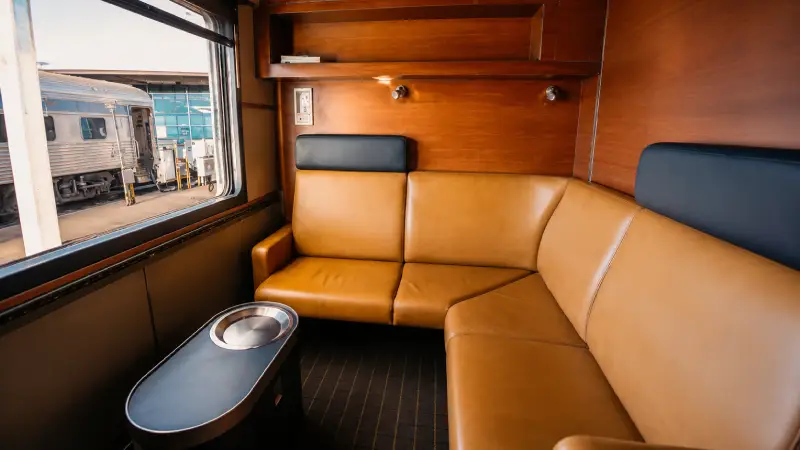
Economy has reclining seats with no meals and no shower access for the full 4 days – 500 to 1,200 CAD one-way. Sleeper Plus offers upper/lower berths (around 1,200 to 1,800 CAD), a cabin for one (around 2,000 to 3,200 CAD), or a cabin for two (around 3,000 to 5,000 CAD per person). All Sleeper Plus includes three meals per day in the dining car, shower access in each car, and Skyline Dome Car access. Prestige Class cabins are 50 percent larger than Sleeper Plus cabin-for-two, include a private bathroom with shower, concierge service, and premium dining – 5,500 to 8,000 CAD per person based on double occupancy.
What Is Included
VIA Rail includes train travel and meals in Sleeper Plus and Prestige classes, all onboard services, and access to the Skyline and Panorama dome cars. What is not included: alcoholic beverages outside of Prestige (Sleeper Plus serves alcohol at extra cost), any ground transport outside train stations, and any hotel accommodation before or after the train journey. Unlike Rocky Mountaineer, VIA Rail does not bundle hotels into the package – you book those separately.
Real Total Cost Comparison
Comparing the two trains requires comparing like-for-like experiences. A 2-day Rocky Mountaineer package includes 2 days of train travel, hotel accommodation for one night, all meals on the train, and soft drinks/alcohol. A VIA Rail 4-day cabin for two includes 4 days of train travel, sleeping accommodations onboard, and all meals on the train. To fairly compare, we should also add VIA Rail’s requirement to book hotels in Toronto and Vancouver separately.
| Scenario | Price per person (CAD) | Duration | Includes |
| Rocky Mountaineer SilverLeaf 2-day | 2,294+ | 2 days, 1 night | Train, 1 hotel night, all meals on train |
| Rocky Mountaineer GoldLeaf 2-day | 3,114+ | 2 days, 1 night | Dome coach, dining car, all meals, 1 hotel |
| Rocky Mountaineer GoldLeaf 3-day Rainforest | 4,200-5,500 | 3 days, 2 nights | Dome, 2 hotels, all meals, Whistler |
| VIA Rail Canadian Sleeper Plus Berth | 1,200-1,800 | 4 days, 4 nights | Berth, all meals, shower access |
| VIA Rail Canadian Sleeper Plus Cabin (pp) | 3,000-5,000 | 4 days, 4 nights | Private cabin, all meals, shower |
| VIA Rail Canadian Prestige (pp) | 5,500-8,000 | 4 days, 4 nights | Luxury cabin with private shower, premium dining |
| Rocky Mountaineer + VIA combined | 7,000-12,000 | Varies | Both trains in one itinerary |
The simple answer: for a Vancouver-Banff or Vancouver-Jasper experience, Rocky Mountaineer’s 2,294 CAD SilverLeaf 2-day beats VIA Rail’s equivalent on per-day cost because VIA Rail’s 1,800 CAD Sleeper Plus berth for the same geography would not include meals and is a berth, not a cabin. For the full transcontinental Toronto-Vancouver experience, only VIA Rail offers it – Rocky Mountaineer does not cover east of Jasper.
Service Level Comparison – What You Feel Different
Dining
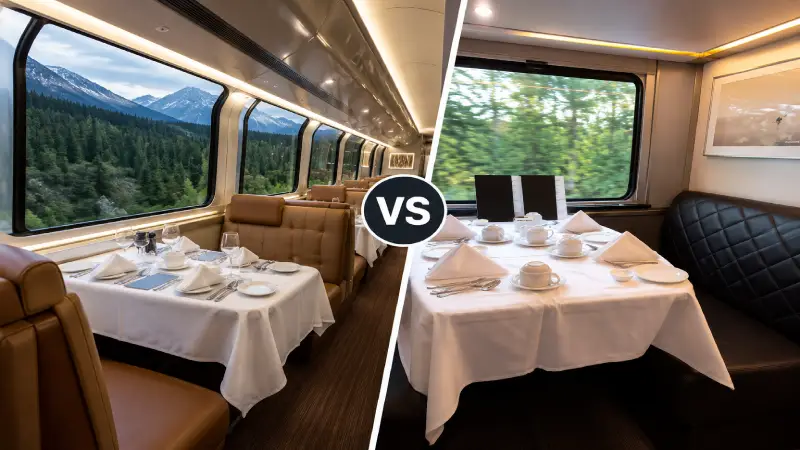
Rocky Mountaineer GoldLeaf has a dedicated lower-level dining car with table service and executive chef-prepared menus inspired by regional ingredients. Breakfast and lunch are included; dinner is taken at the hotel (on your own expense). SilverLeaf has meals served at your seat, airline-style, and they are still high quality. VIA Rail Sleeper Plus and Prestige have a dining car with three-course meals at three daily seatings (breakfast is open; lunch and dinner are reserved). Food quality is reported as solid hotel-restaurant level but less consistently high-end than Rocky Mountaineer’s chef-led production.
Service and Hosts
Rocky Mountaineer onboard hosts are a significant part of the experience – they provide live storytelling about Canadian history, geology, and wildlife as you pass each location. Training is intensive, and the hosts are genuinely excellent. VIA Rail cabin attendants are functional service staff rather than storytellers – they make beds, serve in the dining car, and handle logistics but provide less narrative content. If you value learning about the landscape as you pass, Rocky Mountaineer wins clearly.
Views and Viewing Experiences
Rocky Mountaineer GoldLeaf dome coaches have near-complete glass ceilings – 360-degree visibility is the designed experience. Outdoor viewing platforms on each coach allow passengers to step outside for photos without shooting through glass. VIA Rail has Skyline dome cars and the Panorama car (in peak season) with glass domes, but these are separate cars you walk to rather than your own seat. The park car at the back of the train has large panoramic windows. Both offer strong scenic viewing; Rocky Mountaineer’s integrated dome seating is more convenient.
Which One Is Right for Which Indian Traveler?
Choose Rocky Mountaineer If
You prioritize luxury sightseeing and gourmet dining over covering maximum geography. You want to sleep in real hotel beds rather than on a moving train. You have 2 to 4 days to dedicate specifically to Canadian Rockies scenery as part of a larger trip that might also include Banff/Lake Louise stays. Your budget accommodates 2,300 to 5,500 CAD per person for just the train portion. You are traveling in the April-to-October window when Rocky Mountaineer operates. Your trip is focused on BC and Alberta rather than requiring cross-country coverage.
Choose VIA Rail’s The Canadian If
You want the true transcontinental experience from eastern Canada to western Canada in one continuous journey. You are comfortable sleeping on a moving train for four consecutive nights. Your budget is more flexible – either tighter (economy or sleeper plus berth) or premium (Prestige). Your trip connects Toronto or Ottawa on the east with Vancouver on the west, and you want a single rail journey linking them. You are willing to accept 2 to 8 hour delays as part of the experience. You are travelling any time of year – VIA runs year-round.
Consider Both (Combined Itinerary)
For travellers with 2 to 3 weeks in Canada and a budget of 10,000 to 15,000 CAD per person for rail, the combination is actually the best of both worlds. Take VIA Rail The Canadian, eastbound or westbound between Toronto and Jasper (3 days / 3 nights), offers the transcontinental sleeper experience across prairies and mountains. Then connect with the Rocky Mountaineer Journey Through the Clouds or First Passage to the West for the BC-Alberta scenic luxury daylight experience. Operators like Canadian Train Vacations offer combined packages. This covers both flagship Canadian rail products in one trip and is genuinely how many premium travelers approach Canada.
Mistakes Travellers Make Choosing Between the Two
- Assuming Rocky Mountaineer and VIA Rail are direct substitutes – they are different products covering different geography with different sleeping arrangements and operating seasons.
- Booking Rocky Mountaineer expecting to sleep on the train – Rocky Mountaineer is daylight-only with overnight hotels; nobody sleeps on board. If you want a sleeper train experience, book VIA Rail.
- Booking VIA Rail Economy for the transcontinental experience and expecting hotel-level comfort – Economy is a reclining seat for 4 days with no shower access. The minimum recommended class for the full journey is a Sleeper Plus berth.
- Not factoring in the full duration difference – Rocky Mountaineer 2-day is a long weekend scenic trip; VIA Rail is 4 full days of dedicated travel time that must fit into your overall Canada itinerary.
- Missing the seasonal restriction on Rocky Mountaineer – it operates April to October only; winter Canada travelers must use VIA Rail or fly.
- Assuming VIA Rail is always cheaper – Sleeper Plus cabin for two is actually priced similarly per day to the Rocky Mountaineer SilverLeaf once you factor in VIA Rail’s extra 2 days of journey, making per-day economics close.
- Picking one when both fit the itinerary – for 2 to 3-week Canada trips with an ample budget, combining the two trains delivers the best of both. Do not overlook this combined option.
Before You Book – Understand Each Train Fully
If VIA Rail is your choice, our detailed VIA Rail Toronto to Vancouver 4-day honest review covers exactly what each day of the transcontinental journey looks like, what food is really served in the dining car, how the delays play out, and whether a Sleeper Plus cabin for two or Prestige is the right pick for your specific situation. Read it before committing to the 4-day experience so you know what you are signing up for.
Getting to Canada cheaply for the trip is separate from the onboard experience. Our cheapest months to fly to Canada with real seasonal fare data show how to save 30 to 40 percent on the international flight leg from India to Toronto or Vancouver by timing your trip for November, January, or February (though this only matches VIA Rail’s year-round operations, not Rocky Mountaineer’s April-October season). Time the international arrival with your chosen train season to optimize the total trip cost.
Final Thoughts
Rocky Mountaineer and VIA Rail The Canadian and the Canadian Pacific Railway are both legitimate premium Canadian rail experiences, but they solve different problems. Rocky Mountaineer is the luxury scenic sightseeing product – daylight-only trains, glass-domed coaches, gourmet dining, hotel overnights, focused on the 2 to 3 day Vancouver to Rockies scenic corridor. VIA Rail is the transcontinental experience – 4 days and 4 nights from Toronto to Vancouver with onboard sleeping, meals in the dining car, and a genuine coast-to-coast narrative that Rocky Mountaineer simply does not offer.
The price points overlap (SilverLeaf 2-day at 2,300 CAD vs. a Sleeper Plus cabin for two 4-day trips at 3,000-5,000 CAD per person), but the products are not directly comparable. For Indian tourists making the single-train choice: Rocky Mountaineer if you want the best possible scenic sightseeing experience in the Canadian Rockies region with excellent food and real hotel beds. VIA Rail The Canadian is for you if you want to experience crossing the entire country by train from Toronto to Vancouver, are okay with 4 days on a moving train, and value the continuity of the transcontinental journey.
For travelers with the budget and time for a longer Canada trip, combining both – VIA Rail for the Toronto-to-Jasper transcontinental stretch plus Rocky Mountaineer for the Jasper-to-Vancouver luxury daylight leg – genuinely delivers the best of what Canadian rail travel offers. Rocky Mountaineer wins on service quality and meal experience. VIA Rail wins on scale and genuine sleeper train authenticity. Both are worth the price for the right traveler; neither is worth it for travelers who primarily care about getting efficiently between Toronto and Vancouver (fly instead; it is 5 hours for 300 CAD). Pick based on what you actually want to experience.
Frequently Asked Questions
Q. Is Rocky Mountaineer more expensive than VIA Rail?
A. Yes and no – depends on how you compare. The Rocky Mountaineer SilverLeaf 2-day at 2,294 CAD per person includes hotel and meals. VIA Rail Economy A 4-day stay is 500-800 CAD but includes no meals or shower. A VIA Rail Sleeper Plus cabin for two at 3,000-5,000 CAD per person covers 4 days of travel versus Rocky Mountaineer’s 2 days. Per-day cost is often similar; the total cost difference reflects duration and what is included.
Q. Do you sleep on the train on Rocky Mountaineer?
A. No. Rocky Mountaineer is daylight-only. The train runs during the day; you disembark each evening at Kamloops, Quesnel, or Whistler and sleep in a hotel included in your package. The next morning you reboard the train and continue. This is the fundamental difference from VIA Rail, where you sleep on the moving train.
Q. Which train covers the Canadian Rockies best?
A. Both pass through Canadian Rockies scenery near Jasper. Rocky Mountaineer is designed entirely around maximizing Rockies daylight viewing through purpose-built glass-domed coaches. VIA Rail covers the Rockies as one day of a 4-day transcontinental journey. For the best dedicated Rockies scenic experience, Rocky Mountaineer wins. For scenic viewing combined with prairie crossings and eastern Canada, VIA Rail wins.
Q. Can I take Rocky Mountaineer from Toronto?
A. No. Rocky Mountaineer’s eastern terminus is Jasper or Banff – it does not serve eastern Canada. If you want to travel from Toronto to Vancouver by train, only VIA Rail The Canadian does this directly. Some combined packages use VIA Rail from Toronto to Jasper and then Rocky Mountaineer from Jasper to Vancouver, but this requires booking both separately or via a tour operator.
Q. Which train is better for older travelers or grandparents?
A. The Rocky Mountaineer is generally better for older travelers. Daily hotel overnights mean real hotel beds and hotel bathrooms with proper showers rather than cramped onboard cabin bathrooms. Daylight-only operation means you are never woken by train motion at night. Service is more attentive. Meal presentation is superior. The trade-off: Rocky Mountaineer covers less geography.
Q. Can I combine Rocky Mountaineer and VIA Rail into one trip?
A. Yes, and this is a popular premium option. Typical combined itineraries run VIA Rail from Toronto to Jasper (about 3 days and 3 nights), then Rocky Mountaineer from Jasper to Vancouver (Journey through the Clouds, 2 days and 1 night). A total of 5 days and 4 nights of rail travel covering both operators. Tour operators like Canadian Train Vacations package these – full cost is typically 7,000 to 12,000 CAD per person depending on class selection.


